

HCPCS code E0198: Water pressure pad billing guide
HCPCS code E0198 is a water pad for a standard mattress HCPCS code E0198 is the ...

Last Updated: Oct 13, 2026
J1642 is the HCPCS Level II code for injection, heparin sodium, (heparin lock flush), per 10 units.
The official long description for HCPCS code J1642 is: Injection, heparin sodium, (heparin lock flush), per 10 units. The short descriptor used on remittance advice is "Inj heparin sodium per 10 u."
J1642 sits in the J-code series under the broader HCPCS Level II category "Drugs Administered Other than Oral Method." According to the Centers for Medicare and Medicaid Services (CMS), J-codes are Level II HCPCS codes used to identify drugs, biologicals, and other supplies not covered by CPT. J1642 specifically captures the flush application of heparin sodium, not therapeutic anticoagulation.
Two important code properties distinguish J1642 from adjacent heparin codes:
Let Pabau's smart automation suggest the right codes, reduce claim denials, and keep your practice compliant—effortlessly.
Automate repetitive tasks and focus on what matters most—your patients.
Reduce coding errors and ensure compliance with the latest regulations.
Clean claims, fewer denials, and faster reimbursements.
Powerful insights and reporting to help your practice thrive.
HIPAA compliant SOC 2 certified GDPR-compliant Trusted by 4,000+ clinics worldwide

HCPCS code J1642 describes Injection, heparin sodium, (heparin lock flush), per 10 units – used for low-dose heparin administered to maintain catheter patency, not for therapeutic anticoagulation.
Bill in multiples of 10: a 30-unit flush requires 3 units of J1642. Billing the wrong quantity is one of the most common claim errors for this code.
Medicare flags J1642 with special coverage instructions, and OPPS packaging rules have historically affected reimbursement – verify payer-specific policy before submitting.
Pabau’s claims management software tracks drug quantity, modifiers, and NDC data in one workflow, reducing J1642 billing errors before submission.
Clinically, heparin lock flushes are administered after intravenous catheter placement or use to prevent clot formation inside the lumen. A heparin flush is often documented alongside a normal saline infusion, which is reported under a separate code.
Typical flush concentrations range from 10 units/mL to 100 units/mL, though billing staff should note that J1642 captures the units of drug administered, not the volume or concentration. Clinical dosing decisions remain the responsibility of the prescribing provider.
Unit billing is where the majority of J1642 claim errors occur. The code is priced per 10 units of heparin sodium, so the billed unit quantity on the claim must reflect the total units administered divided by 10.
Round to the nearest whole unit; do not report fractional quantities. If the administered dose falls between increments of 10 (for example, 15 units), bill 2 units of J1642 and document the actual units given in the medical record. Some payers require rounding up; others require rounding to the nearest unit. Check your specific payer’s drug billing policy before defaulting to one approach.
For practices managing IV therapy clinic best practices, tracking the exact heparin units per encounter in the clinical record is the single most important step toward accurate quantity billing. The administered dose must be documented before the billing team can calculate the correct J1642 quantity.
Modifier usage with J1642 varies by payer. Three modifiers are commonly associated with J-code drug billing, and each serves a distinct purpose.
Not all payers require route-of-administration modifiers on J1642. Medicare’s rules on JA and JB applicability can differ by MAC jurisdiction. Verify modifier requirements with each payer’s drug billing policy before claim submission. Using a modifier that a payer does not recognize for this code can trigger a denial as easily as omitting one that is required.
Proper modifier tracking is one of the workflow elements where claims management software reduces manual error. When modifier selection is built into the billing workflow alongside the administered-drug record, coders apply the correct code combination on first submission rather than through a denial-and-correct cycle.
Before billing J1642 with the JW modifier, confirm the discarded amount is separately documented in the medical record with the specific volume or units wasted. Some payers require a line-item entry for the waste rather than a narrative note. Missing waste documentation is a common reason JW modifier claims are denied on audit.
With software designed for IV therapy clinics, drip protocols and drug units stay documented for every session.
Clean documentation is the foundation of a defensible J1642 claim. The medical record must establish medical necessity and capture the specific drug administration details that billing staff need to code accurately.
Required documentation elements include:
When Medicare coverage of a flush or the supplies furnished with it is uncertain, an advance beneficiary notice has to be signed before delivery. Guidance for HCPCS code A4930 spells out the consequence, since a missing notice leaves the practice unable to bill the patient after a denial.
Using digital patient intake forms and structured administration records reduces the missing documentation that causes J1642 denials. When the administered drug fields are standardized and required at point of care, billing staff receive complete data rather than chasing incomplete paper records.
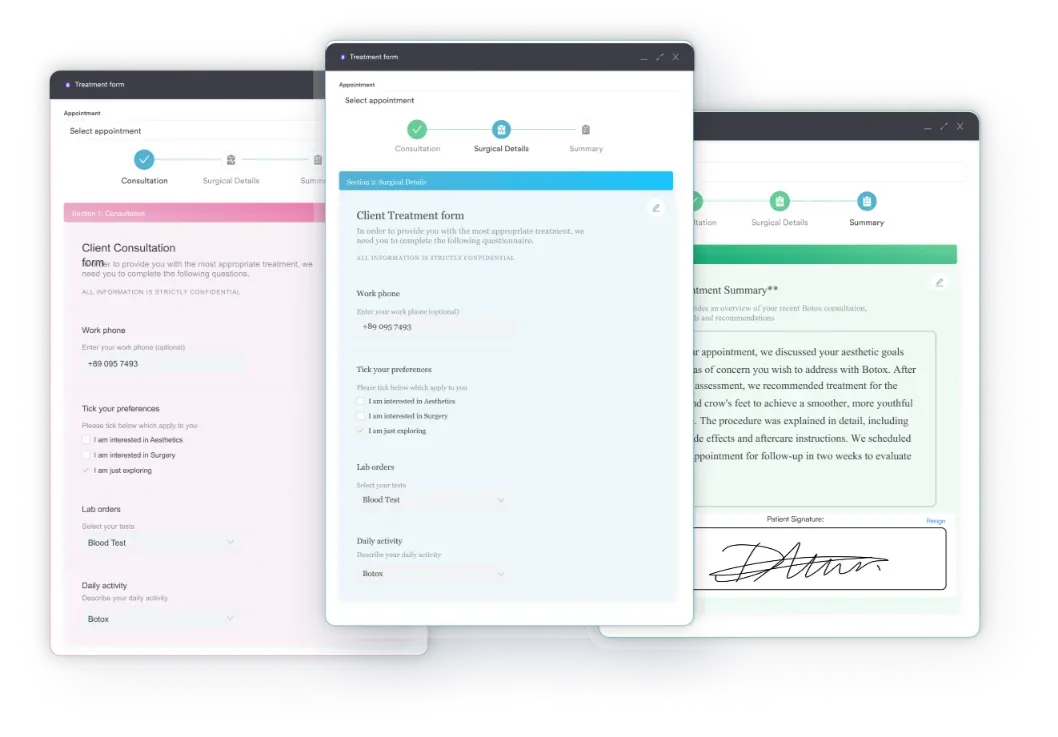
For practices handling IV therapy patient intake forms, integrating heparin flush documentation directly into the treatment record workflow ensures the billing team has everything they need without a separate data-collection step.

Pabau’s claims management software tracks drug quantities, modifier requirements, and NDC data in one connected workflow. See how it helps IV therapy and infusion practices submit cleaner claims from day one.

Medicare Part B covers J1642 as a drug administered incident to a physician’s service, provided the administration meets medical necessity criteria. J1642 carries CMS coverage code D (“special coverage instructions apply”), so coders cannot assume standard drug-reimbursement rules apply without verifying the applicable Local Coverage Determination (LCD) or payer policy.
Under the Outpatient Prospective Payment System (OPPS), low-cost drugs are sometimes packaged into the payment for the primary service rather than reimbursed separately.
A Federal Register correction published April 24, 2012 (document 2012-9837) addressed an error in which the per-day cost for J1642 and J1644 exceeded the $75 OPPS packaging threshold due to a calculation error.
This is historical context. Coders should not assume current packaging status based on that document, but should verify the current OPPS status for J1642 against the current year’s CMS OPPS fee schedule.
For Medicaid, coverage rules vary significantly by state. Do not generalize Medicare coverage policies to Medicaid programs. Check the specific state Medicaid fee schedule and drug coverage policy for each jurisdiction where you bill J1642.
Commercial payer coverage for J1642 is generally aligned with Medicare’s incident-to rules, but prior authorization requirements and coverage criteria vary. Some plans require the heparin flush to be billed as part of the infusion service claim rather than as a standalone line item.
Review each payer contract’s drug billing provisions before submitting. Practices managing medical spa compliance across multiple payer contracts benefit from a centralized drug billing reference to avoid conflicting payer-specific policies.
The CMS Physician Fee Schedule lookup tool provides the current reimbursement amount for J1642 under Medicare Part B. Because pricing may change annually, always verify rates against the current year’s fee schedule rather than relying on prior-year figures.
When billing J1642 under OPPS for a hospital outpatient encounter, check whether heparin lock flush is packaged into the APC payment for the primary procedure. If packaged, submitting J1642 as a separate line item will result in a denial. The OPPS Addendum B, published by CMS each fiscal year, lists current packaging status by HCPCS code.
Most payers require the National Drug Code (NDC) to be reported alongside J1642 on the claim. The NDC is the 11-digit identifier that specifies the exact drug product (manufacturer, formulation, and package size) administered to the patient.
NDC reporting on HCPCS drug claims follows a standard format: the 11-digit NDC in 5-4-2 format (labeler-product-package), a qualifier of “N4,” and the administered quantity in metric decimal units. Report the NDC from the actual vial label used for the specific administration event, not from a formulary list.
Multiple NDC codes are associated with heparin sodium preparations that may map to J1642. However, not every heparin sodium NDC maps correctly to the lock flush application, and the FDA NDC Directory is the authoritative source for NDC-to-product mapping.
Billing staff should cross-reference the NDC on the vial against the AAPC Codify HCPCS lookup or the payer’s published NDC crosswalk to confirm alignment with J1642 before submission.
Practices that administer multiple heparin formulations (for example, both lock flush concentrations and therapeutic doses) should establish an internal NDC reference that maps each vial’s NDC to the correct J-code. This prevents mix-ups between J1642 and J1644 at the point of billing. A structured prescription management software system that captures the dispensed NDC at point of administration removes the manual lookup step entirely.
The most consequential billing error in heparin coding is swapping J1642 for J1644 or vice versa. These two codes describe the same drug but for fundamentally different clinical applications and at very different unit scales.
Applying J1642’s per-10-unit billing logic to a therapeutic heparin dose results in gross overbilling. Conversely, billing a lock flush under J1644 at the per-1,000-unit scale understates the claim and may trigger a query from the payer about whether the documented dose matches the code.
The clinical documentation must clearly state whether the heparin was administered as a maintenance flush or as a therapeutic anticoagulant. “Heparin administered” is insufficient. The record should capture the specific intent and the total units delivered so that the billing team can apply the correct code without ambiguity. Practices opening an IV therapy clinic from the ground up should incorporate code-specific documentation prompts into their administration record templates from day one. Denials on this code repeat until someone reads the pattern rather than reworking each claim.
Denials for J1642 follow recognizable patterns. Addressing them systematically, rather than correcting individual claims reactively, is the faster path to a cleaner AR. For practices running a mobile IV therapy business or any service where heparin flushes are routine, building these checks into the pre-submission workflow prevents the most common errors.
Before submission, verify J1642’s code properties and current status against the CMS HCPCS data set. For payer-specific reimbursement rates, the CMS Physician Fee Schedule remains the authoritative source for Medicare amounts.
Practices that handle IV vitamin therapy administration protocols alongside heparin flush billing benefit from segregating their J-code reference by clinical application. The same discipline applies to home infusion therapy billing: a single reference document covering “lock flush codes” and “therapeutic infusion codes” separately reduces the risk of code crossover at billing.
Heparin lock flush billing errors are almost always preventable. The combination of correct quantity calculation (per 10 units), appropriate modifier selection, complete NDC reporting, and a medical record that distinguishes flush from therapeutic administration covers the vast majority of J1642 denial triggers.
Pabau’s claims management software connects drug administration documentation directly to the billing workflow, so the data needed to bill J1642 accurately is captured at point of care rather than reconstructed at billing. For IV therapy and infusion practices that process heparin flush claims regularly, that connection reduces both error rates and the time spent on denial follow-up. See how Pabau can simplify your J1642 billing workflow—book a personalized demo today.

Coding unspecified back pain correctly? dorsalgia unspecified coding reference explains why M54.9 gets flagged when the documentation supports a more specific diagnosis instead.
HCPCS code J1642 is used to bill for injection of heparin sodium administered as a heparin lock flush, per 10 units, to maintain the patency of an intravenous catheter. It is not used for therapeutic anticoagulation; that application uses a separate code (J1644).
J1642 covers heparin sodium administered as a lock flush at a per-10-unit billing scale, used to prevent clot formation inside an IV access device. J1644 covers therapeutic heparin sodium at a per-1,000-unit scale, used for anticoagulation treatment. Using J1644 quantities to bill a flush dose creates a significant overbilling error and vice versa.
Bill one unit of J1642 for every 10 units of heparin sodium administered. For example, if 30 units of heparin were administered as a lock flush, report a quantity of 3 on the claim. Always base the quantity on the actual documented units administered, not the vial size or concentration.
Medicare Part B covers J1642 when administered incident to a physician’s service and medical necessity is established. Special coverage instructions apply to this code, and OPPS packaging rules may affect separate reimbursement in hospital outpatient settings. Always verify the current year’s LCD and OPPS addendum for the applicable MAC jurisdiction.
OPPS packaging status for J1642 has changed over time, and a Federal Register correction in April 2012 addressed a historical calculation error affecting the code’s packaging threshold status. Current packaging status must be verified against the CMS OPPS Addendum B for the applicable fiscal year. In packaged encounters, billing J1642 as a separate line item results in a denial.
Common supporting ICD-10 codes include Z45.2 (encounter for adjustment and management of vascular access device) when the flush is part of catheter maintenance, plus the primary diagnosis code for the underlying condition requiring the IV access. The diagnosis code must establish why IV catheter maintenance was medically necessary, not simply document that a flush occurred.



