CPT Code 98981: RTM Treatment Management Billing Guide
CPT code 98981: Definition and official descriptor CPT code 98981 is an add-on c...

Last Updated: Nov 9, 2026
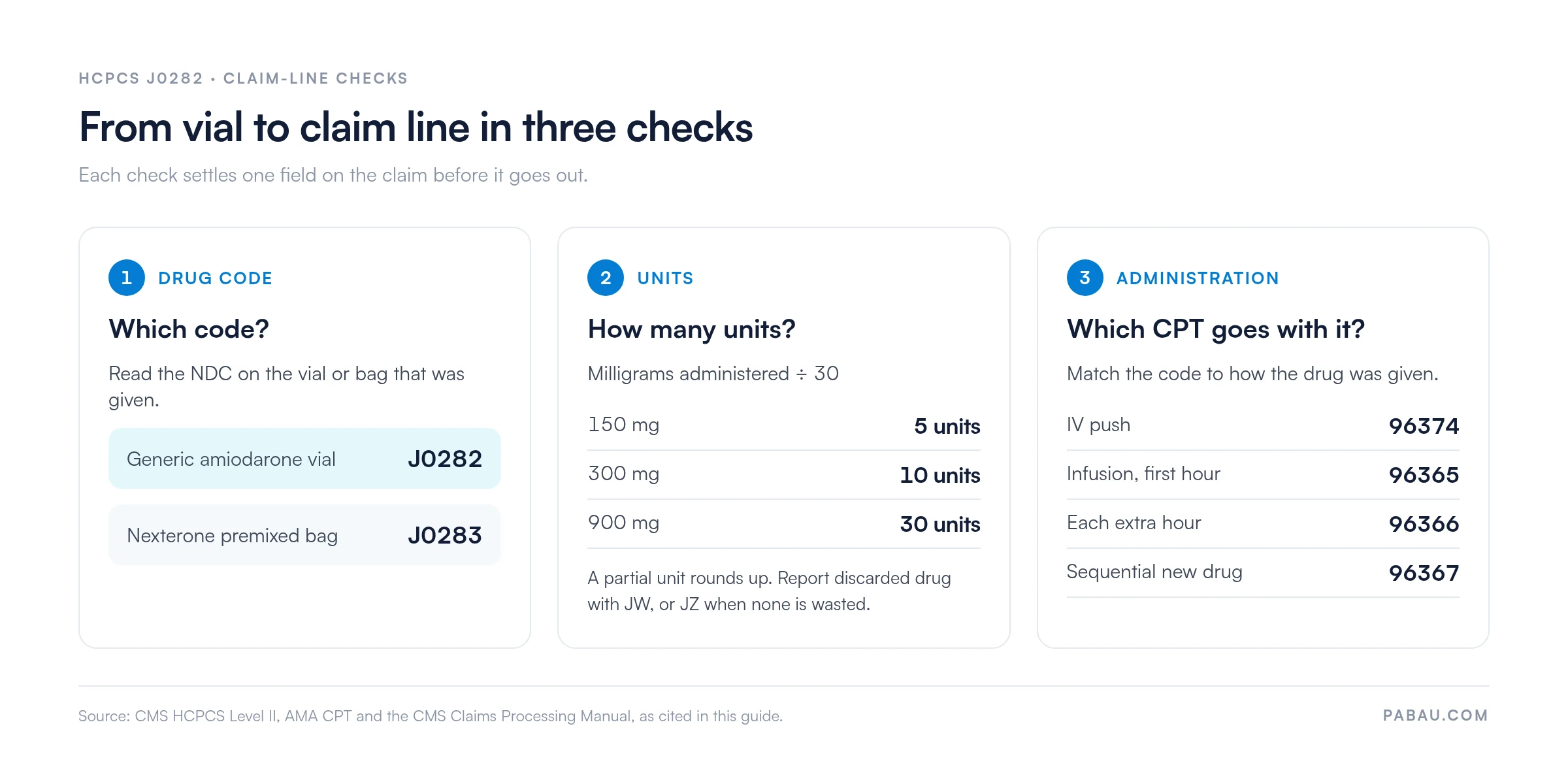
J0282 is the HCPCS Level II code for injection, amiodarone hydrochloride, 30 mg. It covers the generic IV formulation, billed as one unit per 30 mg administered, so a 150 mg dose is 5 units.
The brand-name premixed product, Nexterone, is billed under J0283 instead. The NDC on the vial or bag decides which of the two codes applies.
Let Pabau's smart automation suggest the right codes, reduce claim denials, and keep your practice compliant—effortlessly.
Automate repetitive tasks and focus on what matters most—your patients.
Reduce coding errors and ensure compliance with the latest regulations.
Clean claims, fewer denials, and faster reimbursements.
Powerful insights and reporting to help your practice thrive.
HIPAA compliant SOC 2 certified GDPR-compliant Trusted by 4,000+ clinics worldwide

J0282 covers generic amiodarone HCl injection only, billed per 30 mg, so a 150 mg dose is 5 units.
Nexterone, the brand-name premixed amiodarone IV bag, is billed under J0283, and the NDC on the vial or bag decides which code applies.
IV amiodarone is FDA-approved for ventricular fibrillation and unstable ventricular tachycardia, while atrial fibrillation use is off-label and payer-dependent.
Medicare Part B pays J0282 at ASP+6% in offices, and the rate changes quarterly, so check the current CMS file.
Pabau, our practice management platform, supports insurance billing and claims management, with US claims sent through the Claim.MD clearinghouse.
HCPCS Code J0282 is the Level II drug code for amiodarone hydrochloride (HCl) injection, billed at one unit per 30 mg administered.
The Centers for Medicare & Medicaid Services (CMS) maintains the HCPCS Level II codes, and J0282 applies only to the injectable, intravenous form of generic amiodarone. Oral amiodarone tablets carry no J code and are not separately billable under Medicare Part B.
Units for HCPCS Code J0282 equal the total milligrams administered divided by 30. When the dose falls between two units, CMS has you round up to the next whole unit, so 160 mg bills as 6 units. Drug discarded from a single-dose vial is reported on its own line with the JW modifier, and the JZ modifier states that none was wasted.
CMS also publishes a Medically Unlikely Edit (MUE) for J0282. Check the current value in the CMS MUE table before you submit, because units above it are usually denied. The four scenarios below cover the doses coders see most often in outpatient cardiac settings.
A dose that doesn’t divide evenly by 30 rounds up to the next unit, never down. Billing more units than the dose and documented waste support is an overpayment and an audit risk, so the medication record has to show both. The three checks below take a dose from the vial to a finished claim line.
IV amiodarone is FDA-approved for two indications: ventricular fibrillation and hemodynamically unstable ventricular tachycardia that haven’t responded to other therapy. Medical necessity for a J0282 claim rests on the supporting ICD-10-CM code, so the code chosen at documentation decides whether the claim clears.
I47.2 itself has been a non-billable header since the FY2023 code update, so report one of its child codes. Atrial fibrillation and flutter are off-label uses of IV amiodarone. Commercial payers may still cover them when the record clearly establishes clinical necessity. Medicare uses the FDA-approved indications as its baseline for coverage decisions.
HCPCS Code J0282 covers only the drug. The infusion or injection service is billed separately with CPT codes from the 96360 range, per AMA CPT coding guidance. Reporting the drug without its administration code, or pairing the wrong one, is a frequent source of J0282 errors. Superbill documentation must capture both the drug and the administration service.
For amiodarone, the pairing usually comes down to two codes. Use 96374 for a rapid IV push and 96365 for the first hour of an infusion.
Place of service changes how these codes are paid, not whether they’re reported. Hospital outpatient departments (HOPDs) report both J0282 and the administration CPT codes on the facility claim. OPPS then packages or pays each one under its APC rules rather than at ASP+6%. Physician offices and freestanding infusion centers report both codes on the professional claim.
Always document infusion start and stop times in the clinical record. Without clock times, payers cannot verify the number of hours billed. CPT 96366 add-on units are routinely denied on audit when time documentation is absent.
J0282 covers generic amiodarone HCl injection, and J0283 covers Nexterone, Baxter’s brand-name premixed amiodarone IV formulation. The NDC printed on the vial or bag decides the code. The drug name in the order, the dose and the route don’t. Billing J0282 when the administered product carries a Nexterone NDC is a miscoded claim and can trigger a Medicare overpayment demand.
Medicare Part B pays J0282 using the Average Sales Price (ASP) method, at ASP+6% in physician offices and freestanding infusion centers. CMS updates ASP payment rates every quarter, so any fixed dollar figure goes stale within 90 days. Check the current rate in the CMS Physician Fee Schedule lookup or the quarterly ASP Drug Pricing File on the CMS HCPCS page.
Hospital outpatient departments are paid under the Outpatient Prospective Payment System (OPPS) instead. Drugs below CMS’s per-day cost threshold are packaged into the Ambulatory Payment Classification (APC) payment for the related service rather than paid at ASP+6%. That means the effective rate differs between settings.
Medicare Part B generally does not require prior authorization (PA) for J0282 given for acute cardiac emergencies. CMS does not list it among its prior authorization programs for physician-administered drugs. Commercial payers treat outpatient amiodarone for maintenance or non-emergency use differently.
When PA is required and wasn’t obtained before the infusion, the denial is often hard to overturn. Whether retrospective authorization or an appeal is possible depends on the payer’s policy. Build a pre-service PA check into the workflow for every planned, non-emergency amiodarone infusion.
Missing or incomplete documentation is a leading cause of J0282 denials, alongside code-selection errors. Understanding medical billing workflows shows why each element maps to a specific payer requirement. The elements below belong in the medical record and, where they apply, on the claim before submission.
A clean claim needs every one of these elements verified before it leaves the practice. A single missing field, such as the NDC or the infusion stop time, is enough to send it back.
J0282 denials follow predictable patterns once you map them to their root causes. Effective denial management processes trace each denial type back to the upstream step that produced it.
One pattern sits behind most of these denials, and it points to a workflow fix rather than a coding fix.
Run a weekly denial report filtered to J0282 rejections. If the same denial reason appears on more than two claims in a month, look at the workflow before the coder. Audit the charge capture step, usually the MAR-to-claim transfer, rather than the claim itself.
Many of the J0282 denials above start when the infusion record and the claim sit in separate systems. Someone reads the dose and vial details off the MAR and retypes them into billing, days after the infusion.
In Pabau, the authorization, the infusion and the claim belong to the same patient record. Prior authorization codes, dates and sessions are tracked on the case, with a warning when one is missing. IV sessions record the lot and expiry of the stock used against the patient and the appointment.
Pabau’s claims management software sends US claims through the Claim.MD clearinghouse as CMS-1500/837P claims. Eligibility checks, ERA remittances and secondary claims are handled in the same system. Your billing team works a denied amiodarone line from the place the infusion was documented.

Pabau keeps prior authorizations, infusion lot records and US claims sent through Claim.MD on one patient record. Your team submits J0282 lines from the place the infusion was documented.

The fastest win on J0282 is a pre-submission check that reads the vial’s NDC, divides the dose by 30 and confirms the administration code. Run it on every amiodarone line before it leaves the practice.
If the same denials keep coming back, fix the step where the MAR becomes a claim instead of appealing claim by claim. A few minutes of review per infusion costs far less than weeks of rework on denied lines.
Book a demo to see how Pabau keeps infusion records, prior authorizations and US claims together for your practice.

Need to understand the broader denial management landscape? Denial management in healthcare covers the frameworks practices use to track, appeal, and prevent recurring rejections.
Confused about what makes a claim ‘clean’ before it reaches the payer? What is a clean claim breaks down every field-level requirement that separates a first-pass approval from a denial queue.
Looking for the full picture on how drug billing fits into the revenue cycle? What is revenue cycle management explains where J-code billing sits within the end-to-end RCM workflow.
HCPCS Code J0282 is the Level II drug code for amiodarone hydrochloride injection, billed per 30 mg given intravenously. It applies to the generic formulation only, and the brand-name premixed Nexterone product is billed under J0283. IV amiodarone is FDA-approved for ventricular fibrillation and hemodynamically unstable ventricular tachycardia. Atrial fibrillation use is off-label, so coverage depends on the payer.
Divide the total milligrams administered by 30 to get the number of units to report. A 150 mg dose is 5 units, a 300 mg loading dose is 10 units, and a 900 mg 24-hour infusion is 30 units. When the dose falls between units, round up to the next whole unit and report any discarded drug with the JW modifier. Check the current CMS Medically Unlikely Edit (MUE) for J0282 before you submit a high-unit claim.
J0282 covers generic amiodarone hydrochloride injection, supplied in a vial that needs dilution. J0283 covers Nexterone, the brand-name premixed amiodarone IV bag made by Baxter. The NDC on the administered product decides which code applies. Billing J0282 when a Nexterone NDC is on the label is a miscoded claim and can trigger an overpayment demand from Medicare.
No, Medicare Part B does not require prior authorization for J0282 in acute cardiac emergency use. Some Medicare Advantage plans require it for planned outpatient infusions, so check the specific plan’s formulary. Commercial payers often require it for non-emergency outpatient amiodarone, such as AFib maintenance. A denial for a missing authorization is often hard to overturn, and whether retrospective authorization or an appeal is possible depends on the payer’s policy.
Medicare Part B pays J0282 at ASP+6% (Average Sales Price plus 6%) in physician offices and freestanding infusion centers. Hospital outpatient departments are paid under OPPS, which follows different rules. CMS updates ASP figures every quarter, so no fixed dollar rate is given here. Check the current rate in the CMS quarterly ASP Drug Pricing File or the Physician Fee Schedule lookup tool.