HCPCS Code E0272: Foam rubber mattress billing guide
HCPCS Code E0272: official descriptor and code overview HCPCS Code E0272 is the ...

Last Updated: Nov 6, 2026
H0041 is the HCPCS Level II code for foster care, child, non-therapeutic, per diem.
Its companion code H0042 covers the same non-therapeutic placement, billed per month instead of per day. Your state Medicaid manual sets which billing period applies. Therapeutic foster care has its own codes: S5145 per diem and S5146 per month. Common claim errors in this range include billing daily and monthly units for the same days, and missing modifiers.
Let Pabau's smart automation suggest the right codes, reduce claim denials, and keep your practice compliant—effortlessly.
Automate repetitive tasks and focus on what matters most—your patients.
Reduce coding errors and ensure compliance with the latest regulations.
Clean claims, fewer denials, and faster reimbursements.
Powerful insights and reporting to help your practice thrive.
HIPAA compliant SOC 2 certified GDPR-compliant Trusted by 4,000+ clinics worldwide

HCPCS code H0041 covers non-therapeutic foster care for a child, billed at one unit per calendar day.
H0041 is primarily a Medicaid code, and Medicare generally does not cover foster care placement services.
Billing H0041 per encounter instead of per diem triggers denials; one unit equals one day.
Each billed day needs a daily log, a current placement agreement and proof of Medicaid eligibility for that date.
No national prior authorization rule exists for H0041, so check each state program and MCO contract before placement starts.
HCPCS code H0041 is the Level II Healthcare Common Procedure Coding System code for non-therapeutic foster care for a child, billed per diem. It belongs to the H-series of HCPCS Level II codes (H0001 through H2037). State Medicaid programs use that series for mental health, substance abuse and child welfare services. Within it, H0041 is a social-services billing code rather than a clinical treatment code.
“Non-therapeutic” means the placement includes no structured clinical treatment component. The child lives in a licensed foster home and receives basic care, supervision and a safe environment. If the placement includes therapeutic treatment, the correct code is S5145 (per diem) or S5146 (per month), not H0041. H0042 is not the therapeutic alternative either. It is the same non-therapeutic service billed per month.
According to the Centers for Medicare and Medicaid Services (CMS), H-series codes are allocated to state Medicaid agencies. The agencies use them for alcohol and drug abuse treatment, mental health and social service programs, including foster care placements. Each state Medicaid program sets its own coverage policy and fee schedule.
Scope errors on H0041 take two forms. One is billing it for a therapeutic placement, and the other is billing days that a monthly H0042 claim already covers.
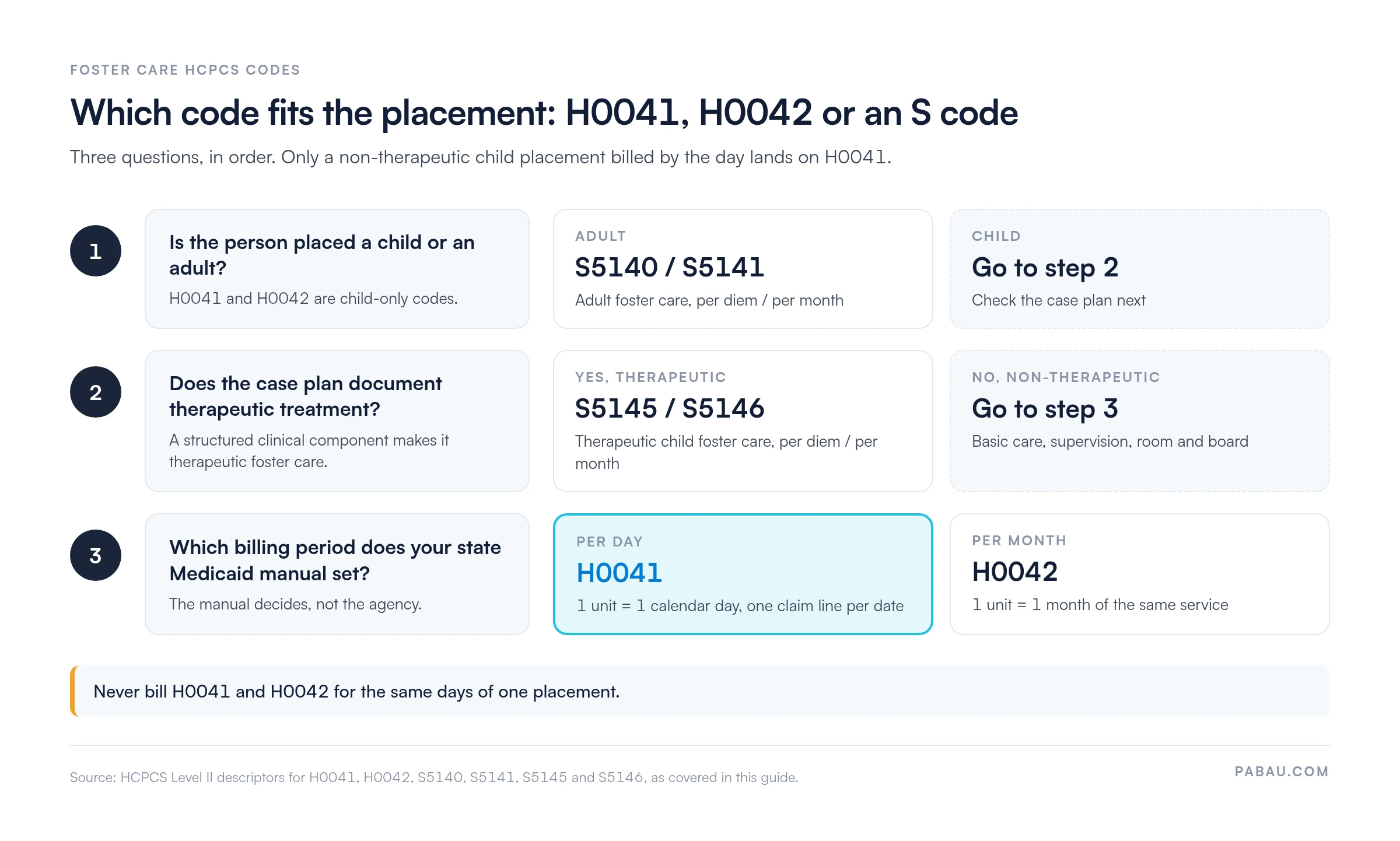
Check your state Medicaid manual before choosing between H0041 and H0042. Both cover non-therapeutic foster care. H0041 bills per day and H0042 bills per month. If the child’s plan documents therapeutic treatment, neither code applies, and the placement moves to S5145 or S5146.
H0041 and H0042 describe the same service, non-therapeutic foster care for a child. The only difference is the billing period, and your state Medicaid manual decides which one you use. Therapeutic foster care is a separate service with its own codes, S5145 per diem and S5146 per month.
Your state Medicaid manual sets whether a placement is billed daily or monthly, so check it before you choose between H0041 and H0042. Never bill both codes for the same days. Adult foster care uses its own pair, S5140 (per diem) and S5141 (per month). The descriptor “Therapeutic behavioral services, per diem” belongs to H2020, not to any foster care code.
Three questions settle the code for any foster care placement, and they work best in the order shown below.
H0041 Medicaid billing follows a per diem model: One unit on the claim equals one calendar day of foster care placement. Billing a single encounter for a multi-day placement, or stacking several units on one date, triggers duplicate-service edits and a denial.
A Medicaid managed care organization’s own billing manual may add requirements beyond the fee-for-service rules. Confirm them with the specific MCO before submitting claims. Pabau, the practice management platform we build, includes claims software for billers that checks each claim before submission and tracks it to payment.
Modifiers tell the payer which population or program context applies to the placement. A claim missing a modifier the state requires is denied. Required modifiers vary by state Medicaid program, so always verify them against your state billing manual.
Whether HA, HE, HK or TG applies to an H0041 claim depends on state Medicaid policy. Your state billing manual is the authority on which modifiers are required, optional or prohibited on H0041.
Every billed day of H0041 needs records proving the child was in a licensed placement on that calendar date. A day without that proof can be denied before payment or recouped after a Medicaid audit.
Keep the following records ready for audit. Your state Medicaid billing manual sets any additional records and the retention period. Our guide to medical billing compliance covers how to turn those rules into a documentation checklist.
Build a daily log template that captures the child’s name, Medicaid ID, placement date, foster home certification number, and the case worker’s signature. A log completed each day answers an audit request faster than records pieced together after a demand letter arrives.
Whether H0041 requires prior authorization (PA) depends on the state Medicaid program and, in managed care states, on the specific MCO contract. No national PA requirement exists for H0041. Treating PA as a yes-or-no rule across every state leads to preventable denials.
Our walkthrough of the prior authorization process covers what payers ask for and how to track each approval to its end date.
H0041 denials tend to cluster around a small number of root causes. Fixing one denial without changing the workflow behind it means the same denial returns on the next billing cycle.
For appeal workflows across behavioral health codes, see our guide to denial management in healthcare. To confirm a code’s descriptor before each billing cycle, use the AAPC Codify HCPCS lookup. The NLM also provides a free HCPCS Level II API for programmatic code lookups.
Without a shared system, placement dates, authorization windows and daily logs sit in separate spreadsheets and payer portals. A lapsed authorization or a missing log then surfaces only when the remittance comes back with a denial code.
In Pabau, the prior authorization number is stored with the appointment it covers, so it follows every claim for that period. Claim validation checks codes and required fields before submission, and each claim is tracked from submission through to reconciliation.
Automated reminders can prompt staff before an authorized period ends, so the renewal request goes in before the authorization lapses. Fewer claims come back as CO-15 or CO-197 denials, and fewer placement days go unpaid.

Pabau helps child welfare and behavioral health providers manage HCPCS code tracking, claim submission, and denial workflows in one platform. See how it fits your billing operations.

H0041 rewards the work done before the first claim. Settle three points against your state Medicaid manual for each new placement: The billing period, the required modifiers and the prior authorization rule. Then keep a signed daily log for every date you bill.
That setup takes longer up front, because every state and MCO writes its own rules. It is still cheaper than appealing the same denial each month or repaying recouped days after an audit. Book a demo to see how Pabau keeps authorizations and per diem claims in step for foster care billing teams.

Billing the same placement by the month? HCPCS code H0042 covers the per-month version of non-therapeutic child foster care and when your state requires it.
Is the service therapeutic behavioral care rather than a placement? HCPCS code H2020 explains the per diem code for therapeutic behavioral services.
Need to understand denial codes on remittance advice? Denial codes in medical billing explains CARC codes and how to read ERAs for corrective action.
Need a structured authorization request? Medical prior authorization form gives you a template for documenting the request and the approved period.
Want to verify clean claim requirements before submitting H0041? Clean claim guidelines covers the elements every Medicaid claim needs to pass initial edits.
HCPCS code H0041 is the Level II billing code for non-therapeutic foster care for a child, billed per diem. It identifies daily, non-clinical foster placement services billed to state Medicaid programs by licensed child placing agencies.
H0041 is billed per diem: One unit equals one calendar day of foster care placement. Each date of service must appear as a separate line on the claim. Billing per episode or submitting multiple units on a single date triggers duplicate-service edits and denial.
H0041 and H0042 cover the same service, non-therapeutic foster care for a child. H0041 is billed per diem, one unit per day, and H0042 is billed per month. Your state Medicaid manual decides which billing period applies, and the two codes must never be billed for the same days. Therapeutic foster care uses S5145 (per diem) or S5146 (per month) instead.
HA (child/adolescent program) is commonly required, and states may also assign U1-U9 modifiers. HE (mental health program) applies only where the state manual requires it for non-therapeutic foster care. HK (specialized mental health programs for high-risk populations) is state-specific and rarely applies to non-therapeutic placements. Always check the state billing manual before submitting.
Prior authorization requirements vary by state Medicaid program and by managed care organization. Some states require PA before the placement start date. Others allow retroactive authorization within a set window. Claims billed without a required PA are denied as non-authorized services, so verify with the specific payer before billing.
Frequent denial reasons include missing or incorrect modifiers, a wrong place of service code and no prior authorization on file. Duplicate date-of-service billing, thin documentation, unenrolled providers and per-encounter billing also cause denials. Fixing each root cause in the billing workflow stops the same denial from recurring.