CPT Code 98981: RTM Treatment Management Billing Guide
CPT code 98981: Definition and official descriptor CPT code 98981 is an add-on c...

Last Updated: Nov 9, 2026
H0039 is the HCPCS Level II code for assertive community treatment, face-to-face, per 15 minutes. It reports direct contact between an ACT team member and an enrolled member, billed in 15-minute units.
ACT is an intensive, team-based model for adults with serious mental illness who live in the community. State Medicaid programs decide who can bill H0039, how many units pay, and how it works alongside H0040, the ACT per diem code.
Let Pabau's smart automation suggest the right codes, reduce claim denials, and keep your practice compliant—effortlessly.
Automate repetitive tasks and focus on what matters most—your patients.
Reduce coding errors and ensure compliance with the latest regulations.
Clean claims, fewer denials, and faster reimbursements.
Powerful insights and reporting to help your practice thrive.
HIPAA compliant SOC 2 certified GDPR-compliant Trusted by 4,000+ clinics worldwide

HCPCS code H0039 reports assertive community treatment (ACT) delivered face-to-face, billed in 15-minute units
H0040 is the ACT program per diem, so confirm whether your state pays ACT by the contact, the day, or the month
Only certified or state-approved ACT programs can bill H0039, and Oregon has restricted it to qualified ACT providers since July 1, 2023
Every unit needs a note with start and end times, the team member, and the treatment plan goal it served
Medicare does not pay H-codes, so state Medicaid programs and Medicaid managed care plans are the main payers
HCPCS code H0039 carries the official descriptor “Assertive community treatment, face-to-face, per 15 minutes.”
It sits in the H-series of HCPCS Level II codes, which the Centers for Medicare and Medicaid Services (CMS) maintains.
H-codes cover behavioral health and substance use treatment, and state Medicaid programs are their main users. H0039 has been an active code since January 1, 2003.
Assertive community treatment is an evidence-based model for adults with serious mental illness who struggle to engage with office-based care. A multidisciplinary team brings treatment, rehabilitation, and support to the member’s home and community.
ACT teams usually include a team leader, a psychiatric prescriber, nurses, and substance use, employment, and peer specialists. Caseloads stay small, and the whole team shares responsibility for every member around the clock.
H0039 captures each face-to-face contact that team delivers, one 15-minute unit at a time.
H0039 pays for direct, face-to-face time between an ACT team member and the enrolled member. The content of each contact can vary widely, as long as it serves the treatment plan.
Billing H0039 for indirect time is a common audit finding. Auditors match billed units against note times, so a unit without a documented contact gets recovered.
H0038, H0039, and H0040 sit side by side, and two of them describe ACT. H0007 enters the picture because ACT teams also handle crises, but it describes a different service.
The decision that matters most is H0039 versus HCPCS code H0040, and your state makes it for you. Some states pay ACT only by the 15-minute contact. Others pay the program a per diem. The flow below runs the three checks that decide which code a contact becomes.
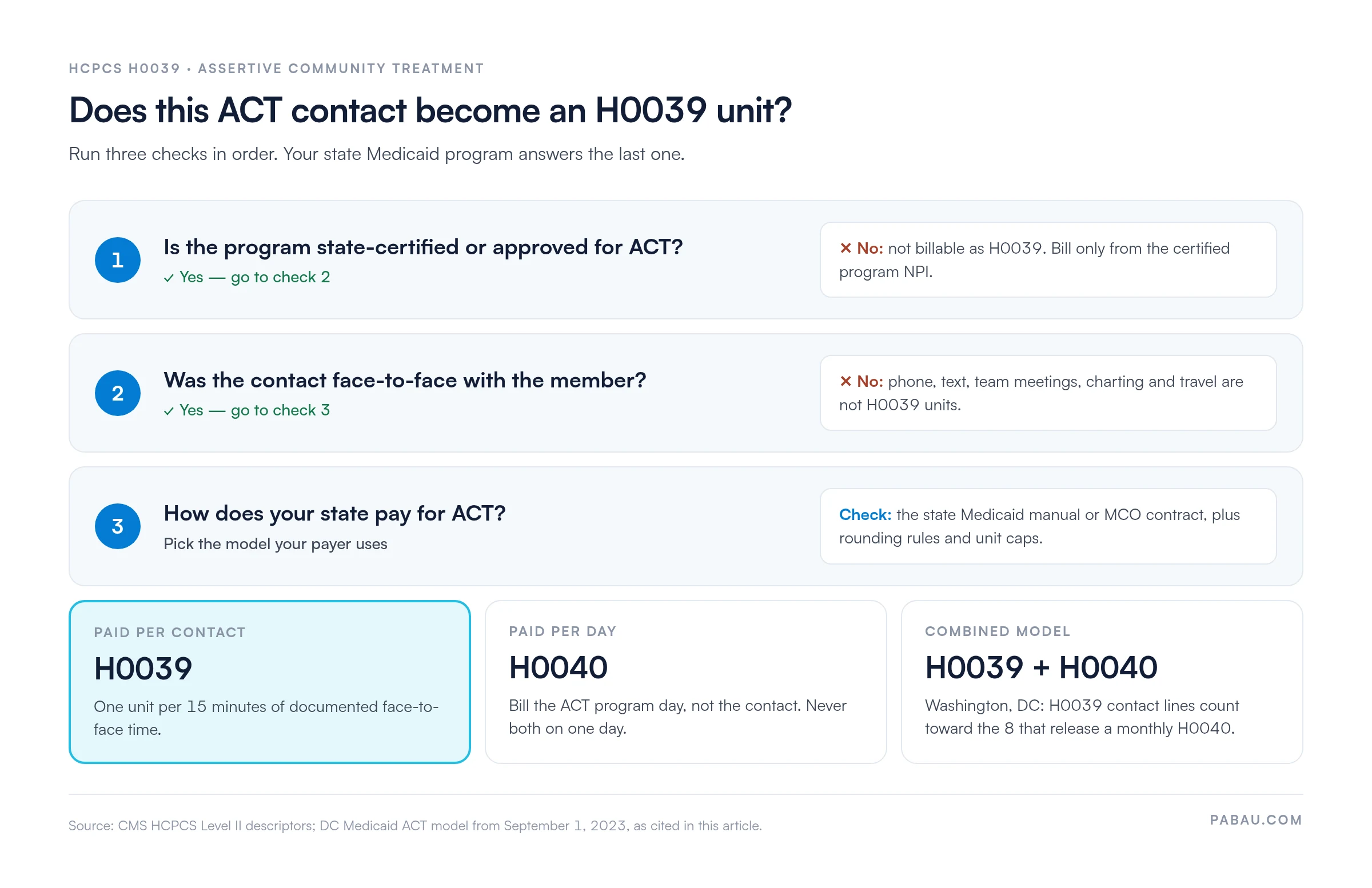
A few states use both codes together. In Washington, DC, Medicaid moved ACT to a monthly H0040 unit on September 1, 2023. The H0039 contact lines on the claim now count toward the eight contacts that release that monthly payment.
Unless your payer runs a combined model like that, never bill H0039 and H0040 for the same member on the same day. For peer services outside ACT, see HCPCS code H0038. For outpatient substance use crisis work, see HCPCS code H0007.
The right to bill H0039 sits with the ACT program, not with an individual clinician. Most state Medicaid programs require the team to hold state ACT certification or approval.
Many states measure the team against a fidelity tool. Common examples are the Tool for Measurement of Assertive Community Treatment (TMACT) and the Dartmouth ACT Fidelity Scale (DACTS).
Oregon shows how strict this has become. Since July 1, 2023, the Oregon Health Authority has restricted H0039 to qualified ACT providers under its ACT rules.
Typical requirements include:
Members usually qualify through a diagnosis such as schizophrenia or bipolar disorder, plus repeated hospital or crisis use. Record how each member met those criteria, so the eligibility decision is on file before the first claim.
Medicare does not pay H0039, because it treats H-codes as not valid for Medicare purposes. State Medicaid programs and Medicaid managed care organizations (MCOs) are the main payers.
One unit equals 15 minutes of face-to-face contact. Many Medicaid manuals require at least 8 minutes before you can bill a single unit. Your state manual sets the exact rounding rule.
Each state Medicaid program sets its own:
There is no national rate for H0039. Pull the rate from your state Medicaid fee schedule or your MCO contract, and recheck it each fiscal year. The CMS HCPCS Level II code set confirms the descriptor, not the rate.
Before you load H0039 into a new MCO contract, confirm three rules in writing: the unit model, the rounding rule, and any unit cap. MCO rules can differ from state fee-for-service rules in the same state.
Every billed unit needs a note that proves a face-to-face contact happened and served the treatment plan. Each note should include:
Keep the member’s ACT eligibility determination and current authorization on file too. Auditors often pull both before they read a single progress note.
If your ACT team runs a federally assisted substance use disorder program, 42 CFR Part 2 adds consent rules for those records. Build that into your medical billing compliance process.
Modifier rules for H0039 are not standardized nationally. Check your state Medicaid provider manual or MCO addendum before each new payer goes live, and confirm the descriptor in the AAPC H0039 reference.
Most H0039 denials trace back to authorization, certification, or unit counts. Denial management for ACT programs usually starts with these failure points:
When a denial needs a formal appeal, read the denial reason codes on the remittance advice first. Answer each code directly in the appeal letter, and attach the notes that prove the billed time.
A clean H0039 claim follows the usual Medicaid workflow, with a few ACT-specific checkpoints added.
The descriptor says face-to-face, and most states read that as in person. Some states accept live audio-video contact as face-to-face for ACT. Audio-only contact usually does not qualify unless the state says so.
Where your state allows video for H0039, billing typically requires:
ACT is built on in-person community contact, so a fidelity review may flag a team that leans heavily on video. Check your state’s current ACT telehealth policy before you schedule video contacts.
Most ACT teams document in cars, kitchens, and shelters. Notes often land in paper logs or spreadsheets, and someone rebuilds the unit count before billing.
Pabau’s practice management platform keeps the schedule, the member record, and billing in one place. Team members record treatment notes against each appointment, and intake and consent forms sit in the same record.
Pabau Scribe, our AI scribe, can draft a note from the conversation for the team member to review. Pabau GO, our iOS app for practitioners, brings Pabau to the team’s phones between community visits.
Insurance billing runs through Pabau’s claims management software, so claims go out from the same record that holds the note. The result is fewer units lost between the visit and the claim.

Pabau brings scheduling, treatment notes, intake forms, and insurance billing into one platform. Every ACT contact gets recorded against the member’s record, ready to bill.

H0039 rewards ACT teams that treat every contact as a billable unit and every note as evidence. The code itself is simple: face-to-face ACT time, counted in 15-minute units.
The risk sits in the state rules around it. Before your first claim, confirm whether your state pays H0039, H0040, or both. Then confirm the rounding rule and whether video counts as face-to-face.
Settle those three points, and most H0039 denials never happen. To see how Pabau keeps ACT notes and claims together, book a demo.

Billing ACT by the day instead? HCPCS code H0040 covers the assertive community treatment program per diem and its documentation rules.
Running peer services outside an ACT team? HCPCS code H0038 explains how to bill self-help and peer services per 15 minutes.
Need a foundation in Medicaid billing basics? Medical billing fundamentals explains the end-to-end claims workflow behind every HCPCS code submission.
Seeing repeat denials across your behavioral health claims? Denial management in healthcare covers how to build a systematic denial reduction program.
Billing case management outside an ACT team? HCPCS code T1017 explains how to bill targeted case management and document each contact.
HCPCS code H0039 covers assertive community treatment delivered face-to-face, billed per 15 minutes. It reports direct contact between an ACT team member and an enrolled member. Indirect time, such as team meetings, charting, and travel, is not billed under H0039.
H0039 bills each face-to-face ACT contact in 15-minute units. H0040 bills the ACT program as a per diem. Your state Medicaid program decides which model applies, and a few states combine the two.
H0038 covers self-help and peer services, per 15 minutes, outside the ACT model. H0039 covers face-to-face contact by a certified ACT team, including the peer specialists on that team.
No. Outpatient alcohol and drug crisis intervention is H0007. H0039 covers face-to-face assertive community treatment, which can include crisis work by the ACT team itself.
No. Medicare treats H-codes as not valid for Medicare purposes. State Medicaid programs and Medicaid managed care plans are the main payers, and some commercial plans cover ACT too.
Each unit needs a note with the date, start and end times, location, and the team member’s name and credential. The note must confirm face-to-face contact and describe the intervention. It must also link the contact to a current treatment plan goal.
Only where your state accepts live audio-video contact as face-to-face for ACT. Where it does, add modifier 95 or GT as directed and use place of service 02 or 10. Audio-only contact usually does not qualify.