CPT Code 31653: EBUS With 3+ Mediastinal Stations
CPT code 31653: Official descriptor and clinical scope CPT code 31653 is the pro...

Last Updated: Oct 20, 2026
H0026 is the HCPCS Level II code for alcohol and/or drug prevention process service, community-based (delivery of services to develop skills of impactors). Impactors are the people who carry prevention into a community, such as coalition members, teachers and agency staff.
It is one of six prevention codes, H0024 to H0029, and covers organizing, planning, training and coalition building. Medicare does not pay it. State substance use agencies set the unit, rate and modifiers.
Let Pabau's smart automation suggest the right codes, reduce claim denials, and keep your practice compliant—effortlessly.
Automate repetitive tasks and focus on what matters most—your patients.
Reduce coding errors and ensure compliance with the latest regulations.
Clean claims, fewer denials, and faster reimbursements.
Powerful insights and reporting to help your practice thrive.
HIPAA compliant SOC 2 certified GDPR-compliant Trusted by 4,000+ clinics worldwide

HCPCS code H0026 is a community-based alcohol and/or drug prevention process service that builds the skills of impactors.
Impactors are the people who shape prevention locally, such as coalition members, teachers and agency staff, rather than people in treatment.
H0026 is one of six prevention codes, H0024 to H0029, that match the six primary prevention strategies in federal block grant rules.
CMS gives H0026 coverage code I, so Medicare does not pay it, and each state sets the unit, rate and modifiers.
State crosswalks can differ from the CMS descriptors, so the state prevention manual decides how each activity is coded.
HCPCS code H0026 is the Level II code for an “Alcohol and/or drug prevention process service, community-based (delivery of services to develop skills of impactors).” It reports prevention work that strengthens the people and organizations who carry prevention into a community.
“Impactors” are those people: coalition members, teachers, youth workers, local officials and agency staff. The service builds their skills so they can reach others. Nobody receives treatment under H0026, and nobody needs a diagnosis to be served.
The code sits in a family of six prevention codes within the HCPCS code set, which the Centers for Medicare and Medicaid Services (CMS) maintains. Federal rules for the block grant describe prevention as strategies “directed at individuals not identified to be in need of treatment.” That premise shapes how H0026 is funded, counted and documented.
Every value in the table comes from the CMS alpha-numeric HCPCS file for October 2026.
A community-based process service builds local capacity to prevent alcohol, tobacco and drug problems. Under 45 CFR 96.125(b)(5), the strategy covers organizing, planning, interagency collaboration, coalition building and networking. The regulation lists these example activities:
State manuals add their own examples. The Alabama Department of Mental Health FY26 Prevention Activity Sheet instructions go further. Under H0026, Alabama lists needs assessments, community readiness surveys, youth-adult partnerships and cross-systems planning. It also names coalitions, collaborations and wellness teams.
H0026 does not cover treatment, screening for treatment need or individual counseling. Assessments belong to treatment codes such as H0001. Sessions that teach a target population directly belong to H0025 instead.
The six prevention codes line up with the six strategies the block grant rules name. The CMS descriptor tells you which one an activity belongs to, as the grid below shows.
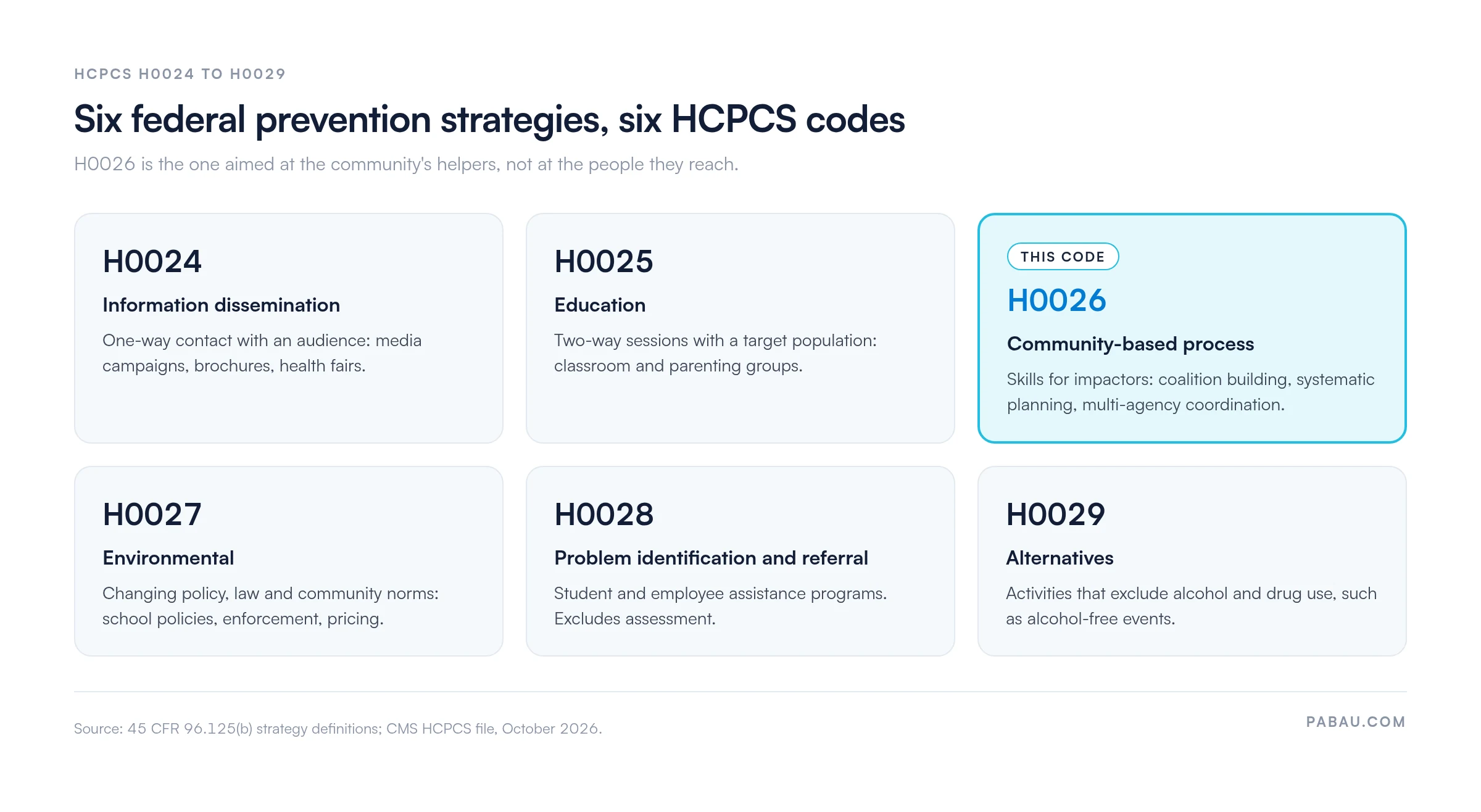
The deciding question is who the activity serves. Training coalition members to run a campaign is H0026. Running the campaign for the public is H0024, and teaching a parenting class is H0025.
Medicare does not pay for H0026. The CMS HCPCS file assigns it coverage code I, “not payable by Medicare,” and pricing indicator 00.
Most H0026 work is funded through state substance use agencies. The federal Substance Use Prevention, Treatment, and Recovery Services (SUPTRS) Block Grant pays for much of it. Under 45 CFR 96.124, each state must spend at least 20% of that grant on primary prevention.
States then contract with providers and track the work by strategy code. In Alabama, providers keep the activity record on file and enter its elements into WITS, the state’s data system. Medicaid and commercial coverage is a state and plan decision, so confirm the code appears on your payer’s fee schedule before you bill it.
The H0026 descriptor carries no time increment or per-session unit. The state agency or payer defines the unit, and that definition is the one to follow.
Alabama’s FY26 instructions are a worked example. They define a contact unit as 15 minutes, so a one-hour activity counts as four units.
That last point matters beyond Alabama. A state crosswalk governs reporting to that state, even where it departs from the CMS wording. Check the crosswalk for every funder before you code an activity, and never carry one state’s rules into another.
Prevention records describe an activity and the community it reached, not a patient encounter. Alabama requires the following details for every billable prevention activity, whatever form the provider uses:
Because prevention serves people not identified as needing treatment, an H0026 record has no substance use disorder diagnosis. If a claim format still asks for a diagnosis, follow your state’s written instruction rather than adding a code.
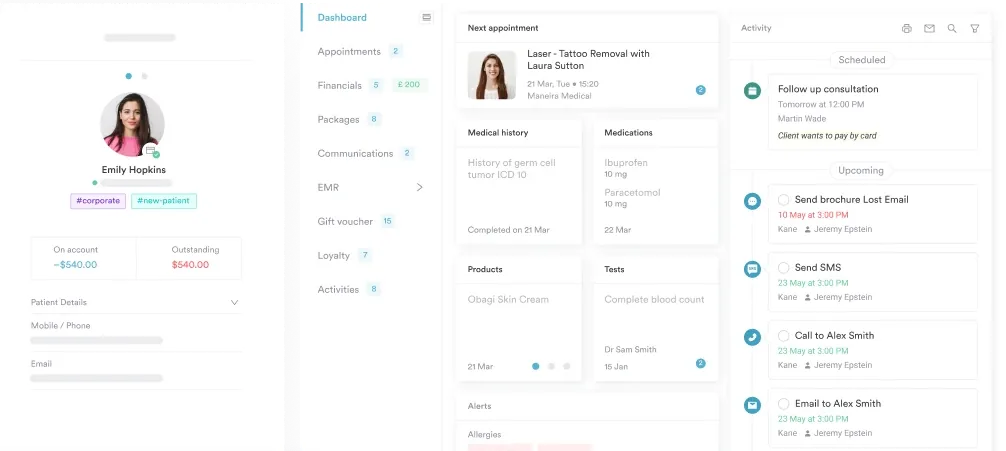
Prevention teams often log coalition meetings and trainings across spreadsheets, paper sign-in sheets and email. When the state asks for contact units or attendance counts, someone rebuilds the record by hand.
Pabau, the practice management and records platform we build, keeps that work in one place. Custom forms capture the date, times, strategy code, description and signature for each activity. Attachments such as sign-in sheets sit in the same file, so each reported unit traces back to its source.
For payers that do accept prevention claims, Pabau’s claims management software submits and tracks claims built from the details your team entered. It does not choose codes or check modifiers and authorizations, so the state manual stays your coding authority.

Pabau stores H0026 activity notes, sign-in sheets and signatures in one record, so state reporting starts from complete data.

H0026 pays for the work that makes prevention possible: training, planning and coalition building with the people who reach a community. Code it by asking who the activity served, then follow your state’s crosswalk and unit rules exactly.
The record matters as much as the code, because state funders audit the activity details behind every unit. Book a demo to see how Pabau keeps prevention activity records complete and ready for state reporting.

Coding a one-way awareness campaign? HCPCS code H0024 covers prevention information dissemination and how it differs from education.
Running sessions with a target population? HCPCS code H0025 explains prevention education units and records.
Working with student or employee assistance programs? HCPCS code H0028 walks through problem identification and referral.
Coding alcohol-free activities? HCPCS code H0029 covers the prevention alternatives strategy.
Screening for treatment need? HCPCS code H0049 explains alcohol and drug screening, which sits outside prevention.
H0026 covers community-based alcohol and drug prevention process services that develop the skills of impactors. Examples include coalition building, community and volunteer training, systematic planning and multi-agency coordination.
No. H0026 is a prevention code for people not identified as needing treatment. Treatment programs, assessments and counseling use other H codes or CPT codes.
No. The CMS HCPCS file assigns H0026 coverage code I, which means not payable by Medicare. Funding usually comes through state substance use agencies.
The descriptor sets no unit, so the state or payer defines it. Alabama, for example, counts 15-minute contact units, so a one-hour activity is four units.
H0025 is prevention education delivered to a target population. H0026 builds the skills of the people who deliver prevention, such as coalition members and staff.
Prevention serves people not identified as needing treatment, so there is usually no diagnosis to report. Follow your state’s written instruction if a claim form asks for one.