

HCPCS code E0198: Water pressure pad billing guide
HCPCS code E0198 is a water pad for a standard mattress HCPCS code E0198 is the ...

Last Updated: Oct 13, 2026
H0024 is the HCPCS Level II code for behavioral health prevention information dissemination service. Its official descriptor covers one-way direct or non-direct contact with service audiences to affect knowledge and attitude.
H0024 sits in the H-series (H0001-H2037), which state Medicaid agencies use for drug, alcohol, and behavioral health services. It is limited to prevention and awareness activities, so sessions with treatment goals, assessment, or counseling belong to other H codes. Each state Medicaid plan sets its coverage, billing unit, and rate.
Let Pabau's smart automation suggest the right codes, reduce claim denials, and keep your practice compliant—effortlessly.
Automate repetitive tasks and focus on what matters most—your patients.
Reduce coding errors and ensure compliance with the latest regulations.
Clean claims, fewer denials, and faster reimbursements.
Powerful insights and reporting to help your practice thrive.
HIPAA compliant SOC 2 certified GDPR-compliant Trusted by 4,000+ clinics worldwide

HCPCS code H0024 covers behavioral health prevention information dissemination, not treatment or counseling.
H0024 is a Medicaid code. Medicare does not recognize or pay for it, so coverage, units, and rates come from each state plan.
Documentation must record the service date, type of prevention activity, number of individuals reached, and staff qualifications.
Pabau, the practice management platform we build, keeps H0024 session logs, forms, and invoices together, so each claim has its supporting record.
HCPCS Code H0024 is the Healthcare Common Procedure Coding System Level II code for behavioral health prevention information dissemination service.
It belongs to the H-series (H0001-H2037), which state Medicaid agencies use for drug, alcohol, and behavioral health services. Because H codes are state Medicaid codes, Medicare does not recognize or pay for them.
Reimbursement rates for HCPCS Code H0024 are set by each state Medicaid plan independently, and there is no single national rate. Before billing, check your state’s published Medicaid fee schedule, because each state updates its amounts on its own cycle. Neighboring H codes, from assessment to case management, are listed in our HCPCS codes reference.
H0024 covers structured prevention activities whose purpose is informational. They share knowledge about behavioral health risks, substance use consequences, and protective factors with people who have not entered a formal treatment program. The key clinical distinction is that the service informs rather than treats.
Qualifying activities fall into these categories:
Some programs funded by the Substance Abuse and Mental Health Services Administration (SAMHSA) deliver sessions that fit this description. Whether those sessions can be billed as H0024 depends on your state Medicaid plan’s coverage rules.
Billing H0024 for a service that belongs to an adjacent code exposes the claim to denial and the program to repayment. These activities fall outside H0024’s scope:
A useful internal test is to picture the record the session would produce. A clinical note with treatment goals, a progress update, or a diagnostic impression means it is not an H0024 session. An H0024 session produces an outreach service log, which records who attended, what was covered, and who delivered it.
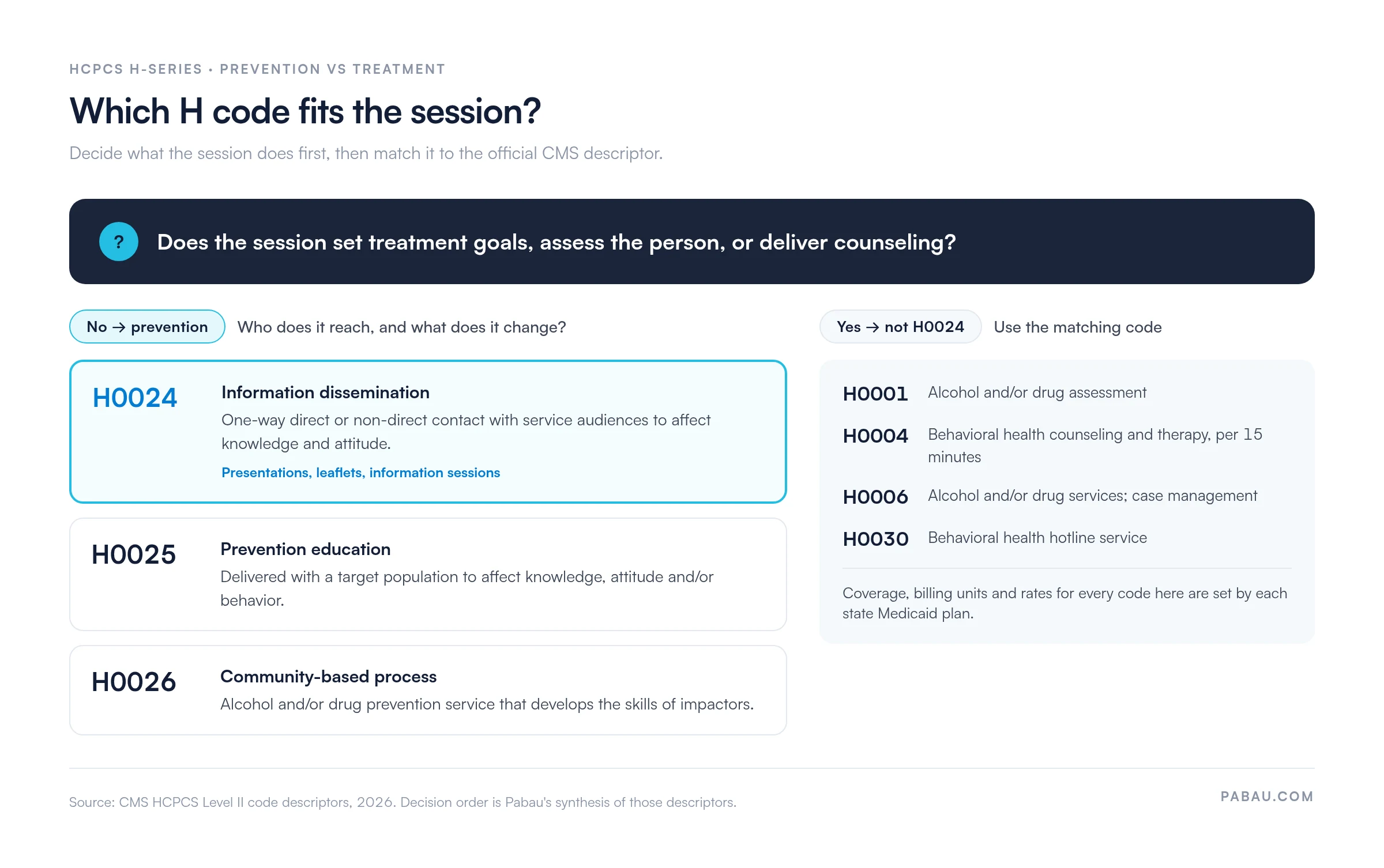
H0024 is most often confused with H0025 (behavioral health prevention education service) and H0026 (alcohol and/or drug prevention process service, community-based). All three are prevention codes. The difference lies in how the service reaches people and what it aims to change.
The clearest decision rule follows the descriptors. Use H0024 when the session is one-way contact that informs an audience, such as a presentation or an information session. Use H0025 when the service works with a target population to change knowledge, attitude, or behavior. Use H0026 when the work builds the skills of impactors in a community-based process.
Always check your state’s Medicaid provider manual, because each state sets its own coverage rules for these codes. The decision path below sets the three prevention codes against the treatment codes they are most often confused with.
Eligible provider types for HCPCS Code H0024 vary by state Medicaid plan, and no federal rule designates a single universal provider type. The following categories are commonly recognized across state plans, subject to state-level credentialing and supervision requirements:
Provider eligibility is governed by your state Medicaid agency’s provider enrollment rules, not by CMS directly. Before billing H0024, confirm that your provider type is listed as eligible in your state’s Medicaid behavioral health provider manual. A claim billed under a provider type your state plan does not recognize is denied, and no modifier can fix it.
Billing HCPCS Code H0024 correctly means getting four things right at once: modifier selection, unit count, place of service code, and claim form fields. A mistake on any one of these commonly results in a denial rather than a request for additional information.
Modifier applicability for H0024 is state-determined. The following modifiers are used on H0024 claims in various state Medicaid plans, but verify each with your state’s billing manual before applying it:
CMS does not define a billing unit for H0024, so the unit comes from your state Medicaid plan. Check whether your state counts a unit per session or per block of time before you enter the unit count. Never bill multiple units for a single session unless your state’s billing manual explicitly allows it for H0024.
Common Place of Service (POS) codes used with H0024:
On CMS-1500 claims, H0024 and its modifiers go in Box 24D. On UB-04 facility claims, use the revenue code your state’s institutional billing manual specifies for prevention services. Keeping session logs and claims in one system, such as claims management software, helps here. The code, modifier, and POS on each claim can then be checked against the record.
H0024 Medicaid billing operates entirely within state Medicaid plans. CMS does not set a national coverage determination for H0024. Each state Medicaid agency decides whether to cover the code, at what rate, and under what prior authorization conditions.
Key Medicaid billing rules that apply in most states covering H0024:
Understanding medical billing workflows for Medicaid-specific codes like H0024 matters most for prevention programs that also receive SAMHSA funding. Dual funding needs careful claim tracking, so Medicaid is never billed for a service a SAMHSA grant already paid for.
Before the billing period opens, download your state Medicaid agency’s current behavioral health provider manual. Flag the H0024 sections on PA requirements, provider types, units, and timely filing windows. State Medicaid agencies update these manuals annually and sometimes mid-year, so last year’s rules quietly cause denials in prevention program billing.
Documentation requirements for H0024 come partly from federal rules, such as HIPAA and SAMHSA program standards, and largely from state Medicaid policy. The elements below are the baseline found across state plans that cover H0024. Verify any additional requirements with your state Medicaid agency.W
H0024 documentation is an outreach activity log, so keep treatment goals, diagnostic impressions, and progress narratives out of it. Clinical language can lead auditors to reclassify the service as a treatment encounter. That may require a different code and could result in a demand for repayment. Behavioral health billing compliance requirements for Medicaid prevention codes treat outreach records and clinical records differently.
Community-based prevention programs often run with small billing teams whose expertise lies in prevention science rather than Medicaid rules. The table below maps each denial category that applies to H0024 to its root cause and fix. Effective denial mWnagement strategies for H0024 start with knowing these categories.
A clean H0024 claim starts before the session is delivered. The workflow below builds documentation and billing steps into service delivery, which cuts rework at claim submission. Effective revenue cycle management for prevention programs depends on that end-to-end process as much as on accurate coding.
Pre-submission checklist for H0024 claims:
Review a sample of your H0024 service logs quarterly against your state Medicaid agency’s documentation requirements. State plans update documentation standards without always notifying providers directly. A quarterly internal audit catches documentation drift before a payer audit does.
Many prevention programs keep attendance sheets on paper, staff credentials in a spreadsheet, and invoices in a separate billing tool. When a state Medicaid reviewer asks for the record behind an H0024 claim, someone has to assemble it from three places.
Pabau, the practice management platform we build, brings those pieces into one system. You can set up the session log as a digital form with the fields your state requires, such as headcount, topic, setting, and staff credentials. Payments and invoicing sit in the same platform, so the invoice and its supporting log stay together.
The outcome is a log completed at the point of service. Your quarterly audit then runs from Pabau’s reporting instead of a search through folders.

Pabau brings digital forms, records, invoicing, and reporting into one platform. Each prevention session log is ready when a Medicaid reviewer asks for it.

H0024 rewards programs that settle the code before the session rather than after a denial. If the session informs an audience and stops there, it is H0024. If it works with participants to change behavior or builds the skills of impactors, look at H0025 or H0026. If it treats, it needs a treatment code.
The practical step this week is to pull your state Medicaid provider manual and answer three questions. Does it cover H0024, how does it define a unit, and which modifiers does it accept? A session log built around those answers holds up in an audit.
The trade-off is a few minutes of logging per session, against the risk of losing every claim from a session that went unrecorded. Book a demo to see how Pabau keeps prevention session logs, forms, and invoices together for Medicaid review.

Weighing software for prevention program billing? Claims management software walks through how Pabau handles claims alongside records and invoicing.
Looking for guidance on Medicaid billing compliance? Billing compliance requirements outlines the federal and state standards that govern Medicaid claims documentation and audit readiness.
Want to understand denial patterns across billing types? Denial management in healthcare covers the systematic approach to identifying, resolving, and preventing claim denials across payer types.
Delivering prevention education rather than information? HCPCS code H0025 covers the behavioral health prevention education service code.
Moving from prevention into counseling? HCPCS code H0004 covers behavioral health counseling and therapy billed per 15 minutes.
HCPCS Code H0024 covers behavioral health prevention information dissemination services. These are one-way activities that inform people about alcohol, drug, and behavioral health risks without clinical treatment, counseling, or assessment. Qualifying services include community presentations, individual information sessions, and evidence-based curriculum delivery, with the billing unit set by each state Medicaid plan.
H0024 covers one-way information dissemination meant to affect an audience’s knowledge and attitude. H0025 covers behavioral health prevention education delivered with a target population to affect knowledge, attitude, and/or behavior. Use H0024 for informational sessions and H0025 when the service works with participants to change behavior, then confirm both against your state plan.
No. H0024 is a Medicaid code. H-series HCPCS codes (H0001-H2037) are used by state Medicaid agencies, and Medicare does not recognize or pay for them.
Common modifiers used with H0024 include HQ (group setting), HN (bachelor’s degree level staff), and HO (master’s degree level staff). Each state Medicaid plan decides which modifiers apply. Verify which modifiers your state plan accepts for H0024 before applying them, because an unaccepted modifier is a common denial trigger.
There is no national reimbursement rate for H0024. Each state Medicaid plan sets its own rate, which varies across states and is updated on each state’s own schedule. To find your current rate, check your state Medicaid agency’s published fee schedule or ask your Medicaid provider relations representative.
CMS does not define a billing unit for H0024, so each state Medicaid plan sets it. Your state’s billing manual says whether a unit is a session or a block of time. Check it before you bill more than one unit for a single session.



