HCPCS code P9058: Red blood cells, leukocytes reduced, CMV-negative, irradiated
HCPCS code P9058: Official descriptor and key attributes HCPCS code P9058 report...

Last Updated: Oct 26, 2026
G8431 is the HCPCS Level II code for screening for depression is documented as being positive and a follow-up plan is documented.
Often searched as the G8431 CPT code, it is technically a HCPCS Level II code.
Let Pabau's smart automation suggest the right codes, reduce claim denials, and keep your practice compliant—effortlessly.
Automate repetitive tasks and focus on what matters most—your patients.
Reduce coding errors and ensure compliance with the latest regulations.
Clean claims, fewer denials, and faster reimbursements.
Powerful insights and reporting to help your practice thrive.
HIPAA compliant SOC 2 certified GDPR-compliant Trusted by 4,000+ clinics worldwide

HCPCS Code G8431 reports a positive depression screen with a documented follow-up plan – the companion code G8510 covers negative results.
G8431 is valid for 2026 and is used for MIPS Quality Measure 134 reporting under Medicare Part B.
Modifier HD is allowable (not required) on G8431 for Medi-Cal; some commercial payers such as EmblemHealth do require it for maternal depression screening.
Documentation must include the screening tool used, the positive result, and the specific follow-up plan before you submit the claim.
HCPCS Code G8431 full descriptor: Screening for depression is documented as being positive and a follow-up plan is documented. Short descriptor: Pos clin depres scrn f/u doc. This is a Level II HCPCS code maintained by the Centers for Medicare & Medicaid Services (CMS), confirmed valid for the 2026 coding year across multiple authoritative databases.
You will often see G8431 written as a CPT code, or searched as the “G8431 CPT code description.” It is an understandable mix-up, because these quality G-codes work much like the older CPT Category II performance measurement codes. Technically, G8431 is a HCPCS Level II code, not a CPT Category I procedure code. The distinction does not change how you report it, but it does tell you where to look it up: the HCPCS Level II set, not the CPT manual. That set is broad.
The code signals two distinct clinical events in a single submission: (1) a standardized depression screening was completed and returned a positive result, and (2) a follow-up plan was formulated and documented. Neither element is optional. If the record lacks a follow-up plan at the time of billing, the correct code is not G8431.
CMS and most payers accept the following age-appropriate, standardized tools to satisfy the screening requirement:
Document the tool name, date administered, and numerical score in the clinical note. A clinician’s narrative statement that the patient “seems depressed” does not satisfy the standardized-tool requirement.
G8431 and G8510 are companion codes that together cover both possible screening outcomes. Selecting the wrong one is one of the most common claim errors in depression screening billing. G8510 carries the full descriptor “Screening for depression is documented as being negative, a follow-up plan is not required,” so it is the code to reach for whenever the screen comes back negative.
The CMS QPP Measure 134 specification confirms that both G8431 and G8510 satisfy “Performance Met” for claims-based reporting. A patient who screens negative and receives G8510 contributes to your MIPS score just as effectively as a positive-screen patient billed with G8431, as long as the code accurately reflects the clinical encounter. A third result code, G8511, applies when the screen is positive but no follow-up plan is documented and no reason is recorded, and it counts as Performance Not Met – exactly the scenario the follow-up-plan requirement is built to catch. An authorization request approved for one code does not cover a different code billed on the day.
G8431 rarely travels alone on a claim. Three codes sit next to it in a depression screening encounter, and mixing them up is a common source of denials and missed quality credit.
Some payers now require the pairing outright. A 2026 Georgia Medicaid policy update, communicated to providers through CareSource, directs clinicians billing 96127 for a depression screening to also submit G8431 for a positive screen or G8510 for a negative one. Check whether your Medicaid plan has adopted a similar rule before billing 96127 on its own, so a screening claim is not returned for a missing quality code.
Tracking preventive services is simpler in software for GP clinics that logs each visit against its billing code.
Modifier HD identifies services for pregnant and postpartum women. Its application to HCPCS Code G8431 varies significantly by payer, and getting this wrong causes preventable denials.
Per the official Medi-Cal NewsFlash dated September 14, 2020, modifier HD is allowable but not required on G8431 and G8510 for dates of service on or after July 1, 2020. Providers billing Medi-Cal for postpartum depression screening may include HD to identify the maternal population, but its absence will not trigger a denial under this policy.
EmblemHealth’s provider guidance specifies that G8431 with modifier HD is the required billing combination for a positive maternal depression screen of the mother. Without HD, the claim may be processed differently or denied under their postpartum depression screening program. Always check the specific EmblemHealth provider bulletin for your contract year before assuming prior-year rules apply.
There is no universal rule. Some commercial payers require HD for maternal screening programs; others treat G8431 as standalone without modifier distinction. Medicare Part B does not have a published blanket requirement for HD on G8431 outside of specific program contexts. Before billing any payer for the first time, verify modifier requirements through the payer’s provider portal or billing department.
Build a payer-specific modifier matrix for your top 5 payers before launching a maternal depression screening program. Document whether HD is required, optional, or not applicable for each. Review it annually when payer contracts renew.
A well-documented G8431 encounter leaves no room for interpretation at audit. Payers and Medicare reviewers look for three elements: proof of the screening, a positive result, and an explicit follow-up plan. Vague or incomplete records are the single largest driver of G8431 denials.
Required documentation elements:
Using digital screening forms embedded in the patient record reduces documentation gaps. When the PHQ-9 score and the follow-up plan live in the same structured note, coders can confirm both requirements are met before claim submission without hunting across multiple chart sections. For practices managing HIPAA-compliant documentation practices, structured digital forms also create a consistent audit trail.
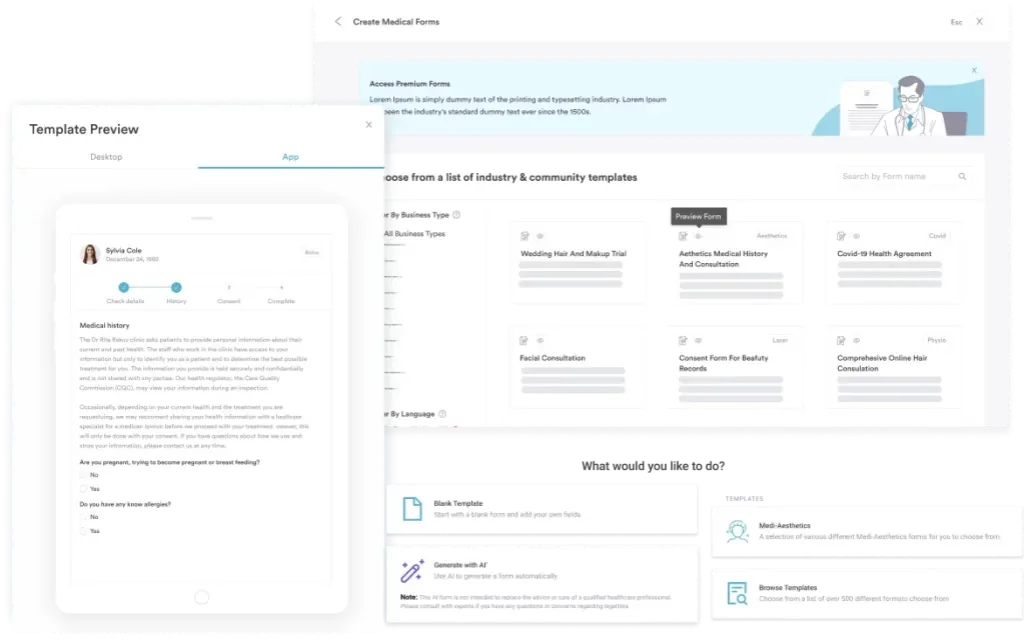
The follow-up plan does not need to be elaborate, but it must be specific. Documentation should name at least one concrete next step. Examples that meet the threshold:
“Patient counseled on depression” without a specific next step does not clearly satisfy the follow-up plan requirement for most payers.

Pabau’s digital forms and claims management tools help practices document depression screenings, follow-up plans, and billing codes in one connected workflow – so G8431 claims go out clean the first time.

Postpartum depression screening is one of the highest-volume use cases for HCPCS Code G8431. Under the CMS HCPCS system, the code can be reported during preventive visits, well-child encounters, and postpartum follow-up appointments when a maternal screen returns positive and a follow-up plan is documented.
OB/GYN and pediatric practices need to track both the mother and the newborn visit context carefully. G8431 reports the maternal screening result at a maternal or well-child visit. The EPDS is widely used in this population alongside the PHQ-9. For practices using OB/GYN practice software, embedding the EPDS as a structured intake form ensures the score and follow-up plan are captured together before the claim is submitted.
G8431 is billed alongside the primary CPT code for the visit. In a well-child visit context, the pediatrician is screening the mother at the child’s appointment – a common model supported by the American Academy of Pediatrics (AAP). The CPT code for the well-child visit (e.g., 99391-99396) appears as the primary code. G8431 appears as an additional HCPCS code on the same claim line or as a supplemental service, depending on payer claim format requirements.
In a direct postpartum visit for the mother, G8431 is billed alongside the appropriate evaluation and management (E/M) CPT code for that visit. The billing flow for mental health practices conducting routine depression screening during intake follows the same logic. The E/M or psychiatric diagnostic code is the primary, and G8431 supplements it when screening was positive and a plan was documented.
Frequency limits for G8431 reporting depend on payer policy and the program context. Some Medicaid managed care plans allow reporting at multiple well-child visits during the first year postpartum. Verify the specific policy with each payer rather than applying a blanket rule. Connecticut’s state Medicaid plan added G8431 as a covered procedure code effective July 1, 2022, per official state SPA documentation. Other state Medicaid programs have their own effective dates and frequency parameters.
Quality Measure 134 under the CMS Quality Payment Program (QPP) is titled “Screening for Depression and Follow-Up Plan.” G8431 is designated as a Performance Met code for this measure. Each qualifying claim submitted with G8431 counts toward the measure’s performance rate for the reporting period.
Eligible clinicians who meet the QPP reporting threshold submit G8431 (or G8510 for negative screens) alongside the primary CPT code on Medicare Part B claims. CMS aggregates these claims across the performance period to calculate the provider’s rate for Measure 134. No separate registry submission is needed for claims-based reporting. The HCPCS code on the claim is the report.
Key practice requirements for MIPS 134 compliance via G8431:
Maintaining compliance management tools that track MIPS measure reporting across your patient panel helps identify gaps before the performance period closes. A practice running 400 qualifying Medicare encounters per quarter needs a reliable way to confirm that every positive screen has a G8431 on the claim, rather than uncovering the gaps in a retrospective audit at year-end.
Run a quarterly G8431 vs G8510 claims audit against your MIPS eligible patient list. If the ratio of G8431 to total depression screening claims is unusually low given your population, investigate whether positive screens are being billed without the HCPCS code appended.
G8431 is a HCPCS procedural code. It reports that a screening occurred and what the result was. The ICD-10-CM diagnosis code paired with the claim reflects the patient’s clinical condition or the reason for the visit, not the screening result itself. Pairings must be clinically appropriate and payer-accepted.
Common ICD-10-CM codes used alongside G8431:
The Z13.89 code is frequently appropriate when the screen is part of routine preventive care and the provider is not yet establishing a definitive depression diagnosis at this visit. For practices managing overlapping anxiety diagnosis coding, note that anxiety and depression codes — along with other documented behavioral-health conditions a screen may surface, such as a brief psychotic disorder (F23) or an unspecified dissociative and conversion disorder (F44.9) — can appear on the same claim when each condition is documented and addressed during the encounter.
A positive depression screening does not, by itself, change the diagnosis code. When the screen is positive but the clinician has not yet established a formal diagnosis, code the encounter with a screening Z-code (Z13.31, or Z13.32 for maternal screening) rather than an F-code. Assign an F-code such as F32.9 or F33.9 only once the documentation supports a diagnosis, and code any coexisting condition that shapes how the screen is interpreted . Pair the ICD-10 code to the reason for the visit, not to the fact that the screen came back positive.
Always verify ICD-10-CM pairing acceptability with your specific payer’s LCD (Local Coverage Determination) or NCD (National Coverage Determination) before submitting. The codes above reflect common clinical and coding guidance but do not substitute for payer-specific verification.
Reimbursement for HCPCS Code G8431 varies by payer. Medicare may or may not reimburse separately for this code. It depends on the carrier, the MAC (Medicare Administrative Contractor) jurisdiction, and whether the service is bundled with the primary visit. Never assume reimbursement without checking the current CMS Physician Fee Schedule for your geographic locality.
Per BCBS New Mexico provider training materials, an additional $10 reimbursement was available for G8431 and G8510 when submitted alongside the qualifying CPT code for the depression screening visit. Fee schedule amounts change annually. Verify the current amount with BCBS NM directly before relying on this figure.
Coverage and reimbursement for G8431 under Medicaid managed care plans is state- and plan-specific. Connecticut added G8431 as a covered procedure code under its state Medicaid plan effective July 1, 2022. California’s Medi-Cal program allows G8431 with the optional HD modifier. Always verify your state’s Medicaid fee schedule directly with your managed care organization (MCO) or state Medicaid agency.
Common denial reasons for G8431 and how to address them:
Using claims management software that validates HCPCS codes against documentation at the point of submission catches these errors before the claim leaves the practice. An automated billing workflow that flags encounters with a positive PHQ-9 score but no G8431 on the draft claim prevents the most common denial scenario entirely.
A step-by-step workflow reduces errors and keeps screening programs running smoothly across a multi-provider practice.
For practices using psychiatry practice management software, embedding this workflow into the electronic health record (EHR) as a triggered checklist reduces billing errors. The checklist activates whenever a PHQ-9 score lands above threshold. Pediatric practices with high well-child visit volumes can configure similar triggers for the PHQ-A and EPDS at maternal screening encounters. Standardized medical forms aligned to each screening tool support consistent documentation across all providers in a group.
Depression screening is a high-volume, high-impact service. HCPCS Code G8431 is only billable when both the positive result and the follow-up plan are captured in the chart. Most claim denials trace back to incomplete documentation, not coding errors. Getting the documentation right at the point of care is faster than appealing a denial after the fact.
Pabau’s claims management tools and structured digital forms help practices document G8431 encounters accurately. They flag missing follow-up plans before submission, and track MIPS Measure 134 compliance across the full patient panel. See how Pabau can streamline your depression screening billing workflow – book a demo.

Looking for the code for adult tetanus? Other Tetanus coding guide This guide covers code A35 for adult tetanus cases, distinct from the neonatal and obstetrical codes.
Coding a different sexually transmitted infection? Chancroid diagnosis and billing guide This guide covers the billable code for chancroid, a sexually transmitted infection causing painful genital ulcers.
Need the code for a related STI diagnosis? Granuloma inguinale coding guide This guide covers the clinical definition, diagnostic criteria, and documentation practices for granuloma inguinale, also known as donovanosis.
Coding an STD that isn’t confirmed yet? Unspecified STD coding guide This guide explains when to use the unspecified STD code, and the audit risk it carries.
G8431 is a Level II HCPCS code that reports a positive depression screening with a documented follow-up plan. It is valid for 2026.
Use G8431 for a positive result with a documented follow-up plan; use G8510 for a negative result. Both satisfy MIPS Quality Measure 134 as Performance Met codes.
It depends on the payer. Medi-Cal allows HD but does not require it. EmblemHealth requires HD for positive maternal screens. Medicare Part B has no blanket HD requirement. Verify with each payer before billing.
Document a specific next step on the same date of service — a referral, medication initiation, return appointment, or crisis resource. A vague note that the patient “was counseled” is not sufficient.
G8431 is the Performance Met code for MIPS Measure 134. Submitting it on a qualifying Medicare Part B claim counts toward your performance rate — no separate registry submission required.
Yes. Its full descriptor is: “Screening for depression is documented as being positive and a follow-up plan is documented.”
It is a HCPCS Level II code, not a CPT Category I procedure code, even though it is frequently searched as the “G8431 CPT code.” These quality G-codes behave like the older CPT Category II performance measurement codes, which is where the confusion starts. You will find it listed in the HCPCS Level II set.
96127 is the billable service line for administering a standardized screening instrument. G8431 and G8510 are the reporting-only MIPS codes for the outcome: positive with a follow-up plan, or negative. Some payers now require one of these result codes to accompany 96127 on a depression screening claim.
Yes. Report it when the screen and the follow-up plan both happen during a synchronous audio-video visit and the note captures the tool, the positive result, and the plan. Add whatever telehealth modifier your payer requires, such as modifier 95.