CPT Code 98981: RTM Treatment Management Billing Guide
CPT code 98981: Definition and official descriptor CPT code 98981 is an add-on c...

Last Updated: Nov 9, 2026
E0373 is the HCPCS Level II code for a nonpowered advanced pressure reducing mattress. It is a Group 2 support surface that replaces the existing mattress and sits on the bed frame, with no pump or blower.
Medicare covers it only for serious pressure ulcers on the trunk or pelvis. That means large or multiple stage 3 or 4 ulcers, failed stage 2 care, or a recent flap or graft. Each claim needs prior authorization, a PDAC listing, and a KX, GA or GZ modifier.
Let Pabau's smart automation suggest the right codes, reduce claim denials, and keep your practice compliant—effortlessly.
Automate repetitive tasks and focus on what matters most—your patients.
Reduce coding errors and ensure compliance with the latest regulations.
Clean claims, fewer denials, and faster reimbursements.
Powerful insights and reporting to help your practice thrive.
HIPAA compliant SOC 2 certified GDPR-compliant Trusted by 4,000+ clinics worldwide

HCPCS Code E0373 is a nonpowered advanced pressure-reducing mattress, a Group 2 support surface that replaces the existing mattress instead of overlaying it.
Medicare covers E0373 under LCD L33642 only when the patient meets one of three Group 2 criteria built around trunk or pelvic pressure ulcers.
E0373 has been on the CMS Required Prior Authorization List nationwide since October 21, 2019, so request prior authorization before delivery.
Only products listed under E0373 on the PDAC Product Classification List may be billed with this code.
E0373 is billed as a capped rental with RR and a KH, KI or KJ modifier, plus KX when the LCD criteria are met.
HCPCS Code E0373 describes a nonpowered advanced pressure reducing mattress. It is a full mattress replacement that can be placed directly on a hospital bed frame. It sits in the Group 2 tier of pressure reducing support surfaces, which Medicare reserves for patients with serious pressure ulcers.
The code is part of the HCPCS Level II system, and Policy Article A52490 sets the product characteristics. An E0373 mattress uses cells whose height and design give significantly more pressure reduction than a Group 1 mattress and prevent bottoming out.
Its total height is 5 inches or greater, and its surface is designed to reduce friction and shear. The manufacturer also needs documented evidence that the product works for the conditions in the Group 2 coverage criteria. Heavy duty and bariatric versions are included in E0373.
E0373 covers a nonpowered mattress that takes the place of the patient’s existing mattress and meets the A52490 specifications. Several products that look similar in a supplier catalog bill under other codes.
Two questions settle most coding decisions in this group, and the grid below maps the four answers. Does the product replace the mattress or sit on top of it? And does it run on a pump or blower?
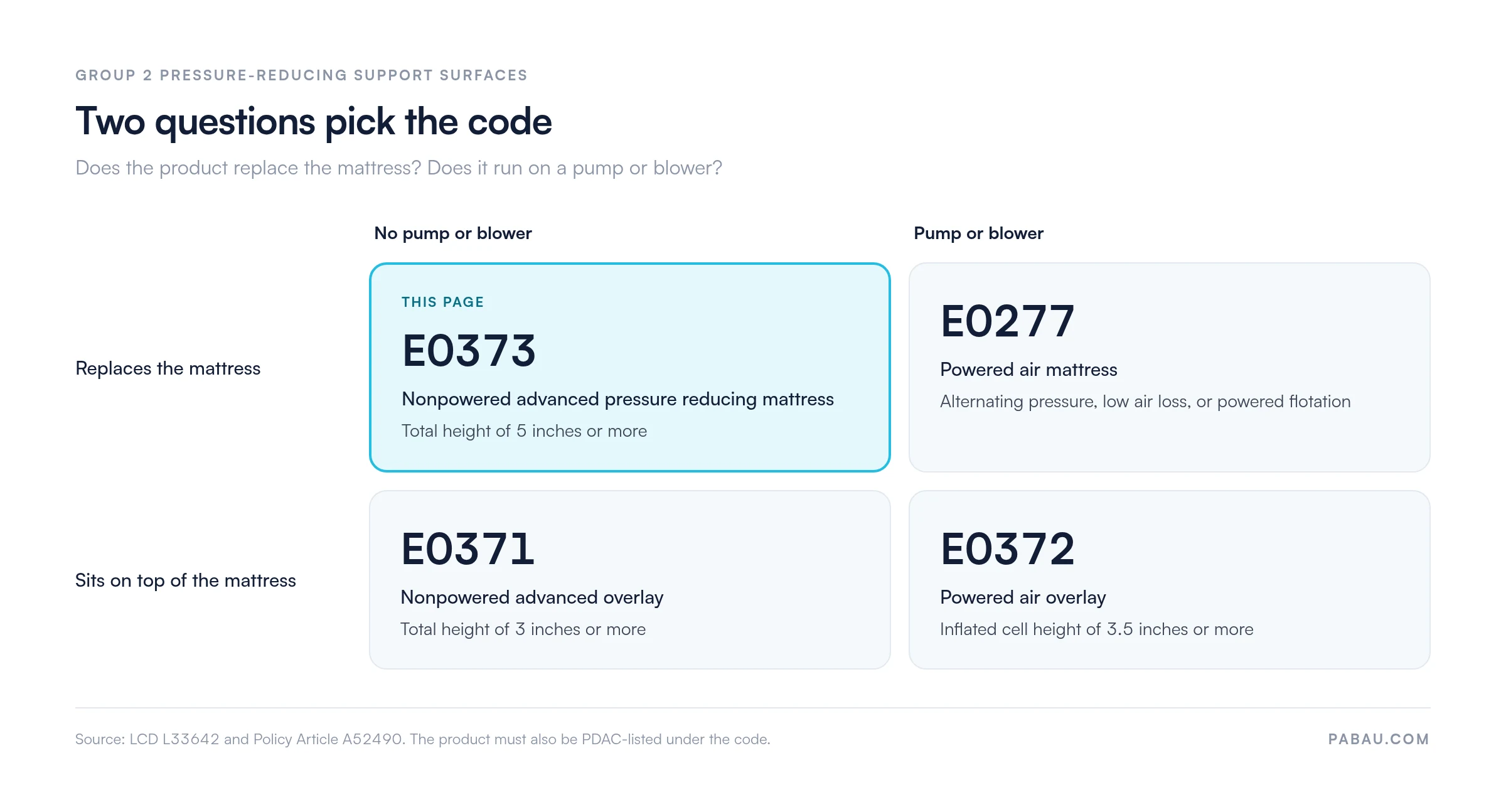
The most common miscoding is billing E0373 for a nonpowered overlay that sits on top of the existing mattress. That product is E0371, and its PDAC listing will say so.
A second error is reaching for E0372 because it sits next to E0373 in the code list. E0372 is a powered air overlay, so it never describes a nonpowered mattress. Check the product against the PDAC Product Classification List before you choose a code.
Medicare covers E0373 when the patient meets at least one of three criteria in LCD L33642, Pressure Reducing Support Surfaces, Group 2.
The comprehensive program in the first criterion has six required parts:
After a flap or graft, coverage is generally limited to 60 days from the date of surgery. Otherwise, continued use is covered until the ulcer heals.
If healing stalls, the record must show the care plan is being modified, or that the surface is still reasonable and necessary for wound management. Ulcers on the heels, elbows, or other sites outside the trunk and pelvis do not meet the Group 2 criteria.
Read LCD L33642 and Policy Article A52490 together. The LCD carries the clinical criteria, while the Policy Article holds the product specifications, the modifier rules, and the covered ICD-10 code list.
Policy Article A52490 lists the covered diagnoses, and each one is an L89 pressure ulcer code for the back, sacral region, hip, or buttock. The table shows examples, and the Policy Article’s full list controls what the DME MAC accepts.
The list has no codes for heel, elbow, or other sites outside the trunk and pelvis. Risk-factor codes such as paraplegia or cachexia do not qualify on their own either. Group 2 coverage turns on an existing ulcer or a recent flap or graft.
E0373 claims need no certificate of medical necessity. They rest on a standard written order and medical records that show the patient meets LCD L33642. Good DME billing compliance starts with this file:
The LCD asks suppliers to keep these records available on request rather than sending them with the claim. Stay in contact with the wound care clinician, so the KX modifier keeps matching the patient’s condition each rental month.
E0373 needs prior authorization before delivery. It is on the CMS Required Prior Authorization List with the other Group 2 support surfaces, nationwide since October 21, 2019.
Check the current list before each delivery. CMS updates it through Federal Register notices, most recently in July 2026.
E0373 claims follow the standard DME MAC workflow, with prior authorization added before delivery. Finish each step before starting the next.
The rental month modifiers mark where the claim falls in the rental period. KH is the first month, KI covers months two and three, and KJ covers months four through 13.
Add KX only when every LCD criterion is met and documented. Otherwise use GA with a valid Advance Beneficiary Notice, or GZ without one. Lines billed without KX, GA, or GZ are rejected as missing information.
E0373 is paid as a capped rental under the DMEPOS fee schedule. Every E0373 row in the October 2026 file carries the RR modifier and the capped rental payment category.
Find the monthly allowable for the patient’s state in the CMS DMEPOS fee schedule files. Points that affect the amount:
E0373 claims fail for predictable reasons. Tracking them through denial management workflows cuts write-offs and shortens the revenue cycle.
Understanding denial codes in medical billing helps your team triage remittance advice faster. It also shows which claims are worth appealing and which to correct and resubmit.
Audit your E0373 claims every quarter. Group denials by reason and look for a shared cause, such as one product model or one referring practitioner. One fix at intake prevents dozens of individual denials.
Only products with a written coding verification review from the PDAC contractor may be billed as E0373 or E0371. The product must also appear on the published Product Classification List. A product missing from the list for that code is denied as incorrect coding.
The coding verification lookup tool from CGS and the PDAC website are the two places to confirm a product’s classification. Use them in this order:
An E0373 claim depends on work done by several people before delivery. Wound notes, the written order, and the prior authorization request all have to line up. After delivery, each rental month bills as its own claim line.
Pabau, the practice management and billing platform we build, keeps notes, forms, and invoices on one patient record. Its claims management software helps track claim submission and remittance status, so your team sees which rental months have paid.
Your billers still choose the codes and assemble the documentation. Pabau makes a denied month visible early, so the correction goes out while the claim is still easy to fix.

Pabau’s claims management software helps track claim submission and remittance status, so your team spots a denied rental month early. Notes and forms stay on the same patient record.

The code decision on E0373 comes down to two physical facts. The product has to replace the mattress, and it has to work without a pump. A product on top of the mattress is E0371, and one with a blower is E0372 or E0277.
After that, payment depends on work finished before delivery. That means a qualifying trunk or pelvic ulcer, a standard written order, a PDAC listing, and a provisional affirmation. Build those checks into intake, and the rental months bill cleanly.
Book a demo to see how Pabau helps your billing team follow E0373 claims from submission to remittance.

Need a broader grounding in DME billing rules? What is medical billing explains the end-to-end claims process that underpins every HCPCS code submission.
Trying to reduce your overall denial rate? Submitting a clean claim covers the pre-submission checks that prevent the most common DME MAC rejections.
Building a denial management workflow? Denial management in healthcare outlines how to triage, appeal, and prevent recurring claim failures across your billing team.
E0373 covers a nonpowered advanced pressure reducing mattress. It is a Group 2 support surface that replaces the existing mattress and sits directly on the bed frame. Its total height is 5 inches or more. Overlays bill under E0371 or E0372 instead.
Both are nonpowered Group 2 support surfaces. E0373 is a full mattress replacement with a total height of 5 inches or more. E0371 is an overlay placed on top of an existing mattress, with a total height of 3 inches or more.
Yes. E0373 has been on the CMS Required Prior Authorization List nationwide since October 21, 2019, with the other Group 2 support surfaces. Request a provisional affirmation from the DME MAC before delivery. The decision is valid for one month.
Policy Article A52490 lists L89 pressure ulcer codes for the back, sacral region, hip, and buttock. The patient must also meet one of the three Group 2 criteria in LCD L33642. Ulcers on the heels or elbows do not qualify.
No. E0373 claims rest on a standard written order and medical records that show the patient meets LCD L33642. Keep the records on file and available on request, rather than sending them with the claim.
E0373 is a capped rental item billed with the RR modifier and a KH, KI, or KJ rental month modifier. Add KX when the LCD criteria are met. The monthly allowable varies by state, so check the current DMEPOS fee schedule file.