CPT code 57283: Uterosacral ligament suspension billing guide
CPT code 57283: Official descriptor and procedure overview CPT code 57283 descri...

Last Updated: Oct 15, 2026
E0372 is the HCPCS Level II code for a powered air overlay for mattress, standard mattress length and width. The overlay has its own pump or blower and sits on top of the patient's existing mattress.
Medicare classes E0372 as a Group 2 support surface under LCD L33642, billed as a capped rental. Timing decides the claim. An affirmed prior authorization has to arrive before delivery, or the rental is denied. Getting paid then depends on the coverage criteria, the right ICD-10 codes and a modifier that matches each rental month.
Let Pabau's smart automation suggest the right codes, reduce claim denials, and keep your practice compliant—effortlessly.
Automate repetitive tasks and focus on what matters most—your patients.
Reduce coding errors and ensure compliance with the latest regulations.
Clean claims, fewer denials, and faster reimbursements.
Powerful insights and reporting to help your practice thrive.
HIPAA compliant SOC 2 certified GDPR-compliant Trusted by 4,000+ clinics worldwide

HCPCS code E0372 is a powered air overlay for mattress, standard mattress length and width, placed on top of the patient’s existing mattress.
Medicare classes E0372 as a Group 2 support surface under LCD L33642, and prior authorization has been required nationwide since October 21, 2019.
Coverage needs one of three Group 2 criteria, each tied to pressure ulcers on the trunk or pelvis or a recent flap or graft.
E0372 is a capped rental, so each monthly line carries RR, a KH, KI or KJ modifier, and KX, GA or GZ.
A powered mattress that replaces the existing one bills as E0277, while the nonpowered overlay and mattress bill as E0371 and E0373.
HCPCS code E0372 pays for a powered air overlay that sits on top of the patient’s existing mattress. The official descriptor from the Centers for Medicare and Medicaid Services (CMS) reads “powered air overlay for mattress, standard mattress length and width.”
The code sits in the E0100-E9999 range of Level II HCPCS codes, which Medicare uses for durable medical equipment. The overlay does not replace the mattress, and no bed frame is included.
Policy article A52490 lists four characteristics an E0372 overlay must have:
CMS places E0372 in Group 2 of the pressure reducing support surfaces, alongside E0193, E0277, E0371 and E0373.
Those four Group 2 neighbors are the codes E0372 gets confused with, so the next section separates them.
Three questions decide the code. Is the surface powered, does it sit on a mattress or replace one, and which group does it meet?
All five Group 2 codes share the same coverage criteria. So the choice turns on the product, not on the stage of the ulcer. The matrix below places each code by power and placement.
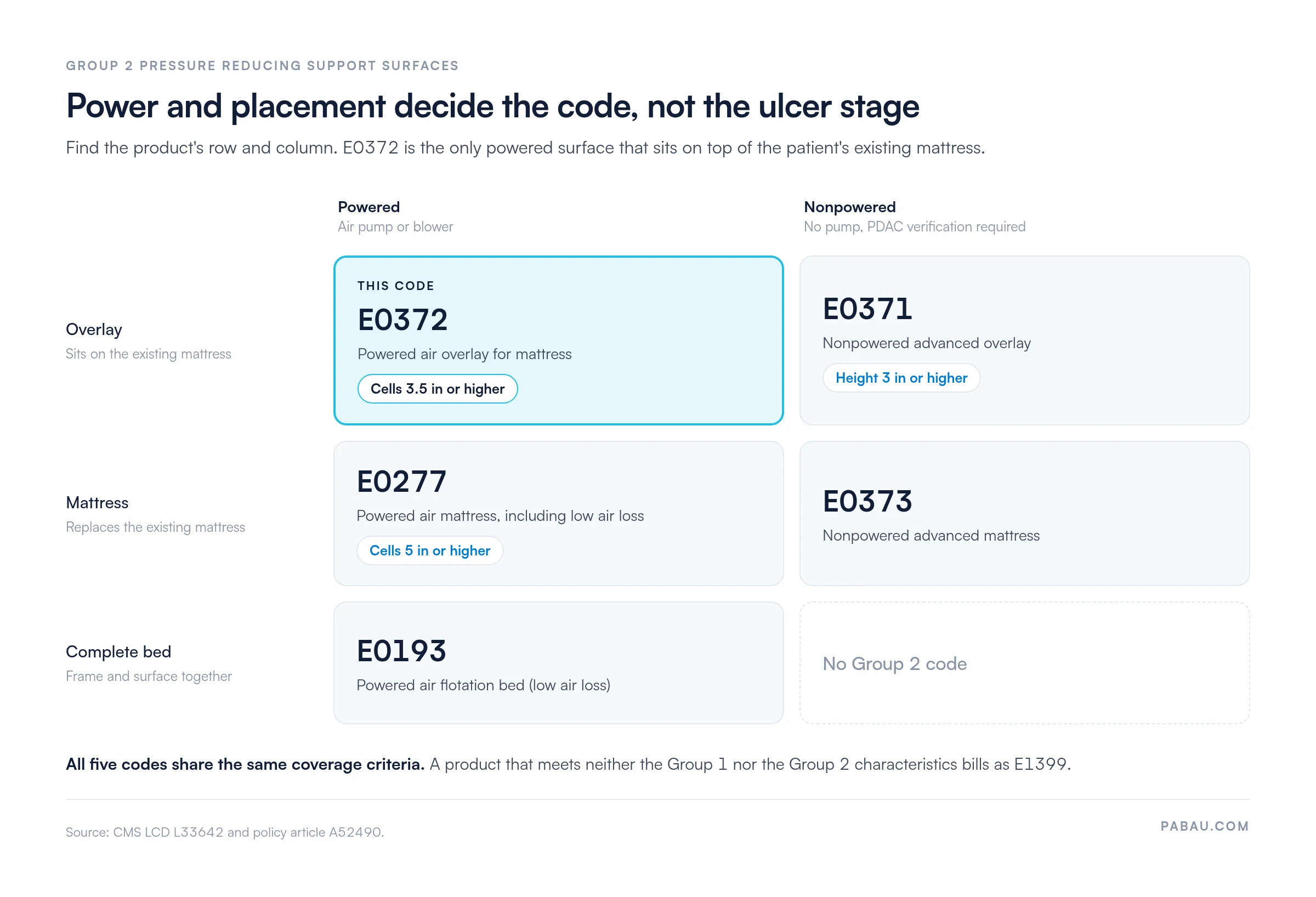
Cell height is the quickest check between the two powered surfaces. An E0372 overlay needs inflated cells of 3.5 inches or more, while an E0277 mattress needs cells of 5 inches or more.
Verification differs too. A52490 allows E0371 and E0373 only for products with a written coding verification review from the Pricing, Data Analysis and Coding (PDAC) contractor. A product that meets neither the Group 1 nor the Group 2 characteristics is billed as E1399, with the manufacturer and model on the claim.
Low air loss has no code of its own in this group. A complete low air loss bed bills as E0193, and a low air loss mattress bills as E0277.
Yes, E0372 needs prior authorization under Original Medicare, and the affirmed decision has to arrive before delivery. CMS added E0372 and the four other Group 2 codes to the Required Prior Authorization List in 2019.
The program began on July 22, 2019 in California, Indiana, New Jersey and North Carolina. It expanded to the remaining states and territories on October 21, 2019.
An affirmed decision for a support surface is valid for one month, according to CGS, a DME MAC. It comes with a unique tracking number (UTN), which goes on every rental claim for that overlay.
A claim without an affirmed decision and a matching UTN is denied. Medicare Advantage and commercial plans run their own authorization rules, so check each plan’s DME policy before delivery. Good medical billing compliance means applying each payer’s policy on its own terms.
LCD L33642 covers a Group 2 surface such as E0372 when the patient meets at least one of three criteria. The wound stage does not choose between E0371, E0372 and E0373, because all three share these criteria.
Criterion 1 is the only route that depends on a Group 1 trial. Its treatment program has six named parts, and the notes for that month need to show each one:
Coverage continues until the ulcer heals. If healing stalls, the notes must show the care plan being changed, or the surface still being needed for wound management.
Policy article A52490 lists 52 ICD-10-CM codes that support medical necessity for Group 2 surfaces. Each is an L89 pressure ulcer code for the back, sacral region, hip or buttock, coded as unstageable or stage 2, 3 or 4.
The codes left off the list matter just as much. None of these supports an E0372 claim on its own:
A quick example shows why the stage matters. A note reading “sacral pressure ulcer, stage 3” supports L89.153. A note that only says “sacral pressure ulcer” codes to L89.159, unspecified stage, which is not on the list.
Under prior authorization, the record has to be complete on the day the request goes out. Run through this checklist before the request, then again before each monthly claim:
Support surfaces do not use a Certificate of Medical Necessity (CMN). The Standard Written Order and the medical record carry the evidence instead.
Suppliers of ordered DMEPOS items must keep this documentation for seven years from the date of service, under 42 CFR 424.516(f). CMS or a Medicare contractor can request access to it at any point in that period.
E0372 is billed as a monthly capped rental. Medicare pays up to 13 months of continuous rental, and title to the overlay then passes to the patient.
The capped rental rules come from section 1834(a)(7) of the Social Security Act. The monthly amounts are set by state on the DMEPOS fee schedule, so pull the current file before quoting a patient.
For a patient who meets the criteria, a full series moves like this:
The table below spells out when each modifier applies.
KX is the supplier’s statement that every Group 2 criterion is met. A52490 states that a line billed without KX, GA or GZ is rejected as missing information. That rejection typically carries CARC 4, the code for a missing or inconsistent modifier.
NU marks newly purchased equipment, so it does not belong on an E0372 rental line. Bill POS 12 when the patient is at home. During a covered Part A skilled nursing facility stay, the facility is paid for the equipment, so the DME MAC is not billed.
Store the UTN against the rental series, not against one claim. Every monthly E0372 claim in that series carries the same tracking number, so pull it from the patient record each month instead of retyping it.
Seven errors turn up again and again on E0372 claims. Each row pairs one with its cause and the check that prevents it.
Denied lines follow the standard Medicare appeal path, starting with a redetermination request within 120 days of the initial determination.
Submitting a clean claim each month is easier once these checks run on a schedule, rather than after a rejection. When one does slip through, a steady denial management routine spots the pattern before next month’s claim repeats it.
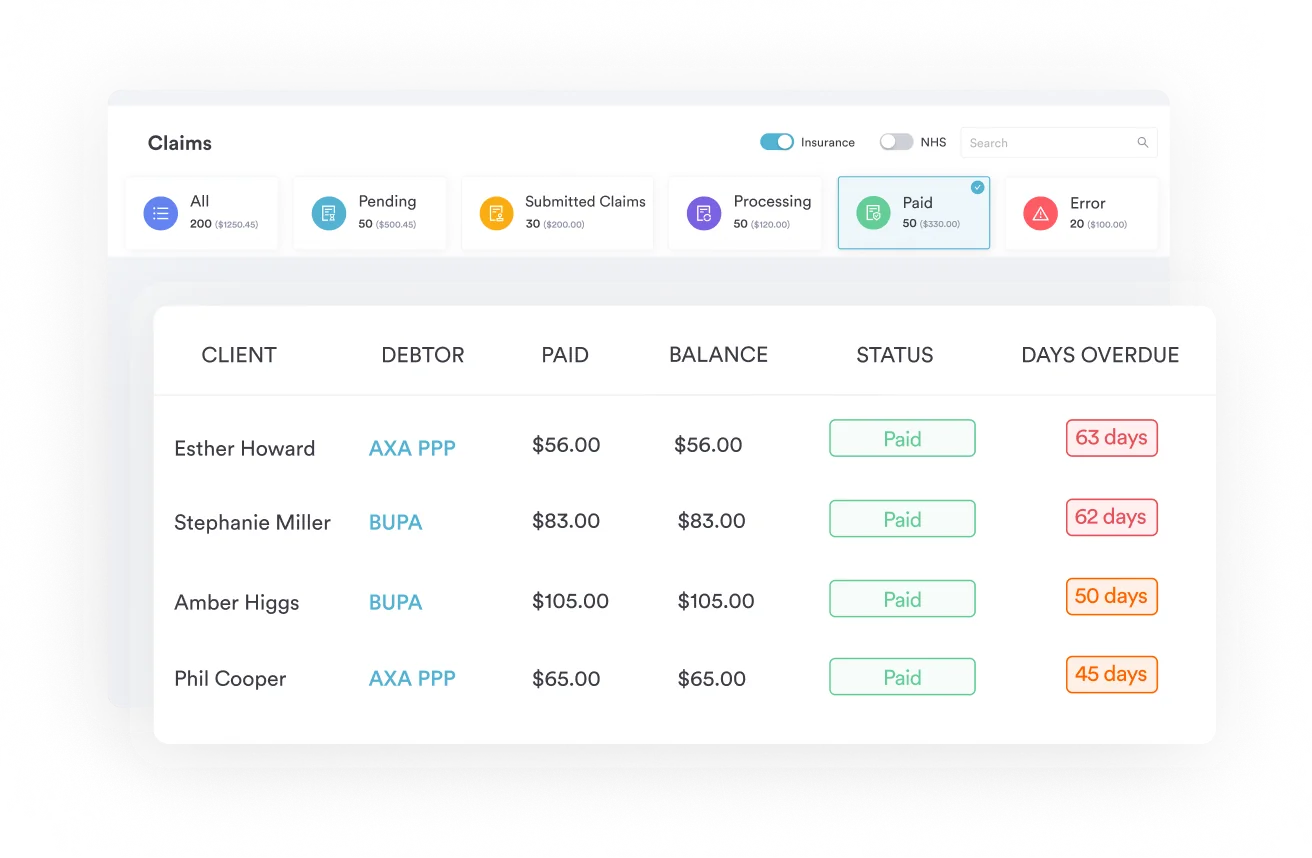
A Group 2 rental creates a new claim every month. Each one carries the same UTN and a changing modifier, and a rejected month can sit unnoticed when billing runs across separate tools.
Pabau, the practice management platform we build, keeps patient records and claims in one system. Its claims management software submits claims electronically, through Claim.MD in the US, and tracks each one until it is paid.
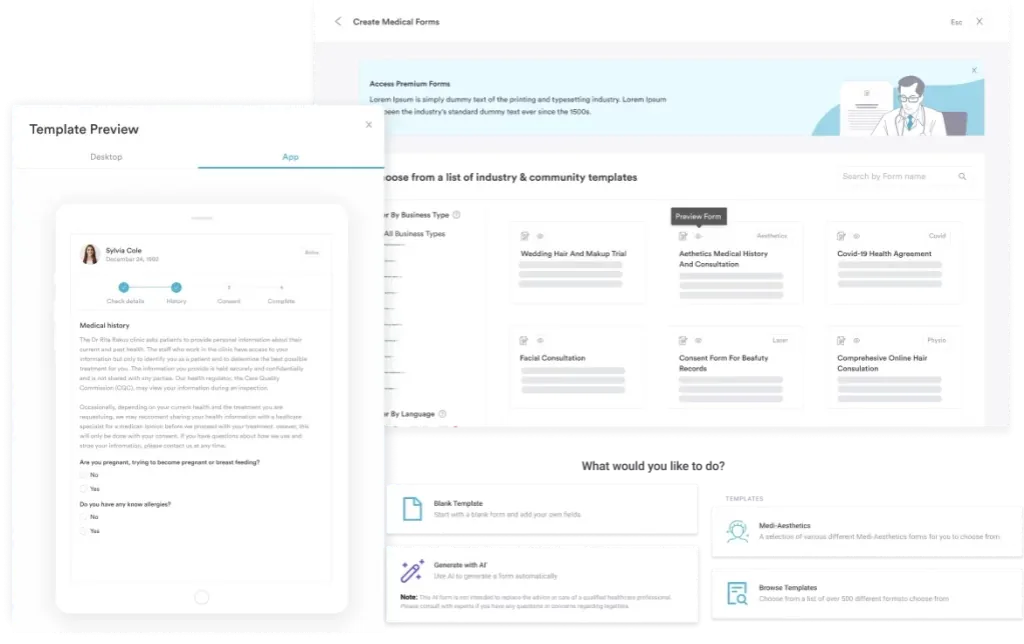
The treating practitioner’s notes carry the Group 2 evidence. Pabau’s digital forms record ulcer site, stage and size in a dated record stored against the patient file.
The outcome is fewer rental months lost to silence. Your billing team sees a rejection when it lands, fixes the line, and keeps the series paid through to month 13.

Pabau submits claims and tracks their status next to the patient record, so your team spots a rejected rental month the day it comes back.

E0372 claims are decided before the overlay arrives. Prior authorization moves the review to the front, so the record has to prove a Group 2 criterion on the day the request goes out.
The code choice deserves the same care. If the powered surface sits on the existing mattress, the code is E0372. If it replaces the mattress, the code is E0277, and the cell height in A52490 confirms which one you have.
Once the UTN arrives, the rental becomes routine, as long as each modifier follows its month. Book a demo to see how Pabau tracks each E0372 rental claim from month 1 to month 13.

Billing a powered mattress instead of an overlay? HCPCS code E0277 covers the Group 2 powered mattress that replaces the existing one.
Is the overlay nonpowered? HCPCS code E0371 explains the nonpowered advanced overlay and its PDAC verification rule.
Delivering a complete low air loss bed? HCPCS code E0193 covers the powered air flotation bed in the same Group 2 policy.
Is a Group 1 overlay enough for your patient? HCPCS code E0181 explains the powered alternating pressure overlay and the Group 1 policy behind it.
Need a guide to managing claim rejections? Denial management in healthcare covers how to track, appeal and prevent recurring claim denials.
Both are powered overlays, but they sit in different coverage groups. E0181 is a Group 1 alternating pressure pad with a pump. E0372 is a Group 2 air overlay with cells at least 3.5 inches high, so the patient must meet a Group 2 criterion.
Not under Medicare’s Group 2 policy. Each criterion needs existing stage 2, 3 or 4 ulcers on the trunk or pelvis, or a recent flap or graft. An at-risk patient without a qualifying ulcer is assessed against Group 1 instead.
E0372 is powered, with a pump or blower moving air through cells at least 3.5 inches high. E0371 is a nonpowered advanced overlay at least 3 inches high. Both are Group 2 and share the LCD L33642 criteria.
No. E0372 describes an overlay that sits on the existing mattress. A low air loss mattress that replaces it bills as E0277, and a complete low air loss bed bills as E0193.
The patient does. Medicare pays up to 13 months of continuous rental, and title then passes to the patient. If the ulcer heals sooner, coverage ends there.
No. Support surfaces do not use a CMN. The supplier needs a Standard Written Order, medical records that meet a Group 2 criterion and an affirmed prior authorization.