

CCSD code G5100: Bypass of duodenum billing guide
CCSD code G5100 bills a bypass that leaves the duodenum in place CCSD code G5100...

Last Updated: Oct 16, 2026
E0149 is the HCPCS Level II code for walker, heavy duty, wheeled, rigid or folding, any type.
The code is covered only when the beneficiary weighs more than 300 pounds and meets the standard walker coverage criteria under CMS LCD L33791. A claim billed for a beneficiary at or below 300 pounds is denied as not reasonable and necessary.
Let Pabau's smart automation suggest the right codes, reduce claim denials, and keep your practice compliant—effortlessly.
Automate repetitive tasks and focus on what matters most—your patients.
Reduce coding errors and ensure compliance with the latest regulations.
Clean claims, fewer denials, and faster reimbursements.
Powerful insights and reporting to help your practice thrive.
HIPAA compliant SOC 2 certified GDPR-compliant Trusted by 4,000+ clinics worldwide

HCPCS Code E0149 describes a walker, heavy duty, wheeled, rigid or folding, any type, covered by Medicare for patients who weigh more than 300 pounds.
Claims billed as E0149 when the beneficiary weighs 300 lbs or less are denied as not reasonable and necessary under CMS LCD L33791.
The KX modifier is required when supplier records confirm the beneficiary’s weight exceeds 300 lbs within one month of providing the walker; brakes issued at the same time are bundled and cannot be billed separately.
Pabau’s claims management software helps DME suppliers and physical therapy practices track documentation requirements and reduce E0149 denial rates.
The “heavy duty” designation signals this device is engineered for bariatric patients. Where a standard walker (E0130) or wheeled walker (E0141) supports patients up to approximately 300 lbs, the E0148 and E0149 codes apply above that threshold. The distinction between E0148 and E0149 is simple: E0148 is the non-wheeled version; E0149 is the wheeled version.
| HCPCS Code | Description | Wheels | Weight Limit |
|---|---|---|---|
| E0130 | Walker, rigid (pickup), without wheels | No | Standard (up to ~300 lbs) |
| E0141 | Walker, rigid, wheeled | Yes | Standard (up to ~300 lbs) |
| E0143 | Walker, folding, wheeled | Yes | Standard (up to ~300 lbs) |
| E0148 | Walker, heavy duty, without wheels | No | Over 300 lbs |
| E0149 | Walker, heavy duty, wheeled, rigid or folding, any type | Yes | Over 300 lbs |
Practices using claims management software can tag patient weight thresholds directly to the order record, reducing the chance of miscoding at the point of billing.
Two conditions must both be met before E0149 is covered. The beneficiary must meet the standard walker coverage criteria, and must weigh more than 300 lbs. Neither condition alone is sufficient.
Standard walker coverage under LCD L33791 requires that the patient has a mobility limitation that significantly impairs their ability to participate in activities of daily living, that the condition is expected to be of long or indefinite duration, and that no other less-costly device would adequately meet the patient’s needs.
The 300-lb weight threshold is absolute. If the beneficiary weighs exactly 300 lbs, E0149 does not apply. The claim must show weight greater than 300 lbs, documented within one month of the date the walker is provided.
Document the beneficiary’s weight in pounds and the date of measurement directly in the Standard Written Order and the supplier’s own records. A weight recorded two months before delivery does not satisfy the CMS one-month window under Policy Article A52503.
Commercial payers frequently follow Medicare LCD criteria but add their own prior authorization requirements. Several state Medicaid programs, including Connecticut’s Husky Health, require prior authorization for E0149 specifically. Suppliers should verify authorization requirements before delivery for every non-Medicare payer. Documentation practices aligned with LCD L33791 make prior authorization requests faster and more defensible.
Under California’s Medi-Cal program, E0149 is reimbursable as either purchase or rental, per the Medi-Cal DURA CD manual. This dual-path coverage matters for suppliers managing long-term DME rental inventory alongside outright sales.
Physical therapy and occupational therapy practices ordering walkers for bariatric patients benefit from integrated patient record management that links weight measurements to equipment orders. This creates a clear audit trail without manual re-entry across separate systems. If your practice also manages mobility assessments for post-surgical or chronic-condition patients, physical therapy practice management software can centralize those workflows in one platform.

Every E0149 claim requires a Standard Written Order (SWO) before the item is delivered. CMS and DME MACs enforce this requirement strictly. A verbal order or retrospective written order does not satisfy the SWO requirement.
The SWO is separate from the clinical notes that support medical necessity. Both must be present and consistent. A common audit finding is an SWO that lists the device but clinical notes that fail to document why a standard walker is insufficient for this specific patient.
The DME supplier must retain documentation showing the beneficiary’s weight, measured within one month of delivery, exceeds 300 lbs. This weight record triggers the KX modifier (see below). Without it, the claim is denied even if the SWO is complete.
Suppliers should also retain delivery confirmation (proof the item was received by the beneficiary), PDAC coding verification when applicable, and any prior authorization approvals from the payer. PDAC product classification confirms the correct HCPCS code for the device before billing.
Practices that have moved to digital intake and order forms reduce the risk of missing SWO elements by using structured templates that enforce required fields before submission. Linking form completion to the billing workflow means missing documentation surfaces before the claim goes out, not during an audit six months later. For a broader look at how paperless documentation reduces compliance risk.
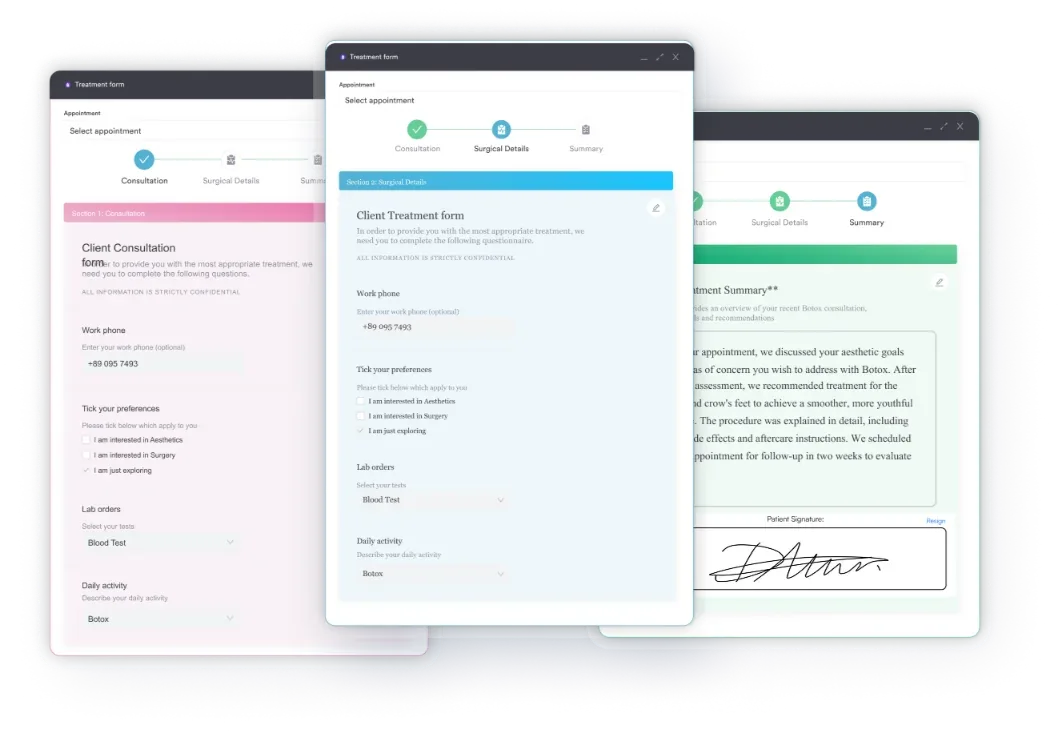

Pabau helps practices and DME suppliers link patient records, weight measurements, and signed orders in one place, so every E0149 claim goes out with complete supporting documentation.

Getting the modifier right is where most E0149 claims succeed or fail on appeal. CMS Policy Article A52503 defines four modifiers relevant to heavy-duty walker billing.
| Modifier | When to use | Effect on claim |
|---|---|---|
| KX | Supplier has documentation confirming beneficiary weight exceeds 300 lbs within one month of delivery | Claim processed for coverage determination |
| GA | Item is expected to be denied as not medically necessary; Advance Beneficiary Notice (ABN) on file | Claim denied; beneficiary may be billed |
| GY | Item is statutorily excluded from Medicare coverage | Claim denied; beneficiary may be billed |
| GZ | Item expected to be denied as not medically necessary; no ABN on file | Claim denied; beneficiary cannot be billed |
The KX modifier is the most common and most consequential. Without it, a claim for E0149 will be denied even when the patient clearly meets the weight threshold. The modifier certifies that the supplier holds the weight documentation in their records at the time of billing.
If the weight documentation is borderline (for example, a weight of 298 lbs at the time of order, with the patient trending upward), do not add the KX modifier speculatively. Bill with the appropriate alternate modifier and document the clinical situation clearly. Speculative use of KX constitutes a false claim under federal statute.
Brakes provided at the initial issue of an E0149 are included in the reimbursement for the walker. Per Noridian Medicare and the PDAC advisory article, they may not be billed separately to the DME MAC or to the beneficiary. This is a hard unbundling rule with no exception for add-on accessories provided simultaneously with delivery.
If brakes are added after the initial issue, a separate billing may be appropriate under the applicable HCPCS code for walker accessories, subject to payer policy. Document the date of the initial delivery versus the date of the subsequent accessory addition clearly in the beneficiary file.
Medicare Part B reimburses E0149 at the fee schedule rate set by CMS, which is updated annually. Rates vary by geographic region based on the competitive bidding area (CBA) or non-competitive bidding area applicable to the supplier’s location. Suppliers should verify current rates against the published CMS DMEPOS fee schedule for their region before billing.
Medicare pays 80% of the approved amount after the Part B deductible. The beneficiary or their supplemental insurer is responsible for the remaining 20% coinsurance. For patient management workflows that track financial responsibility across payers, having a clear record of the payer breakdown at the point of order reduces collection friction downstream.
Selecting the wrong code from the walking aids range is the second most common E0149 error after modifier omission. The E0140-E0159 range includes standard walkers, wheeled walkers, bariatric versions, and combination devices, each with distinct coverage criteria.
For occupational therapy practices ordering mobility aids for rehabilitation patients, clear documentation of why the specific device type is necessary (not merely the most convenient option) is essential for both initial coverage and any subsequent appeal. See how occupational therapy practice management software can support equipment order documentation and patient progress tracking.
Never upcode a standard walker claim to E0149 to capture a higher fee schedule rate. CMS medical review and DME MAC audits cross-reference weight documentation against the billed code. Upcoding without supporting documentation constitutes fraud and triggers recoupment plus potential exclusion from Medicare.
Most E0149 denials fall into three categories. Understanding the pattern helps suppliers fix the documentation workflow rather than just re-submitting the same claim. Common claim denial codes repeat by specialty, so the pattern is worth reading before reworking.
Appeals for E0149 denials should include the complete SWO, the dated weight measurement, clinical notes establishing medical necessity, and the treating practitioner’s attestation. Most DME MAC redeterminations succeed when the record was complete at the time of service but simply not transmitted with the original claim. An appeal filed after the timely filing window is denied on timeliness alone, whatever the coding showed.
For practices managing high claim volumes. Strong HIPAA-compliant medical record management also ensures appeal documentation can be retrieved and transmitted quickly without risking protected health information.
HCPCS Code E0149 is straightforward in principle but requires precise execution at every step: documented weight above 300 lbs, a compliant SWO, the KX modifier, and no separate billing for brakes issued on delivery day. Most denials stem from process failures, not clinical ones.
Pabau’s claims management software helps DME suppliers and multi-specialty practices build those process controls directly into the documentation workflow, so E0149 claims go out complete the first time. To see how Pabau handles DME billing documentation, book a demo with the team.

Billing an additional needle biopsy lesion? CPT code 10004 covers the add-on code billed with 10021 for each extra FNA lesion.
Billing an ultrasound-guided needle biopsy? CPT code 10005 covers fine needle aspiration biopsy with ultrasound guidance for the first lesion.
Billing intralesional injections for several lesions? CPT code 11900 covers intralesional injections for up to seven lesions in dermatology and podiatry visits.
HCPCS Code E0149 is used to bill for a heavy-duty wheeled walker, rigid or folding, any type, prescribed for patients who weigh more than 300 pounds and meet Medicare’s standard walker coverage criteria under LCD L33791. It is a Level II HCPCS code maintained by CMS and applies to Medicare Part B and most state Medicaid DME programs.
E0148 is the heavy-duty walker without wheels; E0149 is the heavy-duty walker with wheels. Both require the same 300-lb weight threshold and the KX modifier. The choice depends on the treating practitioner’s clinical determination of whether a wheeled or non-wheeled design is medically appropriate for the specific patient.
Add the KX modifier when the supplier holds documentation confirming the beneficiary’s weight exceeds 300 lbs, measured within one month of the date the walker is delivered. Without KX, the claim will be denied even when the patient clearly meets the weight criterion. Never add KX without the supporting weight record in the supplier file.
Medicare Part B does not require prior authorization for E0149 under current policy, but suppliers must have the SWO and weight documentation before delivery. Several state Medicaid programs, including Connecticut’s Husky Health, do require prior authorization. Always verify the payer’s specific requirements before providing the equipment.
No. Brakes provided at the initial issue of an E0149 are included in the walker’s reimbursement and cannot be billed separately to the DME MAC or the beneficiary, per Noridian Medicare and PDAC advisory guidance. Separate billing of brakes on the same date as initial walker delivery is subject to automatic denial and overpayment recovery.
Medicare Part B reimbursement for E0149 varies by geographic area and is updated annually by CMS through the fee schedule. Suppliers should verify the current allowable for their competitive bidding area using the AAPC Codify HCPCS lookup or CMS Physician Fee Schedule search. Medicare pays 80% of the approved amount after the Part B deductible.



