

HCPCS code E0198: Water pressure pad billing guide
HCPCS code E0198 is a water pad for a standard mattress HCPCS code E0198 is the ...

Last Updated: Oct 13, 2026
E0154 is the HCPCS Level II code for platform attachment, walker, each.
The descriptor "each" means the code is billed per attachment unit. If a patient receives a platform attachment on each side of the walker, bill two units of E0154 rather than one. Suppliers lose money on this detail more often than they overbill on it.
A platform attachment is not a handle grip. It supports the forearm in a padded trough, shifting weight-bearing from the hand and wrist to the forearm. That makes it the indicated accessory when a patient has grip weakness, arthritis, or post-surgical limits that rule out a standard walker.
Let Pabau's smart automation suggest the right codes, reduce claim denials, and keep your practice compliant—effortlessly.
Automate repetitive tasks and focus on what matters most—your patients.
Reduce coding errors and ensure compliance with the latest regulations.
Clean claims, fewer denials, and faster reimbursements.
Powerful insights and reporting to help your practice thrive.
HIPAA compliant SOC 2 certified GDPR-compliant Trusted by 4,000+ clinics worldwide

HCPCS code E0154 covers a walker platform attachment, a padded forearm trough that is billed per unit as durable medical equipment.
Medicare Part B covers E0154 when a physician documents that the beneficiary cannot grip a standard walker because of upper extremity impairment.
A Standard Written Order must reach the supplier before the claim is submitted, and the governing policy is the walkers LCD, L33791.
Missing the SWO, billing without DMEPOS enrollment, or confusing E0154 with the E0156 seat attachment are the top denial triggers.
Practice management software like Pabau keeps notes, forms, and signed orders in one patient record, so DME claims arrive fully supported.
Medicare reimburses E0154 under the DMEPOS fee schedule, which CMS updates every year. Rates vary by Medicare Administrative Contractor (MAC) jurisdiction, and by whether the supplier sits in a competitive bidding area (CBA). Suppliers in a CBA are paid the competitively bid rate, which is usually lower. Everyone else is paid the standard national allowable.
For exact 2026 figures, check the current fee schedule file rather than a third-party listing. The CMS DMEPOS fee schedule carries the allowed amount for each jurisdiction. The table below sets out the components that decide what you are paid.
Medicaid rates for E0154 vary by state. Some programs cover walker platform attachments outright. Others exclude walker accessories or require prior authorization first. Verify coverage with the state Medicaid agency before the equipment leaves your warehouse.
Medicare Part B covers E0154 as durable medical equipment only when the beneficiary meets specific clinical criteria. Meeting them supports a coverage determination. It does not guarantee payment.
The CMS Walkers policy article, A52503, governs coverage determinations for E0154. All of the following must be satisfied:
The beneficiary also has to be able to use the walker safely, since Medicare expects the equipment to serve a therapeutic purpose. Notes on patient compliance matter here. Coverage can be denied when the record suggests the equipment will sit unused.
Incomplete documentation drives most E0154 denials. Since January 2020 there has been one order type for DMEPOS items, the SWO. It replaced the old detailed written order and the certificate of medical necessity. The walkers LCD requires it in the supplier’s file before the claim goes out. Purpose-built clinical documentation software makes that record easier to assemble.
The documentation set for an E0154 claim includes all of the following:
When notes, orders, and delivery confirmations sit in one patient record, a post-payment review stops being a scramble. Our guide to medical forms covers how to build those workflows.
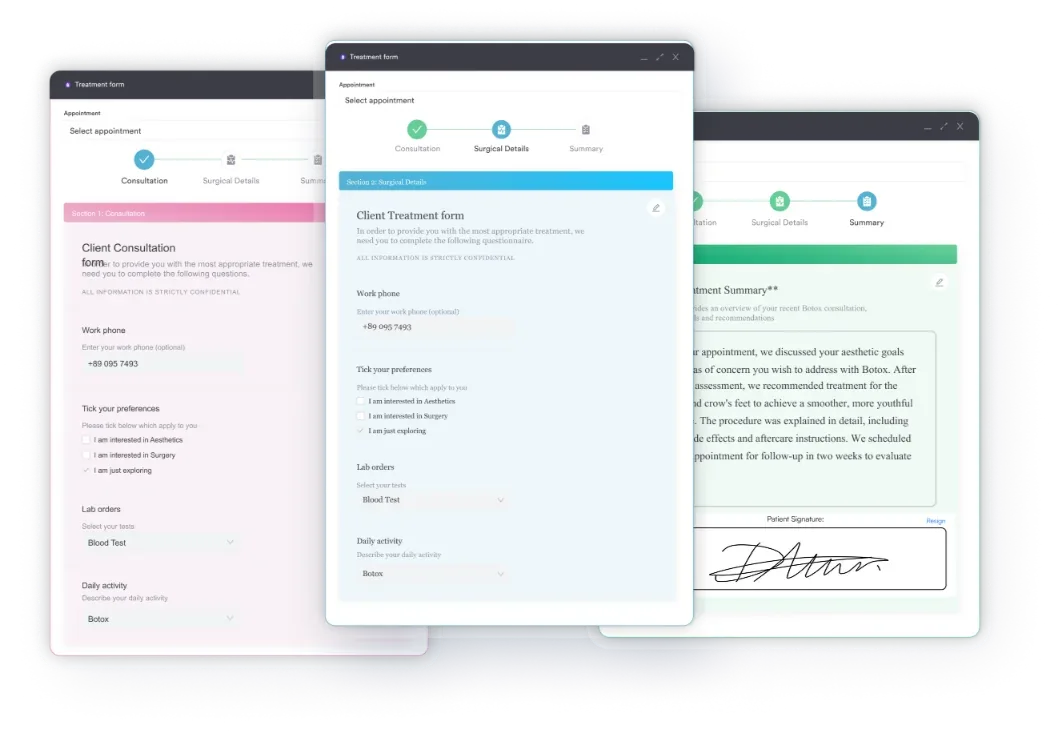
A patient management system reminds you when issued equipment is due for review, replacement, or return.
No ICD-10 code guarantees coverage for E0154. The codes below support the clinical picture that justifies a forearm platform. Whatever you submit has to match the diagnosis in the record. Coding a diagnosis the notes do not support is a compliance problem, not a clerical one.
Pick the most specific code the record actually supports. Submitting R26.89 on its own, with no upper extremity diagnosis behind it, invites review. The reviewer has to see why a forearm platform was warranted rather than a plain walker.
Document the specific functional limitation that rules out a standard walker grip. A line such as ‘unable to grip standard walker handles, bilateral hand arthritis, grip strength below 10 kg’ is auditable. It hands the MAC reviewer a concrete reason for the attachment. Generic ‘needs walker’ language is the fastest route to a medical necessity denial.
E0154 sits in the E0130 to E0160 walker series. Picking the wrong code is one of the most common DME billing errors. A seat, a leg extension, and a forearm platform each carry different coverage rules.
E0154 works in two directions, and the policy article says so explicitly. You can bill it as an accessory supplied with the initial walker issue. You can also bill it as a replacement component on a covered walker the beneficiary already owns.
Gait trainers are the other case worth knowing. They are billed using the walker codes, and where a gait trainer includes a feature described by E0154, that code may be billed separately. Other unique gait trainer features are not separately payable and belong under A9900.
E0154 and E0156 are the two walker attachment codes most often confused, and the clinical difference is easy to check. E0154 is a platform, so the patient rests a forearm in a padded trough and grips a vertical handle above it. Weight-bearing shifts to the forearm. E0156 is a seat that folds down for rest breaks, and the hands still carry the load while walking.
Billing one when the supplier delivered the other is an incorrect coding error, and it will be denied on review. The AAPC reference for HCPCS Level II codes is a quick cross-check once you know which attachment left the warehouse.
Under standard fee-for-service Part B, Medicare does not currently require prior authorization for E0154. CMS does run demonstration programs for certain DME items, and those can expand. Confirm the current position with your MAC rather than assuming.
Commercial payers vary widely. Some require prior authorization for any walker accessory, while others follow Medicare’s criteria with no pre-approval at all. Medicaid differs by state again, with some programs running an authorization process separate from the physician order. CGS Medicare guidance carries the jurisdiction-specific notes for suppliers billing through that MAC.
The denials below are the patterns DMEPOS suppliers actually hit on E0154 claims. Catching them before submission is cheaper than appealing them afterwards, and each one is visible in the file if somebody checks.
Structured records are what let a supplier answer a review request without a week of digging. The practice management software features worth having include a pre-submission checklist that flags a missing SWO, a mismatched diagnosis code, or lapsed enrollment.
Billing E0154 correctly comes down to the claim form details and the supplier-provider split. These guidelines apply to Medicare Part B submissions, and commercial rules can differ.
None of this works if the two halves of the file never meet. The ordering clinician’s record is the foundation the supplier’s claim rests on. That is why revenue cycle management for therapy practices starts in the treatment note rather than the billing screen.
The ordering side of an E0154 claim usually sits outside any billing system. A therapist writes the note, reception scans the order, and the supplier emails back for whatever is missing. Nobody checks that the note actually names the grip limitation.
Practice management software like Pabau holds that whole record in one patient file. Intake forms, consent, treatment notes, and the signed order sit together. The clinician documenting the impairment and the supplier billing the attachment are then reading the same file.
That is what pays off when a MAC asks for the record two years later. Charting templates prompt for the functional detail reviewers look for. You spend less time rebuilding paperwork and more time with patients.

Pabau brings clinical notes, digital forms, and claims into a single patient record for physical and occupational therapy practices. Your DME orders reach the supplier with the medical necessity detail already in place.

E0154 claims fail at the documentation stage far more often than the coverage stage. The attachment is justified and the order exists, but the note never explains why a standard grip would not work.
So treat the wording of the clinical note as part of the billable work. A note that records measured grip strength and a named diagnosis survives review. One that says “needs walker” will not, however obvious the need was in the room.
Get the record right the first time and the payment follows without a second submission. Book a demo to see how Pabau keeps DME documentation and claims in one patient record.

Billing other home safety equipment? E0243 covers toilet rail claims, which follow the same order and proof of delivery rules.
Supplying equipment for the bedroom as well? E0310 sets out full length bed side rail coverage and the documentation a MAC expects.
Quoting a hospital bed alongside mobility aids? E0291 explains fixed height bed billing and how the rental rules work.
Billing a same-visit implant exchange? CPT code 11983 covers billing a Nexplanon removal and reinsertion performed at the same visit.
Adding accessories to a bed rather than a walker? E0274 covers over-bed tables and where they sit in Medicare DME coverage.
HCPCS code E0154 is the billing code for a platform attachment, walker, each. It is an HCPCS Level II code for durable medical equipment. Enrolled DMEPOS suppliers use it to bill Medicare Part B and other payers for a forearm trough fitted to a walker. The code is billed per unit supplied.
The 2026 rate for E0154 varies by MAC jurisdiction and by whether the supplier sits in a competitive bidding area. CMS publishes the annual DMEPOS fee schedule file, which carries the allowed amount for each jurisdiction. Medicare then pays 80% of that amount once the Part B deductible is met, leaving the beneficiary 20% coinsurance.
An E0154 claim needs a Standard Written Order (SWO) in the supplier’s file before the claim is submitted. It also needs clinical notes describing the upper extremity impairment, proof of delivery signed by the beneficiary, and evidence of DMEPOS enrollment. Everything must be available if the MAC requests the file.
E0154 is a platform attachment, so the patient bears weight through the forearm rather than the hand. E0156 is a seat attachment that folds down for rest breaks, with standard hand grips still used for walking. They answer different functional needs and are not interchangeable. Submitting the wrong one is a common denial trigger.
Medicaid coverage for E0154 varies by state. Some programs cover walker platform attachments when they are medically necessary. Others exclude walker accessories altogether, or run a separate prior authorization process. Verify with the state Medicaid agency before you supply the equipment.
Standard Medicare fee-for-service Part B does not currently require prior authorization for E0154. CMS demonstration programs can add codes to the prior authorization list, so check the current position with your MAC. Commercial payers and state Medicaid programs may have prior authorization rules of their own.
Yes. The CMS walkers policy article allows E0154 as an accessory supplied with a new walker. It also allows it as a replacement component on a walker the beneficiary already owns. The medical necessity documentation still has to support the forearm platform.



