HCPCS Code L0472: Hyperextension TLSO billing guide
HCPCS code L0472: Official descriptor and device definition HCPCS code L0472 des...

Last Updated: Nov 5, 2026
E0113 is the HCPCS Level II code for crutch underarm, wood, adjustable or fixed, each, with pad, tip and handgrip. It describes one wooden axillary crutch, so a pair of wooden underarm crutches bills as E0112 instead.
Medicare covers E0113 under LCD L33733 as an inexpensive or routinely purchased item. The October 2026 DMEPOS fee schedule allows $25.61 to $30.13 for a new crutch in the contiguous states.
Let Pabau's smart automation suggest the right codes, reduce claim denials, and keep your practice compliant—effortlessly.
Automate repetitive tasks and focus on what matters most—your patients.
Reduce coding errors and ensure compliance with the latest regulations.
Clean claims, fewer denials, and faster reimbursements.
Powerful insights and reporting to help your practice thrive.
HIPAA compliant SOC 2 certified GDPR-compliant Trusted by 4,000+ clinics worldwide

HCPCS code E0113 describes one wooden underarm (axillary) crutch, including its pad, tip and handgrip.
A pair of wooden underarm crutches is E0112, and forearm (Lofstrand) crutches bill as E0110 or E0111.
Medicare covers E0113 under LCD L33733 when a mobility limitation impairs at least one mobility-related activity of daily living.
The October 2026 DMEPOS fee schedule allows $25.61 to $30.13 for a new E0113 purchase in the contiguous states.
E0113 needs no prior authorization and no KX modifier, but it does need a standard written order and proof of delivery.
HCPCS code E0113 is the Level II code for a single wooden underarm crutch. The official CMS descriptor reads “Crutch underarm, wood, adjustable or fixed, each, with pad, tip and handgrip.” It belongs to the E0110 to E0118 crutch codes, which follow the cane codes E0100 and E0105 in the HCPCS Level II code set.
The underarm crutch is the familiar axillary design. The user bears weight through the hands on the handgrip, while the padded top rests against the side of the chest below the armpit. E0113 applies only when that crutch is made of wood and only one is dispensed.
E0113 covers one wooden underarm crutch, whether it is height-adjustable or fixed. The underarm pad, the rubber tip and the handgrip are part of the descriptor, so the initial item ships as one code.
Most coding errors with E0113 come from the four details the descriptor fixes: the placement, the material, the quantity and the bundled accessories.
Six crutch codes split along three lines: forearm or underarm placement, wood or other material, and one crutch or a pair. The grid maps each combination to its code, and the table after it gives the descriptors from the October 2026 CMS HCPCS file.
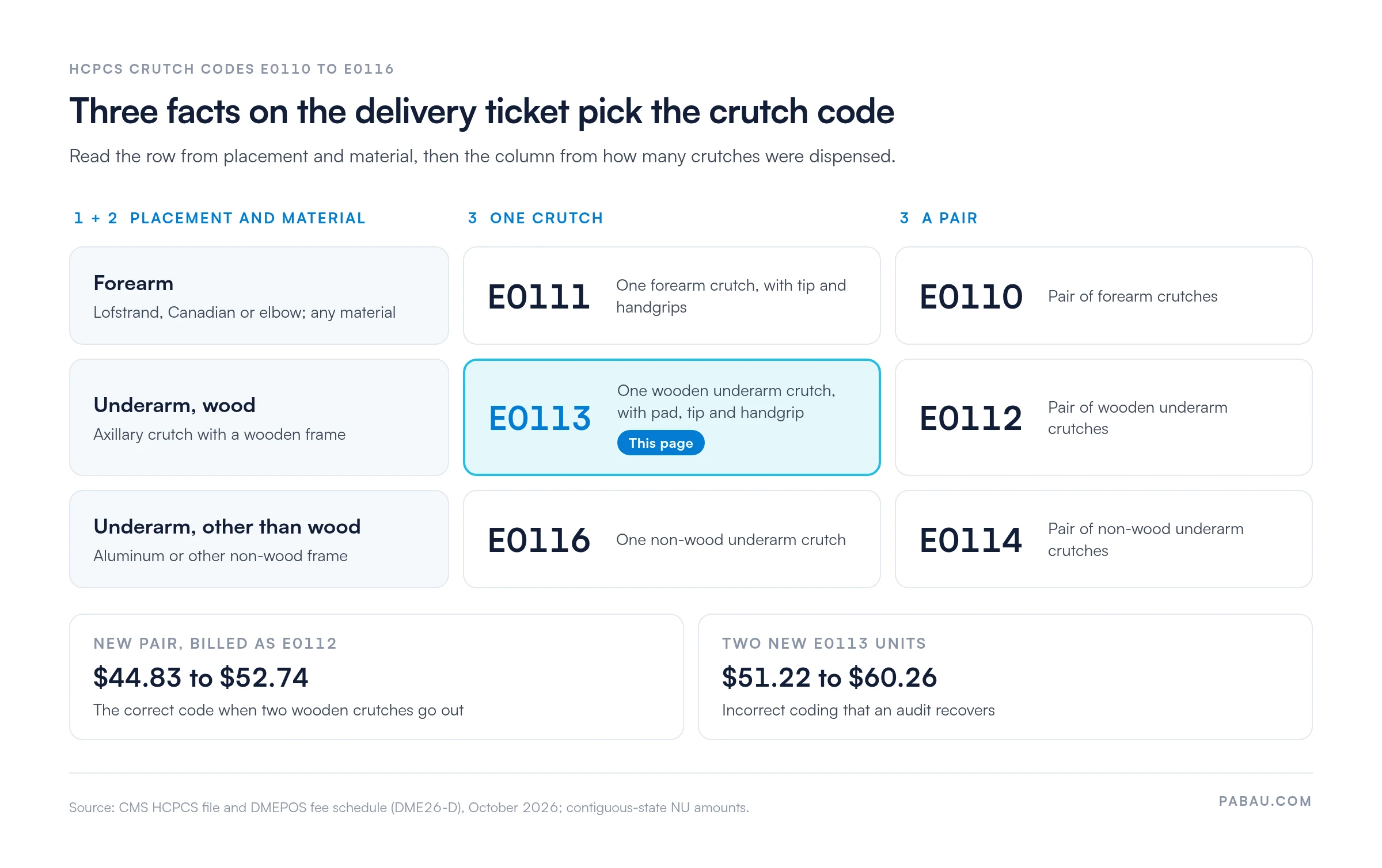
Use E0113 when a patient needs one wooden crutch, such as a replacement for a broken one or a single crutch for light support. When the patient leaves with two wooden underarm crutches, the item is a pair and the code is E0112.
Before you code, check the delivery ticket for three facts. Note where the crutch rests on the body, what the frame is made of, and how many were dispensed.
Medicare Part B covers E0113 as durable medical equipment under LCD L33733 (Canes and Crutches). The four DME MACs apply the same LCD nationally. After the Part B deductible, Medicare pays 80 percent of the allowed amount and the beneficiary owes 20 percent.
The LCD covers a crutch only when all three of these criteria are met:
If any criterion is not met, the crutch is denied as not reasonable and necessary. The supplier must also be enrolled with Medicare as a DMEPOS supplier.
E0113 is not on the CMS Required Prior Authorization List for DMEPOS, so Medicare does not require prior authorization. Crutches are also absent from the Required Face-to-Face Encounter and Written Order Prior to Delivery List as of the October 28, 2026 update.
The LCD still requires a standard written order (SWO). For E0113, the supplier must have the SWO before the claim is submitted, not necessarily before delivery. CMS updates both lists periodically, so check them before dispensing.
LCD L33733 points to the standard documentation requirements article (A55426). Keep these records on file before you submit an E0113 claim:
Crutches do not need a certificate of medical necessity (CMN). Under 42 CFR 424.516(f), suppliers keep this documentation for seven years from the date of service. Good medical billing compliance means the file is complete and easy to retrieve when a contractor asks.
Because E0113 is an inexpensive or routinely purchased item, each claim line needs a payment modifier. That modifier shows whether the crutch was purchased new, purchased used, or rented.
E0113 does not take the KX modifier. LCD L33733 and policy article A52459 set no KX requirement for canes or crutches, so the modifier has no role on these claims. Pair NU with the claim on most new purchases, and use GA or GZ only when you expect a medical necessity denial. Clean claim submission practices catch a missing payment modifier before the claim goes out.
Medicare pays E0113 from the DMEPOS fee schedule, which sets one amount per state rather than per locality. E0113 has no separate rural rate and no former competitive bidding area rate. The figures below come from the October 2026 file (DME26-D).
The pair code is cheaper than two single units. A new E0112 pair pays $44.83 to $52.74, while two new E0113 units would total $51.22 to $60.26. Coding a pair as two E0113 units is incorrect coding, and an audit will recover the difference.
Look up the amount for the beneficiary’s state in the CMS DMEPOS fee schedule files before you quote a patient estimate. Because E0113 pays so little, a single redetermination can cost more staff time than the claim is worth. For low-value DME, sound revenue cycle management means getting the claim right the first time.
Most E0113 denials repeat the same few patterns. A billing team that checks for them before submission avoids most rework. Effective denial management for DME suppliers starts with that pattern list, not with appeals.
Medicare rules drive most E0113 guidance, but many crutch claims go to Medicaid and commercial plans, where the rules differ.
Medicaid: Each state Medicaid program sets its own coverage criteria, prior authorization rules and fee schedule for DME. Some states adopt Medicare’s LCD standards, while others keep their own policies. Check the state Medicaid DME fee schedule directly rather than assuming it matches Medicare.
Commercial payers: Most commercial plans recognize HCPCS Level II E-codes, but coverage, documentation and rates are plan-specific. Some plans pay a pair code and a single-crutch code at different rates or bundle crutches into an orthopedic episode. Verify the patient’s benefit before dispensing.
Claims management software that handles HCPCS Level II codes cuts the manual checking when you bill several payers. You can confirm current descriptors in the AAPC HCPCS code lookup.
Many practices that dispense crutches keep the order in one system, the notes in another and the delivery ticket on paper. When a contractor asks for records, staff then rebuild the file by hand.
Pabau, the practice management software we build, stores the standard written order, the clinical notes and the signed delivery form on the patient record. Digital forms capture the beneficiary’s signature at handover, so proof of delivery exists before the claim is created.
Pabau’s claims management then submits the claim and tracks its status. A rejected E0113 line shows up while there is still time to correct it, and the supporting documents sit one click away.

Pabau keeps the signed order, clinical notes and delivery record on the patient file. Each crutch claim then goes out with its documentation complete.

E0113 is a narrow code, and most of its denials trace back to a coding mismatch rather than coverage. Confirm three facts from the delivery ticket before you bill: underarm placement, wood frame and a single crutch. If any one of those changes, the code changes too.
With the code settled, keep the standard written order, the MRADL-based notes and the signed delivery record together for seven years. Book a demo to see how Pabau keeps DME orders and claims documentation in one place.

Need to understand how HCPCS and CPT codes work together in claims? Medical billing fundamentals explains the end-to-end billing workflow from code selection through payment posting.
Worried about claim rejections slipping through? Denial management strategies covers how to build a systematic denial prevention and appeal process for DME and other claim types.
Want to understand what makes a claim pay on first submission? Clean claim best practices walks through the elements every DME claim needs before it hits the clearinghouse.
Dispensing an aluminum crutch instead? HCPCS code E0116 covers the single non-wood underarm crutch and its Medicare billing rules.
Is the patient using a forearm crutch? HCPCS code E0111 explains how one Lofstrand crutch is coded and billed.
HCPCS code E0113 covers one wooden underarm (axillary) crutch, adjustable or fixed, with its pad, tip and handgrip. It is billed per crutch as durable medical equipment under Medicare Part B. A pair of wooden underarm crutches bills as E0112 instead.
E0110 is a pair of forearm (Lofstrand) crutches of any material, while E0113 is one wooden underarm crutch. They differ in placement, material and quantity. A single forearm crutch bills as E0111, and a pair of wooden underarm crutches bills as E0112.
Yes. Medicare Part B covers E0113 under LCD L33733 when a mobility limitation impairs an activity of daily living in the home. The patient must also be able to use the crutch safely, and the crutch must resolve the deficit. Medicare pays 80 percent of the allowed amount after the Part B deductible.
You need a standard written order on file before the claim is submitted, plus proof of delivery. The medical records must also support the three LCD L33733 criteria. Crutches do not need a certificate of medical necessity. Keep the records for seven years from the date of service.
The most common cause is a coding mismatch, such as billing E0113 for a forearm or non-wood crutch. Billing a pair as two units instead of E0112 and leaving off the NU, UE or RR modifier follow close behind. Weak medical necessity notes, a same-or-similar item on file and missing proof of delivery also cause denials.
No. E0113 is not on the CMS Required Prior Authorization List for DMEPOS. Crutches are not on the face-to-face and written order prior to delivery list either. Commercial plans and state Medicaid programs set their own rules, so check the patient’s plan before dispensing.