

CCSD code XR940: Foreign body retrieval billing guide
CCSD code XR940 is the UK private healthcare code for retrieval of a foreign bod...

Last Updated: Nov 26, 2026
L0978 is the HCPCS Level II code for an axillary crutch extension.
HCPCS code L0978 reports an add-on piece that lengthens an underarm crutch to fit the patient. CMS lists it in the L0970-L0999 range of spinal orthotic accessories, but it is a crutch part, not a spinal brace. Medicare treats coverage as carrier judgment, so the DME MAC decides each claim against the canes and crutches LCD.
Let Pabau's smart automation suggest the right codes, reduce claim denials, and keep your practice compliant—effortlessly.
Automate repetitive tasks and focus on what matters most—your patients.
Reduce coding errors and ensure compliance with the latest regulations.
Clean claims, fewer denials, and faster reimbursements.
Powerful insights and reporting to help your practice thrive.
HIPAA compliant SOC 2 certified GDPR-compliant Trusted by 4,000+ clinics worldwide

HCPCS code L0978 describes an axillary crutch extension, which is a crutch accessory rather than a spinal brace or lumbar-sacral orthosis.
CMS files L0978 in the L0970-L0999 spinal orthotic accessories range, next to peroneal straps (L0980) and stocking supporter grips (L0982).
Medicare lists L0978 with coverage indicator C, carrier judgment, so the DME MAC decides each claim on its documentation.
No LCD names L0978, so build the claim on the canes and crutches LCD (L33733) and policy article A52459.
Pabau, a practice management platform, sends 837P claims through Claim.MD and posts ERA remittances, so L0978 denials surface quickly.
HCPCS code L0978 is the Level II code for an axillary crutch extension.
CMS publishes that descriptor in its quarterly HCPCS update files. The code reports an add-on piece that lengthens an underarm crutch, so the crutch can be set to the patient’s height.
CMS places L0978 in the L0970-L0999 range, which AAPC labels accessories for spinal orthotics. That placement is a quirk of the code set. The item itself is a crutch part, not a spinal device.
Because of its range, L0978 is often mistaken for a lumbar-sacral orthosis (LSO) code. Bill it only for a crutch extension. Lumbar-sacral orthoses have their own codes, mostly in the L0625-L0651 range, such as L0633 for a custom-fitted LSO.
An axillary extension only fits an underarm crutch. Medicare’s crutch codes sit in the E0110-E0118 series, and the canes and crutches LCD (L33733) sets their coverage criteria.
The underarm crutch descriptors already include pads, tips and handgrips. Replacement parts carry their own codes, such as A4635 for a replacement underarm pad and A4637 for a replacement tip.
Before you bill L0978 on top of a new crutch, check whether the extension shipped as part of that crutch. A part included in the base item is not a separate charge.
The L0970-L0999 range mixes corset additions for spinal orthoses with a few unrelated accessories. Reading the descriptors side by side shows how far L0978 sits from the corset codes around it.
L0978 is the only mobility-aid part in the range. A brace, a corset or a body sock never belongs under L0978, whatever its fabrication type. The diagram below maps the range against the crutches an extension can fit.
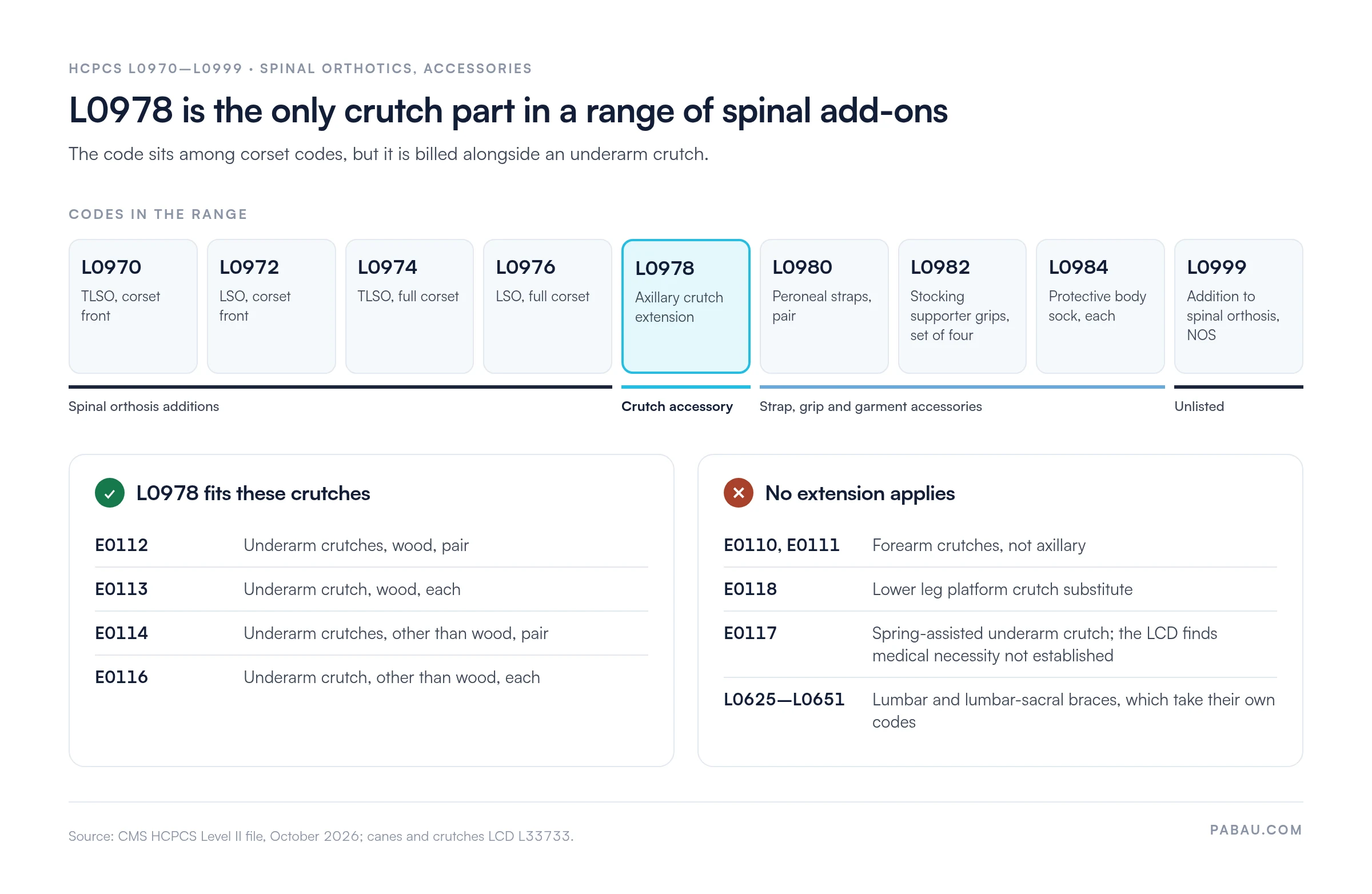
Medicare lists L0978 with coverage indicator C, which means carrier judgment. CMS leaves the coverage decision to the local contractor, and for this code that is the DME MAC.
No LCD lists L0978 by name. The closest guidance is the canes and crutches LCD (L33733) and its policy article A52459, which cover canes and crutches as durable medical equipment.
Under that LCD, a crutch is covered when all three of these criteria are met:
An extension is an accessory to that crutch. Expect the DME MAC to look for the same mobility case, plus a clear reason the standard crutch length does not fit.
Check the current DMEPOS fee schedule file for an L0978 allowable before you quote a patient. Commercial payers set their own rules, so verify coverage with each plan.
On a carrier-judgment code, the paperwork decides the claim. The canes and crutches LCD sets the documentation that applies, and these four records cover it on first submission.
Write the item description on the order as “axillary crutch extension” and list it with the base crutch. A matching order, record and claim line makes a carrier-judgment review far easier to pass.
Modifiers on a crutch accessory claim tell the DME MAC how the item was supplied and who carries the risk of denial. These are the ones that most often apply to L0978.
Neither the canes and crutches LCD (L33733) nor its policy article A52459 names a KX modifier for crutches. Check the current version before every billing cycle, because DME MAC articles are revised without much notice.
L0978 denials usually come from a wrong code or a thin record. Working them fast starts with reading the remittance codes below.
The costliest error is billing L0978 for a back brace. A brace billed under a crutch code fails any record review. See the medical billing denial codes reference for the wider picture.
Small accessory codes like L0978 often get billed from memory, on paper, after the patient has left. That is where a crutch extension turns into a coding error or a missing order.
Pabau keeps the order, the clinical notes and the claim in one patient record. US practices submit CMS-1500 and 837P claims through Claim.MD and run eligibility checks before the visit. ERA remittances come back into Pabau, so billers see a denied L0978 line and its reason code quickly.
Practices can also send secondary claims and track prior authorizations in the same place. See how Pabau’s claims management software carries a DME claim from order to remittance.

Pabau keeps orders, clinical notes and claims in one record, sends 837P claims through Claim.MD, and brings ERA remittances back into your workflow.

L0978 is a small code with an outsized error rate, because its range makes it look like a spinal brace. Treat it as a crutch accessory that needs the crutch’s own mobility case behind it.
Get the base crutch code right, document why the extension is needed, and keep the order and delivery proof on file. Book a demo to see how Pabau runs crutch and DME claims from order to remittance.

Billing the underarm crutch itself? HCPCS code E0116 covers the single non-wood underarm crutch that an extension most often fits.
Seeing recurring denials on DME claims? Denial management in healthcare covers the workflows that reduce denial volume.
Want to understand what makes a claim clean before submission? Clean claim submission breaks down every element that affects first-pass acceptance.
HCPCS code L0978 is the Level II code for an axillary crutch extension. It reports an add-on piece that lengthens an underarm crutch to fit the patient. It is not a lumbar-sacral orthosis code.
CMS places L0978 in the L0970-L0999 range of spinal orthotic accessories, next to peroneal straps and stocking supporter grips. The placement is a quirk of the code set. The item is still a crutch part.
Medicare lists L0978 with coverage indicator C, carrier judgment, so the DME MAC decides each claim. Expect it to apply the canes and crutches LCD (L33733) criteria to the crutch the extension fits.
Keep a standard written order and clinical notes showing the mobility limitation. Add a note on why the standard crutch length does not fit, plus signed proof of delivery.
L0978 fits underarm crutches, such as E0112, E0113, E0114 and E0116. It does not apply to forearm crutches (E0110, E0111) or the lower leg platform crutch substitute (E0118).
No. L0978 describes only an axillary crutch extension. Lumbar-sacral orthoses have their own codes, mostly in the L0625-L0651 range, and billing a brace under L0978 fails any record review.



