

HCPCS code E0198: Water pressure pad billing guide
HCPCS code E0198 is a water pad for a standard mattress HCPCS code E0198 is the ...

Last Updated: Oct 13, 2026
E0116 is the HCPCS Level II code for a crutch, underarm, other than wood, adjustable or fixed, each. The descriptor covers the pad, tip, and handgrip, with or without a shock absorber.
Most E0116 denials trace to three preventable mistakes. Coders pick E0112 or E0113 when the device is not wood, bill one unit for two crutches, or submit without a complete written order. LCD L33733 sets where Medicare draws the line on medical necessity.
Let Pabau's smart automation suggest the right codes, reduce claim denials, and keep your practice compliant—effortlessly.
Automate repetitive tasks and focus on what matters most—your patients.
Reduce coding errors and ensure compliance with the latest regulations.
Clean claims, fewer denials, and faster reimbursements.
Powerful insights and reporting to help your practice thrive.
HIPAA compliant SOC 2 certified GDPR-compliant Trusted by 4,000+ clinics worldwide

HCPCS Code E0116 covers non-wood (aluminum, titanium, composite) underarm crutches, adjustable or fixed, billed per crutch.
E0114 covers that same non-wood underarm crutch dispensed as a pair, so the unit dispensed decides the code.
Medicare coverage requires a documented mobility limitation under LCD L33733 and a valid written order from the treating physician.
E0116 uses modifier NU for new purchase or RR for rental, and two crutches means two units on the claim.
Practice management software like Pabau keeps the written order, the delivery proof, and the invoice on one patient record.
HCPCS Code E0116 describes a crutch, underarm, other than wood, adjustable or fixed, with pad, tip, handgrip, with or without shock absorber, each.
According to the Centers for Medicare and Medicaid Services (CMS), the code sits in the HCPCS Level II E-series for durable medical equipment. The DMEPOS Pricing, Data Analysis and Coding (PDAC) contractor publishes the product classification decisions that say which specific products bill under it.
Breaking the descriptor into its components removes most coding errors before they reach a claim. Each part below is a check that error-checking claims management should make before the line is submitted.
E0116 covers any underarm crutch made from a material other than wood, adjustable or fixed, dispensed as a complete unit with pad, tip, and handgrip. Aluminum is the most common material billed under this code, though titanium and composite-frame crutches qualify equally.
The code does not cover replacement accessories billed after the initial dispensing. It also excludes crutches with a different anatomical placement, a different material, or a different billing unit.
The crutch E-code family is small but frequently confused. Material and anatomical placement narrow the choice, and the number dispensed settles it. E0110 through E0118 is the whole family, and the same descriptor-first check works across every HCPCS code reference in the E-series.
The axis that selects the code is the number dispensed, not the crutch type. E0114 and E0116 describe the same non-wood underarm crutch. E0114 covers the pair, while E0116 covers a single crutch, so a bilateral dispense billed under E0116 needs two units.
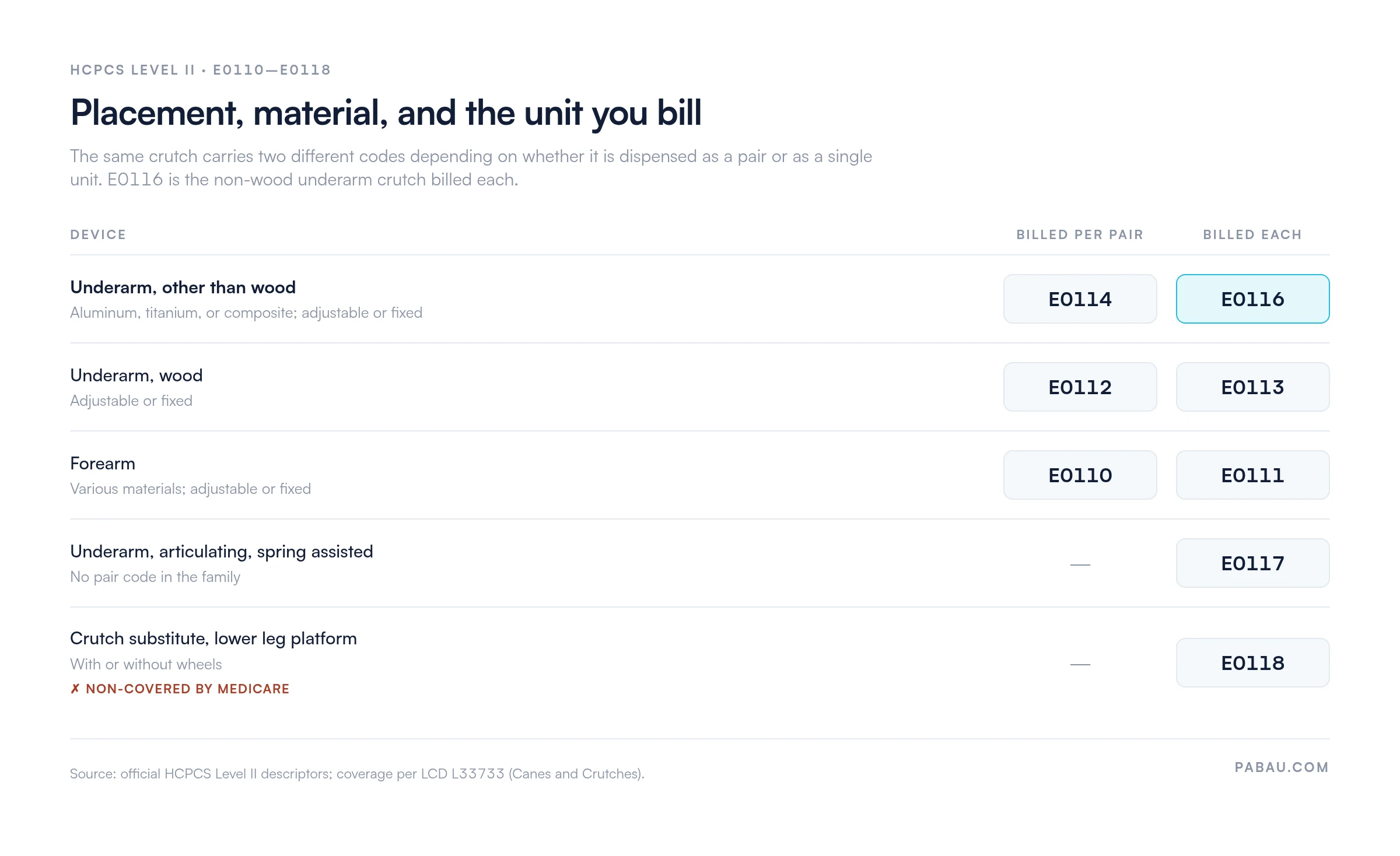
Switching a patient from a wood pair to an aluminum pair changes both the code and the unit count. One line of E0112 becomes one line of E0114, or two lines of E0116.
LCD L33733 (Canes and Crutches) is the Local Coverage Determination governing Medicare medical necessity for E0116 claims. The LCD is maintained by the relevant Medicare Administrative Contractors (MACs). It sets the conditions under which Medicare reimburses a non-wood underarm crutch dispensed by a Medicare-enrolled DMEPOS supplier.
Coverage applies when all of the following criteria are met. Confirm each one appears in the clinical record before the order is written, not after the crutch has been dispensed.
LCD L33733 also specifies non-covered indications. Crutches dispensed for convenience, cosmetic reasons, or maintenance-only situations without an active mobility limitation are not reimbursable under Medicare. Documentation that fails to tie the crutch to an active mobility limitation is the leading denial trigger for E0116 claims.
Documentation for E0116 must satisfy both the DMEPOS supplier’s delivery requirements and the medical necessity standards in LCD L33733. Missing a single element at the time of dispensing can produce a denial that is difficult to overturn on appeal.
Keep the following on file before the claim is submitted.
An incomplete or missing written order is the top denial trigger for E0116 claims. Suppliers that take a verbal order and deliver before the written order arrives face automatic denial under most MAC policies. Records supporting the medical necessity decision also have to be retained for your MAC’s stated retention period.
Audit your E0116 workflow before the claim is submitted: confirm the written order is dated before the delivery date. MACs routinely deny claims where the order date follows the delivery date, and the reversal rate on these appeals is low.
E0116 is typically a purchase item for Medicare billing, not a capped rental item. That distinction drives modifier selection. Verify the applicable modifier against current MAC billing guidelines before submission, as modifier requirements are payer-specific.
For standard bilateral dispensing, submit two claim lines, each carrying E0116 with modifier NU. Using RR on a purchased item triggers a rental payment conversion, which underpays the supplier and leaves a reconciliation problem behind. Capture the modifier at the point of dispensing rather than reconstructing it at billing.
The 2026 Medicare DMEPOS fee schedule for E0116 varies by jurisdiction and competitive bidding area (CBA). CMS publishes annual DMEPOS fee schedule files rather than one national allowed amount. Rates differ between competitive bidding areas and the rest of the country, so a figure quoted without its jurisdiction is not usable.
To find the allowed amount for your zip code or CBA, start from the CMS DMEPOS fee schedule page. It carries the quarterly fee schedule files and the jurisdiction lists. Key pricing context for 2026:
After payment, reconcile the allowed amount against the rate you expected for that jurisdiction. Catching an underpayment during the remittance cycle is far cheaper than finding it in an annual revenue review.
E0116 Medicare billing follows the standard DMEPOS claim workflow with a few crutch-specific requirements. Each step below corresponds to a documentation checkpoint that, if missed, produces a preventable denial.
For clean DMEPOS claims, work through submitting a clean claim before each submission cycle. An error caught before submission costs a fraction of what an appeal costs in staff time.
E0116 denials cluster around six predictable failure points. Each one has a prevention measure that can sit inside the supplier’s intake and billing workflow, well before the claim is submitted.
Tracking denial patterns by reason code after each remittance cycle surfaces systemic problems faster than reviewing denials one at a time. A run of the same code across a month usually traces back to one step in your intake process.
Run a quarterly audit of E0116 claims by filtering your remittance data for CO-4, CO-50 and CO-57. CO-4 flags a procedure code inconsistent with the modifier used. CO-50 flags a service Medicare does not consider medically necessary. CO-57 flags documentation that does not support the level or quantity billed.
E0116 is not on the CMS prior authorization list for DMEPOS items as of 2026. Crutches sit outside the required PA categories that cover power mobility devices and certain other DME. CMS updates that list periodically, so check the current version before dispensing.
Prior authorization requirements vary widely among non-Medicare payers. Confirm coverage and any PA requirement before dispensing, because a hold placed after delivery is hard to unwind.
Most DMEPOS suppliers keep the written order in one system, the proof of delivery in another, and the invoice in a third. When a MAC asks for the file three months later, someone rebuilds it by hand from email and scanned paper.
Practice management software like Pabau holds all three against the same patient record. The order date, the delivery confirmation, and the invoice line carrying E0116 sit on one timeline. Checking that the order predates delivery then takes seconds rather than an afternoon.
Remittance data lands in the same place. When a jurisdiction pays below your expected rate for a unit of E0116, the shortfall shows against the claim itself. Nobody has to find it in a spreadsheet at quarter end.

Pabau holds the written order, the proof of delivery, the invoice and the remittance against one patient record. A DMEPOS audit request then takes minutes to answer instead of an afternoon.

E0116 rewards suppliers who check the physical device before they open the claim. Material decides whether you are in the wood family or the non-wood one. The number dispensed decides whether you bill E0114 or two units of E0116.
The written order is the part worth protecting hardest. Coverage arguments can be won on appeal with better clinical notes, but an order dated after delivery usually cannot be repaired at all.
Build both checks into intake and E0116 becomes a routine line rather than a recurring appeal. Book a demo to see how Pabau keeps orders, delivery proof, and remittance on one patient record.

Dispensing two crutches at once? HCPCS Code E0114: Non-wood underarm crutches covers the pair code that replaces two units of E0116.
Not sure whether the device counts as wood? HCPCS Code E0112: Wooden underarm crutches billing guide shows how material decides which crutch code you bill.
Patient sent home on forearm crutches instead? HCPCS Code E0111: Forearm crutch billing and coverage walks through the coverage rules for that crutch family.
Replacing a worn underarm pad? HCPCS Code A4635: Underarm pad, crutch, replacement explains when an accessory bills separately from the crutch.
Underarm crutches not appropriate for this patient? HCPCS Code E0118: Crutch substitute lower leg platform covers the substitute device and the notes it needs.
HCPCS Code E0116 covers an underarm (axillary) crutch made from a material other than wood, adjustable or fixed, billed per crutch. The unit includes the axillary pad, tip, and handgrip, with or without a shock absorber. It does not cover forearm crutches, wood crutches, or the lower leg platform substitute.
E0111 is a forearm crutch billed each, made from various materials and either adjustable or fixed. E0114 is the underarm, non-wood crutch billed as a pair, which is the same device E0116 covers as a single unit. Placement decides E0111, and the number dispensed decides between E0114 and E0116.
The most common modifier is NU (new purchase) for standard dispensing. RR applies for rental arrangements, followed by KH for the first rental month and KI for months two through three. UE applies to reissued used equipment, and RA applies to replacement items. E0116 is typically purchased rather than rented.
Yes. Medicare Part B covers E0116 crutches when the patient has a documented mobility limitation that significantly impairs ambulation. The treating physician must provide a valid written order, and the supplier must be enrolled in the Medicare DMEPOS program. Coverage is governed by LCD L33733 (Canes and Crutches).
No, E0116 is not on the CMS prior authorization list for DMEPOS as of 2026. However, commercial payers and state Medicaid programs frequently require prior authorization for DME items including crutches. Always verify the specific payer’s PA requirements before dispensing.
LCD L33733 (Canes and Crutches) is the Local Coverage Determination governing Medicare medical necessity for E0116. The relevant Medicare Administrative Contractors maintain it. It sets the coverage indications, the non-covered indications, and the documentation requirements for crutch claims. Check the CMS Medicare Coverage Database for the current version.



