CPT Code 62284: Injection procedure for myelography
CPT Code 62284: official descriptor and procedure overview The American Medical ...

Last Updated: Oct 19, 2026
E0105 is the HCPCS Level II code for cane, quad or three prong, includes canes of all materials, adjustable or fixed, with tips. Medicare Part B pays it under the durable medical equipment benefit, one unit per cane, with the tips bundled into that unit.
Billers can misfile this code against E0100 (the single-tip cane), and that mix-up can lead to a rejected claim or a medical necessity review.
Let Pabau's smart automation suggest the right codes, reduce claim denials, and keep your practice compliant—effortlessly.
Automate repetitive tasks and focus on what matters most—your patients.
Reduce coding errors and ensure compliance with the latest regulations.
Clean claims, fewer denials, and faster reimbursements.
Powerful insights and reporting to help your practice thrive.
HIPAA compliant SOC 2 certified GDPR-compliant Trusted by 4,000+ clinics worldwide

HCPCS Code E0105 covers quad (four-prong) and three-prong canes, adjustable or fixed, in any material, with the tips included.
Medicare Part B covers E0105 under the DME benefit when LCD L33733 criteria are met and a Standard Written Order is on file.
LCD L33733 turns on an in-home mobility limitation, safe use of the cane, and a deficit a cane can resolve.
Bill one unit per cane with the NU modifier for a new purchase, RR for a rental, or UE for used equipment.
Allowed amounts vary by state and by rural or former competitive bidding status, so check the current DME26 file before quoting a figure.
HCPCS Code E0105 is the Healthcare Common Procedure Coding System Level II code for a multi-prong cane. The verbatim CMS descriptor reads “cane, quad or three prong, includes canes of all materials, adjustable or fixed, with tips”. Every word of it matters for claim adjudication. The code sits in the E-series of the CMS HCPCS Level II code set. That set covers durable medical equipment, prosthetics, orthotics, and supplies billed outside the CPT system.
Three elements of the descriptor decide whether the claim is coded correctly. First, “all materials” means wood, aluminum, carbon fiber, and folding canes all qualify. Second, “adjustable or fixed” means there is no separate code for height-adjustable versus fixed-shaft models.
Third, “with tips” means the rubber or other tip attached to each prong is part of the single unit price. Billing a tip separately on the same claim as E0105 creates an unbundling error.
E0105 applies to two distinct base configurations. Knowing which devices fall inside and outside the descriptor prevents upcoding and downcoding errors before the claim is submitted.
E0100 covers a straight cane with a single tip. E0105 covers any cane with a multi-prong base. That is the entire distinction, and getting it wrong in either direction causes a claim problem. Billing a standard straight cane as E0105 may draw a medical necessity review. Downcoding a quad cane to E0100 underpays the supplier and leaves an inaccurate allowance record on the patient’s file.
E0105 is one code within a broader family of HCPCS ambulatory aid codes. Billers working in DME supply or rehabilitation settings meet all of them. The table below maps the adjacent codes, so you can confirm E0105 is the right choice before submission. The AAPC HCPCS code lookup carries the full descriptors.
Medicare Part B covers E0105 under the durable medical equipment benefit. Coverage is governed by LCD L33733 (Canes and Crutches). The LCD sets out the conditions a claim must meet before Medicare will pay. Meeting the code descriptor alone is not enough.
Check these conditions before the cane is dispensed. A supplier who delivers first and reads the chart note later has already lost the chance to ask for an amendment.
The chart note and the order have to make the case for the quad or three-prong configuration, not for a cane in general. Solid medical billing compliance means building that paper trail before the device ships.
Read the ordering practitioner’s chart note before dispensing. If it says only ‘patient uses a cane’, ask for an amendment before you submit. The note has to link the mobility limitation to the need for a multi-prong base. One documentation request takes minutes. A denial and appeal takes weeks.
Billing E0105 for Medicare follows the standard DMEPOS claim workflow. Accurate medical billing workflows for DME require the supplier to confirm enrollment before the first claim is submitted. The steps run in this order.
Medicare reimburses E0105 under the CMS DMEPOS fee schedule, which CMS publishes each year and revises quarterly. Rates vary by state, and separate adjusted rates apply in rural areas and in former competitive bidding areas. For 2026 those adjusted areas take a 2.8% update factor, against 2.0% elsewhere. Look up the current allowed amount in the DME26 public use file and read the NU column.
Confirm the allowed amount for the beneficiary’s own state before you quote an out-of-pocket figure. A rate pulled from one jurisdiction will not hold in another. CMS has not established competitive bidding rates for canes, so there is no separate bid price to check.
Most E0105 denials fall into a small set of recurring patterns. The denial management strategies that clear them fastest fix documentation before submission rather than during an appeal. Reading the remittance advice against the list of common denial codes tells you which pattern you are in.
Each of the six checks below removes one of those patterns, and all six are made before the cane leaves the practice.
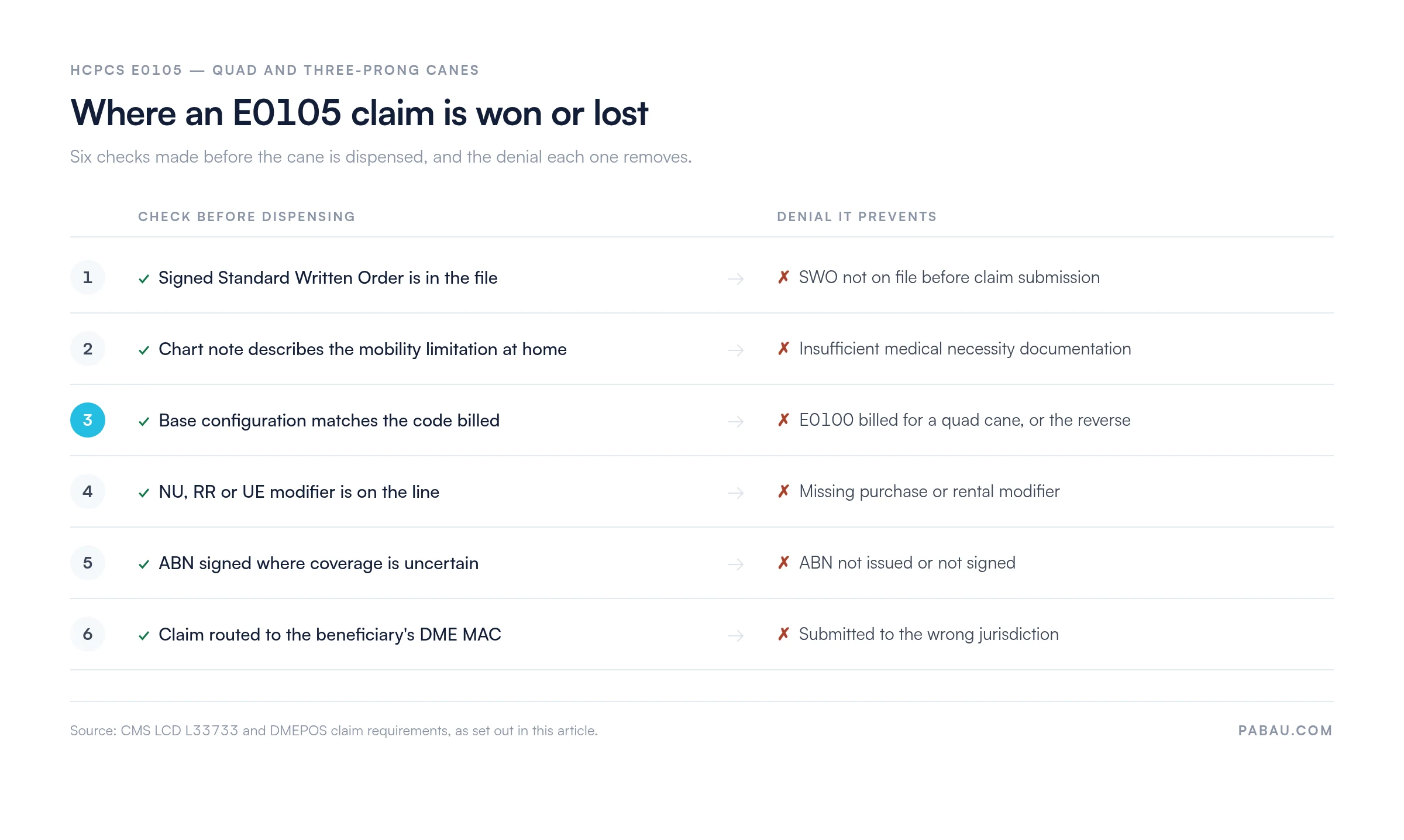
Build a pre-dispensing checklist with four questions. Is the SWO signed and on file? Does the chart note link the mobility limitation to a multi-prong base? Has an ABN been issued where coverage is uncertain? Is the supplier’s PECOS status current? Four questions before the cane leaves the practice head off most E0105 denials.
DMEPOS billing runs on manual lookups. Descriptor checks, fee schedule amounts, DME MAC routing, and LCD criteria all get confirmed before a single claim goes out. Teams working from separate spreadsheets have more places for a routing or documentation error to slip through.
Pabau, the practice management platform we build, keeps insurance claims on one dashboard. Each claim shows as pending, submitted, processing, paid, or error, and you can filter by date, insurer, or invoice ID. Claims are submitted to Claim.MD without leaving the patient record, so figures are not re-keyed between systems.
Validation runs in the background every time you go to send a claim. If a membership number or an authorization code is missing, the Send button stays disabled until it is filled in. That catches the data errors a payer would otherwise reject, so your team can send cleaner claims and spend less of the week on appeals. It is the same discipline behind submitting a clean claim first time.
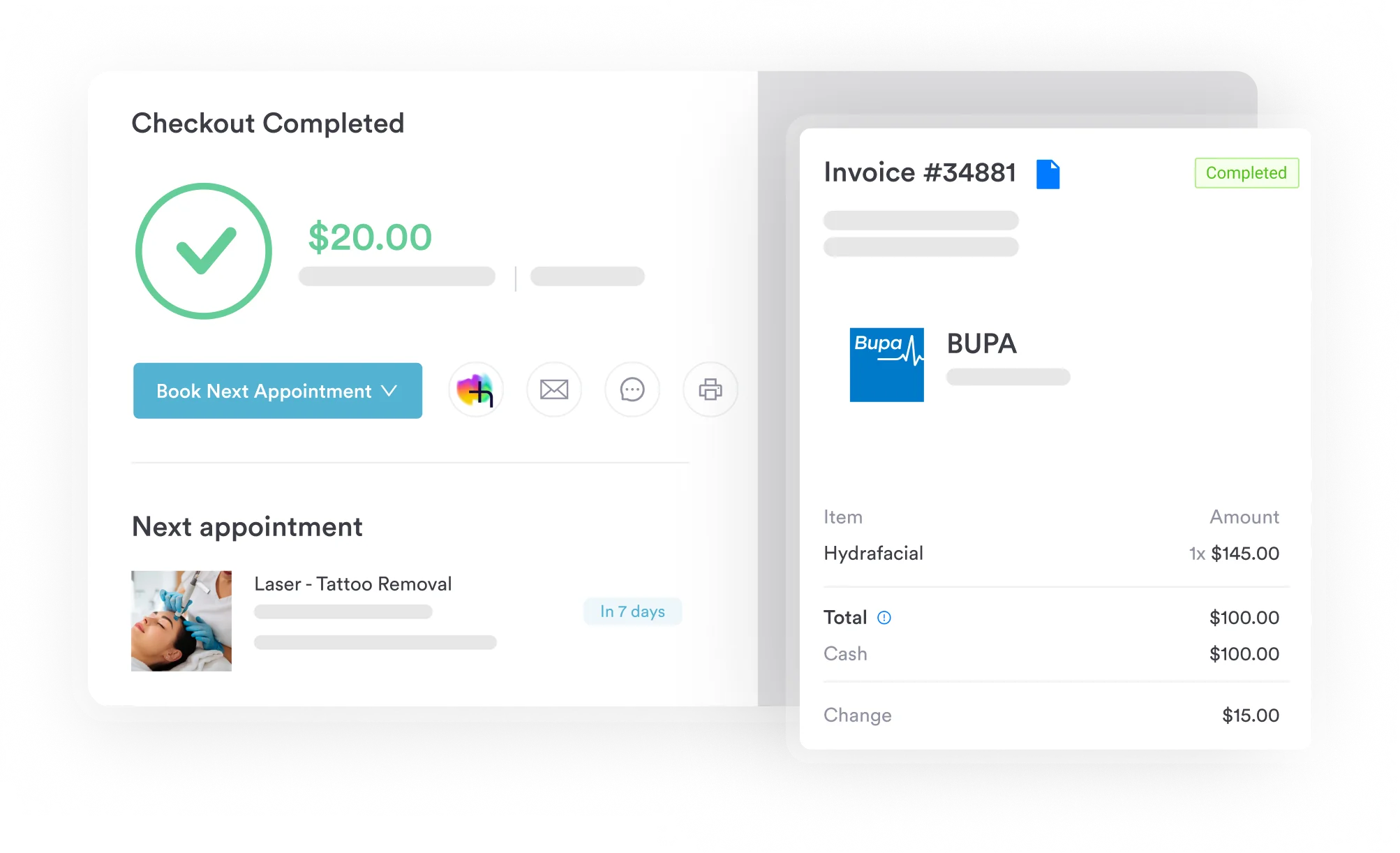

Pabau keeps every insurance claim on one dashboard and runs validation checks before you send. Missing details are caught before a payer sees the claim.

E0105 is a low-value code that carries a high administrative cost, and that is what makes it worth getting right. The two decisions that settle the claim are both made before the cane is handed over. Confirm the base configuration, then confirm the chart note describes a mobility limitation in the home.
Suppliers who run that check at the counter rarely see these claims come back. The ones who run it after a denial are rebuilding documentation that a two-minute conversation would have produced. Book a demo to see how Pabau keeps DME claim submission and follow-up in one place.

Managing claim denials across your practice? Denial management in healthcare covers the core strategies for reducing rework and accelerating payment cycles.
Want to understand the broader billing landscape? What is revenue cycle management explains how DME billing fits into the full practice revenue cycle.
Billing across multiple code sets? Superbill documentation outlines how to capture HCPCS and CPT codes together in a single compliant billing record.
HCPCS Code E0105 is the durable medical equipment code for a cane with a quad (four-prong) or three-prong base. It covers devices in any material, adjustable or fixed, with the tips included. Medicare Part B pays it when LCD L33733 criteria are met and the supplier holds a Standard Written Order.
E0100 covers a standard single-tip straight cane. E0105 covers canes with a quad (four-prong) or three-prong base. The base configuration is the only determining factor. Billing E0105 for a straight cane is upcoding, and billing E0100 for a quad cane is downcoding.
Yes, on three conditions set out in LCD L33733. The mobility limitation must significantly impair the beneficiary’s mobility-related activities of daily living in the home. The beneficiary must be able to use the cane safely. A cane must also sufficiently resolve the deficit. The supplier holds a signed Standard Written Order before the claim is submitted.
Yes. The official CMS descriptor for E0105 includes canes “adjustable or fixed”, so height-adjustable and fixed-shaft quad canes share one code. No modifier is needed to distinguish adjustable from fixed. A purchase or rental modifier is still required. Use NU for a new purchase, RR for a rental, and UE for used equipment.
The recurring reasons are insufficient medical necessity documentation and choosing E0100 instead of E0105. A Standard Written Order that is not on file before submission also triggers a denial. So do a missing purchase or rental modifier and an Advance Beneficiary Notice that was never issued or signed.
There is no single national figure. The allowed amount varies by state. Rural areas and former competitive bidding areas carry separate adjusted rates, which take a 2.8% update factor in 2026 against 2.0% elsewhere. Read the NU column of the current DME26 public use file for the beneficiary’s state.