

CCSD code G5100: Bypass of duodenum billing guide
CCSD code G5100 bills a bypass that leaves the duodenum in place CCSD code G5100...

Last Updated: Oct 16, 2026
E0100 is the HCPCS Level II code for cane, includes canes of all materials, adjustable or fixed, with tip.
HCPCS code E0100 has the full descriptor: Cane, includes canes of all materials, adjustable or fixed, with tip. The short descriptor used on remittance advice is "Cane adjust/fixed with tip." According to the Centers for Medicare and Medicaid Services (CMS) HCPCS Level II code set, E0100 falls within the Durable Medical Equipment range E0100-E8002 and specifically within the Walking Aids and Attachments sub-range E0100-E0159
Let Pabau's smart automation suggest the right codes, reduce claim denials, and keep your practice compliant—effortlessly.
Automate repetitive tasks and focus on what matters most—your patients.
Reduce coding errors and ensure compliance with the latest regulations.
Clean claims, fewer denials, and faster reimbursements.
Powerful insights and reporting to help your practice thrive.
HIPAA compliant SOC 2 certified GDPR-compliant Trusted by 4,000+ clinics worldwide

HCPCS code E0100 describes a cane of any material, adjustable or fixed, with a tip, classified as Durable Medical Equipment (DME) under the HCPCS E0100-E8002 range.
Medicare coverage requires all three LCD L33733 criteria to be met: a mobility-limiting condition, a physician order, and documentation of medical necessity.
Modifiers NU (new purchase), RR (rental), and UE (used equipment) are required on E0100 claims; omitting a modifier is one of the most common denial triggers.
Pabau’s claims management software helps DME suppliers and practices track documentation, attach CMN files, and manage HCPCS billing workflows in one place.
Coverage code “D” means special coverage instructions apply, which is why coverage for E0100 is governed by LCD L33733 rather than a blanket Medicare benefit. Billers who overlook this distinction often submit claims without the supporting documentation LCD L33733 requires, triggering automatic review or denial.
Physical therapy and occupational therapy practices that regularly dispense canes should build LCD criteria verification into their pre-billing workflow. Practices using physical therapy practice management software can automate this step with pre-configured DME checklists.
LCD L33733, maintained by the CMS Medicare Coverage Database, governs coverage for canes (E0100 and E0105) and crutches (E0110-E0116). Coverage is only established when all three of the following criteria are satisfied simultaneously.
Occupational therapy practices play a major role in DME assessment and prescription. Practices with occupational therapy practice software that links patient assessments directly to billing workflows are better positioned to attach the right documentation automatically at claim submission.
Selecting the right ICD-10 code is critical because payers cross-reference the diagnosis against the DME ordered. A cane prescribed for gait instability after stroke requires a different ICD-10 than one ordered for osteoarthritis of the knee. Common pairings include:
Payers expect the ICD-10 code to reflect the patient’s actual documented condition, not a generic fall-back code. Practices managing patients with chronic musculoskeletal conditions or post-surgical recovery should integrate ICD-10-to-HCPCS crosswalk tools into their billing process.
Document the patient’s specific functional limitation in the clinical note using measurable terms, such as ‘ambulates 30 feet before requiring rest’ or ‘fall risk score of 14 on Berg Balance Scale’. Vague language like ‘difficulty walking’ is consistently cited by Medicare contractors as insufficient for medical necessity.
HCPCS code E0100 requires a modifier on every claim. Submitting E0100 without a modifier is a guaranteed denial for Medicare and most commercial payers. Three modifiers apply to E0100 depending on the transaction type — the same NU (new purchase), RR (rental), and UE (used) framework used across durable medical equipment.
For most outpatient cane dispensing, the NU modifier is the standard choice because canes are typically purchased outright. The RR modifier applies in limited circumstances, such as a hospital discharge situation where temporary cane use is expected before the patient transitions to a walker or returns to independent ambulation. The UE modifier is less common but important for DME suppliers who offer refurbished equipment programs. Checking insurance eligibility before the visit catches terminated coverage while the appointment can still be rescheduled.
Chiropractic and sports medicine practices that dispense DME alongside manual therapies often miss the modifier requirement because their billing staff are more familiar with CPT procedure codes than HCPCS Level II conventions.
Similarly.

Pabau helps practices and DME suppliers manage HCPCS claims, attach supporting documentation, and track modifier requirements all in one place. Book a demo to see how Pabau reduces billing errors and speeds up reimbursement.

Medicare reimbursement for E0100 varies by geographic location, payer, and modifier. The VA Community Care Outpatient Fee Schedule (v3-25) provides verified benchmark rates. These figures reflect the VA schedule and serve as a reference point; Medicare Part B rates from the Durable Medical Equipment Medicare Administrative Contractors (DME MACs) may differ by jurisdiction.
These rates are sourced from the VA Community Care Outpatient Data Tables (v3-25). Medicare Part B rates may be lower in competitive bidding areas or higher in rural fee schedule jurisdictions. Commercial payer rates vary significantly; always verify against your payer-specific contract for current fee schedule data by payer and geography.
DME suppliers operating under the DMEPOS Competitive Bidding Program may receive different rates in covered MSAs (Metropolitan Statistical Areas). If your practice is in a competitive bidding area, verify your contracted rate with your DME MAC before posting expected reimbursement in your billing system.
Practices that manage multi-location DME dispensing benefit from multi-location practice management that centralizes rate tracking across sites.
Missing or incomplete documentation is the leading reason E0100 claims fail post-payment audit. The medical record must establish medical necessity at the time the cane was dispensed, not retroactively assembled at the point of appeal.
Practices that rely on paper-based documentation workflows carry a higher audit risk because records are harder to retrieve and incomplete forms often go undetected until a claim is questioned.
The shift to digital medical forms in healthcare practices directly reduces post-payment audit exposure by ensuring all required data fields are captured at the point of care.
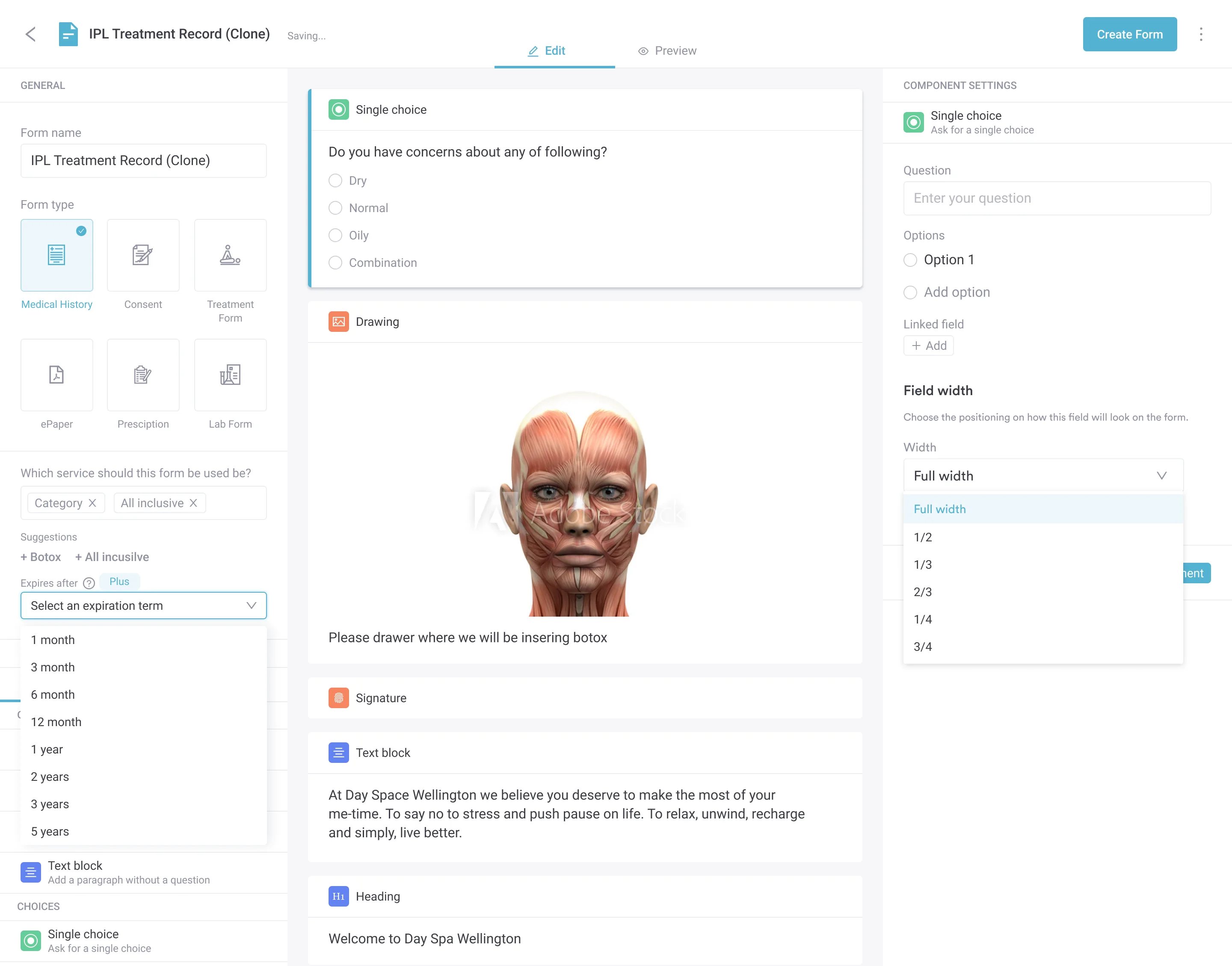
Retain proof of delivery for every DME item dispensed, even low-cost items like canes. Medicare contractors conducting post-payment audits treat missing delivery documentation the same as missing medical necessity evidence: the claim is recouped. A simple patient signature log, scanned and attached to the patient record, is sufficient.
Selecting the wrong cane code is a common coding error, particularly when a patient transitions from a standard cane to a quad cane between visits. Billing E0100 for a quad cane, or vice versa, results in claim denial or downcoding during review.
The practical distinction between E0100 and E0105 is the base design. E0100 is for any single-tip cane regardless of material or handle shape. E0105 applies when the base has three or four points of contact with the floor. If the clinical documentation describes a “quad cane” but E0100 is billed, the payer’s claim edit engine will likely catch the mismatch.
The crutch codes split on how many devices leave the practice. Two non-wood underarm crutches dispensed together go out under E0114, while E0116 bills a single crutch. Each falls under LCD L33733, the Canes and Crutches determination that also governs E0100.
Coders should verify the actual item dispensed matches the HCPCS code selected, not just the physician’s shorthand description in the order. For a comprehensive lookup of the full walking aids code range, the AAPC Codify HCPCS code reference provides current descriptor details and crosswalk data.
Practices that manage a mix of DME items alongside clinical services benefit from inventory management software that ties the physical item dispensed to the HCPCS code billed, eliminating the manual matching step that produces coding errors.
E0100 denials cluster around four specific failure patterns. Understanding these patterns lets billing staff address them before submission rather than during appeals.
The most preventable denial is the missing modifier. Billing platforms that do not enforce HCPCS modifier requirements for DME codes create a structural problem that generates repeated denials.
For practices billing both clinical services and DME, maintaining a clean claim rate requires separate review queues for HCPCS and CPT claims. The documentation requirements, modifier rules, and LCD coverage criteria for DME codes like E0100 are distinct from the evaluation and management (E/M) coding framework most clinical billers know well.
Referencing the related procedure code billing guides on the Pabau site can help clarify how HCPCS and CPT billing workflows differ.
HCPCS code E0100 is a straightforward code with a narrow failure window: most denials trace back to a missing modifier, inadequate medical necessity documentation, or a mismatched ICD-10 code. Meeting all three LCD L33733 criteria before dispensing, selecting the correct modifier (NU, RR, or UE) at claim creation, and retaining a signed proof of delivery will resolve the majority of E0100 denial patterns.
Pabau’s claims management software helps practices and DME suppliers build these requirements into their pre-submission workflow so missing documentation is caught before a claim is submitted, not after a denial arrives. To see how Pabau supports DME billing documentation and HCPCS claim management, book a demo.

Coding a nerve injury claim? ICD-10 code S44.42XA for nerve injury explains when this left-arm nerve injury code can stand as the principal diagnosis.
Coding a follow-up visit for a fracture? ICD-10 code S52.022E covers a follow-up visit for a healing open olecranon fracture.
Billing a subsequent visit for fracture malunion? ICD-10 code S52.266R covers a subsequent encounter for an ulna fracture healing with malunion.
HCPCS code E0100 is a Level II code that describes a cane of any material, adjustable or fixed, with a single tip, classified as Durable Medical Equipment (DME) under the HCPCS range E0100-E8002. It is billed by DME suppliers and practices dispensing standard canes to patients who require ambulatory assistance.
Based on the VA Community Care Outpatient Fee Schedule (v3-25), the benchmark rate is $116.15 for a new purchase (NU modifier) and $60.18 for rental (RR modifier). Medicare Part B rates administered by DME MACs may vary by geographic jurisdiction and competitive bidding area status.
E0100 requires one of three modifiers on every claim: NU for a new purchase, RR for rental, or UE for used equipment. Submitting E0100 without any modifier is a denial trigger for Medicare and most commercial payers.
E0100 applies to single-tip canes (straight, offset, or folding canes with one tip). E0105 applies to canes with a multi-tip base, specifically quad canes (four tips) or three-prong canes. Using E0100 when a quad cane was actually dispensed will result in a code mismatch denial.
LCD L33733 (Canes and Crutches), maintained in the CMS Medicare Coverage Database, governs Medicare coverage for E0100 and E0105. Coverage requires three criteria to be met: a mobility-limiting condition, a written physician or NPP order, and documented medical necessity in the clinical record.
A CMN is not universally required for a standard cane under E0100, but clinical documentation supporting medical necessity must be present in the patient’s record. Some payers and post-payment auditors may request a CMN-equivalent summary, so maintaining thorough documentation is advisable regardless of the initial submission requirements.



