CPT Code 62284: Injection procedure for myelography
CPT Code 62284: official descriptor and procedure overview The American Medical ...

Last Updated: Oct 19, 2026
C1839 is the HCPCS Level II code for an iris prosthesis, the artificial iris implanted to treat a missing or damaged iris. Hospital outpatient departments and ambulatory surgical centers report it with the iris implant procedure.
CMS created C1839 on January 1, 2020, for the CustomFlex ArtificialIris. It is billed alongside CPT 0616T, 0617T or 0618T, depending on whether the lens is left in place, removed or replaced.
Let Pabau's smart automation suggest the right codes, reduce claim denials, and keep your practice compliant—effortlessly.
Automate repetitive tasks and focus on what matters most—your patients.
Reduce coding errors and ensure compliance with the latest regulations.
Clean claims, fewer denials, and faster reimbursements.
Powerful insights and reporting to help your practice thrive.
HIPAA compliant SOC 2 certified GDPR-compliant Trusted by 4,000+ clinics worldwide

HCPCS Code C1839 reports an iris prosthesis, the artificial iris implant, on hospital outpatient department and ASC claims only.
C1839 covers the device alone, so it is billed alongside CPT 0616T, 0617T or 0618T, chosen by the lens work done during surgery.
Every C1839 claim needs the device invoice or UDI in the record, and a missing one is the most common reason for denial.
Pass-through or packaged payment for C1839 is set each year in the CMS OPPS final rule, so check the current addendum before quoting a rate.
Pabau’s claims management software keeps device documentation, modifiers and claim status for each C1839 claim in one place.
HCPCS Code C1839 is the CMS code for an iris prosthesis, an artificial iris implanted when a patient’s iris is missing or damaged. Its official descriptor is simply “Iris prosthesis,” unchanged since the code took effect on January 1, 2020.
CMS created the code for the CustomFlex ArtificialIris, which the FDA approved in May 2018 for congenital aniridia and acquired iris defects. C1839 belongs to the C-series of HCPCS Level II codes, the temporary codes CMS maintains for hospital outpatient and ASC billing.
CMS reviews C-codes through the annual Outpatient Prospective Payment System (OPPS) final rule and quarterly updates. The quarterly files on the CMS HCPCS overview page list each C-code’s descriptor and payment status.
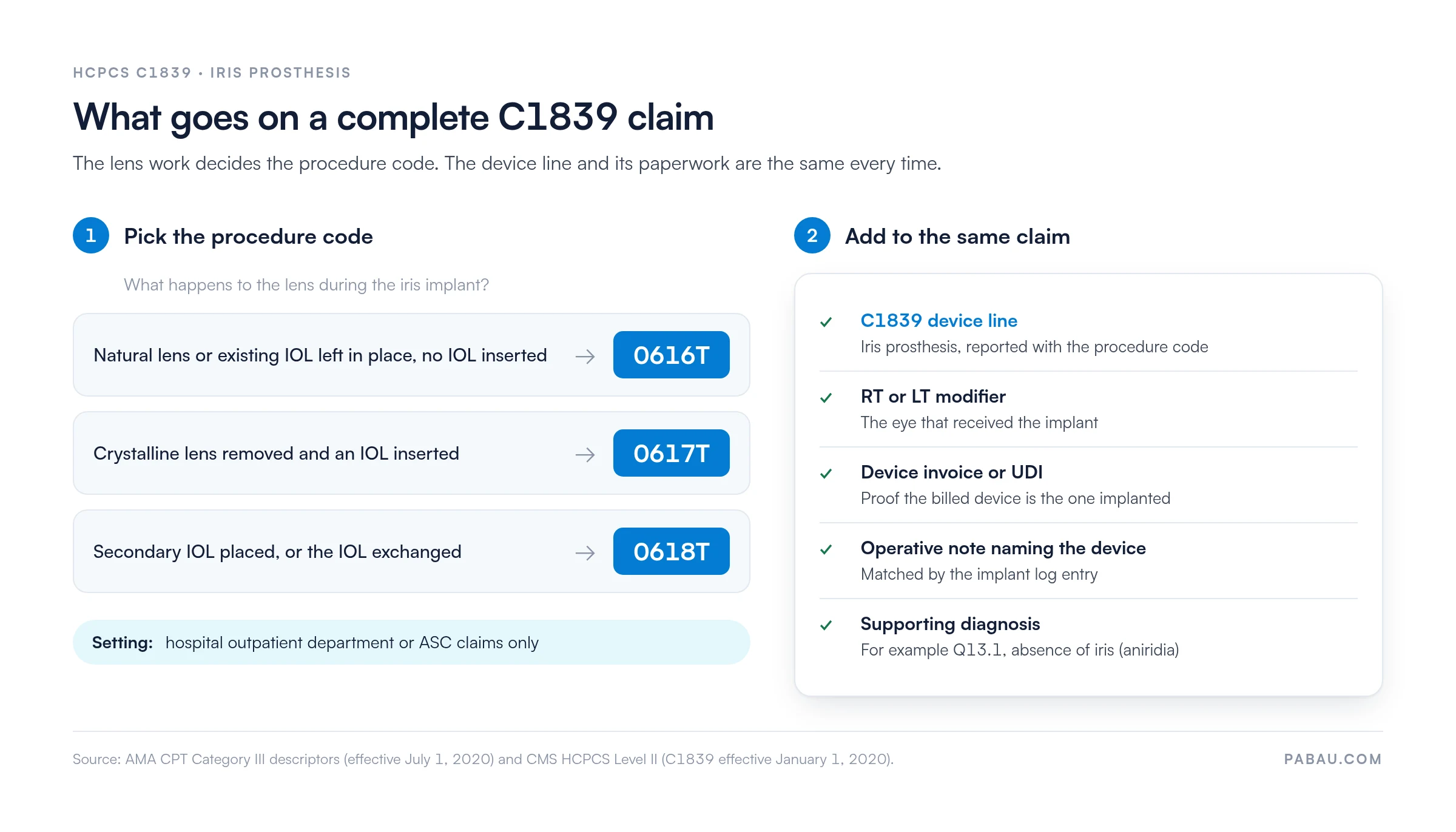
C1839 reports the device only. The surgery goes on the same claim under one of three CPT Category III codes, effective July 1, 2020:
C-codes like C1839 are setting-restricted. They appear only on claims from ASCs and HOPDs, two outpatient settings that CMS pays under separate but related payment systems.
The Outpatient Code Editor (OCE) flags claims when C-codes appear in the wrong billing context. An OCE edit doesn’t always mean an automatic denial, but it does trigger manual review and adds weeks to adjudication.
Submitting C1839 on a claim type the OCE doesn’t accept for C-codes is one of the easiest ASC billing errors to prevent.
Medicare covers C1839 under OPPS when the iris implant procedure is covered and medical necessity is documented. How CMS pays for the device depends on its pass-through status in the current OPPS final rule. C1839 entered pass-through status when it took effect in January 2020.
Reimbursement rates for C1839 change year to year. Pull the current OPPS or ASC fee schedule from CMS at the start of each calendar year instead of carrying old figures forward. Quoting a dollar amount without the CMS addendum and year behind it is a common compliance risk in billing documentation.
Run a fresh HCPCS code lookup at the start of each calendar year for every C-code in your charge master. CMS publishes updated OPPS addenda in November for the following year. Flag that date in your billing calendar, so a payment status change doesn’t catch claims that have already gone out.
A C1839 claim without complete supporting documentation will deny. The record has to establish both the procedure and the device, and tie them to a covered diagnosis.
Pabau’s claims management software lets billing teams attach and track device documentation against the procedure claim. That lowers the chance of a clean claim being held for a missing file.
Put together, a complete C1839 claim pairs the right procedure code with the device line and its paperwork, as the diagram below shows.
ICD-10-CM codes must reflect the condition that makes the iris implant medically necessary. For C1839, that is the iris defect itself. Congenital aniridia is coded Q13.1, and a congenital iris coloboma is coded Q13.0. Diagnosis codes on C1839 claims typically fall into one of these categories:
Always map diagnosis codes to the current ICD-10-CM fiscal year. A code deleted or revised this year creates a claim-level edit, and not every clearinghouse catches it before submission. Review the medical billing workflow for your facility to confirm where ICD-10 validation happens in your claim build.
Medicare fee-for-service doesn’t require prior authorization for most implant device codes at the national level. Medicare Advantage plans and commercial payers frequently do. Several commercial payers publish a dedicated iris prosthesis coverage policy with their own medical necessity criteria.
Payer policies update quarterly, and a procedure that didn’t need prior authorization last year may need it now. Build a payer-authorization check into your annual charge master review, so the list stays accurate. Your medical billing compliance process should include a periodic check of each payer’s prior authorization schedule.
Modifiers explain the circumstances of a claim and prevent automatic denials from bundling or bilateral edits. These are the modifiers most often applied with implant device codes in the ASC and HOPD setting:
Incorrect modifier use is one of the faster routes to a Medicare audit. Apply a modifier only when the clinical scenario matches its definition, and confirm the record supports every modifier on the claim. On a clean claim for C1839, each modifier should make sense from the operative note alone.
C1839 often shares a claim, and sometimes a surgery, with other eye and device codes. Picking the wrong one is easy when you work from memory instead of the current CMS descriptor file. These are the codes most often confused with C1839:
An iris-supported lens and an iris prosthesis sound alike but describe different devices, so check the operative note before choosing between C1839 and V2631.
When the right code is still unclear, compare descriptors side by side in the AAPC HCPCS code lookup or the PGM Billing HCPCS tool. Then confirm against the CMS source file, which wins whenever a commercial lookup tool lags behind a quarterly update.
C1839 denials follow recognizable patterns, and most trace back to missing documentation rather than coding errors. These are the four denial types billing teams see most often on C-code device claims:
When Medicare denies a C1839 claim, redetermination is the first formal appeal level. Acting quickly and systematically gives the best chance of reversal without escalating to higher appeal tiers.
Keep a denial log for C1839 and every other C-code claim for at least 90 days. Track the CARC/RARC code, the denial date and the appeal filing date in a shared spreadsheet or your billing platform. The log shows whether denials come from missing documentation, a payer policy change or a charge master error, and each one needs a different fix.
Many ASC and HOPD billing teams build a C1839 claim from three places. The operative note sits in the clinical record, the device invoice sits with purchasing, and the claim lives in a clearinghouse. Each handoff is a chance for the invoice or UDI to go missing.
Pabau keeps treatment notes, patient records and claims in one system. Your team attaches the device documentation to the procedure claim, applies the RT or LT modifier and follows the claim’s status without switching between tools.
That means fewer claims held for a missing file, and less time spent rebuilding a record when a payer asks for proof of the implant.

Pabau’s claims management tools help outpatient billing teams attach device documentation, apply the right modifiers, and track claim status without switching between systems. See how it works for ASC and HOPD workflows.

C1839 is one of the easier device codes to get right. Its descriptor names a single device, and it pairs with just three CPT codes. Payment depends on the paperwork that travels with it.
So move the checks to the front of the process. Confirm the setting, match the lens work to 0616T, 0617T or 0618T, and attach the invoice or UDI before the claim leaves. That takes a few minutes per claim, far less than the redetermination it prevents.
Book a demo to see how Pabau keeps device documentation and claim status together for your outpatient billing team.

Need to understand how denials get resolved at the claim level? Denial codes in medical billing breaks down CARC and RARC codes and how to respond to each.
Not sure whether a device has its own code? HCPCS Code C1889 explains when the not-otherwise-classified device code applies.
Curious how the broader revenue cycle connects to device billing? Revenue cycle management explained maps every stage from patient registration through payment posting.
HCPCS Code C1839 describes an iris prosthesis, the artificial iris implanted to treat aniridia or a damaged iris. The official CMS descriptor is “Iris prosthesis,” unchanged since the code took effect in January 2020. Hospital outpatient departments and ASCs report it with the iris implant procedure code.
C1839 is billed with one of three CPT Category III codes for iris prosthesis insertion. Use 0616T when no lens work is done, and 0617T when the crystalline lens is removed and an IOL inserted. Use 0618T for a secondary IOL or an IOL exchange.
Yes, Medicare covers C1839 under OPPS when the procedure is covered and medical necessity is documented with an appropriate ICD-10-CM diagnosis code. Payment depends on whether the code has pass-through or packaged status in the current OPPS final rule, which changes annually.
C1839 is billable only in the ambulatory surgical center (ASC) and the hospital outpatient department (HOPD). It can’t go on physician office claims, inpatient claims or any other claim type. Submitting it outside those settings triggers an Outpatient Code Editor edit and usually a denial.
A C1839 claim needs an operative note naming the device, plus a device invoice or purchase order. The Unique Device Identifier (UDI) must appear in the medical record. It also needs an implant log entry and at least one ICD-10-CM diagnosis code establishing medical necessity. A missing invoice or UDI is the most common reason C-code device claims are denied.
C1889 is the catch-all code for an implantable or insertable device with no specific HCPCS code. C1839 describes one specific device, an iris prosthesis, so C1889 doesn’t apply when an artificial iris is implanted. Using a catch-all code when a specific one exists can be flagged in an audit.
Most C1839 denials come from missing device documentation or a non-covered setting. The others are a diagnosis code that fails the relevant LCD and missing prior authorization. Checking all four before the first submission prevents most avoidable denials.