CPT Code 62284: Injection procedure for myelography
CPT Code 62284: official descriptor and procedure overview The American Medical ...

Last Updated: Oct 19, 2026
V2631 is the HCPCS Level II code for an iris-supported intraocular lens. The lens is fixated to the iris, instead of resting in the anterior chamber angle or the posterior chamber. The code reports the lens device itself, and the implantation takes its own CPT code.
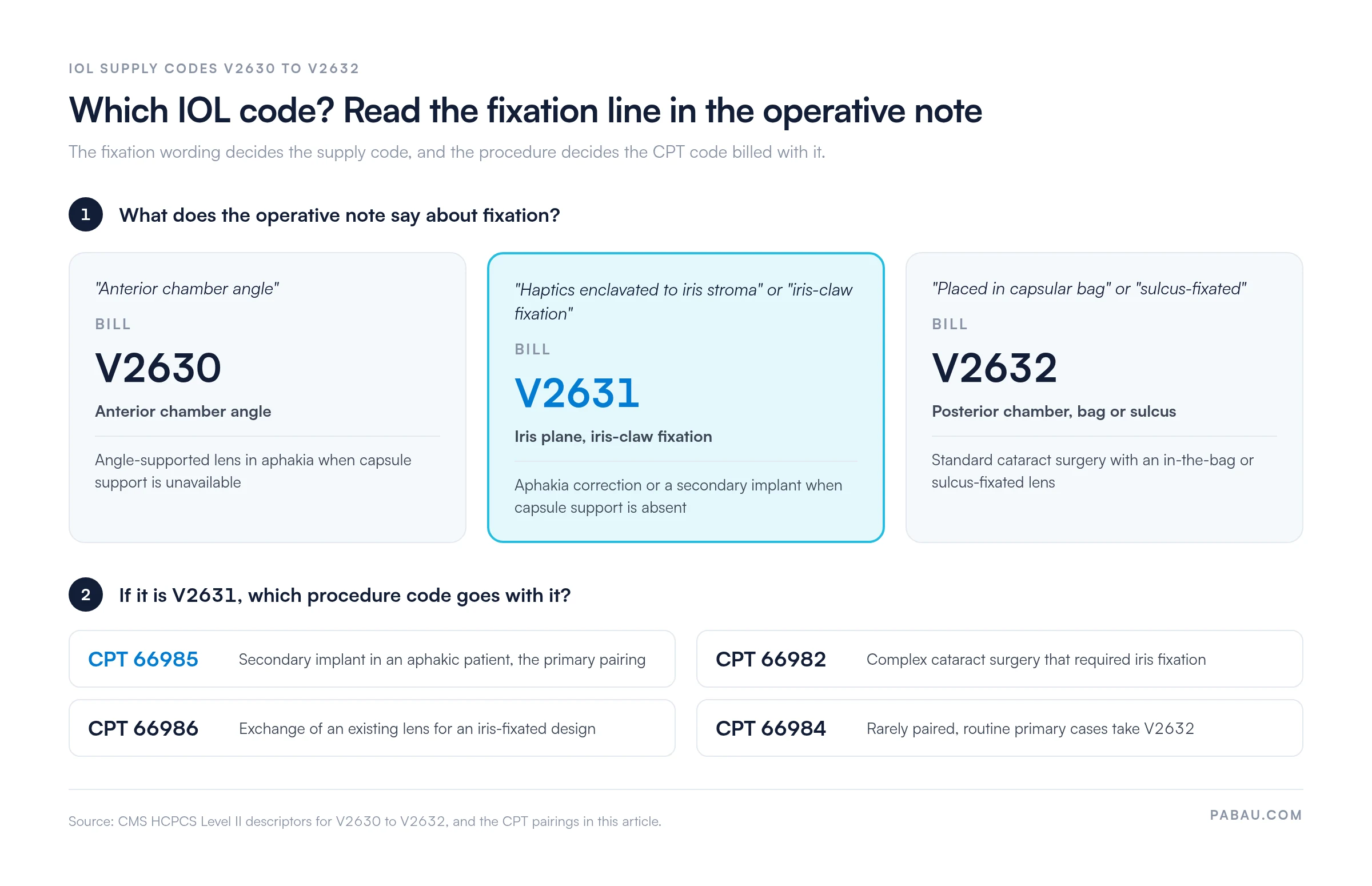
Most V2631 claims involve aphakic patients who receive a secondary implant, usually billed with CPT 66985, because the posterior capsule can't support a standard lens. Anterior chamber lenses take V2630, and posterior chamber lenses take V2632.
Let Pabau's smart automation suggest the right codes, reduce claim denials, and keep your practice compliant—effortlessly.
Automate repetitive tasks and focus on what matters most—your patients.
Reduce coding errors and ensure compliance with the latest regulations.
Clean claims, fewer denials, and faster reimbursements.
Powerful insights and reporting to help your practice thrive.
HIPAA compliant SOC 2 certified GDPR-compliant Trusted by 4,000+ clinics worldwide

HCPCS Code V2631 identifies an iris-supported IOL fixated at the iris plane, not in the anterior or posterior chamber.
The fixation wording in the operative note decides the code, and iris-claw or iris-stroma fixation supports V2631.
V2631 is billed separately on the CMS-1500 when the surgeon supplies the lens in an office. ASC and hospital outpatient payments usually package it.
Medicare Part B covers iris-supported IOLs mainly for aphakia or when posterior chamber placement is contraindicated, not routine cataract cases.
Claims management software like Pabau checks required claim fields and tracks each claim’s status, while code and modifier choices stay with your coder.
HCPCS Code V2631 covers a single intraocular lens that the Centers for Medicare and Medicaid Services (CMS) classifies as an iris-supported (iris-fixated) design. The lens sits at the iris plane rather than in the anterior or posterior chamber, which is why it has its own code.
In the CMS HCPCS Level II code set, V2631 is a supply code in the V section, which covers vision, hearing and speech-language pathology services. It reports the lens itself. The implantation is reported with its own CPT code, most often CPT 66985 for a secondary implant.
The parenthetical “(new and used when applicable)” in the long descriptor reflects CMS policy on reused devices. In rare cases, the IOL supplied to a patient may be a previously explanted lens. In practice, virtually all V2631 claims involve new devices.
V2631 is specific to the iris-fixated (iris-supported) lens design, sometimes called an iris-clip lens. The Artisan/Verisyse family of lenses is the best-known clinical example. Correct code selection depends on where the lens is anatomically positioned and how it is fixated.
The aphakic vs. pseudophakic distinction matters for coverage. Most Medicare and commercial payer policies cover V2631 for aphakia correction or when posterior chamber placement is clinically contraindicated. Routine primary cataract surgery with a standard posterior chamber IOL should be coded V2632, not V2631.
The V263x family covers all three IOL positions, and each code maps to one fixation method. Use the table below to match the clinical scenario to the correct code.
The operative report is the controlling document. Coders should look for the fixation descriptor: “haptics enclavated to iris stroma” or “iris-claw fixation” signals V2631. “Placed in capsular bag” or “sulcus-fixated” signals V2632. “Anterior chamber angle” signals V2630. The chart below maps that wording to a code, then to the CPT code it usually travels with.
Iris-supported IOL implantation is most common as a secondary implant. The typical patient is aphakic after a previous cataract extraction left no posterior capsule support, or after the capsule ruptured during the initial surgery. The procedure can also be performed as a primary implant when standard posterior chamber placement is not feasible.
For billing purposes, the operative note must contain specific elements that justify V2631 over V2632. A generic “IOL implanted” notation is not enough. The superbill should carry the same clinical details as the full operative record.
Secondary IOL implantation is coded with CPT 66985. When billing V2631 alongside CPT 66985, the operative note must substantiate both the procedure and the specific lens type billed.
Medicare Part B covers intraocular lenses furnished during or after cataract surgery. V2631 is packaged into the facility payment the same way as other IOLs. That holds under both the Outpatient Prospective Payment System (OPPS) and the Ambulatory Surgery Center (ASC) fee schedule. Separate billing mainly applies in the physician office, where the surgeon supplies the lens.
Verify the patient’s coverage before the procedure, since Medicare Administrative Contractors (MACs) can differ in their Local Coverage Determinations (LCDs) for iris-supported IOLs.
MAC-specific LCD requirements for iris-supported IOLs may restrict coverage to FDA-approved devices for defined indications. Coders at practices served by Noridian, CGS, Palmetto, Novitas, or NGS should check their MAC’s active LCD for ophthalmology IOL policies before billing.
Before billing V2631 for any patient, confirm whether your MAC has an active LCD for iris-supported IOLs. Search the CMS Medicare Coverage Database by your contractor number and the keyword ‘intraocular lens.’ A missing or expired LCD does not mean coverage is absent. It does mean the claim faces the MAC’s internal medical review criteria, so document against them up front.
Medicare’s payment structure for HCPCS Code V2631 depends on the care setting. For Medicare Part B, the CMS Physician Fee Schedule lookup tool allows coders to verify current allowable amounts by MAC locality.
Iris-supported IOLs are implanted less often than standard posterior chamber lenses. As a result, some MAC fee schedule entries for V2631 are contractor-priced rather than set nationally.
Rates change every year and vary by locality, so verify any 2026 dollar figure for V2631 against the CMS-published fee schedule files. The table below shows how payment is structured rather than a national dollar amount.
Use the AAPC Codify HCPCS lookup or the PGM Billing HCPCS lookup tool to cross-reference the descriptor. Confirm the current year payment status there before submitting claims.
V2631 claim denials follow predictable patterns. Most come from the wrong code, a wrong assumption about packaging, or an operative note that leaves out the fixation method or lens model. Each of the six below can be caught before the claim leaves the practice.
Commercial payer policies for V2631 differ materially from Medicare. Most commercial plans follow Medicare’s coverage framework as a baseline but impose additional prior authorization requirements or coverage restrictions for iris-supported IOLs specifically.
Build each payer’s coverage rules for V2631 into the pre-authorization workflow. A coverage limit found at the remittance stage costs far more to recover than a policy check at scheduling.
V2631 identifies the lens, not the surgery. The companion CPT code describes what the surgeon did, and the pair has to match the operative note. When a complex cataract case required iris fixation, for example, V2631 goes with CPT 66982. A mismatched pair triggers claim edits or denials.
Apply the LT (left eye) or RT (right eye) modifier to show which eye was treated. The KX modifier signals that documentation on file meets coverage criteria. Some MACs require it on iris-supported IOL claims submitted against an LCD, so confirm modifier requirements with your MAC.
When billing CPT 66985 with V2631, confirm the claim carries the aphakia diagnosis code for the right eye (ICD-10-CM H27.00-H27.03). A mismatch between the supply code, the procedure code, and the diagnosis code reliably triggers denials on secondary IOL claims. Build a code triplet check into your billing workflow.
Most ophthalmology billing teams check V2631 claims by hand. They pull the operative note, confirm the fixation method, then chase missing membership numbers or authorization codes before submission. When one field slips through, the claim comes back and the rework starts.
Practice management software like Pabau takes on the admin around that check. Its claims management software validates required fields, such as membership numbers and authorization codes, before a claim goes out. It then routes the claim to the insurer through a clearinghouse such as Claim.MD and tracks its status.
Your coder still chooses the code pair and the modifiers. What changes is that incomplete claims stop leaving the practice. Your team can also see which V2631 claims are paid, pending or rejected without phoning the payer.
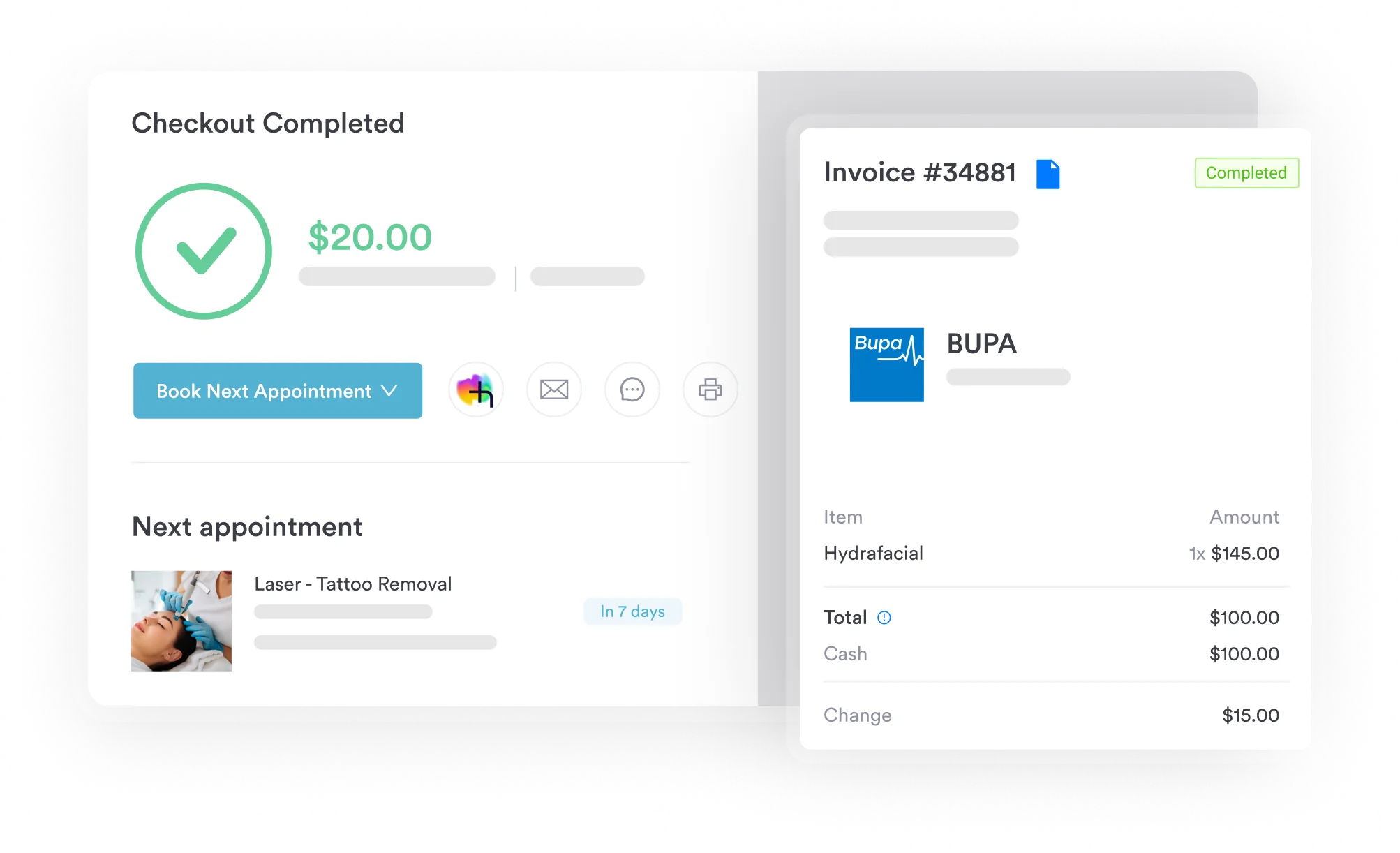

Pabau’s claims management software checks required fields like authorization codes before submission, then tracks every claim’s status. Your team spends less time on rework and payer follow-up calls.

The fixation line in the operative note is where a V2631 claim is won or lost. If it names iris-claw or iris-stroma fixation, bill V2631 with the CPT code that matches the procedure. If it doesn’t, query the surgeon before the claim goes anywhere.
Check the setting next, because an ASC or hospital usually packages the lens while an office claim carries it separately. Then confirm the MAC’s LCD and any commercial prior authorization at scheduling, while a fix is still cheap.
Book a demo to see how Pabau keeps your ophthalmology claims complete and tracked from submission to payment.

Working through a denial on a V2631 claim? Denial management in healthcare covers the classification, appeal, and prevention strategies for common denial types.
Want fewer claims sent back for missing data? What is a clean claim in medical billing? explains the fields and checks that get a claim paid on first submission.
Recording the lens and procedure for the patient’s bill? What is a superbill? walks through the codes and details a superbill needs to support a claim.
Need the full claim lifecycle in one place? What is medical billing explains the end-to-end claim lifecycle from procedure to payment posting.
Comparing platforms for HCPCS billing workflows? Best medical billing software for US practices compares platforms that support HCPCS Level II coding workflows.
HCPCS Code V2631 is the Level II supply code for an iris-supported (iris-fixated) intraocular lens. It sits between V2630 for anterior chamber lenses and V2632 for posterior chamber lenses. It reports the lens device, while a separate CPT code reports the implantation.
V2630 covers an anterior chamber, angle-supported IOL, while V2631 covers an iris-plane (iris-claw or iris-clip) IOL. The fixation method and lens position decide between them, so the operative report must document both.
Yes. Medicare Part B covers V2631 for medically necessary iris-supported IOL implantation, mainly for aphakia or when posterior chamber placement is contraindicated. Routine primary cataract surgery with a standard posterior chamber lens takes V2632 instead. MAC-specific LCD requirements may also apply.
The most common reason is billing V2632 because nobody checked the fixation method in the operative note. Next come not billing the lens separately when the surgeon supplied it in an office, and missing medical-necessity documentation for the iris-fixated design.
Yes, when the surgeon or practice supplies the lens in an office setting. V2631 then goes on the CMS-1500 alongside the procedure code, most often CPT 66985 for a secondary implant. In ASC and hospital outpatient settings, the lens is usually packaged into the facility payment.
It varies by state. Some state Medicaid programs list iris-supported IOLs in their vision fee schedules, while others cover them only for specific indications. Verify coverage with the patient’s state Medicaid program before the procedure.