

HCPCS Code L0472: Hyperextension TLSO billing guide
HCPCS code L0472: Official descriptor and device definition HCPCS code L0472 des...

Last Updated: Nov 5, 2026
C1768 is the HCPCS Level II code for a vascular graft, reported on hospital outpatient claims under the Outpatient Prospective Payment System (OPPS).
It is a device category C-code that hospitals report with the CPT code for the implanting procedure, such as a dialysis access graft. Its transitional pass-through period has ended. Medicare now packages the graft into the procedure payment, so the C1768 line has no separate OPPS or ASC payment.
Let Pabau's smart automation suggest the right codes, reduce claim denials, and keep your practice compliant—effortlessly.
Automate repetitive tasks and focus on what matters most—your patients.
Reduce coding errors and ensure compliance with the latest regulations.
Clean claims, fewer denials, and faster reimbursements.
Powerful insights and reporting to help your practice thrive.
HIPAA compliant SOC 2 certified GDPR-compliant Trusted by 4,000+ clinics worldwide

HCPCS Code C1768 is the OPPS device category code for an implanted vascular graft, and its official CMS descriptor is Graft, vascular.
C1768 carries status indicator N in the October 2026 OPPS Addendum B, so Medicare packages the graft into the procedure payment.
Hospitals still report C1768 with the implanting CPT code, because CMS uses packaged device charges when it recalculates APC rates.
In an ambulatory surgical center, C1768 carries payment indicator N1, which also means a packaged item with no separate payment.
The diagnosis on the claim must support the procedure performed, such as end-stage renal disease for a dialysis access graft.
HCPCS Code C1768 is the Level II code hospitals use to report an implanted vascular graft on a Medicare outpatient claim. The official CMS descriptor is Graft, vascular, and the short descriptor reads the same. It belongs to the C-code series that CMS maintains for the Hospital Outpatient Prospective Payment System (OPPS).
The code describes the graft itself, not the surgery. A vascular graft is a synthetic or biological conduit that a surgeon sews in to bypass, replace, or connect blood vessels. The procedure that places it is reported separately with its own CPT code.
Report C1768 when a vascular graft is implanted during a procedure performed as a hospital outpatient case. The most common outpatient example is dialysis access built with a nonautogenous arteriovenous graft, reported with CPT 36830.
Open aortic and most lower-extremity bypass operations, including aortobifemoral bypass, are usually inpatient cases. Inpatient claims do not carry C-codes, because the graft cost sits inside the MS-DRG payment. An autogenous graft, such as a patient’s own saphenous vein, is tissue rather than a device, so it is not reported with C1768.
The C-code series holds more than transitional pass-through codes. It also carries new technology services, drugs, and device category codes whose pass-through period has ended. C1768 is in that last group.
Transitional pass-through payment for devices is governed by 42 CFR 419.66. It limits a device category to at least two and no more than three years of separate payment. C1768 was one of the original device category codes, and its pass-through period ended long ago. Since then Medicare has packaged the graft into the payment for the procedure that implants it.
Packaging does not make the code optional. CMS uses the device charges on outpatient claims when it recalculates APC payment rates. A missing C1768 line understates the procedure’s cost in future years. Check the current OPPS Addendum B each quarter, because CMS can change status indicators with any update.
Nearby C-codes cover other implanted or insertable devices, and several of them are used in the same vascular procedures. Code from the implant log rather than the procedure name. Every descriptor below is taken from the October 2026 CMS HCPCS file.
Before the claim drops, match each line of the implant log to a device code. A graft, a closure device, and a guide wire used in one access procedure each take their own C-code. One generic device line understates the case.
Because C1768 is packaged, documentation matters less for the line payment and more for the procedure it supports. The record should show which graft was implanted, why, and during which procedure. Strong billing compliance requirements start with a consistent checklist.
No diagnosis list is tied to C1768 itself. Medical necessity is judged on the procedure that implants the graft, so the supporting ICD-10-CM diagnosis must back that procedure. For a dialysis access graft, the record usually documents end-stage renal disease (N18.6) or chronic kidney disease, stage 5 (N18.5).
If a local coverage determination applies, it attaches to the procedure code, so check the procedure against your MAC’s policies.
Most C1768 problems come from setting and claim-type errors, not from the code itself. A packaged line that pays $0 is working as designed, so it is not a denial to appeal. Structured denial management in healthcare starts with separating the two.
The device edit comes from section 61.2 of chapter 4 of the Medicare Claims Processing Manual, in force since January 1, 2017. A pre-submission check on setting, claim type, and device codes prevents most of these problems. Submitting a clean claim from the outset is faster than reworking a returned one.
Commercial payers do not have to follow OPPS packaging. Some hospital contracts pay implants separately as a percentage of invoice cost, so check each contract before writing off a C1768 line.
Which claim carries C1768 depends on who bills the facility side of the procedure. The grid below maps each care setting to its claim and its payment.
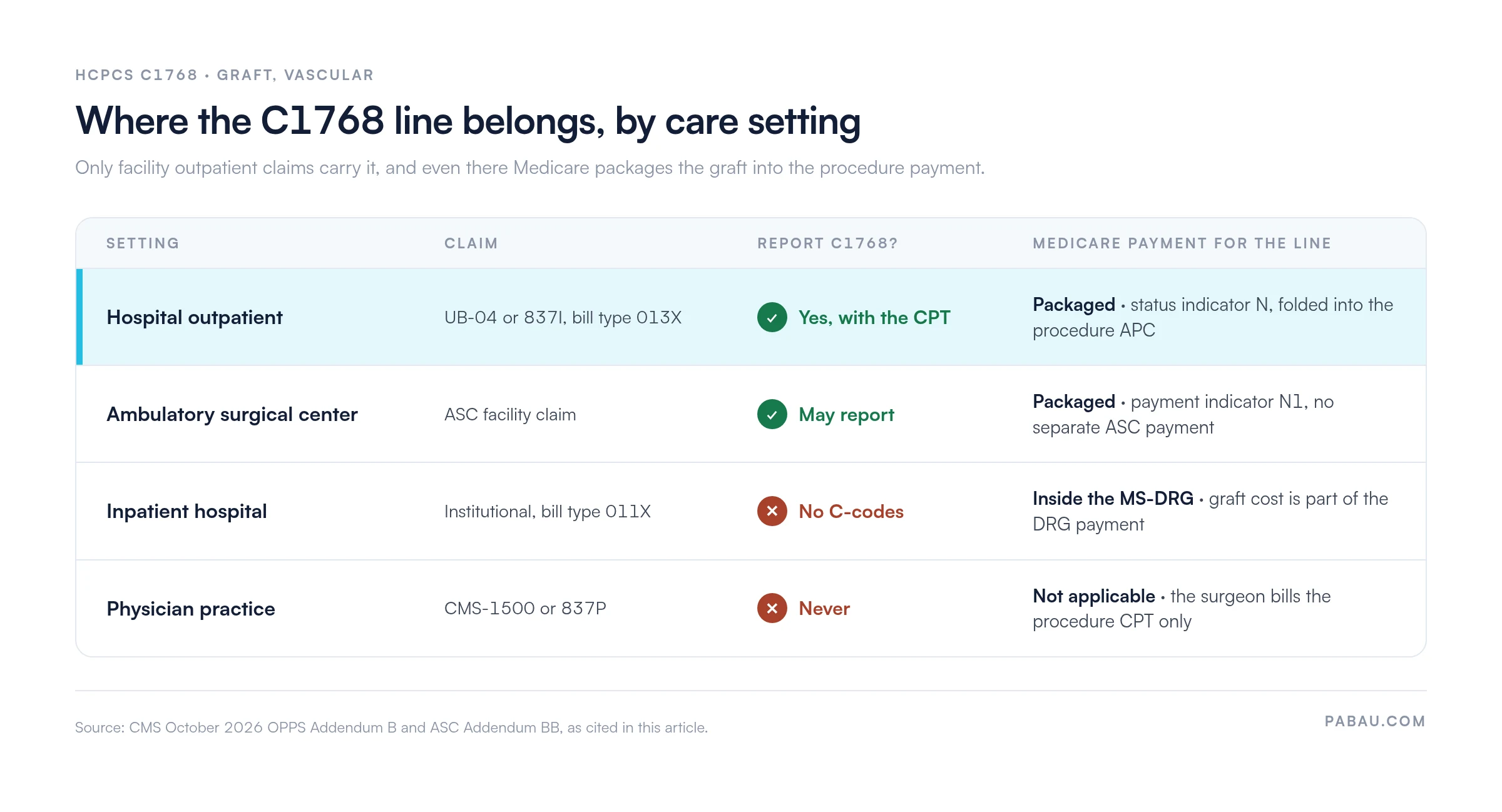
Under revenue cycle management, the split matters. The hospital bills the facility side with the graft, and the surgeon’s practice bills only the professional side.
C1768 sits on the hospital’s claim, but the surgeon’s practice still bills the professional side of the same procedure. That claim depends on the operative note, the diagnosis, and the patient’s insurance details being right and in one place.
Pabau, the practice management platform we build, keeps patient records, treatment notes, and insurance details together. Its claims management workflows build a claim from data already on the patient record. For US practices, Pabau then submits the claim through Claim.MD and tracks its status through to payment.

Your billing team sees which claims are pending, paid, or in error without chasing each payer separately. That leaves more time to answer a hospital coder’s query about the operative note before either claim goes out.

Pabau builds claims from the data on each patient record, submits them through Claim.MD for US practices, and tracks every claim to payment.

Treat C1768 as a reporting obligation rather than a revenue line. Medicare packages the graft, so the value of getting it right shows up in future APC rates and in claims that are not returned. Code it from the implant log, keep it on the outpatient claim, and let the diagnosis support the procedure.
The trade-off is a little extra coding work on a line that pays $0. In return, the hospital gets accurate cost data in future APC rates and fewer claims returned by the device edit. Book a demo to see how Pabau helps your practice submit and track the surgeon’s claims for these procedures.

Need to understand how clearinghouse edits affect device claims? Denial management in healthcare covers the full appeal and prevention workflow for outpatient billing teams.
Want to see how clean-claim requirements apply to institutional submissions? Submitting a clean claim explains the elements payers validate before adjudication.
Looking for a broader overview of outpatient billing compliance? Billing compliance requirements walks through documentation, coding accuracy, and payer-specific rules.
Revising an existing dialysis access? CPT code 36832 covers open revision of an AV fistula or graft and how it is billed.
Closing the arterial access site as well? HCPCS code C1760 explains when a vascular closure device takes its own C-code line.
HCPCS Code C1768 covers an implanted vascular graft, and its official CMS descriptor is Graft, vascular. Hospitals report it on outpatient claims with the CPT code for the procedure that places the graft, such as a dialysis access graft.
No. C1768 is a device category code whose transitional pass-through period ended long ago. The October 2026 OPPS Addendum B lists it with status indicator N, so Medicare packages its cost into the procedure payment.
The operative report should name the graft by manufacturer, product, size, and placement site. The implant log or device sticker records its lot or serial number. The claim also needs the procedure CPT code and a diagnosis that supports that procedure.
C1768 itself does not trigger prior authorization. Any requirement attaches to the procedure that places the graft, so check that CPT code against each payer list. Commercial and Medicare Advantage plans set their own rules.
An ASC can report C1768, but it is not paid separately there. The October 2026 ASC addendum assigns it payment indicator N1, which means a packaged item with no separate payment.
No diagnosis list is tied to C1768 itself, because the diagnosis must support the procedure performed. For a dialysis access graft, that is usually end-stage renal disease (N18.6) or chronic kidney disease, stage 5 (N18.5).



