

CPT Code 30801: Superficial turbinate ablation billing guide
CPT Code 30801: Official descriptor and procedure overview The American Medical ...

Last Updated: Nov 27, 2026
36819 is the CPT code for arteriovenous anastomosis, open; by upper arm basilic vein transposition. It reports a new hemodialysis fistula built from the basilic vein. The surgeon frees the vein from beneath the fascia, reroutes it through a superficial tunnel, and joins it to the brachial artery.
The transposition is what separates 36819 from 36821, a direct anastomosis that leaves the vein in place. Cephalic vein transposition in the upper arm is reported with 36818, and a revision of an existing fistula with 36832.
Let Pabau's smart automation suggest the right codes, reduce claim denials, and keep your practice compliant—effortlessly.
Automate repetitive tasks and focus on what matters most—your patients.
Reduce coding errors and ensure compliance with the latest regulations.
Clean claims, fewer denials, and faster reimbursements.
Powerful insights and reporting to help your practice thrive.
HIPAA compliant SOC 2 certified GDPR-compliant Trusted by 4,000+ clinics worldwide

CPT code 36819 reports a new upper arm AV fistula made by basilic vein transposition. A direct anastomosis is 36821, and a fistula revision is 36832.
A staged Stage 2 billed inside Stage 1’s global period needs modifier 58. Coders still disagree on whether Stage 2 is 36819 or 36832.
Medicare covers most ESRD patients at any age, but an employer group health plan pays first during the 30-month coordination period.
Allowed amounts for 36819 vary by locality and change every year, so check the CMS Physician Fee Schedule lookup before you quote a figure.
Pabau’s claims management software sends 36819 claims through the Claim.MD clearinghouse and warns when a prior authorization is missing.
CPT code 36819 is defined by the AMA as arteriovenous anastomosis, open; by upper arm basilic vein transposition. Medicare lists the same descriptor, separate from 36818 for the cephalic vein, in CMS’s October 2024 OPPS update.
The surgeon mobilizes the deep basilic vein, moves it to a superficial position, and joins it to the brachial artery. The resulting fistula can then be cannulated repeatedly for hemodialysis.
The key clinical distinction is the transposition. In a radiocephalic or brachiocephalic AV fistula, the vein already sits where it can be joined to the artery directly. The basilic vein sits deep in the upper arm, beneath the fascia.
Transposing it takes a longer incision, fascial release, and rerouting through a subcutaneous tunnel. That additional surgical work is what 36819 captures.
The bundle for CPT code 36819 covers each surgical step needed to create the transposed fistula. Know where it ends before you submit secondary charges. Billing separately for work already captured in 36819 is unbundling, and it is a common audit trigger.
Included in 36819:
Not included, and separately billable when performed:
Documentation is what keeps a 36819 claim intact on audit. The operative report must reflect each element of the transposition, not just the fact that an AV fistula was created. Payers and MACs look for language in vascular access notes that confirms the transposition happened. Without it, the auditor recodes the claim to 36821 (direct anastomosis) and the payment difference is recouped.
The operative note should explicitly address each of these elements:
When the operative note omits any of these elements, a payer’s coding auditor cannot confirm that a transposition was performed. The claim is downcoded to 36821 and the practice absorbs the difference.
Ask the surgeon to include a brief statement in the operative note confirming the basilic vein was transposed subcutaneously, not simply anastomosed in situ. That single sentence is what separates a defensible 36819 claim from one that gets downcoded on review.
The descriptors in this code family read so alike that wrong-code selection is a frequent denial reason on upper arm AV fistula claims. The table below maps the four codes coders most often confuse, including 36830 for a synthetic graft.
The mix-up with 36832 arises most often in staged basilic vein transposition cases (see the next section). The mix-up with 36821 starts with operative notes that describe the anastomosis but never state the transposition. The coder is left guessing and defaults to the simpler code.
Taken in order, three questions settle the choice between all four codes, as the chart below shows.
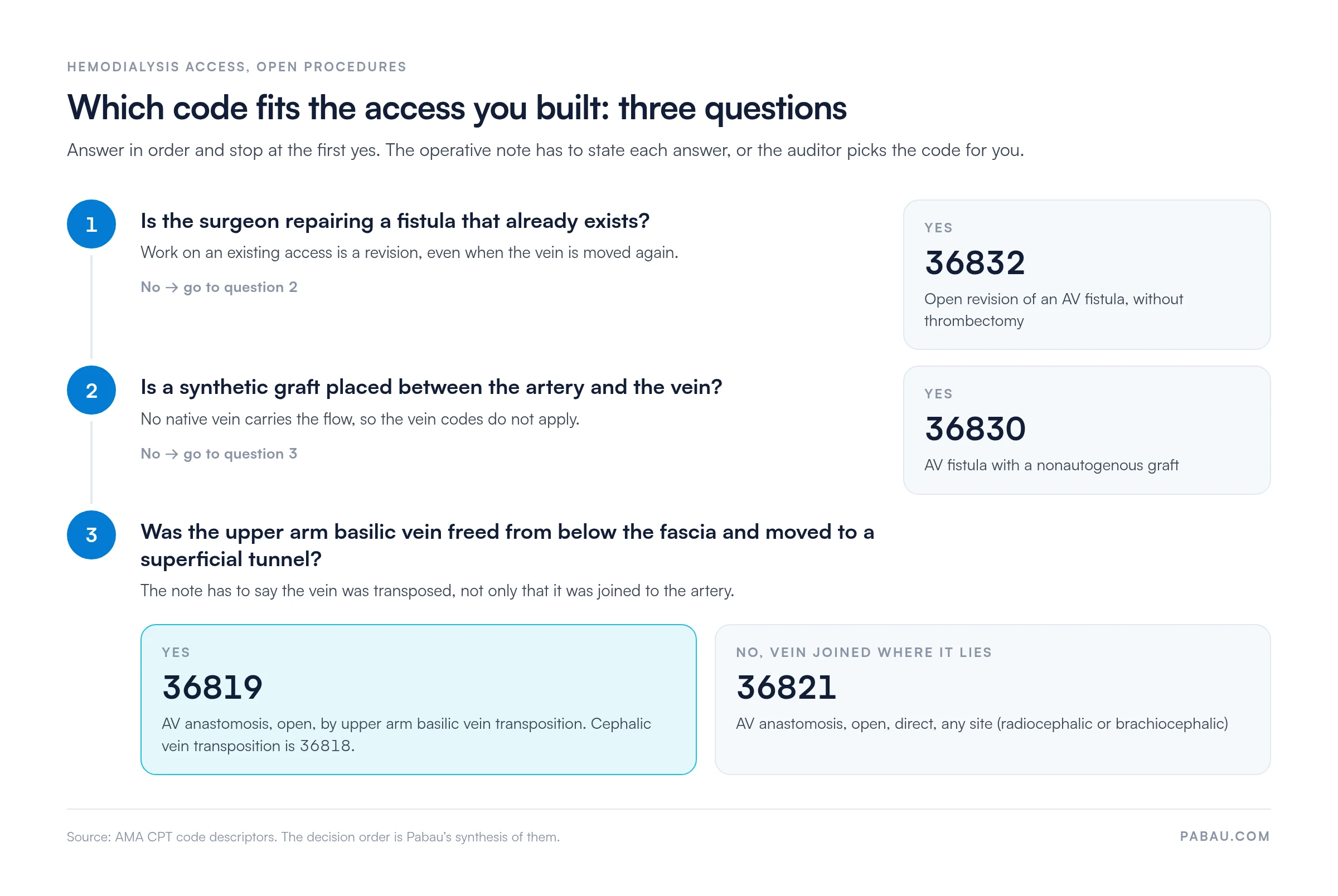
Staged cases are where that order matters most, because Stage 2 touches a fistula that already exists.
Basilic vein transposition coding gets complex when the surgery is planned in two stages. Stage 1 creates the fistula and lets it mature. Stage 2, weeks to months later, transposes the matured vein to its final superficial position. Both stages involve substantial surgical work, and each must be billed correctly.
The question that splits coders is which code applies to Stage 2 when it falls inside Stage 1’s 90-day global period. Some say 36819, and others say 36832.
The governing modifier rule is clear. Under CMS Claims Processing Manual guidance, modifier 58 applies when the same physician performs a staged or related procedure during the original procedure’s postoperative period. The second procedure must have been planned prospectively. Modifier 58 starts a new global period for the second procedure.
The code for Stage 2 is where coding experts disagree. Some coders and surgeons argue Stage 2 completes a new fistula and belongs under 36819-58. Others treat it as a revision of the existing access, billed as 36832-58. The split shows up in AAPC forum threads and in direct questions to coding resources. No published AMA guidance settles it as of this writing, so the safest course is to:
Every CPT code 36819 claim needs at least one ICD-10-CM diagnosis code that establishes medical necessity for the procedure. For ESRD patients, who make up most 36819 cases, the primary diagnosis codes are well established. Supporting codes document the clinical indication and any comorbidities that payers may require.
Verify every ICD-10-CM code against the current year’s official code set before submission. Codes are updated annually, and effective dates matter for Medicare claims.
The CDC/NCHS ICD-10-CM web tool is the authoritative source for current US code definitions. For a supporting diagnosis outside this table, browse our ICD-10-CM code reference.
Medicare covers most ESRD patients regardless of age, under the ESRD program in Social Security Act section 226A. A 35-year-old dialysis patient can hold Medicare just as a 72-year-old does. Who pays first depends on other cover. An employer group health plan stays primary during a 30-month coordination period, and Medicare becomes primary after it.
Reimbursement for CPT code 36819 is calculated from relative value units (RVUs) under the Medicare Physician Fee Schedule (MPFS). Three RVU components apply: work RVU (physician effort), practice expense RVU (overhead), and malpractice RVU.
Each is adjusted by the geographic practice cost index (GPCI) and multiplied by the annual conversion factor. The allowed amount for 36819 therefore varies by state and by metropolitan area.
Site of service also matters. The practice expense RVU differs between facility settings (hospital outpatient, ambulatory surgical center) and non-facility settings (office).
Most 36819 procedures happen in a facility, so the facility-rate practice expense RVU applies to the professional claim. A hospital outpatient department bills its own share under the Outpatient Prospective Payment System (OPPS).
A dollar figure published here would be out of date within months. Check the current allowed amount for 36819 in the CMS Physician Fee Schedule lookup tool, for the current year and your pricing locality.
The FastRVU lookup tool is a free alternative built on CMS data. It shows the work, PE, and MP RVU breakdown and the allowed amount for a ZIP code.
Medicare fee-for-service does not require prior authorization for CPT code 36819. Medicare Advantage plans and commercial payers often do require it for vascular access surgery, and their documentation requirements can be substantial.
When prior authorization applies, the documentation package typically needs to include:
Authorization policies change frequently. Confirm requirements with each commercial payer before scheduling the procedure. Some Medicare Advantage plans follow CMS fee-for-service policy and skip prior auth for established vascular access codes, while others require it.
Denials for CPT code 36819 cluster around a few recurring errors. Each has a direct corrective action, and the aim is to build those actions into the pre-submission workflow instead of fixing them on appeal.
CPT code 36819 carries a 90-day global surgical period. Confirm the global days for the current year in the CMS MPFS lookup, because CMS can reclassify codes. Routine follow-up visits inside the global period are included in the original payment and cannot be billed separately.
Three modifiers govern what can be billed separately during the global period:
High-complexity CPT codes like 36819 fail in the workflow as often as in the coding. A coder can pick the right code and still see a denial. The prior auth was never flagged, the eligibility check was skipped, or the modifier dropped off during charge entry.
Pabau, a practice management platform with built-in insurance billing, keeps the operative note and the claim on one patient record. Billing runs through its streamlined claims management, which sends CMS-1500 claims to US payers via the Claim.MD clearinghouse. Here is what that changes for a 36819 case:
Many practices billing 36819 also run a broader nephrology or surgical case mix. Our denial management overview and guidance on submitting clean claims cover the wider workflow these code-level rules fit into.

Pabau sends claims through the Claim.MD clearinghouse, checks eligibility, tracks prior authorizations, and posts remittances against the patient record. See how it handles 36819 billing.

A 36819 claim stands or falls on one sentence in the operative note, the one stating that the basilic vein was transposed. With it, the code holds up on audit. Without it, the claim drops to 36821 and the practice absorbs the difference.
Staged cases carry the most risk. Write the staged plan into the Stage 1 note and apply modifier 58 at Stage 2. Get a written coding opinion before a commercial Stage 2 claim goes out. Check the payer order for ESRD patients with employer cover, too.
Pabau keeps the operative note, the prior authorization and the Claim.MD submission on one patient record. Book a demo to see how it handles vascular access billing from the first stage to the last remittance.

Want to understand how clearinghouses fit into claims submission? Medical claims clearinghouse guide explains how clearinghouses validate and route claims before they reach the payer.
New to the billing side of vascular access? Medical billing fundamentals walks through the process from charge capture to payment.
CPT code 36819 is the AMA procedure code for open arteriovenous anastomosis by upper arm basilic vein transposition. It creates hemodialysis access in patients with end-stage renal disease. The surgeon mobilizes a deep upper arm vein and reroutes it to a superficial position, so it can be cannulated repeatedly for dialysis.
CPT 36819 requires vein transposition. The basilic vein is mobilized from its deep position and rerouted subcutaneously before the anastomosis. CPT 36821 is a direct arteriovenous anastomosis, with the vein joined in its native position. If the operative note does not document the transposition, auditors will downcode to 36821.
Coders disagree on this one. Modifier 58 applies when Stage 2 falls inside Stage 1’s 90-day global period and the staged intent was documented at Stage 1. Whether Stage 2 maps to 36819 or 36832 depends on the work performed and your MAC’s local coverage determination. Query your MAC and document the staged plan in the original operative note.
The allowed amount varies by geographic pricing locality and is updated annually. Look up the current work, practice expense, and malpractice RVUs for 36819 in the CMS Physician Fee Schedule lookup tool. Then apply the conversion factor and your locality’s GPCI. Never rely on a published dollar figure without checking it against the current year’s fee schedule.
Yes. Modifier 58 applies when the same physician performs a staged or related procedure during the global period. The staging must have been planned and documented at the first procedure. A new global period then starts for the second procedure. It is not appropriate if Stage 2 was not anticipated or documented as planned at Stage 1.
The most common trigger is selecting 36832 instead of 36819, which confuses revision with new creation. Others are a missing modifier 58 on a staged procedure inside the global period, and weak medical necessity documentation with no N18.6 or N18.5 code. A POS code that doesn’t match the surgical setting, or a missing prior authorization from a Medicare Advantage or commercial payer, also leads to denials.




