CPT code 21011: Excision of soft tissue tumor of the face
CPT code 21011: Official descriptor and procedure overview CPT code 21011, as pu...

Last Updated: Oct 8, 2026
36830 is the CPT code for creating an arteriovenous fistula with a nonautogenous graft, such as ePTFE, biological collagen, or a thermoplastic conduit. Surgeons use it when a dialysis patient has no vein suitable for a native fistula. A manufactured tube then joins the artery to the vein.
The graft material is the fact that decides the code. A note that names the conduit supports 36830, while vague graft documentation is a common reason for audit queries and downcoding. Getting that detail right, along with laterality, the ESRD diagnosis, and prior authorization, is what moves a 36830 claim through on the first pass.
Let Pabau's smart automation suggest the right codes, reduce claim denials, and keep your practice compliant—effortlessly.
Automate repetitive tasks and focus on what matters most—your patients.
Reduce coding errors and ensure compliance with the latest regulations.
Clean claims, fewer denials, and faster reimbursements.
Powerful insights and reporting to help your practice thrive.
HIPAA compliant SOC 2 certified GDPR-compliant Trusted by 4,000+ clinics worldwide

CPT code 36830 reports AV access created with a nonautogenous graft, such as ePTFE, biological collagen, or a thermoplastic conduit.
Name the graft material and type in the operative note, because vague graft documentation is a common reason for audit queries and downcoding.
Medicare gives 36830 a 90-day global period and 18.18 total RVUs in 2026, or about $607 at the national conversion factor.
N18.6 for end-stage renal disease is the main diagnosis supporting medical necessity, and RT or LT shows the operative side.
Most Medicare Advantage and commercial plans require prior authorization, so confirm it is active on the date of service.
CPT code 36830 reports the surgical creation of an arteriovenous (AV) fistula using a nonautogenous graft. Put simply, the surgeon connects an artery to a vein with a manufactured tube instead of the patient’s own vessel.
Expanded PTFE (ePTFE), biological collagen, and thermoplastic conduits all qualify. A vein harvested from the patient does not, because that is an autogenous graft with its own code. Here are the reference fields to confirm before the claim goes out.
The clinical setting is almost always end-stage renal disease (ESRD), coded N18.6. These patients need permanent vascular access for dialysis, usually three times a week.
Surgeons choose a graft over a native fistula when vein mapping shows veins too small to use, or when earlier fistulas have failed. Common setups include upper arm loops, such as brachioaxillary grafts, and forearm loops. Thigh grafts are kept for patients whose arm access is exhausted.
The descriptor also labels 36830 a separate procedure. You can bill it on its own when it is the only access procedure performed. Payers bundle it when it is incidental to a larger service at the same session.
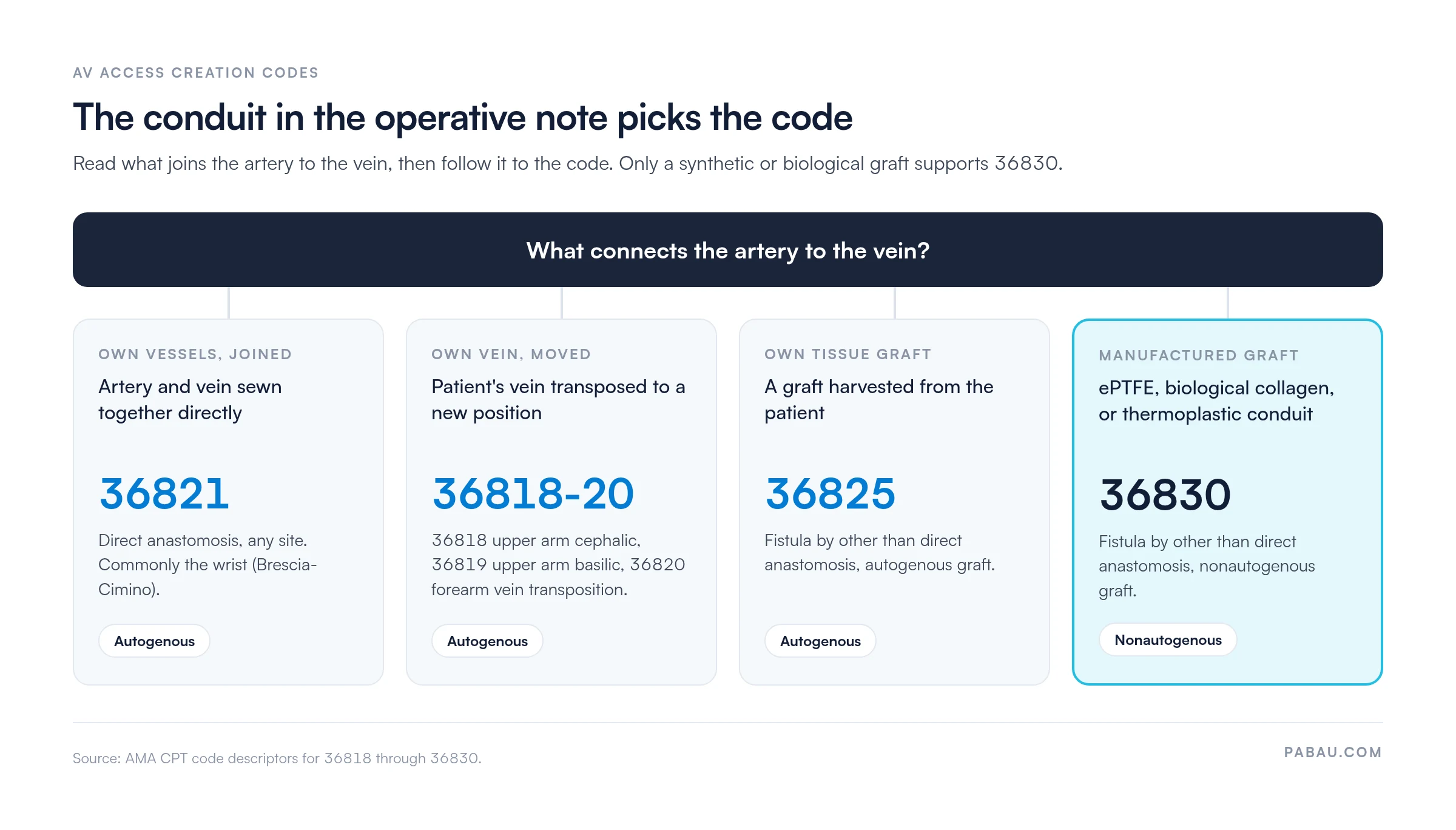
Codes 36818 to 36833 span AV access creation, open thrombectomy, and open revision. Picking the wrong one is a frequent compliance risk for nephrology and vascular surgery billers. The table shows where each code fits.
So the choice between 36821 and 36830 comes down to the operative note. If it names an ePTFE or other manufactured conduit, bill 36830. If the surgeon joined the patient’s own artery and vein directly, bill 36821 instead. The diagram below follows that same question across the creation codes.
Say the note reads “6 mm ePTFE loop graft, left forearm, brachial artery to antecubital vein.” That supports 36830 with modifier LT, and N18.6 as the linked diagnosis.
Now picture the same note saying only “graft placed.” An auditor can’t tell an autogenous graft from a manufactured one, so expect a records request before payment.
National Correct Coding Initiative (NCCI) edits treat 36821 and 36830 as mutually exclusive for the same session. Billing both for a single access creation is a compliance violation. Check current edit pairs in the CMS NCCI Policy Manual before submission.
A 36830 claim passes through five steps, and a miss at any one of them can stall payment. Here is the usual path in a surgical billing office.
Most denials trace back to the first three steps. Getting them right is what makes a clean claim, one the payer can process on the first pass.
A superbill that carries the code, modifier, and linked diagnosis from the encounter also cuts retyping at charge entry. The next sections take each step in turn, starting with the operative note.
Payer audits on 36830 usually start with the operative report. Vague graft-material documentation is a common reason for audit queries and downcoding. Check that each note supporting 36830 contains these elements.
A medical billing compliance program that standardizes operative-note templates makes these elements hard to skip. A required graft-material field is the simplest place to start.
Submitting 36830 without a diagnosis that establishes medical necessity is a frequent denial driver. These are the codes payers most often accept for the procedure. Accepted codes vary, so check payer policies and any Local Coverage Determination (LCD).
N18.6 is the primary diagnosis for 36830 in most cases. When a new graft replaces a failed fistula or graft, add an access-failure complication code, such as a vascular graft or fistula complication code. T82.49XA describes a catheter complication, so it fits only when a prior catheter problem is documented.
A vague or unrelated diagnosis, such as a hypertension code alone, is a reliable path to denial. Search the ICD-10-CM codes when you need the exact complication code for the access history.
Modifier selection on 36830 is a frequent source of claim rejections. The table shows when each modifier applies and the documentation that backs it.
Leaving off RT or LT, when a payer requires laterality, is a common rejection reason for 36830. Check each payer’s modifier rules at enrollment rather than discovering them at denial.
Medicare sets 36830 payment with the Resource-Based Relative Value Scale (RBRVS), and rates vary by geographic locality. The figures below are national values from the 2026 Medicare Physician Fee Schedule. Use the CMS Physician Fee Schedule look-up tool to check the rate for your MAC jurisdiction.
Both settings carry the same 18.18 total RVUs. Multiply that by the CY2026 conversion factor of about $33.40 ($33.4009) and you get roughly $607 nationally.
Your geographic practice cost index (GPCI) then adjusts that figure for your locality. For quick RVU checks without a CMS login, try the FastRVU look-up tool.
CPT code 36830 carries a 90-day global surgical period under Medicare. During that window, the operating surgeon can’t bill these services separately.
By contrast, these services can be billed separately during the global period, as long as the correct modifier is applied.
Mischaracterizing what sits inside the global package is a consistent overpayment audit finding. When in doubt, review the AAPC CPT guidance on the surgical package before billing post-op services separately.
Traditional Medicare does not require prior authorization (PA) for 36830. Medicare Advantage plans and most commercial payers do, because they treat it as a non-emergent surgery. Aetna, UnitedHealthcare, Cigna, and BCBS plans commonly require PA for AV graft creation.
A complete PA request for 36830 typically includes the following elements. Leaving one out extends the review or ends in a denial.
ESRD Network requirements may add documentation standards beyond the PA process. Confirm with the specific MAC or plan before scheduling. Then track PA status alongside the surgery date, so no case reaches the OR without approval.
Denials on 36830 cluster around six failure points. A denial management routine for vascular access works like one for any high-value surgical code: document first, submit second.
Run each claim against this list. It takes a minute and catches the six triggers above.
Run a quarterly audit of your 36830 claims. Pull every denial in the period, group them by reason code, and trace each one to documentation, modifier selection, or the PA workflow. Graft-material denials often share one operative note template that lacks a required field. Fixing that template once prevents the whole category.
In many vascular and nephrology practices, the 36830 claim is rebuilt by hand from the operative note. Someone retypes the codes, chases the PA number, and checks a clearinghouse portal for rejections.
Pabau, the practice management and billing platform we build, pre-fills the claim from the patient record instead. The CPT code attached to the service lands on the charge line, and ICD-10 codes come from the recorded problem list. Required fields, such as authorization numbers, must be complete before the claim can be sent.
US claims go out through the Claim.MD integration, with real-time eligibility checks and ERA posting. Pabau’s claims management software then tracks each claim to payment, so a rejected 36830 claim surfaces the day it fails.
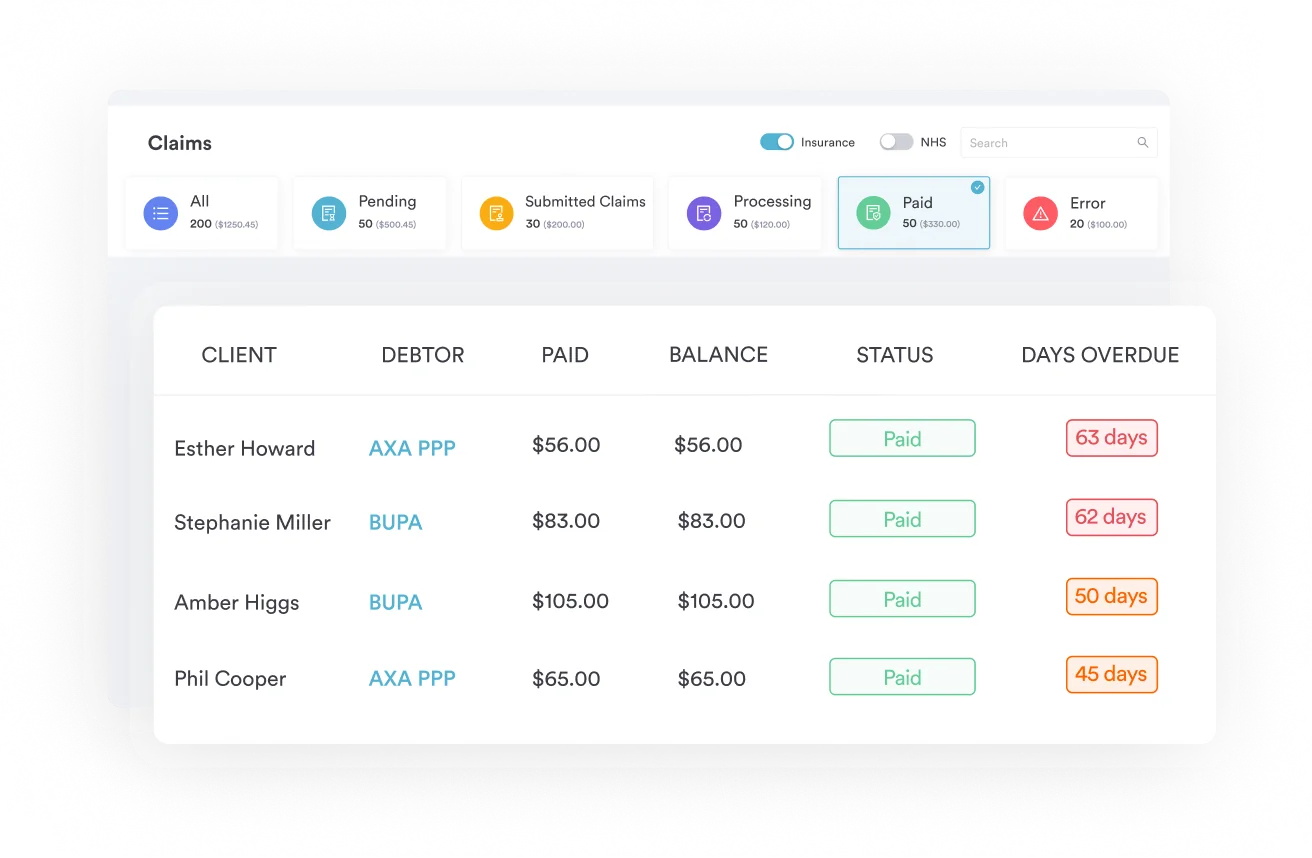

Pabau’s claims management software helps nephrology and vascular surgery practices link diagnosis codes and submit claims to your clearinghouse for codes including CPT 36830.

A clean 36830 claim starts in the operating room. When the note names the graft, the side, and why a native fistula wasn’t an option, the code choice follows.
The trade-off is a little more structure up front. A required graft-material field and a PA check at scheduling take minutes. In return, they head off the records requests and resubmissions that hold up payment.
Start with your next five 36830 notes and check them against the list above. Book a demo to see how Pabau carries the codes from those notes onto a ready-to-send claim.

Coding a native fistula instead? CPT code 36821 covers direct AV anastomosis with the patient’s own vessels.
Billing the dialysis sessions that follow? CPT code 90935 covers hemodialysis with a single evaluation.
Need to understand how claims reach your payer? Medical claims clearinghouse guide explains the electronic path from charge capture to ERA.
Dealing with ERA reconciliation after 36830 payment? Electronic remittance advice (ERA) in medical billing covers how to read and post 835 remittance files.
Want to decode the rejections on your 36830 claims? Denial codes in medical billing explains the CARC codes behind common rejections.
Both terms apply. The AMA descriptor calls it creation of an arteriovenous fistula, but clinicians call the result an AV graft. The fistula wording describes the artery-to-vein connection, and the manufactured conduit makes it a graft.
A standard ePTFE graft is usually cannulated two to four weeks after placement, once swelling settles. Early-cannulation grafts can be used within a few days. Until then, the patient often dialyzes through a tunneled catheter.
Yes, when they happen at separate sessions. CPT 36902 covers angioplasty of the peripheral dialysis segment with diagnostic angiography, usually to treat a narrowed circuit later. For the same encounter, check current NCCI edit tables first, since CMS updates them quarterly.
CPT 36901 reports a diagnostic fistulogram through direct puncture of the dialysis circuit. Codes 36147 and 36148 were deleted on January 1, 2017, when CPT moved access, imaging, and interpretation into 36901 to 36909. Report it apart from 36830 only as a distinct study.
N18.6, end-stage renal disease, is the primary supporting code. Z99.2, dependence on renal dialysis, is a common secondary code. When a graft replaces failed access, add an access-failure complication code, such as a vascular graft or fistula complication code. T82.49XA fits only a prior catheter complication.