CPT code 21011: Excision of soft tissue tumor of the face
CPT code 21011: Official descriptor and procedure overview CPT code 21011, as pu...

Last Updated: Oct 8, 2026
36832 is the CPT code for revision, open, arteriovenous fistula; without thrombectomy, autogenous or nonautogenous dialysis graft (separate procedure). It covers an open repair of a failing dialysis access, such as a stenosis or an aneurysm, when no clot is removed. If the surgeon also removes a clot, the claim moves to 36833.
Most denials on this code start with documentation, an operative note that never proves medical necessity. Missing laterality, the wrong global-period modifier and bundling with same-day endovascular work follow close behind.
Let Pabau's smart automation suggest the right codes, reduce claim denials, and keep your practice compliant—effortlessly.
Automate repetitive tasks and focus on what matters most—your patients.
Reduce coding errors and ensure compliance with the latest regulations.
Clean claims, fewer denials, and faster reimbursements.
Powerful insights and reporting to help your practice thrive.
HIPAA compliant SOC 2 certified GDPR-compliant Trusted by 4,000+ clinics worldwide

CPT code 36832 covers an open revision of an AV fistula or dialysis graft when no clot is removed.
Bill 36833 when the revision also removes a clot, and 36831 for an open thrombectomy without revision.
N18.6 and Z99.2 support medical necessity, while T82.590A or T82.858A describes the access problem itself.
The 90-day global means a related return to the OR needs modifier 78, and a planned staged procedure needs 58.
Most denials start with an operative note that never proves medical necessity, so fix the note before the claim.
CPT code 36832 is the code for an open revision of an arteriovenous (AV) fistula or dialysis graft when the surgeon removes no clot. The official descriptor reads “Revision, open, arteriovenous fistula; without thrombectomy, autogenous or nonautogenous dialysis graft (separate procedure).”
In plain terms, the surgeon opens the access to fix a stenosis, an aneurysm or a flow problem. “Autogenous” means the fistula is built from the patient’s own vein. “Nonautogenous” means a synthetic graft, and the same code covers both.
The “separate procedure” label matters too. When the revision is an incidental part of a bigger vascular operation at the same site, it’s bundled into that operation. Report 36832 on its own only when it’s the main service or clearly distinct.
The American Medical Association (AMA) maintains the CPT code set. It places 36832 in the hemodialysis access range, 36800-36861. Within that range, the absence of a thrombectomy is what defines this code.
Surgeons reach for 36832 when a working fistula develops a problem that needs open repair. Most of these patients have end-stage renal disease (ESRD) and depend on the access for dialysis.
Medicare and other payers expect documented medical necessity before they pay. These scenarios usually support the code:
N18.6 (end-stage renal disease) and Z99.2 (dependence on renal dialysis) are the diagnosis codes most often paired with 36832. For the access problem itself, coders turn to the T82 complication codes.
T82.590A covers other mechanical complications of a surgically created AV fistula. T82.858A covers stenosis of a vascular graft or access. Pick the one the operative note supports, and confirm it against the CDC’s ICD-10-CM tabular list.
Bundling decides whether a 36832 claim clears the National Correct Coding Initiative (NCCI) edits. CMS runs the NCCI and updates its procedure-to-procedure edits every quarter.
Because the edits change every quarter, check the current NCCI procedure-to-procedure edits before you bill 36832 with any endovascular code.
The 36818-36838 codes cover a tight spectrum of AV access work. Picking the wrong neighbor is a common cause of NCCI unbundling denials on dialysis access claims.
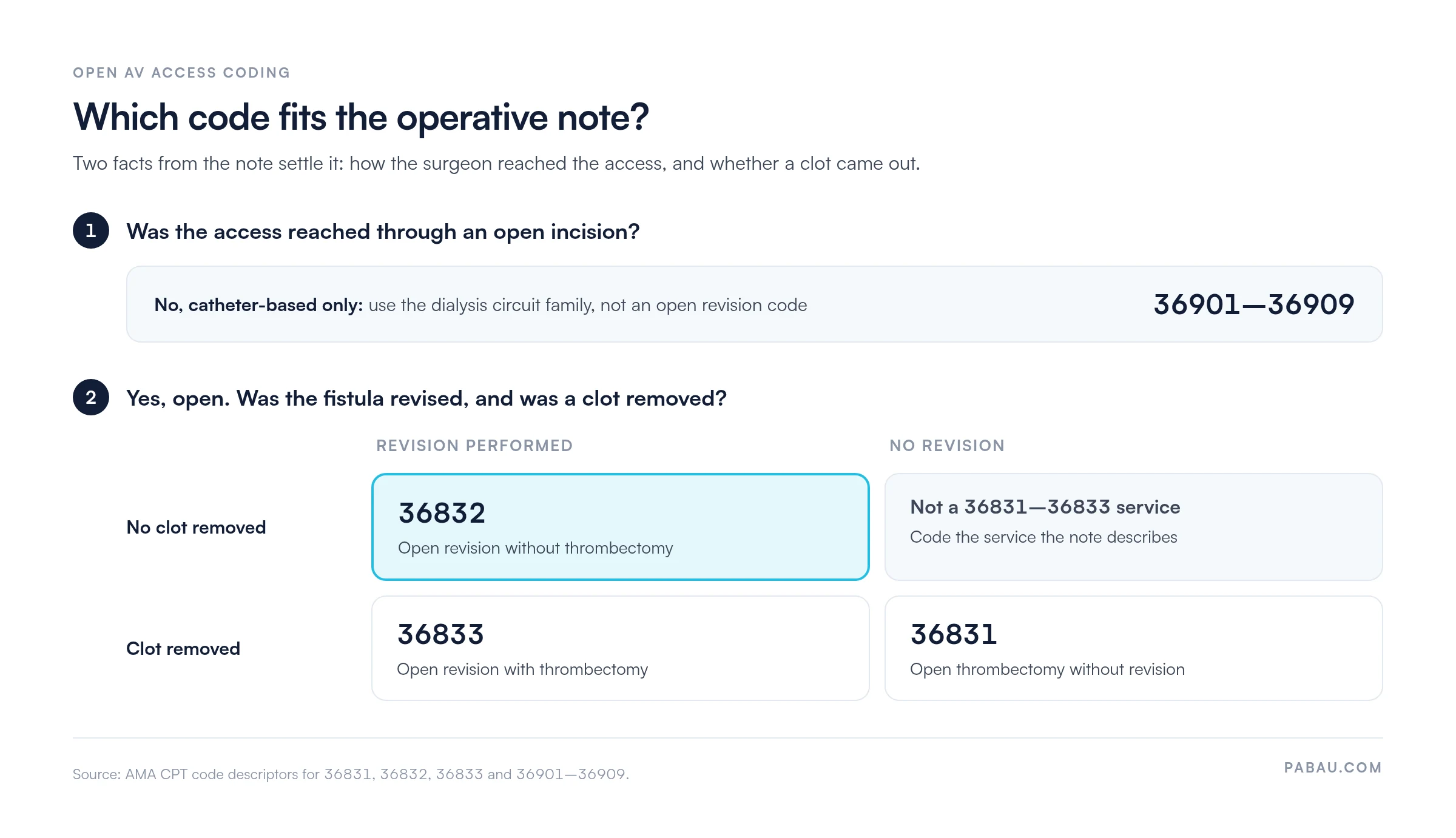
The selection rule comes down to three questions. Did the surgeon make an incision? Was the access revised? Was a clot removed?
Revision without clot removal is 36832. Revision with clot removal is 36833, and clot removal without revision is 36831. A purely percutaneous procedure moves to the 36901-36909 family instead, such as 36902 for circuit angioplasty. The chart below walks through the same logic.
Most modifier trouble on 36832 comes from the 90-day global, same-day endovascular work and laterality. The table covers the modifiers you’ll use most.
Medicare Administrative Contractors (MACs) apply modifier rules with some variation. Confirm what your MAC expects for LT and RT instead of leaving laterality off by default.
CPT code 36832 carries a 90-day global period. Routine pre-op and post-op care is bundled into the surgical payment for 90 days after the procedure.
CMS reviews global assignments from time to time. Confirm this year’s value in the CMS Physician Fee Schedule lookup before you rely on it.
Pull a list of patients in an active 36832 global period at the start of each month. Flag anyone booked for a follow-up procedure, and settle modifier 58, 78 or 79 before the claim goes out.
An incomplete operative note is the leading cause of medical necessity denials on 36832. Building medical billing compliance into the note itself saves appeal work later. Every 36832 note should include these elements:
A clean claim submission depends on checking these elements against the claim before it goes out. A CMS-1500 form missing the date of service, place of service code or rendering provider NPI gets rejected, which delays payment.
Once the surgeon signs the note, the claim follows a short path. The coder assigns 36832, the diagnoses and any modifiers. Next, the biller builds a CMS-1500, or its electronic version, the 837P.
The claim then goes through a clearinghouse to the payer. The payer runs its edits, pays or denies, and sends back a remittance advice. Most problems are cheaper to catch before the first step than after the last one.
Medicare pays the surgeon for 36832 under the Medicare Physician Fee Schedule (MPFS). The facility gets a separate payment.
Hospital outpatient departments are paid under the Outpatient Prospective Payment System (OPPS). Ambulatory surgery centers (ASCs) are paid under the ASC payment system. Rates vary by locality and update every January 1.
Dialysis facilities are paid under the ESRD Prospective Payment System (ESRD PPS), which bundles renal dialysis services. The surgeon’s open revision generally sits outside that bundle and is billed under the MPFS.
The CMS ESRD PPS page sets out the consolidated billing rules for each year. Check it when a dialysis facility asks whether a service belongs on its claim or yours.
Each state Medicaid agency sets its own fee for 36832, so there’s no single national rate. Some states tie their rates to Medicare, while others build independent schedules.
If the portal can’t search by code, ask your Medicaid provider relations representative for the current surgical fee schedule.
Traditional Medicare doesn’t currently require prior authorization for 36832. Coverage still depends on the applicable LCD or MAC policy, so meet its criteria before the surgery. Medicare Advantage plans set their own rules, which can differ sharply from traditional Medicare.
Run insurance eligibility verification before you schedule, so you know the patient’s plan and its requirements. Commercial and Medicaid payers commonly require prior authorization. A complete request includes:
Prior authorization denials usually cite medical necessity when imaging or flow data is missing. The strongest appeals show flow or pressure readings outside the payer’s or KDOQI-referenced thresholds. Tie those readings to the ICD-10 codes on the request.
Denials on 36832 cluster around documentation, bundling, the 90-day global and payer coverage rules. Track them apart from your other surgical denials with structured denial management workflows, so patterns surface sooner. The table maps each common reason to its fix.
Looking for patterns across dialysis access codes? The guide to medical billing denial codes shows which denials need a process fix and which need an appeal.
Set a 30-day follow-up on every 36832 claim when you submit it. If nothing has come back by then, ask the payer for the claim status. Catching a problem early leaves time to fix it well inside the timely filing limit.
Plenty of surgical practices still build claims by hand. A biller retypes the codes, chases a missing NPI and then waits to hear whether the claim landed.
Pabau, the practice management platform we build, connects to the Claim.MD clearinghouse for electronic claim submission. Its claims management software pre-fills the CMS-1500 or 837P from the patient record, with the CPT and ICD-10 codes already attached.
Pabau won’t send a claim until its required fields are complete. It also runs eligibility checks, tracks claim status and posts remittance advice. Modifier choice and global-period decisions stay with your coders, so your team spends its time on the claims that need judgment.
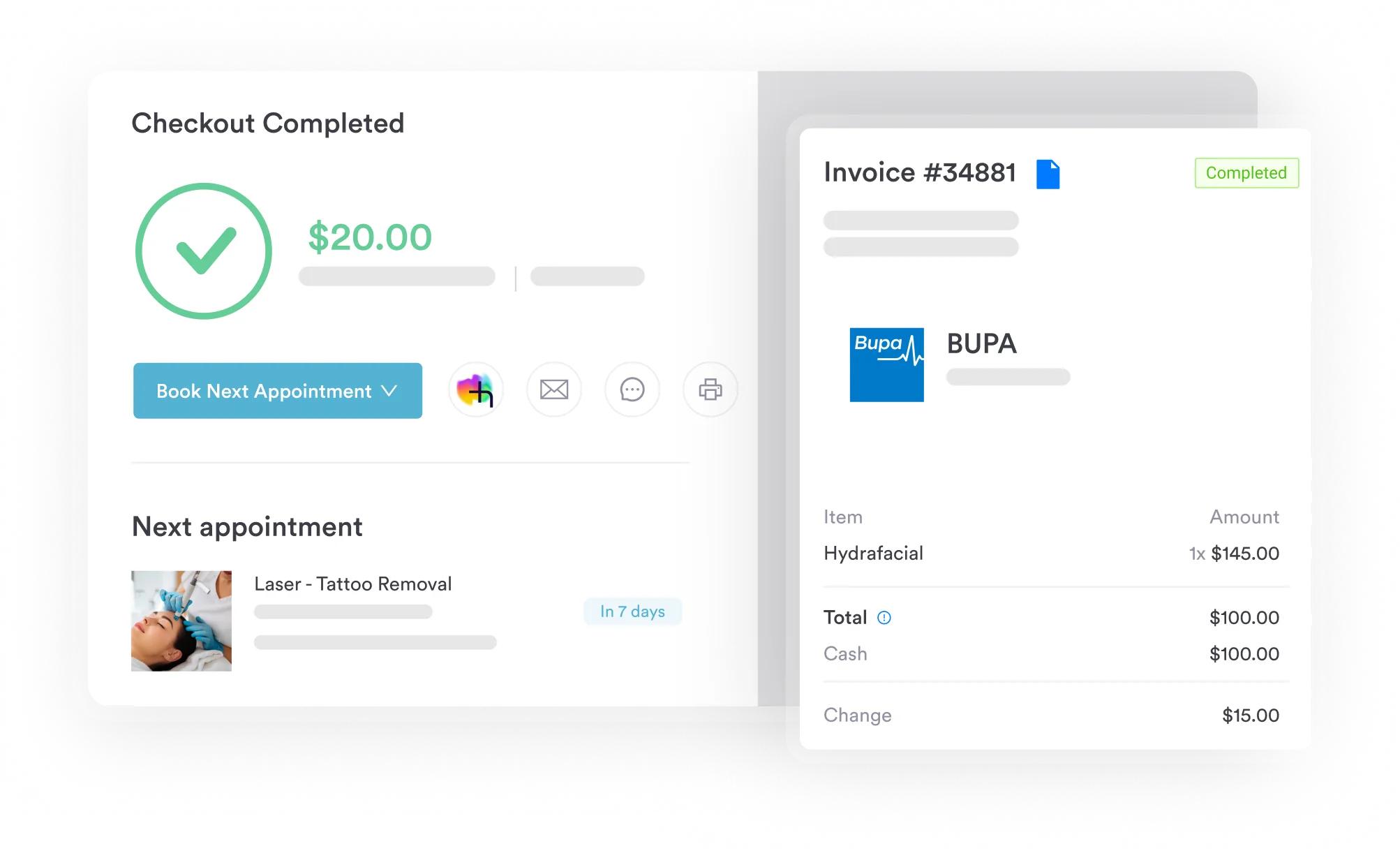

Pabau pre-fills claims from the patient record and submits them electronically through Claim.MD. Your team can follow every 36832 claim from submission to remittance.

Getting 36832 right comes down to the operative note. If the note names the arm, describes the revision and states that no clot was removed, the code choice is simple.
Start with your next three dialysis access claims and check each note against the checklist above. Where a note comes up thin, fix the template your surgeons use, not just the claim. That one change protects every claim that follows.
If you’d rather build claims straight from the patient record and send them through a clearinghouse, Pabau can help. Book a demo to see a 36832 claim go from patient record to remittance.

Need a structured clearinghouse workflow for vascular surgery claims? Medical claims clearinghouse guide explains how electronic claim routing reduces dialysis access billing errors.
Submitting 837P files for AV fistula procedures? 837 EDI transaction set overview covers the format behind electronic claim submission.
Want to understand how remittance advice maps to CPT 36832 payments? Electronic remittance advice (ERA) guide explains how to read 835 files and reconcile AV fistula revision payments.
Creating a new fistula instead of revising one? CPT 36821 covers direct AV anastomosis for dialysis access.
Preparing a prior authorization for vascular access surgery? Prior authorization process guide walks through what payers ask for and how to avoid delays.
No. Banding or ligating an AV fistula is reported with 37607. Use 36832 only when the surgeon revises the access itself, for example by repairing a stenosis or an aneurysm.
Distal revascularization and interval ligation (DRIL) has its own code, 36838. It treats hand ischemia caused by the access without revising the fistula, so it isn’t billed as 36832.
Yes. The descriptor covers autogenous fistulas built from the patient’s own vein and nonautogenous grafts made of synthetic material. The note should still say which one the surgeon revised.
Yes, with the right modifier. Use 58 when the revision was planned or staged, and 78 for an unplanned return to the OR for a related problem. Without one, the payer treats it as part of the first surgery.
Vascular, transplant and general surgeons who maintain dialysis access bill it most often. Interventional nephrologists mostly work percutaneously, so their access procedures usually fall under 36901-36909.