HCPCS Code L0472: Hyperextension TLSO billing guide
HCPCS code L0472: Official descriptor and device definition HCPCS code L0472 des...

Last Updated: Nov 5, 2026
99606 is the CPT code for face-to-face medication therapy management by a pharmacist with an established patient, covering the first 15 minutes of the session. It includes assessment and any intervention the pharmacist makes.
CPT 99606 is a primary code billed on its own, and each additional 15 minutes goes on the claim as add-on code 99607. Most billing errors come from the wrong patient status or missing start and stop times.
Let Pabau's smart automation suggest the right codes, reduce claim denials, and keep your practice compliant—effortlessly.
Automate repetitive tasks and focus on what matters most—your patients.
Reduce coding errors and ensure compliance with the latest regulations.
Clean claims, fewer denials, and faster reimbursements.
Powerful insights and reporting to help your practice thrive.
HIPAA compliant SOC 2 certified GDPR-compliant Trusted by 4,000+ clinics worldwide

CPT code 99606 bills the first 15 minutes of face-to-face medication therapy management a pharmacist provides to an established patient.
99606 is a primary code billed on its own. It does not need 99605 on the claim, and the two are never reported for the same session.
Add-on code 99607 covers each additional 15 minutes, so a 30-minute session is 99606 plus one unit of 99607.
Medicare Part D MTM is run by the plan sponsor, so rates are plan-negotiated rather than set by the Medicare Physician Fee Schedule.
Wrong patient status, 99607 billed without a primary code and missing start and stop times cause most 99606 denials.
CPT code 99606 is the medication therapy management (MTM) code for the first 15 minutes of a face-to-face pharmacist session with an established patient. It belongs to the American Medical Association’s CPT code set. The descriptor, as quoted by Utah Medicaid, reads as follows.
“Medication therapy management service(s) provided by a pharmacist, individual, face-to-face with patient, with assessment and intervention if provided; initial 15 minutes, established patient.”
Three elements decide when 99606 applies. The pharmacist meets the patient face to face, and the patient has already received an MTM service. The code then covers the first 15 minutes of assessment and any intervention. Some payers publish their own rule for new versus established status, so check the plan’s MTM policy.
The MTM CPT code family contains three codes. Two of them open a session, and the third extends it.
Patient status is the only difference between 99605 and 99606. All three descriptors specify face-to-face service, so none of them is a telephone code. CPT 99607 never stands alone, and the diagram below shows how it extends whichever initial code opened the session.
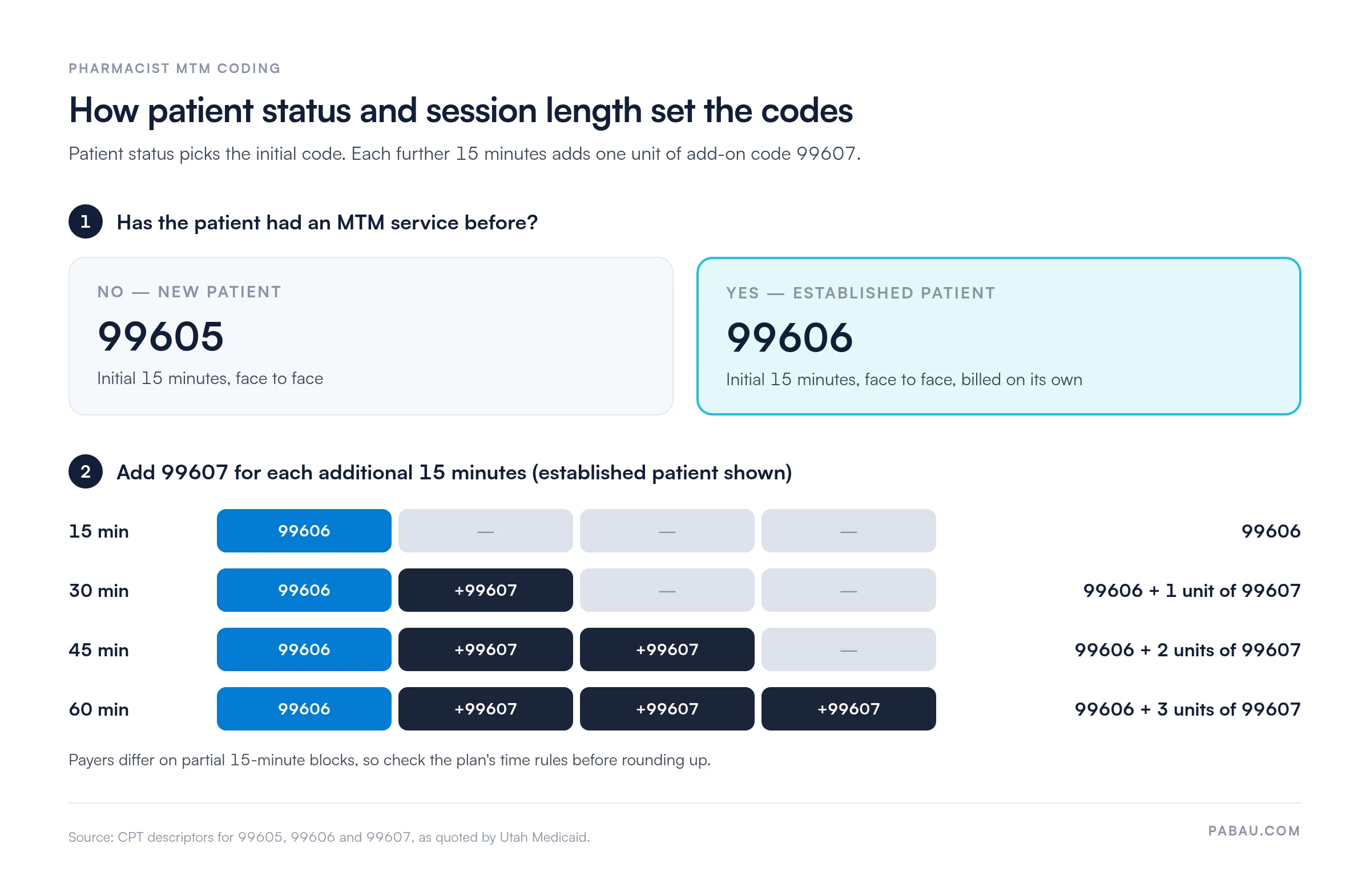
CPT 99606 covers the first 15 minutes of the session. Each additional 15 minutes goes on the same claim as one unit of add-on code 99607. Because 99607 is an add-on, it is only reported alongside 99605 or 99606 for the same session.
Payers also cap how many MTM sessions they pay for. Utah Medicaid fee-for-service, for example, allows one initial encounter and up to three follow-ups per member per calendar year. Those follow-ups are where 99606 is used.
Eligible providers for CPT code 99606 are licensed pharmacists delivering MTM services. Medicare does not recognize pharmacists as Part B billing providers for MTM. Most 99606 claims therefore flow through Medicare Part D plan MTM programs, Medicaid or commercial plans.
Provider status varies by state and payer. A growing number of states have granted pharmacists provider status under Medicaid or commercial plans, which opens direct billing pathways. Before submitting 99606 to any payer, confirm the following:
The Part D plan sponsor runs and funds the MTM program, so most pharmacists bill the plan for 99606 and never bill CMS. The sponsor contracts with pharmacists or MTM vendors, who submit claims to the plan or its MTM platform. That route differs from the Part B claim path in most explanations of how medical billing works.
CPT codes 99605, 99606 and 99607 are the standard codes used within Part D MTM programs. Reimbursement rates are negotiated between the plan and the MTM provider rather than set by the Medicare Physician Fee Schedule. Two pharmacists at different Part D plans may therefore receive different rates for the same 99606 service.
There is no single national rate for CPT code 99606. Part D plans negotiate MTM rates with pharmacists or MTM vendors, and Medicaid programs set their own fee schedules. Commercial plans pay a contracted rate where they recognize pharmacist billing. Check these points before you quote a rate:
Documentation for CPT code 99606 must show the patient’s established status and the time spent face to face. Auditors and payer reviewers look for a small set of specific data points.
A clean claim submission for 99606 needs every one of these elements in place before the claim leaves the practice. Correcting documentation after a denial means an appeal, which delays payment.
Build your MTM note template with start-time and stop-time fields, plus a field for the date of the patient’s last MTM service. Those three fields settle the patient status and the number of 99607 units before anyone codes the claim.
Most 99606 denials trace back to a short list of preventable errors. Proactive denial management workflows catch these issues before submission rather than after a rejection arrives. When a denial does arrive, the remittance explains it with a reason code from the standard list of medical billing denial codes.
The table below maps each common error to its fix.
CPT 99606 needs no modifier for a standard in-person session. The place of service (POS) code must match where the session happened. Getting POS right early in revenue cycle management avoids adjudication failures later.
The 99606 descriptor specifies face-to-face contact. Some payers authorize MTM by telehealth. In that case, bill 99606 and any 99607 units as usual, with the POS code and modifier the payer’s policy names. Many payers use modifier 95 for synchronous audio-video visits, but confirm the policy in writing before submission.
Without that authorization, a remote session does not meet the descriptor. CPT 99607 is a time add-on, not a telephone code, so never swap codes to fit a remote session.
Most 99606 denials start in the session note rather than on the claim. A missing stop time or the wrong patient status only surfaces once the payer rejects the line.
Pabau, the practice management and billing platform we build, lets pharmacists record each MTM session on a form. It holds fields for start time, stop time and medications reviewed. The note and the invoice sit on the same patient record. The biller can check patient status and minutes before choosing 99606 and the 99607 units.
Claims then go out through Claim.MD, Pabau’s US clearinghouse partner. Pabau creates the CMS-1500 claim from the invoice, runs real-time eligibility checks and tracks each claim to payment or denial. Remittances come back matched to their claims, and denied claims are flagged for rework. See how this works in Pabau’s claims management software.

Pabau keeps MTM session notes, invoices and Claim.MD claims on one patient record. Your 99606 and 99607 claims go out with the minutes and patient status payers check.

The costly mistakes on CPT code 99606 come from treating it as an add-on. It is a primary code for an established patient’s first 15 minutes, and 99607 carries any extra time.
Settle patient status before the session is coded, and record start and stop times while the patient is still with you. Those two habits remove the denials that take longest to rework.
Book a demo to see how Pabau keeps MTM notes, invoices and claims together so 99606 claims go out right the first time.

Want to understand how clearinghouse submissions work for add-on codes? Medical claims clearinghouse guide explains how 837P files route add-on code pairs through Claim.MD to payers.
Need to reduce your denial rate across all CPT codes? Denial codes in medical billing covers CARC codes and corrective actions for the most common claim rejection types.
Looking for billing compliance guidance? Medical billing compliance outlines the documentation and audit readiness standards that support clean MTM claims.
CPT code 99606 covers the first 15 minutes of face-to-face medication therapy management a pharmacist provides to an established patient. It includes the medication assessment and any intervention made during that time. Extra time is billed with add-on code 99607.
Patient status is the only difference. CPT 99605 covers the initial 15 minutes for a new patient, and 99606 covers the initial 15 minutes for an established patient. Never bill both for the same session.
No. CPT 99606 is a primary code and can be billed on its own. The add-on code in the MTM family is 99607, which is reported with 99605 or 99606 for each additional 15 minutes.
Bill 99606 for the first 15 minutes and one unit of 99607 for the next 15 minutes. A 45-minute session is 99606 plus two units of 99607.
Record the patient’s details, the date of service, the pharmacist’s credentials and NPI, and the session’s start and stop times. Add the medications reviewed, drug therapy problems found, interventions recommended and the place of service. Part D comprehensive medication reviews also need a written summary in the CMS standardized format.