HCPCS Code E0272: Foam rubber mattress billing guide
HCPCS Code E0272: official descriptor and code overview HCPCS Code E0272 is the ...

Last Updated: Nov 6, 2026
T1505 is the HCPCS Level II code for an electronic medication compliance management device, including all components and accessories, that is not otherwise classified. It reports the device itself, such as a locked dispenser that reminds the patient and logs each dose. It has no time unit.
T1505 is a T code for state Medicaid programs, and CMS lists it as not payable by Medicare. Because it is a not otherwise classified code, the claim needs a description of the device, its make and model, and usually an invoice. Personal care at home is a separate service, billed with T1019.
Let Pabau's smart automation suggest the right codes, reduce claim denials, and keep your practice compliant—effortlessly.
Automate repetitive tasks and focus on what matters most—your patients.
Reduce coding errors and ensure compliance with the latest regulations.
Clean claims, fewer denials, and faster reimbursements.
Powerful insights and reporting to help your practice thrive.
HIPAA compliant SOC 2 certified GDPR-compliant Trusted by 4,000+ clinics worldwide

HCPCS code T1505 reports an electronic medication compliance management device, with all its components and accessories, that no specific code describes.
T1505 is a device code with no time unit, so it never reports personal care time or a medication visit.
T1505 is a not otherwise classified code, so the claim needs a description of the device, its make and model, and usually an invoice.
CMS lists T1505 with coverage code I, not payable by Medicare, so coverage and rates come from each state Medicaid program or other payer.
In Pabau’s billing software, each claim is checked for missing details before it leaves, and the authorization code carries from the booking to the claim.
HCPCS code T1505 is the Level II code for an electronic medication compliance management device that no more specific HCPCS code describes. The descriptor covers the whole device, including all components and accessories.
The code reports equipment. There is no visit, no time unit and no caregiver attached to it. CMS added T1505 on January 1, 2011, in the T code range it set aside for state Medicaid agencies.
The descriptor, date added, coverage code and NOC listing come from the October 2026 CMS alpha-numeric HCPCS file. The unit row is our reading of the descriptor. Check the current quarter before you rely on it, because CMS updates the file four times a year.
An electronic medication compliance management device helps a patient take the right dose at the right time. Most of these devices pair a locked dispenser with reminders and a record of each dose.
Depending on the model, a device may do the following:
Prescribers consider these devices for patients who manage several medications at home. A payer that covers one will want the record to show why this patient cannot manage their doses reliably without it.
T1505 appears on the CMS list of not otherwise classified codes. An NOC code exists for items that no specific HCPCS code describes. Because the code name is broad, the payer cannot tell from it which device was supplied.
That puts extra work on the claim. Before you report T1505, confirm that no specific HCPCS code fits the device. A payer that finds a more specific code will deny the line or ask you to rebill.
Most payers expect an NOC claim line to carry the following:
On a paper CMS-1500, the description usually goes in Item 19 or the shaded area of the service line, as the payer directs. On an 837P, it goes in the service line’s procedure description field (SV101-7). Placement varies, so follow your payer’s NOC instructions. The diagram below maps each piece of a T1505 claim to where it sits.
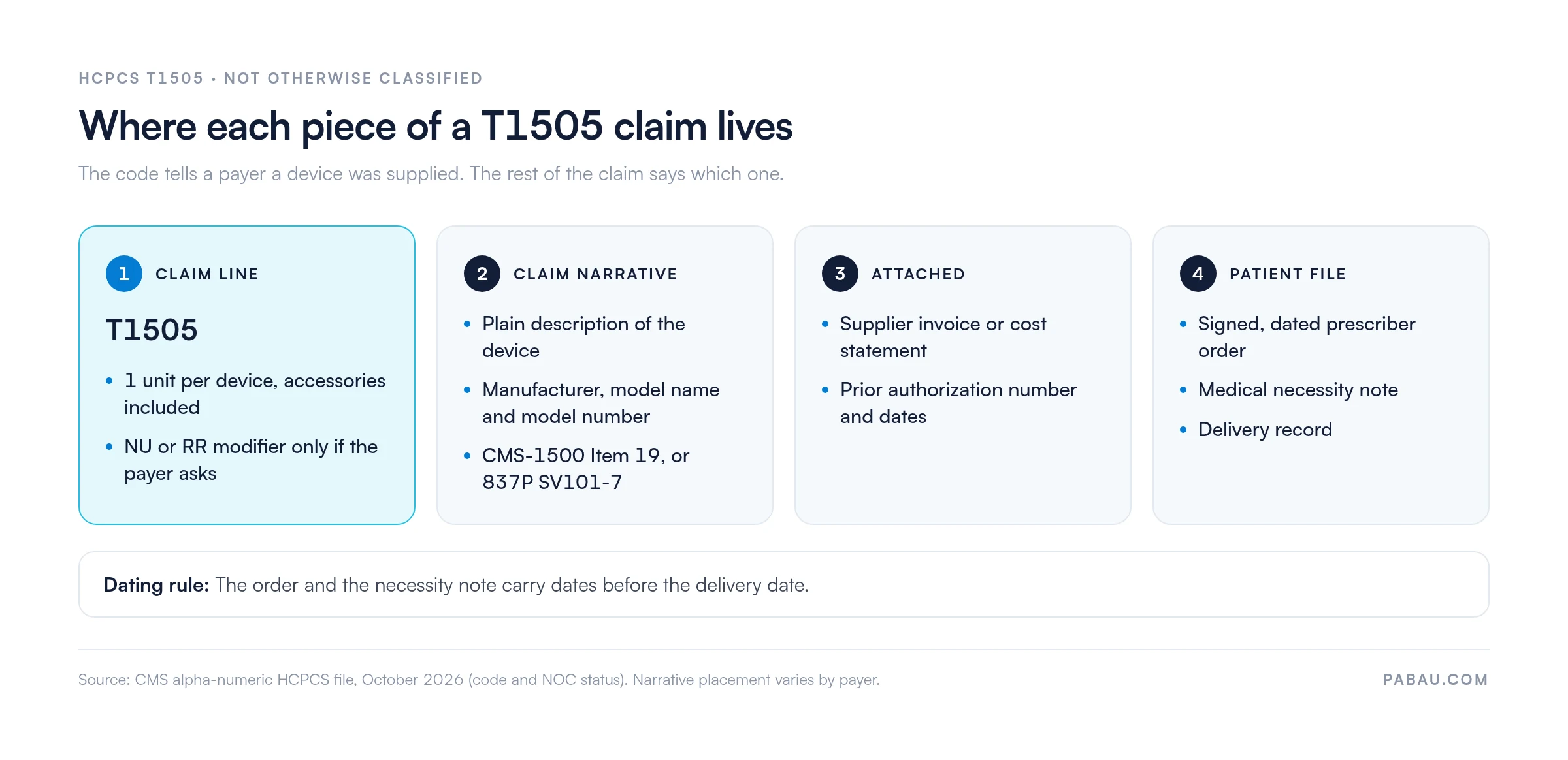
The documentation for T1505 has two jobs. It shows what the device is, and it shows why this patient needs it. For the wider rules, see our guide to medical billing compliance.
Date the order and the necessity note before the delivery date. A payer that sees an order written after the item shipped can deny the claim, even when the device was appropriate.
Before you submit a T1505 claim, read the narrative as a reviewer would. If it names the device type, the manufacturer and the model, and the invoice matches the billed amount, most NOC questions are already answered.
CMS created T codes for state Medicaid agencies, and each state decides whether to use a given T code. A state may cover T1505, cover medication devices under another code, or not cover them at all. No single national policy governs the code.
Payer by payer, the picture looks like this:
There is no national fee for T1505, because each state sets its own rate. Where a state lists a price, it appears in that state’s fee schedule. Where the state prices NOC items manually, the invoice usually drives the payment.
Some states ask for the equipment modifiers NU (new equipment) or RR (rental) on device codes. Use them only where your state manual or plan asks for them.
T1503 and T1019 sit close to T1505 in the T code range, and all three relate to care at home. Only T1505 reports equipment, while HCPCS code T1503 and HCPCS code T1019 report services delivered by people.
A nurse who visits to give an inhaled or topical medication provides a T1503 visit. Time spent on personal care under the plan of treatment is T1019. The dispenser the patient keeps at home is T1505. One patient can have all three on file, but each claim line reports one of them.
Most T1505 denials trace back to the NOC rules or to payer coverage. The table maps each common reason to its fix. For the codes payers send back, see our guide to denial codes for billers.
Use the AAPC HCPCS code lookup or the NLM HCPCS API to confirm the code is still active before you submit.
A T1505 claim pulls details from several places. The order and the necessity note sit in the clinical record. The invoice and the authorization often sit elsewhere, and someone re-keys them onto the claim.
Pabau opens each claim pre-filled from the invoice in the patient’s record. Its claims software for practices checks every claim for missing or invalid details before it leaves.
An authorization stored as a case follows the appointment through to the claim. A claim with no authorization code gets flagged before submission.
US practices send CMS-1500 claims through Claim.MD and can verify eligibility before the visit. Pabau does not choose the code or decide what your state covers. Your team still checks both, but it works from one record.

Pabau opens each claim from the patient’s invoice and checks for missing details before sending, so your T1505 claims carry what payers ask for.

T1505 lives or dies on the claim narrative. The code name tells a payer only that a medication compliance device was supplied, so the description, the model and the invoice carry the claim.
Settle coverage before the device ships. Confirm the payer recognizes T1505, get authorization where it is required, and file the order and necessity note first. A reviewer then reads the file instead of asking you to rebuild it.
To see how Pabau keeps the order, the invoice and the claim together, book a demo.

Need a framework for managing denied Medicaid claims? Denial management in healthcare covers the full operational workflow for tracking, appealing, and preventing recurring denials.
Looking for a primer on the full billing cycle? What is revenue cycle management explains how claim submission, denial handling, and payment posting connect from intake to final payment.
Want to understand what makes a claim clean before it reaches the payer? Clean claim submission details the field-by-field requirements that determine whether a claim adjudicates on first submission.
HCPCS code T1505 reports an electronic medication compliance management device, including all its components and accessories, that no specific code describes. It is a Level II T code and a not otherwise classified code. It has no time unit.
No. T1505 reports a device, not a service. Personal care services are reported with T1019, which is billed per 15 minutes. If a patient receives both, each goes on its own claim line.
No. The CMS HCPCS file lists T1505 with coverage code I, which means not payable by Medicare. Coverage depends on the state Medicaid program or another payer that recognizes the code.
The claim needs a description of the device, its manufacturer and model, and usually the supplier’s invoice. The record should hold a signed order, a medical necessity note and a delivery record. Add the prior authorization number where the payer requires one.
Bill one unit per device. The descriptor includes all components and accessories, so they are not billed as extra units. Add a purchase or rental modifier only if your payer asks for one.
T1503 reports a visit in which a health care agency or professional gives medication by a route other than oral or injection. T1505 reports the compliance device itself. One is a service billed per visit, and the other is equipment.
The most common causes are a missing item description and a missing prior authorization. Others are a payer that does not recognize T1505, or a more specific code that fits the device. A missing invoice or an unclear medical necessity note can also cause a denial.