

HCPCS Code L0472: Hyperextension TLSO billing guide
HCPCS code L0472: Official descriptor and device definition HCPCS code L0472 des...

Last Updated: Nov 5, 2026
99494 is the CPT add-on code for each additional 30 minutes of behavioral health care manager activities in a calendar month. The care manager works in consultation with a psychiatric consultant, under the direction of the treating physician or other qualified health care professional.
It is reported only alongside CPT 99492 or 99493, once the care manager's time passes the base code's threshold for that month. Claims are most often denied when the time log doesn't separate base-threshold minutes from add-on minutes.
Let Pabau's smart automation suggest the right codes, reduce claim denials, and keep your practice compliant—effortlessly.
Automate repetitive tasks and focus on what matters most—your patients.
Reduce coding errors and ensure compliance with the latest regulations.
Clean claims, fewer denials, and faster reimbursements.
Powerful insights and reporting to help your practice thrive.
HIPAA compliant SOC 2 certified GDPR-compliant Trusted by 4,000+ clinics worldwide

CPT code 99494 is an add-on to 99492 or 99493 for each additional 30 minutes of behavioral health care manager time in a month.
A base code (99492 or 99493) must appear on the same claim in the same calendar month, or 99494 is denied outright.
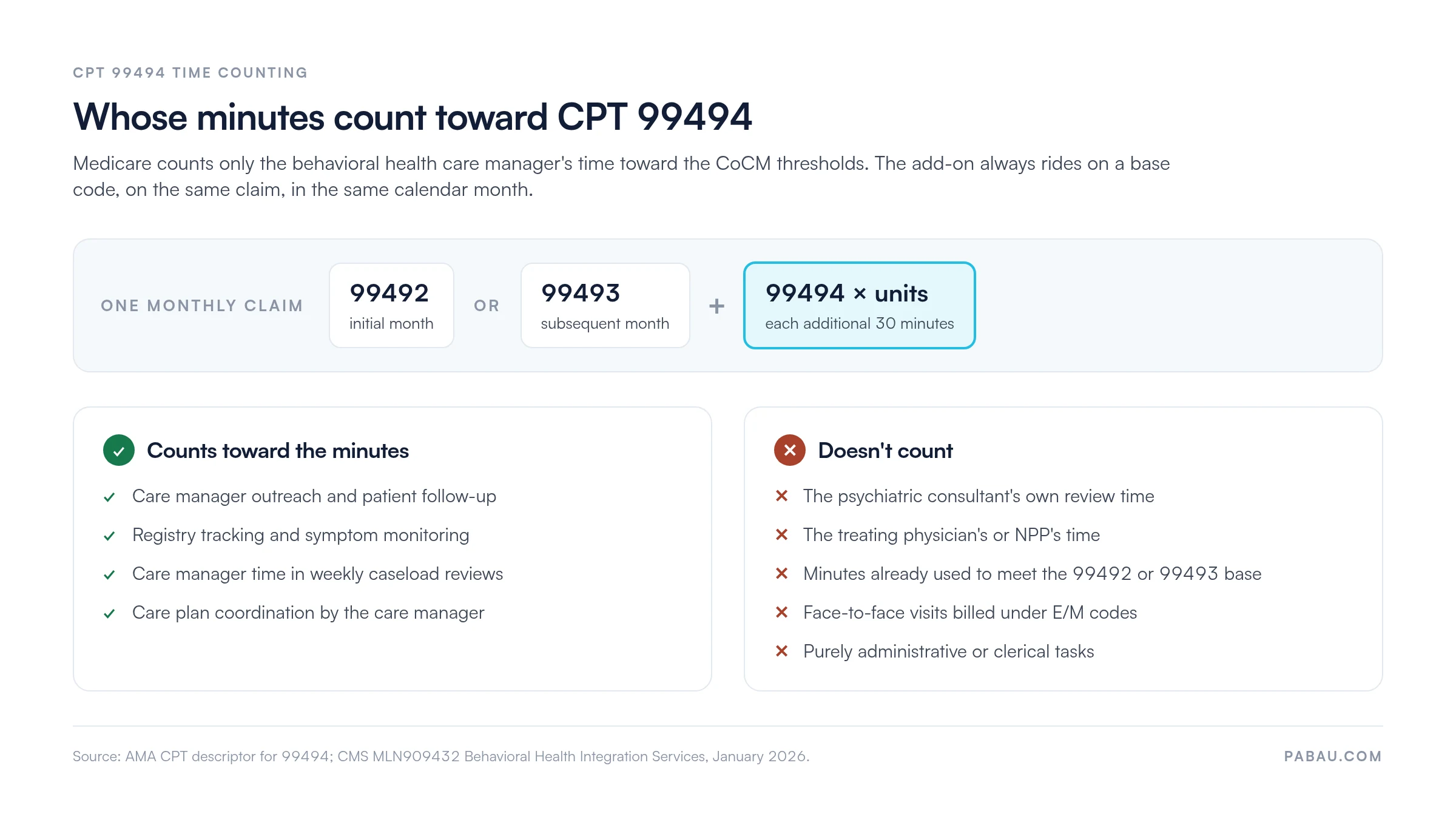
Only the behavioral health care manager’s minutes count toward the thresholds, so psychiatric consultant and treating practitioner time stay out of the total.
Time already counted toward the 99492 or 99493 base threshold can’t also count toward 99494, so the time log must show the split.
Pabau’s claims management software submits CoCM claims through Claim.MD and tracks each one until the payer responds.
CPT code 99494 is the add-on code for each additional 30 minutes of behavioral health care manager activities in a calendar month. It is reported with CPT 99492 or CPT 99493. The care manager works under the direction of the treating physician or NPP, in consultation with a psychiatric consultant. The American Medical Association’s CPT code set defines it as a supplemental time unit, not a standalone service. In short, it cannot appear on a claim without one of those base codes.
The medical billing fundamentals behind add-on codes matter here, because 99494 has no minimum time threshold of its own. Instead, the threshold belongs to the base code. Once the care manager’s time exceeds that base threshold by a full 30 minutes, one unit of 99494 is earned. Then each additional 30 minutes beyond that earns another unit.
The three CoCM codes form a family. CPT 99492 covers the first calendar month of CoCM services, requiring at least 70 minutes of care manager time. Meanwhile, CPT 99493 covers each subsequent month, requiring at least 60 minutes. CPT code 99494 then extends either of those base codes when care manager time runs long.
A practical example: A patient in month one of a CoCM program logs 100 minutes of behavioral health care manager time. The practice bills 99492 for the first 70 minutes and one unit of CPT code 99494 for the remaining 30. Likewise, if care manager time reached 130 minutes, two units of 99494 would be appropriate.
CPT code 99494 covers additional monthly behavioral health care manager activities in a CoCM program. Covered time is the care manager’s own work on outreach, follow-up, registry management, and weekly caseload reviews with the psychiatric consultant. In fact, the consultant’s review time and the treating practitioner’s time don’t count toward the 99494 minutes.
Equally important is what 99494 does not cover:
General BHI without a psychiatric consultant is reported under CPT 99484 instead, and it has no add-on code like 99494.
Medicare counts only the behavioral health care manager’s time toward the 99492, 99493, and 99494 thresholds, as the CMS behavioral health integration booklet sets out. Specifically, psychiatric consultant and treating practitioner minutes are not added in. In addition, time spent solely on administrative or clerical duties doesn’t count, and minutes count only within the calendar month in question.
Base-code time and add-on time must be tracked separately in the medical record. Indeed, a single running total in the registry doesn’t satisfy documentation requirements. Consequently, it doesn’t show which minutes belong to the base code and which belong to CPT code 99494. Overall, the cleanest approach is a timestamped log of the care manager’s minutes, with a clear notation of when the base threshold was reached.
Run a monthly time audit before submitting any CoCM claim. Compare the care manager’s total minutes in your registry against the base threshold for the applicable code. Document the exact minute at which the base threshold was met, then log subsequent time separately under the 99494 entry. This step puts the base and add-on split on record before the claim goes out.
For a CPT code 99494 claim to hold up to audit, the medical record must show four elements. They are patient enrollment in a structured CoCM program, a maintained registry entry, a timestamped time log, and care plan activity during the billing month. Claims software for practices can submit the claim. However, the activity notes and time log still have to live in the patient record, not only in the billing system.
Required documentation elements:
The billing provider for CPT code 99494 is the treating physician or non-physician practitioner (NPP). Specifically, this practitioner directs the behavioral health care manager and consults with the psychiatric consultant. Additionally, they bill under their own National Provider Identifier (NPI) and take responsibility for the care plan for the month. In contrast, the care manager and psychiatric consultant don’t bill 99494 separately.
CMS lets physicians and NPPs whose scope of practice includes evaluation and management services bill CoCM. Eligible billing practitioners include:
In short, the psychiatric consultant advises on the care plan but doesn’t bill 99494, and their case review time doesn’t count toward its minutes. When the consultant is on the practice’s own staff, keep their review notes in the record and leave their minutes out of the count.
Medicare has paid for CPT code 99494 since 1 January 2018. The CY2018 Physician Fee Schedule final rule adopted the new CoCM codes 99492 to 99494. In 2017, CMS paid for the same collaborative care services through temporary HCPCS G-codes. The CMS Physician Fee Schedule lookup tool is the authoritative source for the current-year national payment amount. Rates change annually, so any dollar figure published in a coding guide may be outdated.
For current reimbursement data, use the FastRVU 2026 RVU lookup tool to retrieve the Work RVU, Practice Expense RVU, and Malpractice RVU values for 99494. Geographic Practice Cost Indices (GPCIs) apply, so the payment amount varies by locality. The electronic remittance advice (ERA) your clearinghouse returns after adjudication will show the allowed amount, applied deductible, and coinsurance for each 99494 unit.
Medicare payment amounts for CPT code 99494 update each January with the annual Physician Fee Schedule. However, the national payment amount from the prior year is not a reliable guide to what Medicare will pay in the current year. Therefore, use the CMS Physician Fee Schedule lookup tool linked above to retrieve the current RVUs and the payment amount for your locality.
Two variables set Medicare’s payment for 99494. First, the national non-facility or facility rate depends on where the service is provided. Second, the GPCI adjustment applies for your locality. For example, urban practices in high-cost markets receive more than the national rate, and rural practices may receive less. In addition, your Medicare Administrative Contractor (MAC) publishes locality-specific rates.
Medicaid coverage for CPT code 99494 varies significantly by state. Some state Medicaid programs have adopted BHI billing codes in alignment with Medicare; others have not, or have implemented different time thresholds and documentation requirements. Therefore, never assume a state Medicaid program covers 99494 without verifying the current state fee schedule or issuing a prior-authorization inquiry.
In contrast, commercial payers follow their own policies. Coverage, prior authorization requirements, and reimbursement rates differ by plan and by employer group contract. Before billing a commercial payer for the first time, request a coverage determination in writing. Indeed, some plans require CoCM program enrollment documentation as a condition of coverage, which Medicare does not.
Strong denial management workflows matter here because 99494 denials follow predictable patterns. As a result, knowing the trigger lets you fix it at the documentation stage, not the appeals stage. The claim adjustment reason code on your remittance names each trigger, and a list of medical billing denial codes explains what each one means.
Submitting a clean claim for CPT code 99494 requires a structured monthly workflow rather than ad-hoc coding at month-end. Overall, the steps below show the sequence CoCM practices follow.
The requirements for a clean claim are straightforward for add-on codes once the monthly time-tracking workflow is in place. In fact, failures usually start upstream, with incomplete logs, merged time totals, or a missing registry entry.
A typical CoCM workflow keeps the care manager’s time log in a registry, then rebuilds the claim in a separate billing system at month-end. As a result, each re-keyed line is another chance for 99494 to lose its base code or carry the wrong unit count.
In Pabau, the claim sits next to the patient record that holds the care notes and care plan. Pabau’s claims management software submits the 99492 or 99493 line and the 99494 units through Claim.MD. It then tracks the claim’s status until the payer responds.
Your team still owns the time log and the code choice. In short, the difference is that the submitted claim, its status, and the payer’s response sit in one place. As a result, a denied add-on line gets spotted and corrected quickly.

Pabau’s claims management software submits your CoCM claims through Claim.MD and tracks each one until the payer responds. See how the claim workflow fits a monthly behavioral health billing cycle.

Treat CPT code 99494 as a time-log job before it becomes a coding job. Set up the care manager’s log on day one of the program and mark the minute the base threshold is met. In addition, keep consultant review notes out of the count.
With that log in place, the add-on becomes the routine part of a long CoCM month. Otherwise, each extra unit rests on minutes reconstructed from memory, which is the first place an auditor looks.
Pabau’s claims management software then handles submission and tracking, so your team sees each 99494 line through to payment. Book a demo to see how it fits your CoCM billing cycle.

Billing the first month of a CoCM program? CPT code 99492 covers the initial-month base code that 99494 is most often added to.
Want to understand how medical billing flows from encounter to payment? Revenue cycle management explained covers the end-to-end process from patient registration through final payment posting.
Looking for a comparison of medical billing clearinghouses? How Claim.MD clearinghouse works outlines how electronic claim routing, real-time edits, and ERA handling operate in practice.
CPT code 99494 is used to bill each additional 30 minutes of behavioral health care manager time in a psychiatric Collaborative Care Management (CoCM) program. The minutes must fall beyond the base threshold of CPT 99492 or 99493 in the same calendar month. It lets practices capture time when complex patients need substantially more care manager effort than the base code covers.
CPT 99492 covers the first calendar month of CoCM (70-minute minimum). CPT 99493 covers each subsequent month (60-minute minimum). CPT 99494 is the add-on for each additional 30 minutes beyond whichever base code applies. Only one base code can be billed per calendar month, but multiple units of 99494 may be billed if care manager time warrants it.
Yes, 99494 is an add-on code. It requires a base code (99492 or 99493) on the same claim in the same calendar month. The patient also needs a behavioral health registry entry, and the record needs a timestamped time log that separately documents base-threshold minutes and add-on minutes.
Medicaid coverage for CPT code 99494 varies by state. Some state Medicaid programs have adopted BHI billing codes in alignment with Medicare; others have not. Verify coverage through your state Medicaid fee schedule or submit a prior-authorization inquiry before billing 99494 to a Medicaid payer for the first time.



