CPT Code 46924: Extensive destruction of anal lesions
CPT code 46924: Official descriptor and procedure overview CPT code 46924 is def...

Last Updated: Nov 13, 2026
99491 is the CPT code for the first 30 minutes of chronic care management a physician or other qualified practitioner performs personally each month. The patient needs two or more chronic conditions expected to last at least 12 months, plus a comprehensive care plan.
Clinical staff time never counts toward 99491. Practices that route practitioner-performed CCM time through 99490 leave revenue unclaimed, because Medicare pays 99491 at a higher rate than 99490.
Let Pabau's smart automation suggest the right codes, reduce claim denials, and keep your practice compliant—effortlessly.
Automate repetitive tasks and focus on what matters most—your patients.
Reduce coding errors and ensure compliance with the latest regulations.
Clean claims, fewer denials, and faster reimbursements.
Powerful insights and reporting to help your practice thrive.
HIPAA compliant SOC 2 certified GDPR-compliant Trusted by 4,000+ clinics worldwide

CPT code 99491 bills the first 30 minutes of chronic care management a physician or other qualified health care professional performs personally each month.
Each further 30 minutes of practitioner time goes on add-on code 99437, while 99489 only extends complex CCM code 99487.
Medicare accepts verbal or written consent, as long as you record it in the patient’s chart before you bill.
CCM can run during a TCM period, but no minute may count toward two billed codes.
Pabau, the practice management platform we build, keeps CCM consent on the patient record and sends claims through Claim.MD.
CPT code 99491 bills the first 30 minutes of chronic care management (CCM) a physician or other qualified health care professional performs personally each month.
CMS’s chronic care management booklet lists 99491 as practitioner time only, and states that clinical staff minutes don’t count toward it. The qualified health care professionals here are nurse practitioners, physician assistants, clinical nurse specialists and certified nurse-midwives.
The current AMA descriptor, revised for 2022, reads:
“Chronic care management services, with the following required elements: multiple (two or more) chronic conditions expected to last at least 12 months, or until the death of the patient; chronic conditions that place the patient at significant risk of death, acute exacerbation/decompensation, or functional decline; comprehensive care plan established, implemented, revised, or monitored; first 30 minutes provided personally by a physician or other qualified health care professional, per calendar month.”
AMA CPT code set, code 99491
Two words in that descriptor do most of the work. “Personally” means the practitioner does the care management, rather than directing staff who do it. “First” means 99491 now covers only the opening 30 minutes, and each further 30 minutes of practitioner time goes on add-on code 99437.
Check all four before the first minute goes into the time log.
CPT 99491 can be billed by physicians (MD or DO), nurse practitioners, physician assistants, clinical nurse specialists and certified nurse-midwives. It applies only to the minutes they spend on care management themselves. The same practitioner list appears in the AMA CPT guidelines and the AMA’s CPT code set framework.
Think of it as a “who holds the pen” test. If a physician designs the care plan but a medical assistant makes the follow-up calls, those calls belong to 99490. Clinical staff can support the program, but their time never reaches the 99491 threshold.
A short month isn’t wasted either. CMS lets practitioner time count toward the 20-minute 99490 threshold when that time isn’t used to report 99491. A doctor who logs 24 minutes can’t bill 99491, but those minutes can still support 99490.
The 30 minutes accrue across the calendar month, so ten minutes on the 3rd and 20 on the 18th add up. What matters is who did the work and whether another billed code already used the minute.
Log every qualifying activity with the date, the minutes and a line on what was done. Time logs without that detail are a common audit finding, so record them as you go rather than at month-end.
Check each patient’s running practitioner total on the last business day of the month, before you close the billing period. A shortfall can’t be fixed after the fact by adding time nobody documented.
An auditor will look for each of these in the record. Missing any one of them is grounds for a denial or a recoupment, and the CCM documentation guide covers each element in more depth.
Both codes cover non-complex CCM. They differ on whose minutes count, the time threshold and the add-on that extends them. Picking the wrong one is the most common coding error in CCM programs.
The higher rate reflects the practitioner’s direct time. Where physicians or nurse practitioners do the care management themselves, 99491 describes the service accurately. Billing 99490 for that work under-codes it.
Complex CCM sits in the same code family, but it counts clinical staff time and adds a medical decision-making test. The table shows where each code applies.
A common assumption is that 99489 extends 99491 once practitioner time passes 30 minutes. It doesn’t. 99487 and 99489 count clinical staff time, so extra practitioner time on 99491 goes on 99437 instead, one unit per additional 30 minutes.
The three families also can’t be mixed, as the overview below shows.
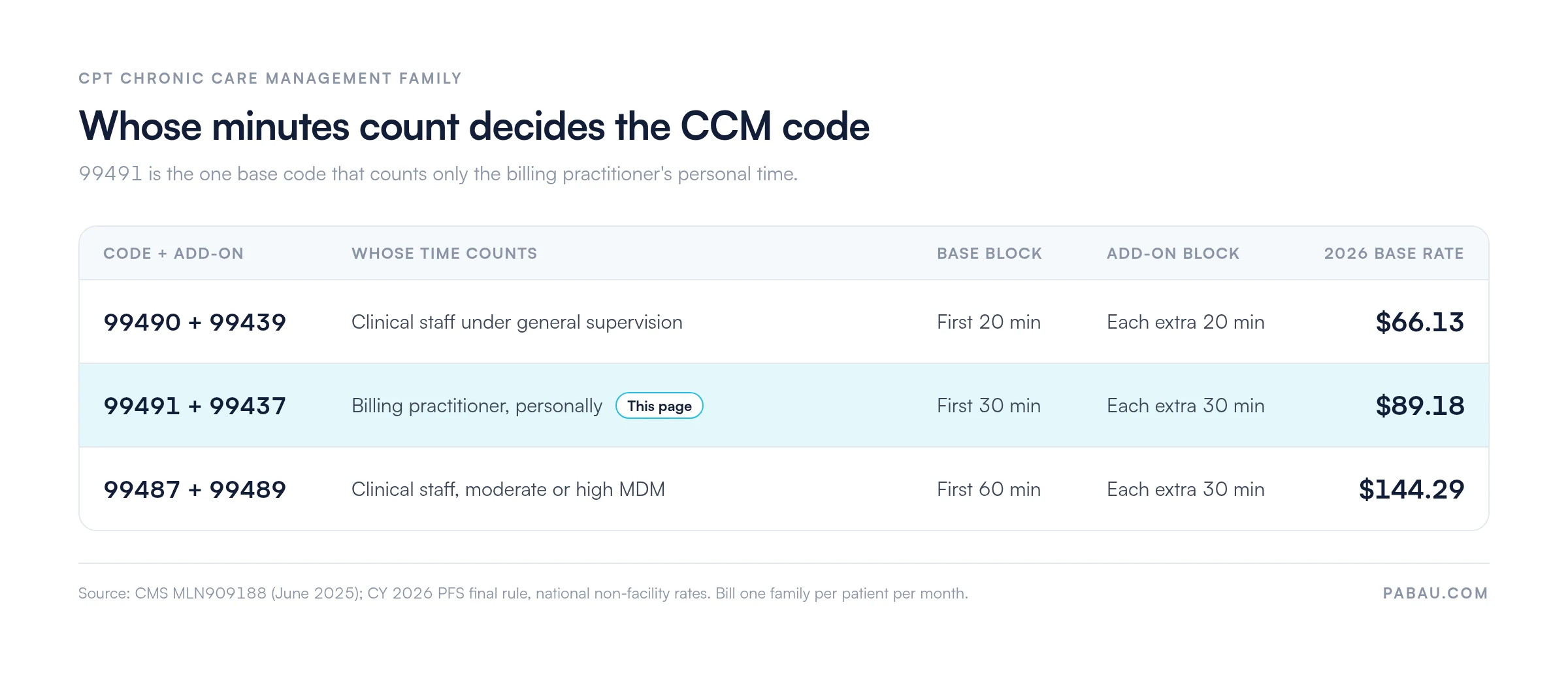
The 2026 national non-facility rate for 99491 is $89.18, up from $82.16 in 2025. Those figures come from the CY 2026 final rule at the $33.4009 conversion factor, as tabulated in the American Urological Association’s 2026 rate table. Practitioners in a qualifying alternative payment model get a slightly higher conversion factor.
For comparison, the same table lists 99437 at $63.13, 99490 at $66.13, 99487 at $144.29 and 99489 at $70.52. Your own rate moves up or down with the Geographic Practice Cost Index (GPCI) for your locality. Enter your ZIP code in the CMS Physician Fee Schedule lookup tool to get it. The FastRVU lookup tool shows the work, practice expense and malpractice RVUs behind each figure.
Track CCM collections on their own line in your revenue cycle management reports and compare them with the expected rate each month. Practices that lump CCM in with office visits tend to spot underpayments only at year-end.
A 99491 claim follows the same seven steps every month. Each one has a checkpoint that turns into a denial when it’s skipped.
Run through this list for each patient on the last working day of the month. It takes a few minutes per chart, while working a denial takes far longer.
Medicare blocks a short list of codes in the same month as 99491. For the rest, the rule is simpler: you can bill both, as long as no minute counts toward two codes. Your payer’s edit list has the final say.
Seven documentation failures cause most 99491 denials. The table pairs each trigger with its fix.
When a 99491 claim comes back denied, read the CARC denial codes on the remittance first. The reason code points straight at the missing element, so you can correct and resubmit before the timely filing deadline.
In many practices, CCM consent sits on a paper form in one place and the claim gets built in another system. When an auditor asks for proof of consent, someone has to dig through both.
Pabau, the practice management platform we build, keeps CCM consent and intake forms as digital forms on the patient record. Its claims management software sends US claims through Claim.MD, with eligibility checks before submission. ERA remittances then come back into the same system, so denials and payments sit beside the claim.
The outcome is a shorter audit trail. Consent, the patient record and the claim history sit in one place. The payer list comes from Claim.MD, which connects to thousands of US payers.
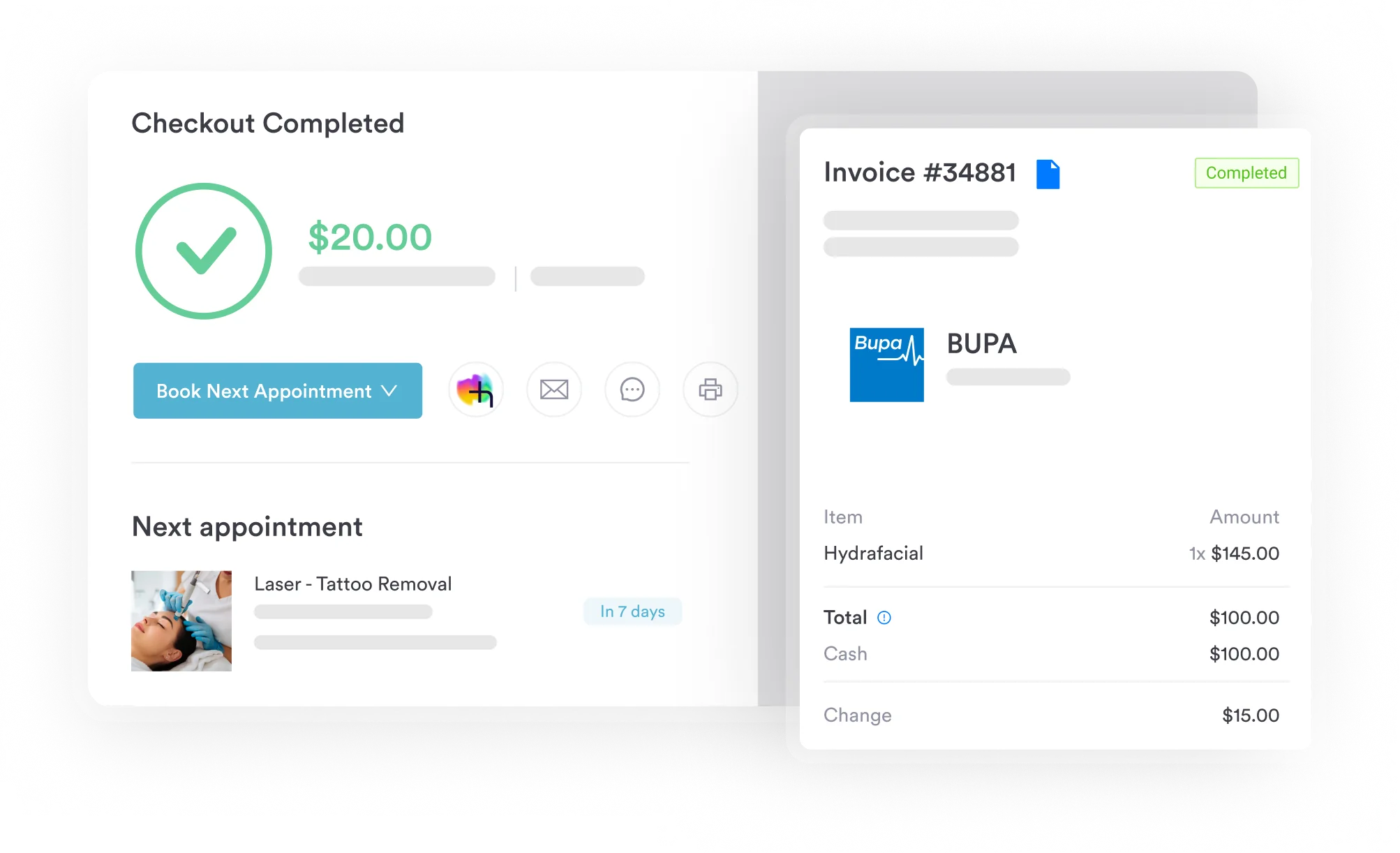

Pabau stores CCM consent forms on the patient record and submits claims through Claim.MD with eligibility checks. ERA remittances return to the same record.

Bill 99491 when the practitioner’s own logged minutes reach 30 in the month. When they don’t, let the time support 99490 instead of dropping it. Extra practitioner time goes on 99437, never 99489.
The trade-off is effort. A personal time log takes discipline from busy clinicians, but it earns about $23 more per patient per month than 99490 at 2026 national rates. If your physicians already do the calls, logging them properly is one of the cheapest revenue fixes available.
Book a demo to see how Pabau keeps CCM consent on the patient record and sends 99491 claims through Claim.MD.

Comparing the staff-time code? CPT code 99490 covers the 20-minute clinical staff threshold and its 99439 add-on.
Need a documentation checklist for CCM audits? CCM documentation guide walks through consent, care plans and time logs.
Choosing a clearinghouse for CCM claims? Claim.MD clearinghouse review explains how it checks claims against thousands of US payers.
Want to understand how CCM denials are classified and appealed? Denial management in healthcare covers CARC codes, appeal timelines and denial queues.
Looking for the full revenue cycle behind CCM billing? Revenue cycle management explained runs from eligibility checks to payment posting.
Only for some patients. Medicare requires an initiating visit for new patients and anyone you haven’t seen in the past year. That can be a comprehensive E/M visit, an annual wellness visit or an initial preventive exam, billed separately.
Yes. Part B coinsurance applies, so tell patients at consent. A Medigap plan often covers it. That cost-sharing conversation is also a common reason patients decline CCM.
Yes, at any time. The stop takes effect at the end of the calendar month. A patient who moves to a new CCM practitioner gives consent again to that practitioner.
Yes. Medicare lets you bill remote physiologic monitoring or remote therapeutic monitoring alongside CCM, but not both. Keep the minutes separate, because time can’t count toward two codes.
No. 99491 is one unit per patient per calendar month. Extra practitioner time goes on 99437, one unit for each full additional 30 minutes.