

HCPCS Code L0472: Hyperextension TLSO billing guide
HCPCS code L0472: Official descriptor and device definition HCPCS code L0472 des...

Last Updated: Nov 5, 2026
99415 is the CPT add-on code for the first hour of prolonged clinical staff service during an office or outpatient evaluation and management (E/M) visit. Clinical staff provide the extra face-to-face time under direct physician or QHP supervision.
The code becomes reportable once that time runs at least 30 minutes past the typical clinical staff time for the visit. Each further 30 minutes is reported with 99416. Both codes have been part of CPT since 2016, and neither can share a date of service with 99417 or G2212.
Let Pabau's smart automation suggest the right codes, reduce claim denials, and keep your practice compliant—effortlessly.
Automate repetitive tasks and focus on what matters most—your patients.
Reduce coding errors and ensure compliance with the latest regulations.
Clean claims, fewer denials, and faster reimbursements.
Powerful insights and reporting to help your practice thrive.
HIPAA compliant SOC 2 certified GDPR-compliant Trusted by 4,000+ clinics worldwide

CPT code 99415 is an add-on code for the first hour of prolonged clinical staff face-to-face time during an office or outpatient E/M visit.
It becomes reportable 30 minutes past the typical clinical staff time of the primary E/M code, and 99416 adds each further 30 minutes.
The supervising physician or qualified health care professional reports the code, but the minutes counted are the clinical staff member’s.
99415 and 99416 cannot share a date of service with 99417 or Medicare’s G2212, which cover the physician’s own prolonged time.
CPT code 99415 reports the first hour of prolonged clinical staff service during an office or outpatient evaluation and management (E/M) visit. As an add-on code, it is billed alongside that visit’s E/M code.
A clinical staff member spends extra face-to-face time with the patient or caregiver. A physician or other qualified health care professional (QHP) provides direct supervision throughout.
The American Medical Association (AMA) added 99415 and its companion code 99416 to CPT in 2016. CPT 2023 revised the descriptor, replacing “typical time” with “the highest time in the range” of the service. The same update added the AMA’s table of typical clinical staff times.
Add-on codes carry a ZZZ global period in the Medicare Physician Fee Schedule, so 99415 never appears on a claim without its primary E/M code.
The minutes counted belong to the clinical staff member, not the physician. That single distinction decides which code family applies. The physician’s or QHP’s own extra time is reported with 99417 or G2212, covered further down.
The table below summarizes the key billing facts for CPT code 99415 and its companion code 99416. Consult the CMS Physician Fee Schedule lookup tool for current-year national payment amounts, which vary by Geographic Practice Cost Index (GPCI) locality.
CPT code 99415 becomes reportable once clinical staff face-to-face time runs 30 minutes past the typical staff time of the primary E/M code. That baseline comes from the AMA’s table of typical clinical staff times. The physician’s time for the visit plays no part in it.
Source: AMA CPT E/M guidelines, Reporting Prolonged Clinical Staff Time table. Each further unit of 99416 starts 30 minutes after the previous one. On a 99214 visit, for example, the second unit starts at 145 minutes of clinical staff time.
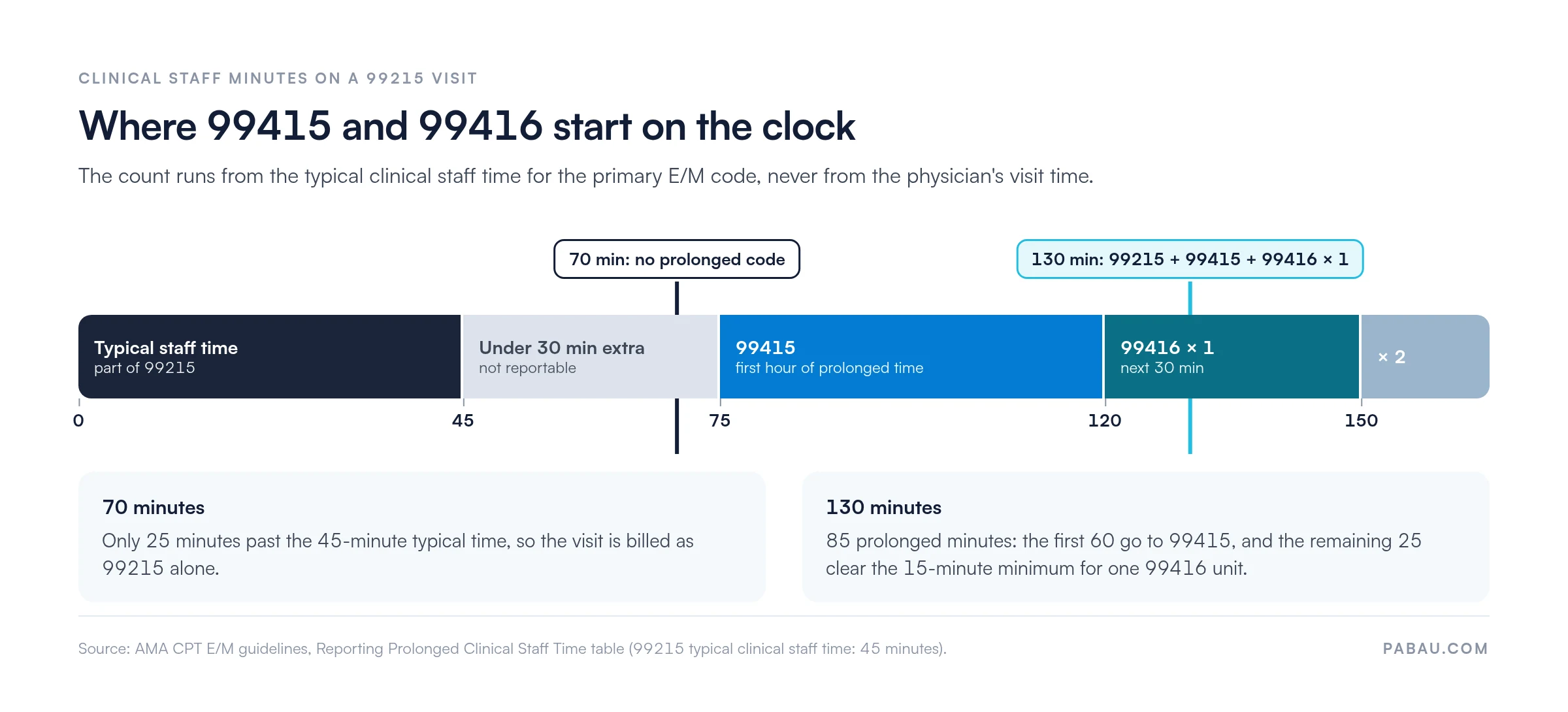
Worked example: A nurse spends 130 minutes of face-to-face time with an established patient during a 99215 visit, under direct physician supervision. The typical clinical staff time for 99215 is 45 minutes, so 85 minutes count as prolonged service. The first 60 of those minutes are reported with 99415. The remaining 25 minutes clear the 15-minute minimum for one unit of 99416.
Bill 99215 + 99415 + 99416 × 1. A second unit of 99416 would need 150 minutes of staff time. Had the same nurse spent 70 minutes instead, the visit would fall short of the 75-minute start point and no prolonged code would apply.
The timeline below plots both visits against the 99215 start points.
The supervising physician or other QHP reports CPT code 99415 on the claim, based on the clinical staff member’s time. Medical assistants (MAs), licensed practical nurses (LPNs), and registered nurses (RNs) provide the service. They do not bill it under their own provider numbers.
Two more limits apply. Clinical staff can report prolonged time for no more than two patients at once, and only the time devoted to a single patient counts. Facilities may not report 99415 or 99416, so the codes belong to office (POS 11) and other non-facility outpatient settings.
Documentation decides whether a CPT code 99415 claim survives review. The medical record must show that the extra clinical staff time happened, how long it lasted, and why it was medically necessary. The record-keeping standards of your medical billing compliance program apply here too, with timestamps added.
Add a dedicated prolonged service time log to your EHR templates. Fields for start time, stop time, staff name, and reason take seconds to fill in. They also show an auditor the total staff minutes at a glance.
Prolonged office and outpatient services split into two parallel families for different billers. 99415 and 99416 capture clinical staff time, while 99417 and G2212 capture the physician’s or QHP’s own time. Neither family replaced the other, and the two cannot share a date of service.
Medicare does not pay 99417 for office or outpatient E/M visits. CMS created HCPCS code G2212 for that physician or QHP time instead, effective January 1, 2021, and the code remains active.
99415 and 99416 play no part in that substitution. CPT bars reporting them with 99417, and Medicare bars reporting them with G2212 on the same date of service.
The AAPC’s CPT code lookup includes the current descriptors and AMA guidelines for each code in this family.
Medicare covers CPT codes 99415 and 99416 for office and outpatient E/M visits, subject to the conditions below. Both have been CPT codes since 2016. CMS did not create them as a Medicare stand-in for 99417.
For current national payment rates, use the CMS Physician Fee Schedule search tool and select the current calendar year. Rates vary by locality. Use the FastRVU lookup tool to retrieve work RVU, practice expense RVU, and malpractice RVU values for 99415 with GPCI adjustments applied for your area.
Payers audit prolonged service claims often, because the start points are easy to miscalculate and the documentation rules are specific. The table lists the most common denial patterns for CPT code 99415, with root causes and fixes. Route each denial through your denial management workflows, so the same root cause doesn’t reach the next claim.
For the claim-level meaning of each denial, the denial codes in medical billing guide covers CARC and RARC codes that payers attach to remittance advice. Pabau, the practice management platform we build, routes electronic claims via Claim.MD. Denial reason codes surface in the same interface where your team manages scheduling and patient records.
Billing CPT code 99415 correctly takes six steps, from confirming the visit level to ordering the claim lines. Step five, payer verification, is the one that prevents non-covered service denials.
CPT code 99415 appears most often where complex patients need longer clinical staff contact. Four specialties meet it regularly, each with its own documentation pattern.
Run a monthly claim audit for CPT code 99415 alongside your primary E/M codes. Filter for encounters where documented clinical staff time reached the 99415 start point but the code was not billed. Each one is a service the practice delivered and never billed.
Many practices still log clinical staff time in free-text notes and add up the minutes at billing time. That is where 99415 claims go wrong. The start point gets measured against the physician’s time, or the stop time never reaches the chart.
In Pabau, staff record start and stop times in structured note templates, and the claim is built from the same patient record. Claims go out through Claim.MD with eligibility checks, and denial reason codes return to the patient’s billing history. Your team sees a rejected 99416 unit next to the note that produced it.
The outcome is a 99415 claim that carries its minutes, its supervising provider, and its parent E/M code before it leaves the practice.

Pabau’s claims management tools help your team document clinical staff time and submit 99415 and 99416 correctly. Denials get tracked before they age into write-offs.

On a long visit, the coding decision turns on one question: whose minutes ran over? Answer it from the chart, and 99415 stops being a code coders avoid for fear of an audit.
Build those start points into your note templates and train coders on the clinical staff table rather than the physician’s visit times. The cost is a few seconds of timestamping per visit. In return, each claim carries minutes an auditor can check rather than an estimate. To see how Pabau handles prolonged service billing end to end, book a demo.

Wondering how clearinghouses fit into your billing workflow? How Claim.MD clearinghouse works explains the electronic submission process, ERA delivery, and payer enrollment steps.
Looking for guidance on the revenue cycle behind E/M billing? What is revenue cycle management walks through the end-to-end process from patient intake to final payment posting.
Billing physician time spent outside the visit? CPT code 99358 covers prolonged non-face-to-face service and where it still applies.
Coding a long hospital or nursing facility visit? CPT code 99418 explains prolonged time in inpatient and observation settings.
CPT code 99415 reports the first hour of prolonged clinical staff face-to-face time during an office or outpatient E/M visit. Clinical staff such as an MA, LPN, or RN provide the service under direct supervision. The supervising physician or QHP reports it as an add-on code.
CPT 99415 counts the clinical staff member’s prolonged time, while 99417 counts the physician’s or QHP’s own prolonged time in 15-minute units. They are parallel codes for different billers, and CPT bars reporting them together. Medicare does not pay 99417 and uses HCPCS G2212 for physician or QHP time instead.
CPT code 99415 is reportable once clinical staff time runs at least 30 minutes past the typical clinical staff time of the primary E/M code. That means 54 minutes for 99212, 57 for 99213, 70 for 99214, and 75 for 99215. CPT 99416 then starts at 99, 102, 115, and 120 minutes, with one unit per further 30 minutes.
Yes. Medicare covers CPT codes 99415 and 99416 for office and outpatient E/M visits, subject to MAC local coverage determinations. They have been CPT codes since 2016 and are not a Medicare substitute for 99417. Medicare’s code for physician or QHP prolonged time is G2212.
No. CPT 99415 and 99416 cannot be reported on the same date of service as 99417 or G2212. Choose the family that matches whose time ran long. Clinical staff time goes to 99415 and 99416, and physician or QHP time to 99417 or G2212.
The medical record must include the clinical staff member’s start and stop times, name, and credential. It must also record why the additional time was medically necessary and which physician or QHP provided direct supervision. Time spent on separately reported services does not count toward the prolonged time.
Medicare reimbursement for CPT code 99415 varies by Geographic Practice Cost Index locality and is updated annually in the Medicare Physician Fee Schedule. Use the CMS MPFS lookup tool and select the current calendar year to retrieve the national and locality-adjusted rates. Commercial payers set their own rates, so check your payer contracts for specific fee schedule amounts.



