CCSD Code K6020: Resiting of pacemaker or ICD
What CCSD Code K6020 covers CCSD Code K6020 is the procedure code for resiting o...

Last Updated: Oct 22, 2026
99418 is the CPT add-on code for prolonged inpatient, observation or nursing facility evaluation and management time, reported in 15-minute units. It applies only when total time on the date of service was used to select the primary visit level.
The AMA added 99418 in 2023 for six parent codes: 99223, 99233, 99236, 99255, 99306 and 99310. Medicare does not pay it and uses G0316 or G0317 instead. Office, outpatient, home and residence visits take 99417.
Let Pabau's smart automation suggest the right codes, reduce claim denials, and keep your practice compliant—effortlessly.
Automate repetitive tasks and focus on what matters most—your patients.
Reduce coding errors and ensure compliance with the latest regulations.
Clean claims, fewer denials, and faster reimbursements.
Powerful insights and reporting to help your practice thrive.
HIPAA compliant SOC 2 certified GDPR-compliant Trusted by 4,000+ clinics worldwide

CPT code 99418 adds 15-minute units of total time beyond the required time of a high-level inpatient, observation or nursing facility E/M visit.
It is reported only with 99223, 99233, 99236, 99255, 99306 or 99310, and only when total time selected the primary service level.
The first unit needs 15 full minutes beyond the primary code’s required time, such as 90 minutes with 99223 or 60 minutes with 99310.
Medicare does not pay 99418, so traditional Medicare claims use G0316 for inpatient or observation care and G0317 for nursing facility care.
Office, outpatient, home and residence visits take 99417 instead, and Medicare’s G2212 is the office counterpart of 99417, not 99418.
CPT code 99418 is the add-on code for prolonged inpatient, observation and nursing facility evaluation and management (E/M) services. Each unit reports 15 minutes of total practitioner time beyond the required time of the primary visit. The time can include work with or without direct patient contact on the date of the encounter.
The code applies only when the primary service level was selected using total time, and only after the highest-level codes in each family. It carries the “+” add-on symbol, so it never appears on a claim without its parent code.
The American Medical Association (AMA) created 99418 in the 2023 E/M revisions. The same update deleted the old face-to-face prolonged codes 99354-99357 and extended 99417 to home and residence visits. Codes 99358 and 99359 remain in use for prolonged work done on a date other than the E/M visit.
CPT 99418 attaches to six parent codes, all at the highest level of their family. Lower levels such as 99222 or 99232 cannot take the add-on, even when the visit ran long.
Office and outpatient visits (99205, 99215, 99245) and home or residence visits (99345, 99350) take CPT code 99417 instead. Discharge day management, emergency department visits and lower-level inpatient codes take no time-based prolonged add-on at all.
The first unit of 99418 is reportable once total time on the encounter date passes the primary code’s required time by 15 full minutes. Each further full 15 minutes adds one unit. A partial increment does not count, and the midpoint rule does not apply.
Time does not need to be continuous. Count the practitioner’s own time on that calendar date, including chart review, the exam, counseling, ordering, care coordination and documentation. Leave out clinical staff time and the time of any separately reported service.
These are the CPT thresholds that commercial payers follow. Medicare counts the same minutes against different thresholds under its own G-codes, covered below.
CPT 99417 and 99418 do the same job in different settings. 99417 extends office, outpatient, consultation, home and residence visits. 99418 extends inpatient, observation and nursing facility care.
Pick the add-on by where the patient was seen, never by how complex the visit felt. A long home visit to an assisted living resident is a 99350 with 99417, even though the patient lives in a care setting.
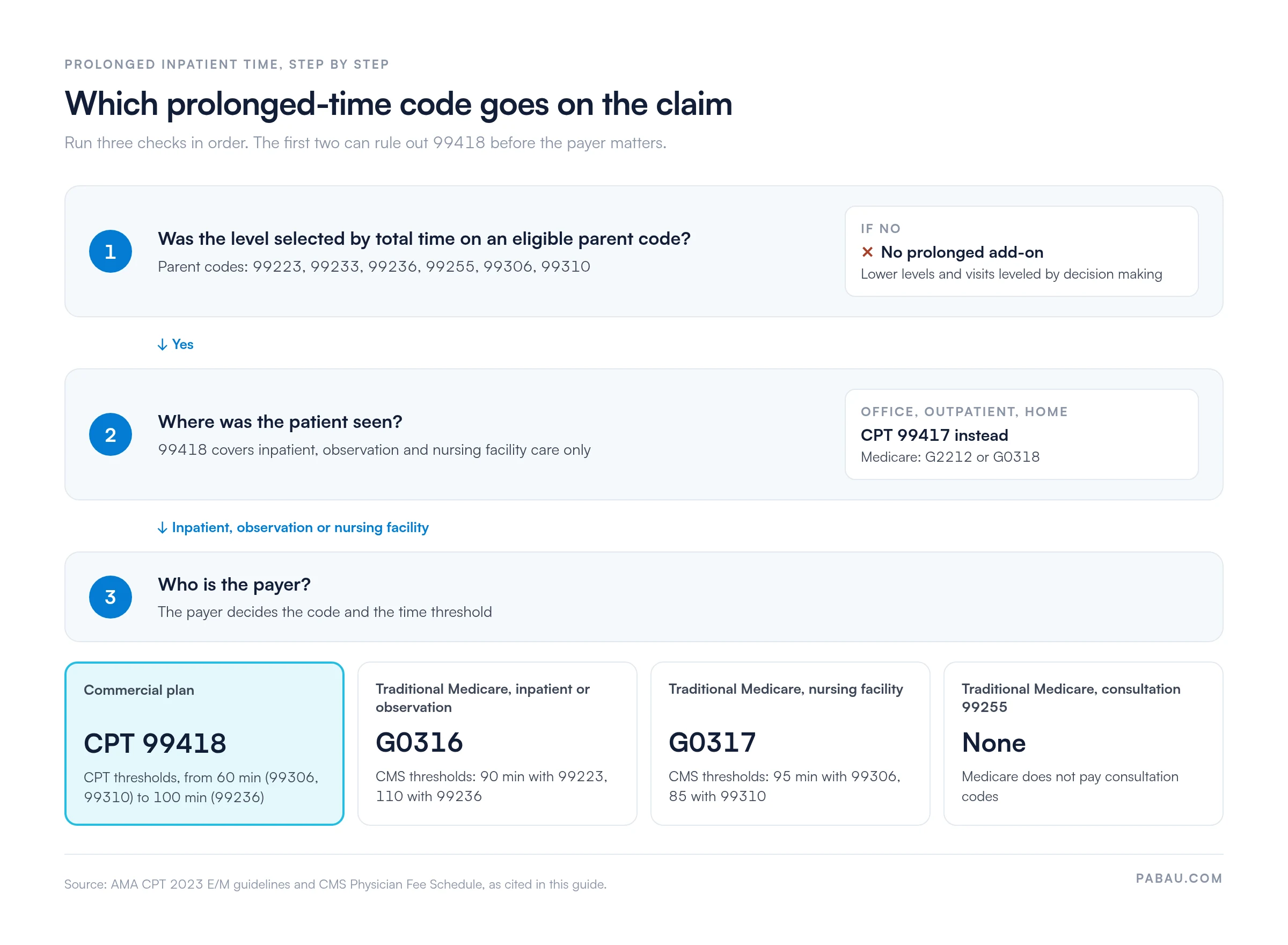
Medicare does not pay CPT 99418. For traditional Medicare patients, report HCPCS code G0316 after 99223, 99233 or 99236, and HCPCS G0317 after 99306 or 99310. Medicare does not pay consultation codes, so a 99255 visit has no Medicare prolonged code.
HCPCS G2212 often gets confused with these codes. G2212 is Medicare’s office and outpatient prolonged add-on, the counterpart of 99417, and never belongs on an inpatient or nursing facility claim.
CMS also sets its own thresholds, and in nursing facilities they run well past the CPT ones. G0317 starts at 95 minutes with 99306 and 85 minutes with 99310.
Payer type then decides which code goes on the claim.
Check the current year’s CMS Physician Fee Schedule for G0316 and G0317 payment status. CMS revises the schedule every year, and the 2023 thresholds were corrected after the first final rule.
A clean 99418 claim depends on four checks before submission: the parent code, the level-selection method, the time total and the payer. A solid medical billing workflow runs them at charge entry, not after a denial.
The decision path below shows where those checks lead, from the parent code to the payer.
Payers paying 99418 want the note to prove the time on its own. For a clean claim, an auditor should be able to read the total and see how it was spent without calling the practitioner.
What the note should show:
Common omissions that lead to denials:
Several common situations look like prolonged inpatient care but cannot support 99418.
Commercial payers set the 99418 rate in their own fee schedules or contracts, so the figure differs from plan to plan. Medicare pays nothing under 99418 and pays G0316 and G0317 through the Physician Fee Schedule instead.
CMS publishes the next year’s fee schedule each November, and geographic adjustments change the payment by location. Pull current-year values from CMS rather than from figures quoted in older articles.
Before billing a long inpatient or nursing facility visit, check whether the patient has traditional Medicare, Medicare Advantage or a commercial plan. That one answer decides between 99418, G0316 and G0317, and which time threshold applies.
99418 denials usually trace back to the payer split, the parent code or the time record. Sorting them by cause is the first step in denial management for this code.
Read electronic remittance advice (ERA) alongside the payer denial codes to tell these causes apart. A documentation problem, a code-selection problem and a payer problem each need a different fix.
Telehealth coverage for prolonged inpatient and nursing facility time depends on the payer and the year. Check the payer’s current policy before you bill an add-on for a virtual visit.
Most of the work on 99418 is settled before the claim is built. A few standing rules keep each visit from depending on one coder’s memory.
Errors on 99418 start at charge entry. Typical ones are the wrong code for the payer, an ineligible parent code, or units nobody checked against the note. Catching them only when the remittance arrives means a rebill and weeks of delay.
Pabau, the practice management and billing platform we build, validates every claim before it leaves the system. Missing or invalid details are flagged while the fix still takes seconds. Pabau’s claims software for billers then sends US claims as CMS-1500s to thousands of payers.
That submission runs through Claim.MD, Pabau’s US clearinghouse partner. Eligibility checks run before the visit, so you know whether the patient has traditional Medicare or another plan. Remittances flow back into Pabau and tie each payment or denial to its claim.
With the payer known before the visit and every claim checked before it goes, prolonged-time lines reach the payer under the right code more often.

Pabau checks eligibility before the visit, validates every claim before submission and sends US claims through Claim.MD to thousands of payers. Prolonged-time add-ons reach the payer with fewer errors.

Treat 99418 as a commercial-payer code. For traditional Medicare patients, the same minutes are billed as G0316 or G0317, and in nursing facilities those thresholds sit 25 to 35 minutes later.
The decisions that matter come before charge entry. Was the level picked by time, and did the practitioner write down the total? Get those two right and the unit count follows from the table.
If your team bills both Medicare and commercial inpatient work, keep both threshold columns in one place and check them on every high-level visit. Book a demo to see how Pabau validates claims and tracks remittances for time-based E/M add-ons.

Need to understand how claims move through a clearinghouse? Medical claims clearinghouse guide explains how payer routing, eligibility checks, and 837 submission work end to end.
Confused about denial code patterns on prolonged services? Denial codes in medical billing decodes CARC and RARC remark codes so you can categorize and appeal denials faster.
Comparing clearinghouse costs? Claim.MD pricing and features covers what Pabau’s clearinghouse partner charges and what each plan includes.
CPT code 99418 is the add-on code for prolonged inpatient, observation or nursing facility E/M time, reported in 15-minute units. It follows only 99223, 99233, 99236, 99255, 99306 or 99310, when total time selected the visit level. The AMA introduced it on January 1, 2023.
CPT 99417 extends office, outpatient, consultation, home and residence visits, while 99418 extends inpatient, observation and nursing facility care. Both report 15-minute units of total time. The setting decides which one applies, not the complexity of the visit.
No, Medicare does not pay CPT 99418. Traditional Medicare uses HCPCS G0316 after 99223, 99233 or 99236, and G0317 after 99306 or 99310. Both use CMS time thresholds, which differ from the CPT ones in some settings.
No, G2212 is Medicare’s office and outpatient prolonged add-on, the counterpart of 99417. Inpatient and observation time goes on G0316, and nursing facility time goes on G0317.
Total time on the date must pass the parent code’s required time by a full 15 minutes. That means 90 minutes with 99223, 65 with 99233, 100 with 99236, 95 with 99255, and 60 with 99306 or 99310.
No, home and residence visits 99345 and 99350 take CPT 99417 for prolonged time. Medicare uses G0318 for prolonged home and residence visits.
The note should state the total time in minutes on the date of the encounter and confirm the level was selected by time. It should also describe the work that filled the extra time. Without those, payers usually deny the add-on.