



CCSD code G5100: Bypass of duodenum billing guide
CCSD code G5100 bills a bypass that leaves the duodenum in place CCSD code G5100...

Last Updated: Oct 16, 2026

CPT 99417 is an add-on code for prolonged provider time, reported with one of six parent codes: 99205, 99215, 99245, 99345, 99350 or 99483
Each unit covers 15 more minutes of total time beyond the parent code’s minimum, so the trigger time is different for every parent code
Medicare never pays 99417. It uses G2212 for 99205, 99215 and 99483, and G0318 for the home or residence visits 99345 and 99350
Medicare’s clock also starts later, because the G codes run from the parent code’s maximum time rather than its minimum
Practice management software like Pabau submits claims through Claim.MD and tracks remittance by payer, so 99417 denials surface fast
CPT Code 99417 is an add-on code for prolonged outpatient evaluation and management time. In addition, one unit covers each additional 15 minutes of total provider time beyond what the parent code already requires. Six parent codes qualify, and each one triggers the first unit at a different total time.
Getting a 99417 claim paid means answering three questions in order. Which parent code is on the claim? Which payer is processing it? And does the documentation support every unit billed? So this guide works through each one in the order coders meet them. It starts with the six parent codes and ends with the Medicare substitution that causes most denials.
CPT Code 99417 describes prolonged outpatient evaluation and management time, with or without direct patient contact, beyond the required time of the primary service. It is reported for each additional 15 minutes of total provider time. It is an add-on code under American Medical Association CPT rules, so it can never be reported on its own.
The AMA descriptor carries a parenthetical instruction naming every code 99417 may accompany. Use 99417 in conjunction with 99205, 99215, 99245, 99345, 99350 and 99483. Matching cross-references sit at each of those codes in the CPT book. In short, that is six parent codes, not two.
The word outpatient in the descriptor causes most of the confusion here. In this context it means anything that is not an inpatient or observation service, which is why home and residence visits qualify. Instead, prolonged inpatient and observation time uses a different code, 99418. So 99417 is not limited to Place of Service 11, and a home visit is not an exception to the rule.
However, one condition applies to every parent code on that list. The level of the primary service must have been selected using total time rather than medical decision making. If the provider coded the visit on medical decision making, 99417 cannot be added no matter how long the encounter ran.
The table below summarizes the key billing parameters for CPT 99417 at a glance. Use it as a pre-claim checklist before you submit.
The threshold system works in two steps. First, the provider has to reach the minimum total time for the parent E/M code. Second, every additional 15-minute block beyond that minimum earns one unit of 99417. Because each parent code has its own minimum, the first unit starts at a different total time in each row below.
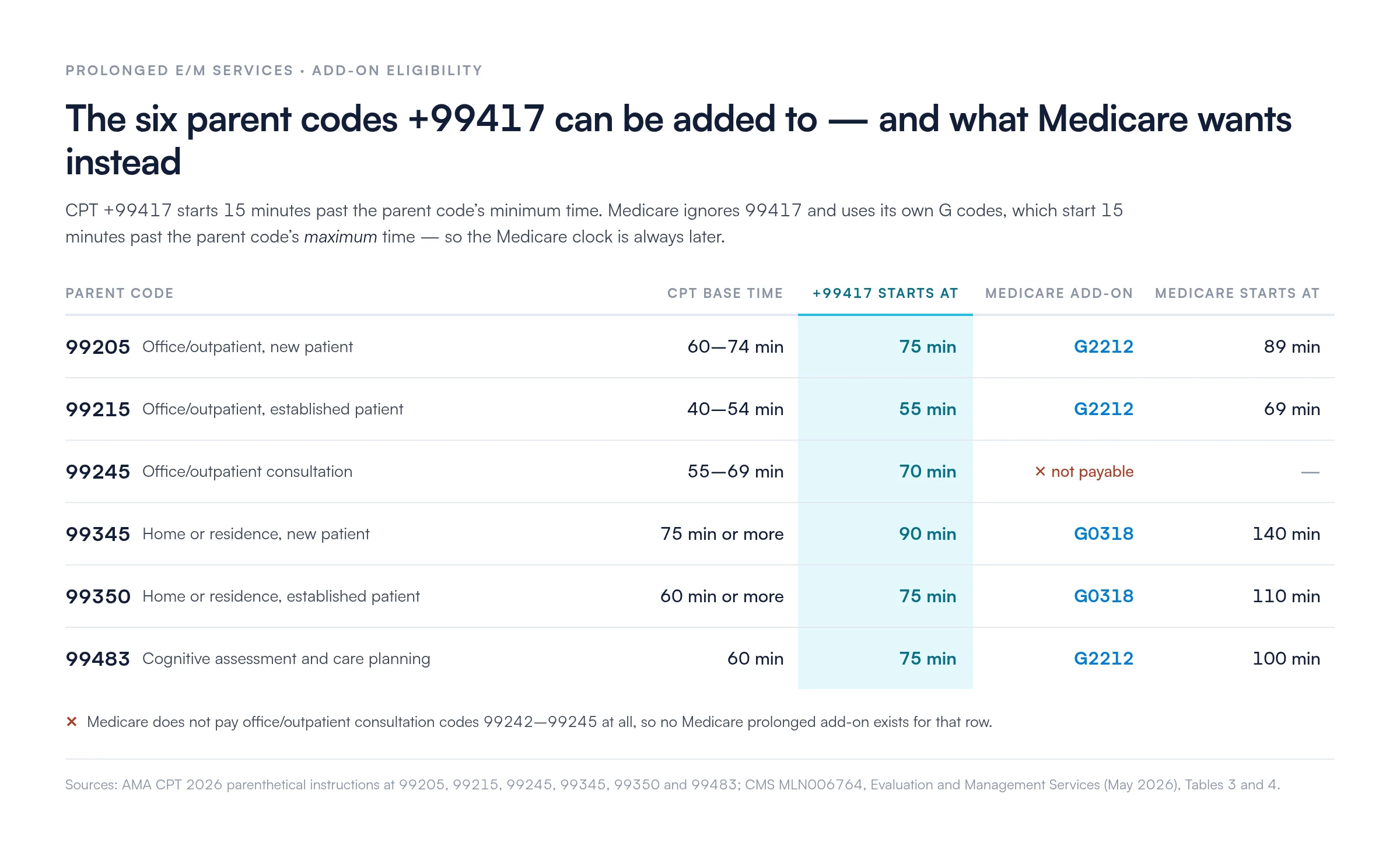
Then, each further 15-minute block earns one more unit. An established patient visit that runs 80 minutes supports 99215 plus two units of 99417, because the second unit starts at 70 minutes. A visit at 90 minutes supports three units, since the third starts at 85.
Total time means all the time the provider spends on that encounter on the date of service. Specifically, it includes chart review, ordering, care coordination and writing the note, not only face-to-face contact. Time spent by clinical staff does not count toward 99417.
Services outside that parent list follow their own time rules. A long interprofessional e-consult earns no 99417 unit and reports as CPT 99451 alone, which starts at 5 minutes with no upper limit.
Track total provider time at the point of care, not retrospectively. Document the start and stop time for the date of service, or note the total minutes spent. Reconstructing time from vague notes after the visit is a common audit trigger for CPT Code 99417 claims.
This is the most consequential decision on any prolonged E/M claim. Medicare does not recognize CPT Code 99417, so submitting it to a Medicare payer produces a denial. Catching the substitution before submission is far cheaper than appealing one afterward.
Two things differ: the parent list and the clock, mapped below. HCPCS G2212 covers only 99205, 99215 and 99483, and home visits move to G0318. The Medicare clock starts 15 minutes past each parent code’s maximum time rather than its minimum, so reusing that threshold on a Medicare claim overstates the units billed.
One more wrinkle: for 99205 and 99215, CMS counts only time on the date of service. For a 99483 cognitive assessment, and for home visits billed with G0318, the window runs from three days before the visit to seven days after, which is why those Medicare thresholds look so much higher.
Medicaid coverage for 99417 varies by state. Overall, some programs follow AMA guidance, others use a state-specific code, and some do not cover prolonged add-ons at all, so check the state fee schedule and provider manual first.
Medicare pays the prolonged unit through G2212 or G0318, never through 99417 itself. Instead, G2212 is priced under the Medicare Physician Fee Schedule. It carries roughly 1.02 total non-facility RVUs for 2026: about 0.61 work, 0.36 practice expense and 0.05 malpractice.
CY2026 has two conversion factors. Qualifying APM participants are paid at $33.5675, and everyone else at $33.4009. Multiplying those against 1.02 RVUs puts one unit of G2212 at roughly $34 nationally, before any geographic adjustment. Confirm the current figure and your locality in the CMS Physician Fee Schedule Look-Up Tool rather than relying on a third-party listing.
Commercial payers that accept 99417 usually price it as a percentage of the Medicare allowable, commonly somewhere between 90% and 130% depending on the contract. Verify your contracted rate instead of assuming the national average applies. Overall, tracking remittance advice by payer shows which carriers pay at the rate they agreed to.
Every unit of CPT Code 99417 needs contemporaneous documentation in the medical record. Instead, coders cannot infer time from the complexity of the note. The record has to support the specific time claimed.
An itemized charge document that breaks out the time components of the visit makes the audit trail clearer. It also speeds up any payer request for records. As a result, a minute count the provider enters during the encounter is easier to defend than one added days later.
CPT Code 99417 carries elevated audit risk. It is a time-based, payer-specific add-on that the Office of Inspector General has flagged as an area of heightened scrutiny. The errors below account for most denials and audit findings.
Practices with high E/M volumes should audit their 99417 attachment rate. A consistently low rate suggests under-billing, while an unusually high one warrants a documentation review. Reading the denial codes on the remittance shows whether a rejection came from payer routing or documentation.
No single policy governs 99417 across payers, so verify coverage before you submit.
For a mixed payer population, confirm coverage at scheduling and note which add-on code applies. Settling that before the visit means the coder is not guessing at the payer while building the charge.
The history explains why so many coding resources still describe 99417 as an office-only code.
CPT 99417 sits inside a family of prolonged service and E/M codes. Knowing the relationships is what stops a claim going out with the wrong add-on.
Run a monthly report on your prolonged services attachment rate, split by payer. If commercial claims never carry 99417 on visits past 75 minutes, you are leaving revenue uncaptured. If any Medicare claim carries 99417 at all, your payer checks need an audit that week.
The rules around 99417 are exactly the kind that break down when they live in someone’s head. First, the threshold changes with the parent code. Second, the code itself changes with the payer. Third, the unit count changes with every extra 15 minutes. So each of those is a decision point where a busy biller can slip.
Practice management software like Pabau settles the facts a coder needs before the charge is built. Real-time eligibility checks at booking confirm which payer is responsible for the visit, and that answer decides between 99417 and a Medicare G code.
From there, Pabau’s claims management software submits the claim electronically through Claim.MD. In addition, Claim.MD validates it across thousands of US payers before it reaches the insurer. Remittance data flows back as electronic remittance advice, so the team can see which payers deny prolonged service lines and how often.

Pabau checks eligibility before the visit, submits claims electronically through Claim.MD, and tracks every remittance in one place. See how practices spot prolonged service denials by payer and act on them sooner.

CPT 99417 captures prolonged provider time across six parent codes, not two, and the setting is wider than most coding summaries admit. What narrows is the Medicare side. G2212 covers only 99205, 99215 and 99483, home visits move to G0318, and every Medicare threshold sits later than its CPT equivalent. Get the parent code, the payer and the clock right and the claim pays. Otherwise, miss any one of them and it does not.
Practices that encode these rules in their billing workflow, rather than relying on recall, see fewer denials and cleaner audit records. To see how Pabau’s eligibility checks, Claim.MD submission and remittance tracking work day to day, book a demo with our team.

Need the Medicare side of this code in full? HCPCS code G2212 covers the thresholds, documentation and pricing rules for the Medicare prolonged add-on.
Need to understand what medical billing actually involves? What is medical billing covers the full claims workflow from charge capture to payment posting.
Want a cleaner claims submission process? Clean claim best practices outlines the elements that prevent front-end denials before claims reach the payer.
Managing denials across multiple payers? Denial management in healthcare explains how to categorize, track and appeal denied claims systematically.
Looking for a structured billing compliance framework? Medical billing compliance covers the audit risk areas that affect outpatient E/M practices most often.
CPT Code 99417 is an add-on code for prolonged provider time on an evaluation and management service. One unit covers each additional 15 minutes of total time. It may be reported with six parent codes: 99205, 99215, 99245, 99345, 99350 and 99483. The parent visit level must have been selected using total time rather than medical decision making.
No. Medicare does not recognize CPT Code 99417 and will not reimburse it. Use G2212 for prolonged time on 99205, 99215 or 99483, and G0318 for prolonged time on the home or residence visits 99345 and 99350. CMS and the Medicare Administrative Contractors state the same rule, and there is no crosswalk that makes 99417 payable.
The first unit of 99417 is billable at 75 minutes of total time with 99205 and 55 minutes with 99215. With the other parent codes it starts at 70 minutes for 99245, 90 for 99345, and 75 for both 99350 and 99483. Each further unit needs another full 15 minutes. Total time covers all provider activity on the date of service, not only face-to-face contact.
No. CPT Code 99417 may only be reported with 99205, 99215, 99245, 99345, 99350 or 99483. Lower-level office visits such as 99213 and 99214 do not qualify, and prolonged inpatient or observation time uses 99418 instead. Adding 99417 to a code outside that list will result in a denial.



