CPT code 93503: Swan-Ganz catheter billing and modifiers
CPT code 93503: Official descriptor and procedure overview In the AMA CPT code s...

Last Updated: Oct 23, 2026

CPT code 99205 is the highest-level new patient office or outpatient E/M code, requiring high complexity MDM or 60-74 minutes of total time on the date of encounter.
Code selection uses either the MDM pathway or the time pathway – not both; high MDM requires meeting 2 of 3 AMA elements at the high level.
Modifier 25 is required when billing 99205 on the same day as a procedure; upcoding 99205 is a known OIG and RAC audit target.
Practice management software like Pabau, with claims management and an AI medical scribe, helps practices document, code, and submit E/M visits accurately to reduce denials.
CPT code 99205 is the highest-level evaluation and management (E/M) code for a new patient office or outpatient visit. Also searched as procedure code 99205, it applies when the encounter involves high-complexity medical decision-making or 60 to 74 minutes of total time on the date of service. This guide covers the definition, the MDM and time documentation rules, modifier and reimbursement considerations, and how 99205 differs from 99204. Claim scrubbing catches the mismatches that would otherwise come back as a denial two weeks later.
Most new patient visits never reach this level.
CPT code 99205 is the highest-level evaluation and management code for new patient office or other outpatient visits, as defined by the American Medical Association’s CPT code set.
The official descriptor reads: Office or other outpatient visit for the evaluation and management of a new patient, which requires a medically appropriate history and/or examination and high level of medical decision making. When using time for code selection, 60-74 minutes of total time is spent on the date of the encounter.
This article covers the documentation requirements, MDM criteria, time rules, 2026 Medicare reimbursement rates, applicable modifiers, and common denial reasons for CPT code 99205.
CPT code 99205 sits at the top of the new patient office visit series. Understanding where it lands in the full range helps coders choose the right level and avoid upcoding exposure.
CPT code 99201 was deleted effective January 1, 2021, when the AMA overhauled the E/M guidelines and the new patient series became 99202-99205. Before 2021, all three key components (history, examination, and MDM) were required for new patient codes. That requirement no longer applies. Code selection now rests on MDM complexity or total time on the date of encounter – whichever the provider chooses.
One important distinction: 99205 is classified as a new patient code. A patient is “new” if they have not received professional services from the billing provider (or any provider of the same specialty in the same group practice) within the past three years. Established patients use codes 99211-99215.
The three-year test decides the E/M level, and the diagnosis codes carry their own 7th character for encounter stage. A constriction wound check referred in from the emergency department is a new patient visit that still reports ICD-10 code W49.09XD.
Every 99205 claim needs documentation that supports the selected pathway – MDM or time. Incomplete or vague notes are the most common reason for downcoding on audit.
High complexity MDM requires meeting at least 2 of the following 3 AMA elements at the high level:
The note must reflect each element clearly. Phrases like “patient has complex medical history” don’t cut it. Document the specific conditions addressed, the data reviewed, and the risk-based decision made during the encounter.
The 99205 time requirement is 60 to 74 minutes of total time on the date of the encounter. Since 2021, “time” for E/M purposes means total provider time – not just face-to-face time. This includes reviewing records, ordering tests, coordinating care with other providers, and preparing notes. Time spent by clinical staff members who are not the billing provider does not count.
The note must document the total time spent and briefly describe the activities performed. A simple statement such as “Total time today including pre-visit review, examination, and care coordination: 65 minutes” satisfies the requirement when the activities are also summarized.
For encounters exceeding 74 minutes, prolonged services can be added to CPT code 99205: bill HCPCS add-on G2212 for Medicare, or CPT +99417 for commercial and other AMA-aligned payers. Verify payer-specific acceptance before billing.
Practices managing high-volume new patient schedules benefit from consistent documentation templates. Reviewing your HIPAA compliance checklist for primary care alongside your documentation standards helps ensure notes meet both privacy and billing requirements.
Document MDM elements and time in separate, clearly labeled sections of the note. Auditors and coders look for explicit statements – never assume that clinical complexity is self-evident from the note’s content alone. A structured note template covering Problems Addressed, Data Reviewed, and Risk Assessment takes less than 90 seconds to complete and dramatically reduces audit exposure.
Two modifier situations arise frequently when billing CPT code 99205, and both carry audit risk.
When a provider performs a procedure on the same date as a new patient E/M visit, Modifier 25 must be appended to the E/M code. It signals that the E/M service was a separately identifiable evaluation – not just the pre-service workup for the procedure itself.
The documentation burden here is real. The note must demonstrate that the E/M service addressed a problem or condition that was distinct from the procedure, or that the decision to perform the procedure was itself based on findings from the E/M.
The Office of Inspector General (OIG) has flagged Modifier 25 as a high-risk billing pattern for years. Claims that bill an E/M with a procedure on every date of service attract RAC scrutiny.
The practical question for most coders is whether a given new patient encounter supports 99205 or the adjacent 99204. The MDM distinction is moderate versus high complexity.
In behavioral health and psychiatry, CPT code 99205 is commonly appropriate for initial evaluations involving multiple psychiatric comorbidities, active suicidal ideation, or severe substance use disorders with medical complications. Practices serving these populations should review their psychiatry EMR software capabilities for documentation support at these complexity levels.
Primary care and family practices see similar complexity when new patients present with several unmanaged chronic conditions. Reviewing how GP clinic software handles time tracking and problem lists helps support the same MDM documentation standard.

Pabau’s claims management tools and AI-assisted documentation help practices capture the right MDM evidence, flag incomplete notes before submission, and track denial patterns across providers – so 99205 claims hold up on audit.

Medicare reimbursement for CPT code 99205 is calculated using the Resource-Based Relative Value Scale (RBRVS). The 2026 national non-facility rate is approximately $236.81, but this figure varies by geographic locality. Always verify the current rate using the CMS Physician Fee Schedule lookup tool for your specific practice location.
The 99205 RVU breakdown has three components. For CPT code 99205, the approximate 2026 values are:
These are approximate 2026 values. Verify the exact current figures against the CMS 2026 Medicare Physician Fee Schedule (MPFS) RVU file using the CMS Physician Fee Schedule lookup tool before relying on them for billing. RVU values shift annually with the MPFS final rule, and the total RVU above is what supports the payment figure quoted earlier in this guide.
NPs and PAs can bill CPT code 99205 independently under Medicare at 85% of the physician fee schedule rate. Under incident-to billing, the rate is 100% – but incident-to rules require the supervising physician to have an established treatment plan and be present in the office suite during the visit.
New patients almost always require the NP or PA to bill in their own name, since incident-to applies only when treating an established condition. Always confirm payer-specific rules before selecting the billing path.
State Medicaid programs and commercial insurers set their own rates independently of Medicare. Reimbursement can vary significantly. For practices evaluating software that tracks payer-specific rates.
Track your 99205 acceptance rate by payer separately from your overall E/M acceptance rate. A single commercial payer rejecting 99205 at a higher rate than Medicare is a signal that their LCD or medical policy defines high complexity differently – worth reviewing before your next claims cycle.
CPT code 99205 is a known audit target. It’s the highest-level new patient code, which makes it the first place payers look when reviewing outlier billing patterns. Practices with high 99205 utilization relative to their specialty benchmark attract RAC and payer review.
Practices running direct primary care software sometimes bypass insurance billing entirely, but for those who bill Medicare or commercial plans, periodic internal audits of CPT code 99205 claims are standard risk management. Pulling a sample of 99205 claims quarterly and checking the notes against MDM or time criteria takes less than an hour and identifies pattern problems before a payer audit does.
Practices can also benefit from reviewing how other CPT code guides.
CPT code 99205 can be billed for telehealth encounters under CMS’s ongoing telehealth flexibilities. The same MDM or time criteria apply. For time-based billing via telehealth, total time includes the video visit itself plus pre- and post-encounter work completed on the same date.
Post-PHE telehealth rules continue to evolve, so confirm the current Place of Service (POS) code requirements with your Medicare Administrative Contractor (MAC) before billing 99205 for a telehealth new patient visit. POS 02 (telehealth, patient not in their home) and POS 10 (telehealth, patient in their home) carry different reimbursement implications.
Modifier 95 is typically appended to the E/M code for synchronous audio-video telehealth, in addition to the correct POS code.
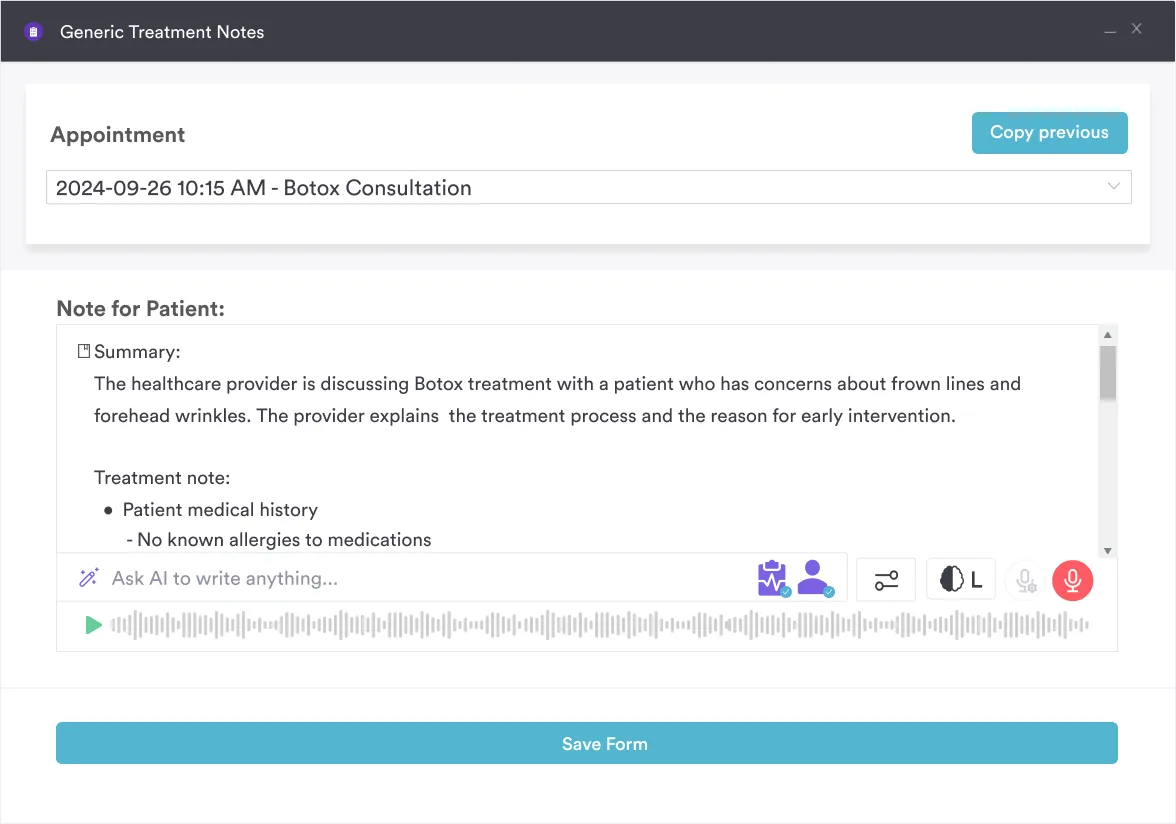
On the software side. The note generated during the visit should be reviewed and attested by the billing provider before the claim goes out.
For practices building out their first visit workflows. The 99205 claim is only as strong as the workflow supporting it.
CPT code 99205 is the highest-stakes new patient E/M code in the 99202-99205 series. Getting it right means meeting the MDM or time threshold, documenting it clearly, and applying Modifier 25 correctly when procedures appear on the same date.
Pabau’s claims management software connects documentation to the billing workflow, flagging incomplete notes and tracking denial patterns before they compound. To see how it works for new patient E/M billing, book a demo.

Need the code for hemodialysis tubing? blood tubing billing guide covers when blood tubing for hemodialysis can be billed outside the facility bundle.
Want to reduce admin time on new patient intake? Capture forms software captures structured history before the visit, giving providers the MDM starting point their notes need.
Need to code dialysis supplies correctly? Dialysate solution test kit covers the CMS descriptor and clarifies when this supply is billed as a standalone claim.
CPT code 99205 is used to bill for a new patient office or outpatient visit that requires high complexity medical decision making or 60-74 minutes of total provider time on the date of the encounter. It is the highest-level new patient E/M code and is commonly used in primary care, psychiatry, and internal medicine for complex first visits.
99204 requires moderate complexity MDM or 45-59 minutes of total time, while 99205 requires high complexity MDM or 60-74 minutes. High MDM means the problems addressed involve a threat to life or bodily function, or the risk involves drug therapy requiring intensive toxicity monitoring or a hospitalization decision.
The 2026 national non-facility Medicare rate for CPT code 99205 is approximately $236.81, based on CMS Physician Fee Schedule data. Rates vary by geographic locality. Use the CMS fee schedule lookup tool to confirm the exact amount for your practice location and MAC jurisdiction.
Yes. Nurse practitioners and physician assistants can bill CPT code 99205 independently under Medicare at 85% of the physician fee schedule rate. Incident-to billing at 100% is rarely applicable for new patients, since incident-to requires an established treatment plan from the supervising physician.
Yes, when a procedure is performed on the same date as the new patient visit, Modifier 25 must be appended to 99205 to indicate the E/M was a separately identifiable service. The documentation must support both services independently. Modifier 25 is an OIG-flagged high-audit-risk billing pattern.
CPT code 99205 requires 60-74 minutes of total provider time on the date of the encounter when using the time-based selection pathway. This includes pre-visit record review, the examination, care coordination, and note preparation – not just face-to-face time with the patient.