

CPT Code 98981: RTM Treatment Management Billing Guide
CPT code 98981: Definition and official descriptor CPT code 98981 is an add-on c...

Last Updated: Nov 9, 2026
95716 is the CPT code for the technical work on a video EEG (VEEG) that an EEG technologist monitors live for the whole recording. One unit covers each increment of 12 to 26 hours, and one technologist may watch no more than four patients at once.
It is a technical code, so it never takes modifier 26 or TC. Setup is billed once per recording with 95700. The physician bills the interpretation separately, with 95720 for each 24-hour period or a complete-study code after the recording ends.
Let Pabau's smart automation suggest the right codes, reduce claim denials, and keep your practice compliant—effortlessly.
Automate repetitive tasks and focus on what matters most—your patients.
Reduce coding errors and ensure compliance with the latest regulations.
Clean claims, fewer denials, and faster reimbursements.
Powerful insights and reporting to help your practice thrive.
HIPAA compliant SOC 2 certified GDPR-compliant Trusted by 4,000+ clinics worldwide

CPT code 95716 reports the technical work on video EEG with continuous, real-time technologist monitoring, once for each 12-26 hour increment.
It is a technical code with PC/TC indicator 0 in the 2026 fee schedule file, so modifiers 26 and TC are never appended.
Continuous monitoring means live review of EEG and video for the whole recording, with one technologist watching no more than four patients.
Setup is billed once per recording with 95700, and the physician bills the interpretation separately with codes from 95717 to 95726.
Medicare lists 95716 with status C, so each MAC sets the office and home rate, while hospital outpatient departments are paid under OPPS.
CPT code 95716 is the technical code for a video EEG (VEEG) recording that an EEG technologist monitors live for the whole recording. One unit covers each increment of 12 to 26 hours. The code pays for the technologist’s review of data, technical description and maintenance of the recording.
It does not cover the physician’s reading. The neurologist’s review, interpretation and report are separate professional services with their own codes. The long-term EEG family that holds both sides took effect on January 1, 2020, and replaced the older 95950-95953 series.
The CMS fields in the table come from the October 2026 release of the physician fee schedule relative value file. The descriptor and family structure match the ASET CPT code selection guide for neurodiagnostic procedures.
The monitoring level is what separates 95716 from its two siblings, 95714 and 95715. All three describe the same 12-26 hour VEEG increment. The difference is how closely the technologist watched the recording while it ran.
Under continuous monitoring, the technologist identifies events as they happen and alerts the physician to critical issues. The monitoring can be done on-site or remotely. Remote monitoring still has to be live and documented.
Two situations push a study down a level. If one technologist watches more than four patients at once, those studies are reported as intermittent or unmonitored. If the live monitoring breaks during the recording, the study is reported as intermittent, which means 95715.
Build the patient-to-technologist ratio into your monitoring log, with a time stamp for every handover. When an auditor asks how a study qualified for 95716, the log answers the question without anyone reconstructing the staffing rota.
The family splits technical work from professional work. The technical codes sort by three choices: recording length, video or no video, and monitoring level. The professional codes sort by length, video, and whether the physician reports daily or at the end of the study.
A continuously monitored VEEG study therefore produces three kinds of line. The technical entity reports 95700 once and 95716 for each 12-26 hour increment. The physician reports the matching professional code for the same recording.
Report 95716 once per 24-hour period of continuously monitored VEEG. A study that lasts 12 to 26 hours in total takes a single unit. A final increment of 2 to 12 hours beyond 26 hours moves to the 2-12 hour code, which is 95713 for continuous VEEG.
Take a 50-hour outpatient VEEG with remote continuous monitoring throughout. The technical claim looks like this.
The physician side runs in parallel. A neurologist who reads and reports after each 24-hour period uses 95720 for those increments. A neurologist who writes one summary report after the whole recording uses the complete-study code for that length, which is 95722 for a 50-hour VEEG. Laid out on one timeline, the whole study becomes four technical lines and one professional line.
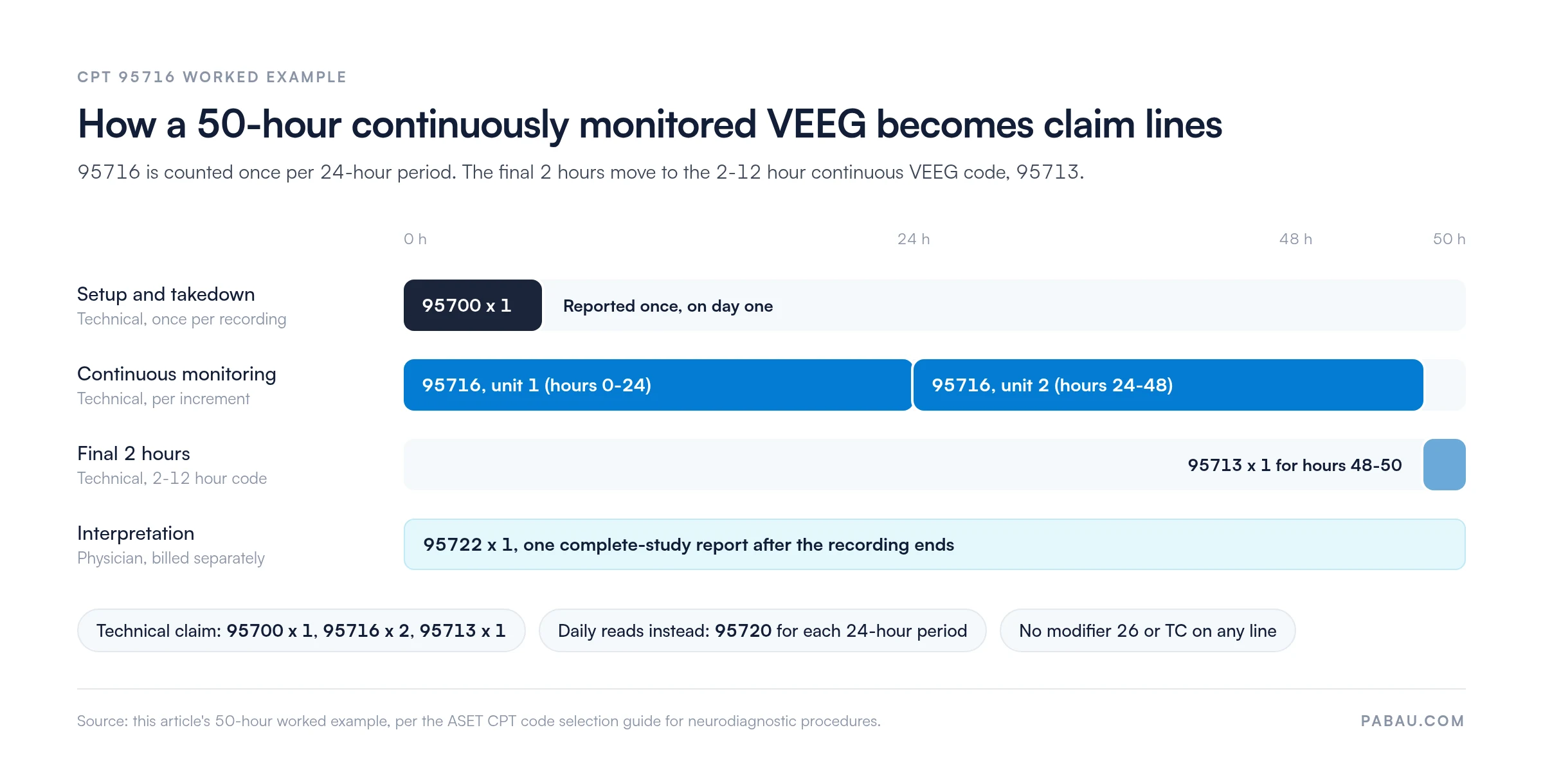
Record the start and stop time of every recording segment, not only the total. Payers count 95716 units from those times, and a missing stop time turns a two-unit study into an argument about one.
The entity that owns the equipment and employs or contracts the technologist bills 95716. The setting decides which payment system applies.
Because 95716 has PC/TC indicator 0, there is no global version to split. The technical code stands alone, and the physician’s professional code stands alone. Two entities can bill the same study without either one appending 26 or TC.
Medicare publishes no national rate for 95716. The 2026 relative value file lists it with status C, and every RVU field reads 0.00. Each MAC sets its own amount for office and home studies.
CY2026 has two conversion factors. Clinicians who are qualifying APM participants are paid at $33.5675, and everyone else at $33.4009. Neither one produces a figure for 95716, because a zero RVU total multiplied by any factor stays at zero. The 95720 amounts are total RVUs multiplied by each factor, before the geographic adjustment.
For an office or home study, ask your MAC for its 95716 fee schedule, or check its published contractor-priced amounts. For hospital outpatient claims, look up 95716 in the current OPPS Addendum B. Commercial payers set their own rates by contract.
The modifier that most 95716 claims get wrong is 26. Older guidance treated long-term EEG codes as split professional and technical services, and claim templates still carry that habit.
If a payer rejects 95716 for a missing 26 or TC modifier, the payer’s edit is out of date. Appeal with the CMS indicator rather than adding a modifier the code does not support.
The documentation has to prove two things: the time recorded and the level of monitoring. Without both, a payer can step 95716 down to 95715 or 95714, or cut the unit count.
ASET’s guide adds one limit worth knowing. Long-term EEG done by staff who do not meet the EEG technologist definition is reported with unlisted code 95999, not 95716.
Keep these records for the payer’s audit window, and file them where the billing team can reach them. Our billing compliance guide covers retention in more detail.
The diagnosis has to explain why the patient needed long-term VEEG with live monitoring. The codes below are common examples, not a coverage list. Check each one in our ICD-10-CM codes library. Then confirm it against your MAC’s policy and the payer’s own rules before you submit.
Medicare has no national coverage determination for long-term EEG. CMS retired NCD 160.22, Ambulatory EEG Monitoring, effective January 1, 2023. Coverage decisions now sit with each MAC, so check your contractor’s local coverage determination and billing article.
Commercial payers write their own policies for video EEG monitoring. Aetna’s Clinical Policy Bulletin 0322 is one example. Many plans require prior authorization, and some limit the setting or the number of monitored days.
Before the study, confirm three points with the payer. Ask whether 95700 and 95716 need authorization, how many days are approved, and whether the approval covers home, outpatient or inpatient monitoring. Insurance eligibility verification at booking catches most of these problems early.
Most 95716 denials come from the code’s identity, its unit count or its monitoring proof. The table pairs each with a fix. Denial management workflows that sort rejections by root cause make the patterns easier to see.
A 95716 claim stands or falls on records made during the study: the order, the segment times, the monitoring log and the authorization. Pabau, the practice management platform we build, keeps those records on the patient’s file next to the invoice.
Before the study, staff run a real-time eligibility check from the patient record through our US partner, the Claim.MD clearinghouse. After it, Pabau turns the invoice into an electronic CMS-1500, so the billing team works from the same file the clinical team filled in.
Claim status updates and electronic remittance advice come back into Pabau’s claims management software. Your team can see which 95716 claims are paid, pending or denied, and follow up before they age.

Pabau runs real-time eligibility checks, sends CMS-1500 claims through Claim.MD and brings remittances back to the patient record. Your team can follow each 95716 claim from booking to payment.

CPT 95716 pays for the technologist’s live watch over a video EEG, one 12-26 hour increment at a time. The physician’s reading goes on its own professional code, so 95716 never carries modifier 26.
Get three facts right and the claim holds up. Prove the monitoring was continuous, count units from the segment times, and let the physician bill the professional side separately. Price it from your MAC or the OPPS file, because Medicare sets no national rate.
Book a demo to see how Pabau keeps the order, the authorization and the claim for each VEEG study on one patient record.

Want to see how claims reach payers? Claim.MD clearinghouse overview explains how claims are checked and routed through Pabau’s US clearinghouse partner.
Seeing recurring claim rejections? Denial codes in medical billing breaks down the most common CARC codes and the fix for each.
Tracking EEG revenue by code? Revenue cycle management explained outlines the measures billing teams use to follow collections.
CPT code 95716 reports the technical work on a video EEG with continuous, real-time monitoring by an EEG technologist. One unit covers each 12-26 hour increment of recording. The physician interpretation is billed separately.
No. CMS lists 95716 with PC/TC indicator 0, so neither modifier 26 nor modifier TC applies. The code already describes technical work. The physician bills the interpretation with a professional code from 95717 to 95726.
All three report a 12-26 hour video EEG increment. 95714 is unmonitored, and 95715 needs live review at least every two hours, with up to 12 patients per technologist. 95716 needs live monitoring for the whole recording, with no more than four patients per technologist.
Bill one unit for each 24-hour period of continuously monitored video EEG. A study of 12 to 26 hours takes one unit. A final segment of 2 to 12 hours beyond 26 hours is billed with 95713 instead.
Yes. CPT 95700 covers setup, patient education and takedown by the EEG technologist. It is billed once per recording period, on the first day of a multiday study, alongside the monitoring code.
Medicare sets no national amount. The 2026 fee schedule file lists 95716 with status C and zero RVUs, so each MAC prices office and home studies. Hospital outpatient claims are paid under the outpatient prospective payment system.




