HCPCS code K0552: Non-insulin infusion pump cartridge guide
HCPCS code K0552: Definition and code description HCPCS code K0552 describes sup...

Last Updated: Nov 23, 2026
95961 is the CPT code for the first hour of functional cortical and subcortical mapping, with a physician or other qualified professional in attendance. Mapping uses stimulation or recording through electrodes on the brain surface, or depth electrodes, to provoke seizures or identify vital brain structures.
It is reported almost only in pre-surgical epilepsy workups and before resections near eloquent cortex. Each further hour of attendance goes on add-on code 95962, once 31 minutes or more of that hour are spent in the room. The note must record start and stop times.
Let Pabau's smart automation suggest the right codes, reduce claim denials, and keep your practice compliant—effortlessly.
Automate repetitive tasks and focus on what matters most—your patients.
Reduce coding errors and ensure compliance with the latest regulations.
Clean claims, fewer denials, and faster reimbursements.
Powerful insights and reporting to help your practice thrive.
HIPAA compliant SOC 2 certified GDPR-compliant Trusted by 4,000+ clinics worldwide

CPT code 95961 covers the first hour of a physician’s attendance during functional cortical and subcortical mapping, not routine EEG monitoring.
Add-on code 95962 covers each additional hour, and it is never billed without 95961 for the same session.
An additional hour becomes a 95962 unit only once 31 minutes or more of it are spent in attendance.
The attending physician must be in the room, and the note needs exact start and stop times.
Pabau, a practice management platform, sends US claims through Claim.MD and warns staff when a prior authorization is missing.
CPT code 95961 reports the first hour a physician or other qualified health care professional spends in attendance during functional cortical and subcortical mapping.
The ASET neurodiagnostic coding guide describes it as brain mapping for the initial hour, with add-on 95962 for each hour after it. The full descriptor, owned by the American Medical Association, is below.
Functional cortical and subcortical mapping by stimulation and/or recording of electrodes on brain surface, or of depth electrodes, to provoke seizures or identify vital brain structures; initial hour of attendance by a physician or other qualified health care professional.
In practice, the neurosurgeon places a subdural grid, strips or depth electrodes. A neurologist or epileptologist then stays in the room while the team stimulates them.
The aim is to map motor, sensory or language cortex before epilepsy surgery, or before removing a tumor that sits near eloquent cortex. The neurologist reads each response and tells the surgeons where resection is safe.
95961 pays for the neurologist’s time and judgment during mapping, nothing more. Knowing where that line sits prevents the unbundling errors that NCCI edits catch.
Included in 95961:
Billed separately, by the right provider:
Equipment and surgical work stay with the neurosurgeon and the facility. When a claim blends the two roles, an auditor usually finds it.
Before you submit any claim for CPT code 95961, confirm the record holds two separate notes. The neurosurgeon’s note documents electrode placement. The neurologist’s note documents physical presence, stimulation parameters and mapping results. Payers audit these separately, and a single combined note often fails to satisfy both.
CPT 95962 is the add-on code for each additional hour of attendance beyond the first. It is never billed without 95961, so a claim carrying 95962 alone will be denied.
The hour rule is where most unit errors start. A CPT Assistant time rule, reported by AAPC, says an hour counts once 31 minutes or more of it are performed. So 95 minutes is one unit of 95961 plus one unit of 95962. Exactly 60 minutes, or 90, is 95961 alone.
The chart below shows where each extra unit starts.
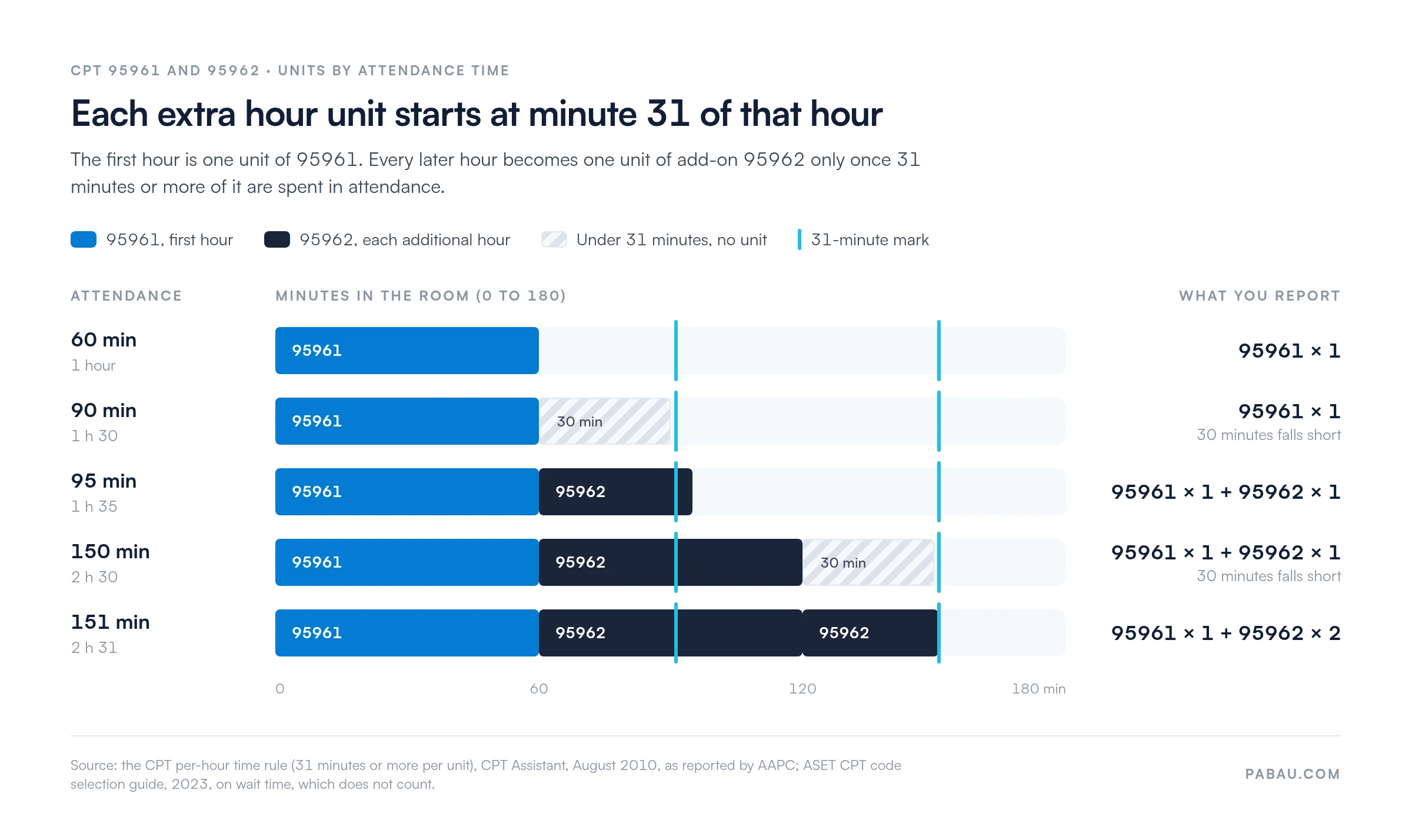
Two more limits come from the ASET guide. Time spent waiting for mapping to begin does not count, and virtual attendance does not qualify for 95962. Check your payer’s policy as well, since some apply their own edits.
These codes either get mixed up with 95961 or show up on the same claim. Keep the distinctions straight and most bundling questions answer themselves.
Long-term monitoring usually comes before mapping in an epilepsy workup, so the same patient may carry codes such as 95716 from the 95700-95726 family. Those services sit on their own dates and their own documentation.
Routine studies are the commoner overlap. If 95819 or 95816 appears on the same date as 95961, check the NCCI table first. Modifier 59 fits only when the services were distinct and separately documented.
Spike analysis follows its own rule. Bill 95957 once per session, and leave it off when automated detection software already ran with long-term EEG.
Mapping claims fail in predictable places, so it helps to see the whole route. Here is the order most neurology billing teams follow.
Each step has an owner. When a denial comes back, the reason code usually points to the step that slipped.
Documentation for CPT code 95961 has to satisfy the CPT descriptor and your MAC’s criteria. Thin records are behind most post-payment recoupments on mapping claims.
Check that these elements are in the record before the claim goes out. AAPC’s CPT code ranges are a quick way to confirm descriptors.
The neurologist’s note must stand on its own, apart from the neurosurgeon’s operative report. Payers review the two separately.
A payer needs a diagnosis that justifies mapping. The table covers the ICD-10-CM codes most often paired with CPT code 95961.
Most pre-surgical candidates carry a symptomatic code from G40.1- or G40.2-, because a structural cause is what surgery targets. Use the most specific subcategory the documentation supports. Search the full ICD-10-CM codes library when the note names a cause outside this table.
Intractable codes such as G40.019 and G40.219 carry more weight. They show that seizures continue despite medication, which is the usual reason a patient reaches surgery.
CMS assigns relative value units (RVUs) to CPT code 95961 in the annual Medicare Physician Fee Schedule. The dollar amounts change every January. Look up current figures in the CMS Physician Fee Schedule or the FastRVU lookup tool before quoting a rate.
Payment follows the standard RBRVS structure:
Medicare coverage for CPT code 95961 depends on your Medicare Administrative Contractor (MAC). Noridian, Novitas, CGS and the other MACs can word their criteria differently, so pull the policy for your jurisdiction before billing.
Mapping reviews tend to turn on the same questions:
For brain tumor cases, the record should show the tumor sits near eloquent cortex and that the results will shape the approach. Routine pre-operative mapping without that link is at risk of a medical-necessity denial.
Commercial payers: Many follow Medicare’s logic, but they require prior authorization more consistently. Confirm the requirement plan by plan, secure the authorization before the procedure date and put the number on the claim.
The right modifier depends on the billing arrangement, so settle it before the first claim. The table covers the modifiers that come up with functional cortical mapping.
Modifier 51 is not needed on 95962, because add-on codes are exempt from it. When a neurologist and a neurosurgeon bill the same date, each reports their own scope. The neurologist bills 95961 for mapping, and the neurosurgeon bills the craniotomy and electrode codes.
CMS updates the NCCI edit tables every quarter. A code pair that needed no modifier in January may need one after the April release. Recheck the current table before each claim cycle.
Run through this list on every mapping claim. It takes a couple of minutes and catches most of what payers reject.
For the general version, the clean claim submission guide covers the fields every claim needs before it goes out.
Most denials on mapping claims trace back to six errors. Each one has a simple corrective step.
Track denials by CARC reason code and CPT code, and the biggest source of lost revenue shows itself quickly. A structured denial management workflow turns that tracking into fixes before denials become write-offs.
On many neurology teams, mapping claims are still assembled by hand. Someone copies times from the note, retypes the diagnosis and chases the authorization number by email.
Pabau, a practice management platform with claims management software built in, works from the patient record instead. It pre-fills the claim with the codes already recorded and holds it until required fields, such as the authorization number, are complete. Prior authorizations are tracked on the patient’s case, with a warning when one is missing.
US claims go out electronically through Claim.MD as CMS-1500/837P claims, with eligibility checks and ERA remittances in the same system. Your coders still own the units and the modifiers. They just stop losing claims to a blank field.

Pabau pre-fills the claim from the patient record, holds it until required fields are complete and submits it through Claim.MD. Your team sees eligibility and remittances in the same place.

Paying 95961 reliably comes down to two habits. Get a signed attendance note with clock times, and convert those minutes into units with the 31-minute rule.
Build both into the mapping session itself, where the times are first written down. When the neurologist records times in the room and the coder applies one rule, the 95962 count stops being a debate. Modifiers, diagnosis specificity and prior authorization still matter, but they rarely sink a claim that starts from a clean note.
Book a demo to see how Pabau keeps every 95961 claim complete, from authorization to remittance.

Need a clearinghouse that handles neurology claims? Claim.MD clearinghouse guide explains how electronic claim submission and remittances work for US practices.
Want the full picture from encounter to payment? Understanding revenue cycle management walks through each stage, from scheduling to payment posting.
Billing mapping outside an insurance contract? Superbill guide covers the fields a superbill needs so patients can claim reimbursement.
New to the billing side of neurology? What is medical billing explains how codes, claims and payers fit together.
Worried about audit exposure on time-based codes? Medical billing compliance covers the rules and controls that keep claims defensible.
No. Time spent waiting for mapping to begin is not reported, according to the ASET coding guide. Count only the minutes the physician is in attendance while mapping is underway.
No. CMS expects the physician in the room during mapping, and ASET excludes virtual attendance from 95962. Remote neurophysiology monitoring is a different service with its own codes.
No. The Wada test, with its EEG monitoring, has its own code, 95958. Bill 95961 only for stimulation or recording that maps cortical function.
Yes, when they are performed and documented separately. AAPC treats evoked potential studies such as 95925-95927 as distinct from mapping, so they are not bundled into 95961.
No. Magnetoencephalography (MEG) has its own codes, 95965-95967, because it records magnetic fields without electrodes on the brain. Use 95961 only for electrode-based mapping.