ICD-10 Code R06.02: Shortness of breath billing guide
ICD-10 Code R06.02: Definition and quick-reference details ICD-10 Code R06.02 is...

Last Updated: Nov 9, 2026
Billable Code Specific Code
R56.9 is the billable ICD-10-CM code for unspecified convulsions. It covers a documented convulsive episode whose type and cause have not yet been confirmed.
Coders use it most in emergency department visits, first-seizure evaluations, and workups still in progress. Once the record confirms epilepsy, fever, head trauma, or a newborn presentation, a more specific code replaces it.
Let Pabau's smart automation suggest the right codes, reduce claim denials, and keep your practice compliant—effortlessly.
Automate repetitive tasks and focus on what matters most—your patients.
Reduce coding errors and ensure compliance with the latest regulations.
Clean claims, fewer denials, and faster reimbursements.
Powerful insights and reporting to help your practice thrive.
HIPAA compliant SOC 2 certified GDPR-compliant Trusted by 4,000+ clinics worldwide

R56.9 covers a convulsive episode whose type and cause have not been confirmed, so it fits first presentations and workups still in progress.
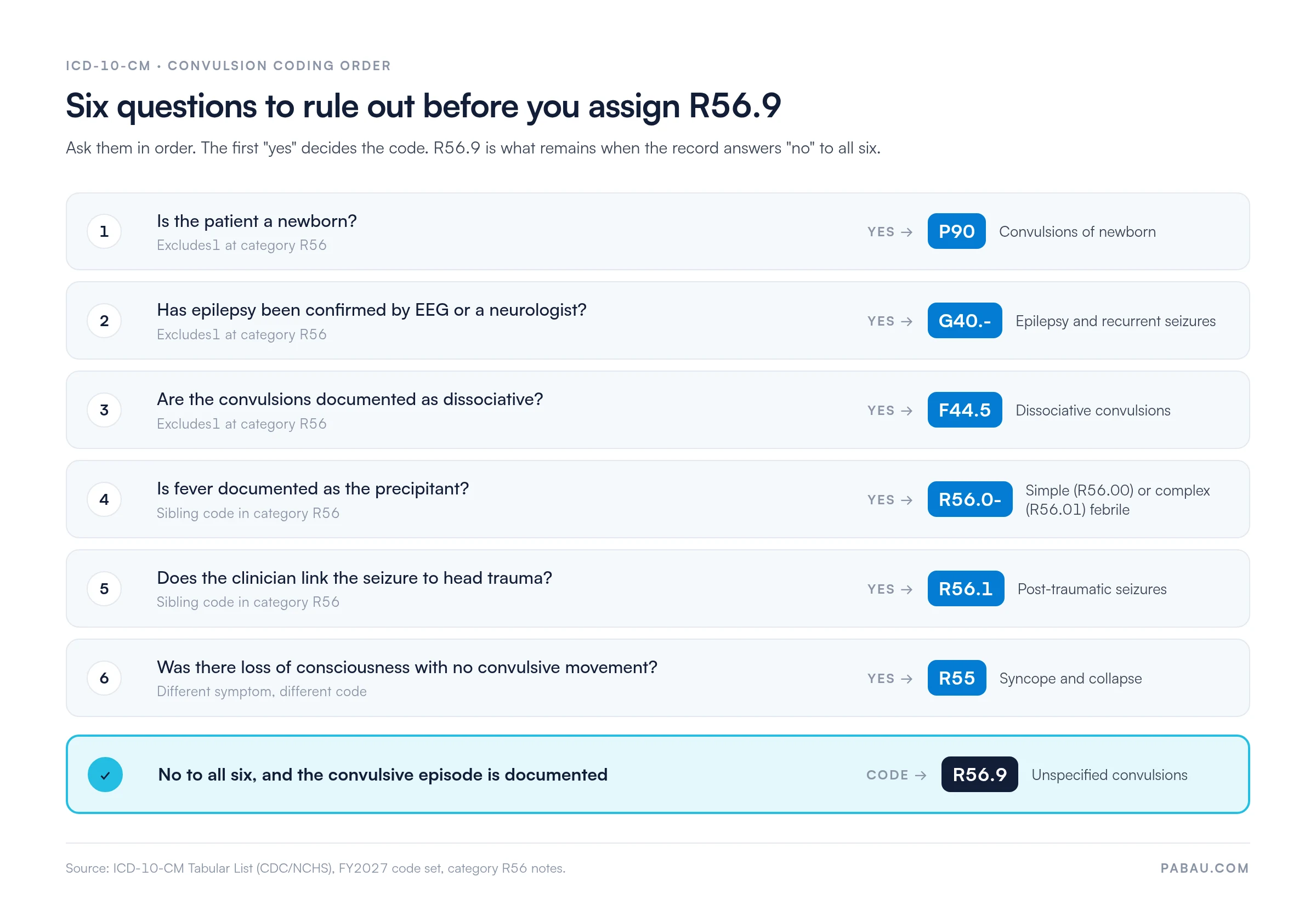
Category R56 carries Excludes1 notes for epilepsy (G40.-), dissociative convulsions (F44.5), and newborn convulsions (P90), so none of them is coded with R56.9.
Febrile convulsions (R56.00, R56.01) and post-traumatic seizures (R56.1) are sibling R56 codes that you use in place of R56.9 when the record supports them.
Once an EEG report or neurologist confirms epilepsy, a specific G40 code replaces R56.9 on that encounter and every later one.
Pabau’s claims management submits US claims through the Claim.MD clearinghouse, so rejections and remittances come back against the patient record.
ICD-10 Code R56.9 is the billable ICD-10-CM code for unspecified convulsions. You assign it when a convulsive episode is documented but its type and cause are not yet known.
It sits in category R56 (Convulsions, not elsewhere classified), in Chapter 18 of ICD-10-CM (R00-R99). The CDC/NCHS ICD-10-CM web tool lists it as a complete code with no seventh character.
R56.9 describes a convulsive episode whose type, cause, or classification the treating clinician has not yet determined. It is a symptom code, so the ICD-10-CM Official Guidelines for Coding and Reporting allow it only while no definitive diagnosis explains the episode.
Three clinical scenarios support its use:
R56.9 does not cover confirmed epilepsy, febrile convulsions with fever documented as the precipitant, or post-traumatic seizures. It also excludes newborn and dissociative convulsions, and any episode where the record names a specific seizure type.
The Excludes1 notes for R56.9 sit at the category level, under R56, so they apply to every code in it. An Excludes1 note means the two conditions are not coded together, so the excluded code and R56.9 never share a claim for the same episode.
A convulsion in a newborn is coded P90, whatever the record says about its cause. Submitting R56.9 alongside a G40 code is an Excludes1 conflict, and payer claim edits commonly reject it. The CMS ICD-10 codes page publishes the code set and the official guidelines that define these notes.
The R56 category and nearby neurological codes overlap in clinical territory. This table compares the codes most often confused with R56.9 and what separates each one. Syncope is the most common mimic, and a faint with no convulsive movement is coded R55 instead.
Read in order, those codes become a short checklist, and R56.9 is what remains once every question gets a no.
Once epilepsy is confirmed, a specific G40 code must replace R56.9. ICD-10-CM guidelines don’t allow a symptom code once a definitive diagnosis explains it, so the change is a compliance requirement. Coders who see the neurology note at the point of coding make that switch on the right encounter.
Three events trigger the mandatory upgrade from R56.9 to G40.x:
Audit any chart where R56.9 appears beyond the first or second encounter. A neurology note or EEG report in the record means R56.9 is now a coding error and a compliance exposure. Flag these charts before submission.
What the clinical record says decides whether a payer accepts an R56.9 claim. The standards differ between outpatient and inpatient settings, which matters for practices that bill in both. Our guide to medical billing fundamentals shows how a diagnosis code moves from the note onto the claim.
The minimum documentation required to support R56.9 in any setting:
Outpatient standard: R56.9 is the first-listed diagnosis when it represents the chief complaint. Per ICD-10-CM guidelines, outpatient coders don’t code suspected or probable conditions, only what is confirmed at the visit. If the clinician documents “rule out epilepsy,” code the presenting symptom (R56.9), not the suspected diagnosis.
Inpatient standard: UHDDS guidelines govern principal diagnosis selection. R56.9 is appropriate as the principal diagnosis when, after workup, the convulsions remain the reason for admission with no more specific cause established. If epilepsy is confirmed during the admission, G40.x becomes the principal diagnosis.
The same convulsive episode is coded under different rules depending on where it is evaluated. A wrong encounter type affects DRG assignment, reimbursement, and audit exposure, so settle the setting before you choose the code.
Payers look harder at unspecified symptom codes submitted as principal diagnoses, especially on inpatient and high-cost outpatient encounters. Structured denial management workflows help practices track these patterns and build appeal templates before they recur. Five triggers come up most often:
Appeal strategy: For denials citing “more specific code available,” pull the neurology notes and EEG report. If the record shows no confirmed epilepsy at the time of coding, the original R56.9 assignment was correct. Appeal with the dated documentation showing the evaluation was still in progress on the date of service.
R56.9 most often supports EEG studies and evaluation and management (E/M) visits in the emergency department or neurology clinic. A routine EEG such as 95816 is the most common pairing on a first-seizure workup.
LCD policies for high-cost EEG studies vary by Medicare Administrative Contractor (MAC). The CMS Medicare Coverage Database holds each MAC’s LCDs and billing articles, including the diagnosis codes that support each EEG CPT code. Check the pairing there before you submit a high-cost EEG claim with R56.9 as the only diagnosis.
Before submitting an EEG claim with R56.9, pull your MAC’s LCD for the EEG CPT code billed. Some LCDs expect a secondary diagnosis that documents the clinical scenario, such as a known central nervous system condition or a prior episode. A missing secondary code may not stop the claim, but it can lead to underpayment or a recoupment on audit.
Most R56.9 denials trace back to a claim that no longer matches the note. The EEG report lands in one system and the neurology letter in another, and the coder works from whatever reached the billing queue.
Pabau, the practice management platform we build, keeps the clinical record and the claim in one place. Your coder sees the neurology note and EEG report beside the claim, so a confirmed epilepsy diagnosis gets spotted before R56.9 goes out.
Pabau’s claims management software creates CMS-1500 claims, checks eligibility, and posts ERA remittances against the patient record.
US claims go out through the Claim.MD clearinghouse. Rejections and payer responses come back against the same patient. A denied R56.9 claim reaches your billing team with the record already attached for the appeal.

Pabau keeps the neurology note, the EEG report, and the claim in one patient record. US claims go out through the Claim.MD clearinghouse, and rejections come back to the same place.

R56.9 is a holding code. It is correct on the first emergency visit and wrong once a neurologist confirms epilepsy. The code on the claim has to match the record on the date of service.
The habit that protects these claims is the six-question check above, run on every encounter that carries R56.9. It takes a minute per claim, while an Excludes1 denial or a missed upgrade costs an appeal. Book a demo to see how Pabau puts the neurology note and the claim side by side for your coding team.

Billing an EEG with R56.9? CPT code 95819 covers the awake-and-asleep EEG and the documentation payers ask for.
Looking for the clearinghouse behind clean claim submission? Claim.MD clearinghouse overview explains how claims, eligibility checks, and remittances move between practice and payer.
Want the full revenue cycle behind a diagnosis code? Revenue cycle management explained connects coding accuracy to claim approval rates and cash flow.
ICD-10 Code R56.9 is the billable diagnosis code for unspecified convulsions. You use it when a convulsive episode is documented but no seizure type or cause has been confirmed. It is a Chapter 18 symptom code, suited to first-time seizures, emergency department visits, and inpatient workups where the differential is still open.
Use R56.9 when no confirmed epilepsy diagnosis exists in the clinical record at the time of coding. The moment a neurologist confirms epilepsy in a progress note or EEG report, the code must be upgraded to the appropriate G40.x code. R56.9 is a placeholder for unconfirmed or acute presentations only.
R56.9 is a symptom code for unspecified, unconfirmed convulsions. G40 codes are disease codes for epilepsy and recurrent seizures where the diagnosis has been established. Category R56 carries an Excludes1 note for G40, so the two are not coded together for the same episode.
No. When fever is documented as the precipitant, use R56.00 (simple febrile convulsions) or R56.01 (complex febrile convulsions). These are sibling codes in category R56 that you use instead of R56.9, not an Excludes1 pair. R56.9’s Excludes1 codes are F44.5, G40.-, and P90.
The most common denial occurs when the medical record supports a more specific code but the coder submitted R56.9. Payers also deny R56.9 on repeat visits after epilepsy was confirmed, and on high-cost EEG claims that miss LCD requirements. State the absence of a prior confirmed epilepsy diagnosis explicitly to defend the original assignment.
Yes. The ICD-10-CM Tabular List has no Excludes1 or Excludes2 note between R56.9 and Z86.69. Z86.69 is the personal history code for other nervous system diseases. Both may appear on the same claim when the history is clinically relevant, with R56.9 first and Z86.69 as a secondary code.