HCPCS code J7186: Alphanate billing, units and NDC guide
What HCPCS code J7186 covers and how it’s counted HCPCS code J7186 describ...

Last Updated: Nov 10, 2026
95813 is the CPT code for electroencephalogram (EEG) extended monitoring; 61-119 minutes. It covers a continuous EEG recording of 61 to 119 minutes, plus the neurologist's interpretation and signed report.
Recordings of 41 to 60 minutes bill as 95812, and recordings of 2 hours or more move to the 95700-95726 long-term series. Exact start and stop times in the record are what prove a session falls inside the 61-119 minute window.
Let Pabau's smart automation suggest the right codes, reduce claim denials, and keep your practice compliant—effortlessly.
Automate repetitive tasks and focus on what matters most—your patients.
Reduce coding errors and ensure compliance with the latest regulations.
Clean claims, fewer denials, and faster reimbursements.
Powerful insights and reporting to help your practice thrive.
HIPAA compliant SOC 2 certified GDPR-compliant Trusted by 4,000+ clinics worldwide

CPT Code 95813 covers EEG recording and interpretation lasting 61-119 minutes, between 95812 (41-60 minutes) and the 95700-95726 series (2+ hours).
Documentation must include explicit start and stop times confirming a duration of 61-119 minutes, plus a signed interpretation report.
Medicare reimburses 95813 globally; use modifier 26 when the neurologist interprets only and does not own the recording equipment.
Top denial causes: duration not documented as 61-119 minutes, missing signed report, and absent or non-matching ICD-10 diagnosis code.
CPT Code 95813 is defined by the American Medical Association (AMA) as: Electroencephalogram (EEG) extended monitoring; 61-119 minutes. The AMA revised the descriptor effective January 1, 2020, adding the 119-minute cap. The session must exceed 60 minutes of continuous recording time, not approach it. A recording of 2 hours or more moves to the long-term series, 95700-95726.
When billed globally, the code covers two distinct services. The technical component is electrode placement, operation of the recording equipment, and the EEG tracing itself. The professional component is the neurologist’s interpretation of the tracing and their signed written report. Split billing between a facility and an interpreting physician requires the correct modifier, covered below.
This code applies in both inpatient and outpatient settings. It is ordered most often for prolonged seizure evaluation, encephalopathy workup, and altered mental status assessments. In each, a standard 20-40 minute tracing is too short to capture the diagnostic information.
CPT Code 95813 covers routine extended EEG with standard scalp electrode placement, continuous recording of 61-119 minutes, and a written interpretation. It does not cover every long-duration brain monitoring study.
These services sit outside 95813 and are reported with their own codes:
When a monitoring session runs under 61 minutes or reaches 2 hours, do not report 95813. Under 61 minutes bills as 95812, and 2 hours or more moves to 95700-95726. The duration threshold is strict, and payers audit duration-based codes closely.
CPT 95812 covers EEG recording lasting 41-60 minutes; CPT Code 95813 covers recording lasting 61-119 minutes. Duration is the only distinguishing factor between the two codes. At 2 hours or more, neither applies, and the study moves to the long-term series, 95700-95726.
This distinction trips up practices that use approximate time documentation. If a note reads “approximately one hour,” a payer may deny 95813 for insufficient evidence that the 61-minute threshold was crossed. Record exact start and stop times every time.
A session that runs 59 minutes bills as 95812. A session that runs 61 minutes bills as CPT Code 95813. A session that runs 2 hours or more bills from the 95700-95726 series. There is no interpolation between codes.
Add a mandatory time-stamp field to your EEG technologist’s recording sheet. When start time, stop time, and calculated duration all appear in the same document, the coder can defend the code selection. Nobody has to chase the neurologist for clarification.
Understanding where CPT Code 95813 sits within the broader EEG code family prevents miscoding to neighboring codes. The AAPC’s CPT code reference organizes these codes by duration and monitoring type.
The long-term series (95700-95726, effective 2020) replaced the older 95950-95953 and 95956 codes. Once a recording reaches 2 hours, those codes apply instead of CPT Code 95813. That holds in an epilepsy monitoring unit and at home.
Incomplete documentation is the leading cause of 95813 denials. Before submitting a clean claim, verify that every element below appears in the medical record.
Payers conducting post-payment audits look specifically for the duration evidence. Without start and stop times in the record, the practice cannot defend a 95813 claim even if the session genuinely ran 61-119 minutes.
The claim’s supporting diagnosis codes must demonstrate medical necessity for extended EEG monitoring. Use a CPT-to-ICD-10 crosswalk tool to verify payer-accepted pairings for specific clinical scenarios. Commonly accepted ICD-10-CM codes include:
Use the most specific ICD-10-CM code available for the clinical situation. Payers increasingly flag claims where the diagnosis code is a broad unspecified category when more specific codes exist. For encephalopathy, distinguish toxic, metabolic, and unspecified presentations where the documentation supports it. Toxic encephalopathy codes to G92.8 (other toxic encephalopathy) or G92.9 (unspecified toxic encephalopathy). Metabolic encephalopathy codes to G93.41, and unspecified encephalopathy to G93.40.
Medicare pays for CPT Code 95813 through the annual Medicare Physician Fee Schedule (MPFS), published by the Centers for Medicare and Medicaid Services (CMS). Payment rates change each calendar year and vary by geography through the Geographic Practice Cost Index (GPCI). Always verify the current rate using the CMS MPFS lookup tool rather than relying on figures from prior years.
The FastRVU 2026 RVU lookup provides current Work RVU (wRVU), Practice Expense RVU (PE RVU), and Malpractice RVU (MP RVU) values for 95813. The national payment amount is calculated as [(Work RVU × Work GPCI) + (PE RVU × PE GPCI) + (MP RVU × MP GPCI)] × Conversion Factor.
When the neurologist performs interpretation only and does not own or operate the recording equipment, bill with modifier 26 (professional component). The facility or EEG lab billing the technical component appends modifier TC. Global billing (no modifier) applies when one entity provides both the recording and the interpretation.
Prior authorization requirements for CPT Code 95813 vary by payer type and individual plan. Medicare fee-for-service does not require prior authorization for 95813. Medicare Advantage plans set their own authorization rules, and many require pre-certification for extended EEG studies.
Commercial payers and Medicaid managed care organizations commonly require PA for extended EEG when the clinical indication is not a confirmed epilepsy diagnosis. Supporting documentation typically requested includes:
CMS publishes Local Coverage Determinations (LCDs) through Medicare Administrative Contractors (MACs) that define medical necessity criteria for EEG services by jurisdiction. Search the Medicare Coverage Database at lcd.cms.gov for the LCD applicable to your MAC region. Meeting LCD criteria is not the same as meeting commercial payer criteria, so verify each payer separately before the study.
Reviewing medical billing compliance protocols for prior authorization tracking helps neurology practices prevent authorization-related denials before the claim is even submitted.
Three modifiers appear regularly on 95813 claims, and a fourth belongs on the same-day E/M code. Using the wrong one, or omitting a required one, is a steady source of denials in neurology medical billing.
The National Correct Coding Initiative (NCCI) may bundle 95813 with a same-day evaluation and management (E/M) service, depending on the edit pair. The fix for that bundle belongs on the E/M code. Append modifier 25 to the E/M code when the visit was significant and separately identifiable from the EEG. Modifier 59 on 95813 is reserved for NCCI edits between two procedures. Check the current NCCI table for the code pair before appending either one.
Before billing an E/M code on the same date as 95813, check the current NCCI edit table for the code pair. Modifier 25 goes on the E/M, not modifier 59 on the EEG. Blanket use of either modifier to override edits is an audit flag, so append one only when the note documents a separate service.
Most 95813 denials share the same root causes. Identifying them in advance is what denial management workflows are designed to prevent, and what claims management software automates at the point of submission.
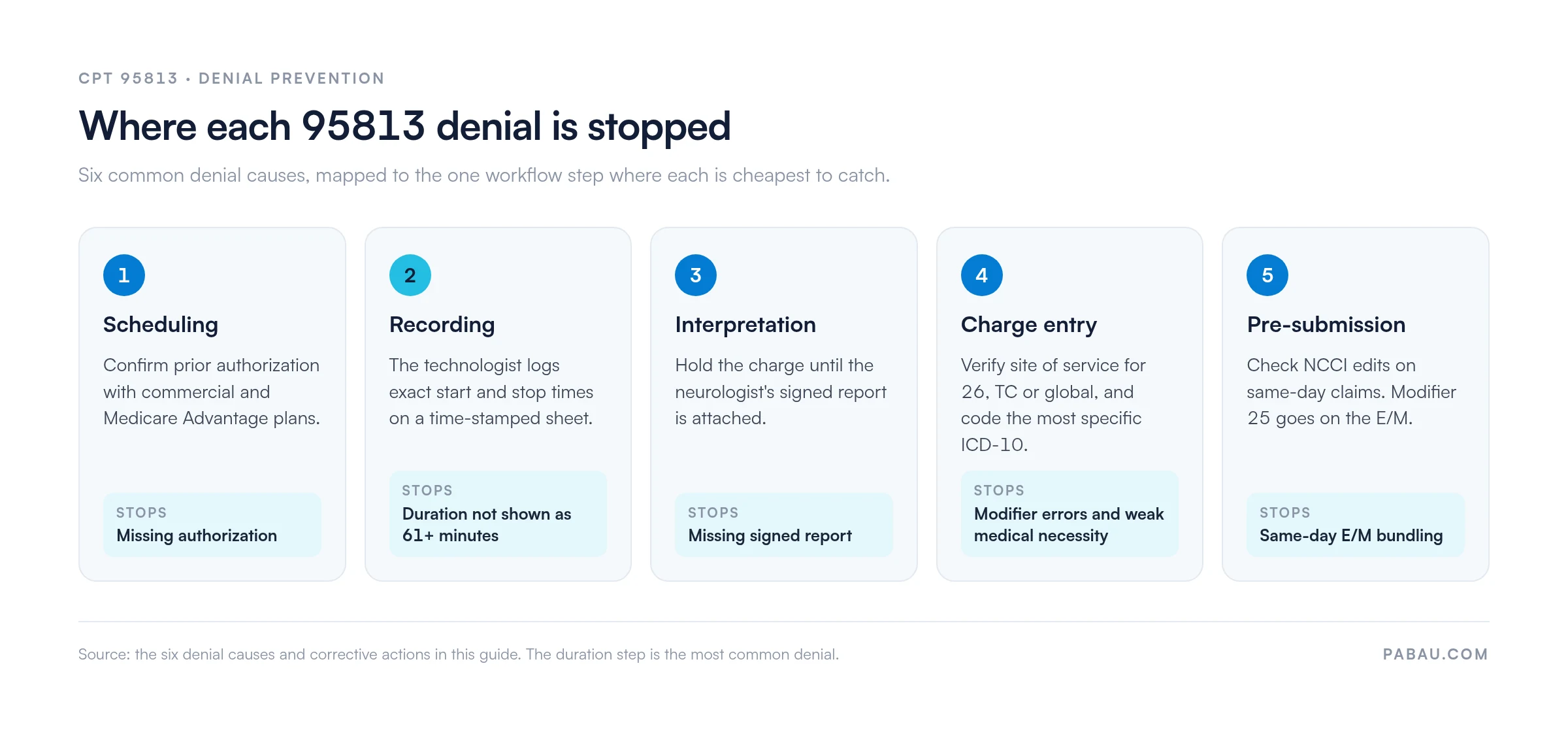
Each of these causes has one point in the claim’s path where it costs the least to stop. The workflow below maps them in order.
When a 95813 claim still comes back unpaid, the remittance names the reason with a claim adjustment reason code. Our guide to denial codes explains what each common code means and how to correct the claim before resubmitting.
Without a check at submission, a 95813 error surfaces on the remittance. The coder then corrects the modifier or the diagnosis code and resubmits, often weeks after the study was read.
In Pabau’s claims management software, US claims go out through the Claim.MD clearinghouse, which reaches thousands of US payers. Each 95813 claim runs through claim scrubbing before submission. Modifier errors and missing diagnosis code pairings surface while the claim is still in the practice, rather than at remittance.
The patient’s case also tracks the prior authorization code, its dates and its sessions, with a warning when one is missing. Eligibility checks run before the study, and ERA remittances post back once the payer responds. The team sees each 95813 claim from authorization to payment in one place.

Pabau scrubs each claim before it reaches Claim.MD, so 95813 modifier and diagnosis errors surface at submission instead of on the remittance.

Treat the recorded start and stop times as the deciding field on every 95813 claim. Duration picks the code, and auditors look for that evidence first.
The other checkpoints cost little by comparison. Confirm authorization at scheduling, hold the charge for the signed report, and check same-day E/M pairs before submission. Building those steps into your revenue cycle management process trades a few minutes per study for far fewer appeals.
Book a demo to see how Pabau carries a 95813 claim from charge entry to Claim.MD submission, with claim scrubbing on every claim.

Need to understand how clearinghouse submission works for neurology claims? Claim.MD clearinghouse overview explains how electronic claim routing reaches payers and what happens at each step.
Got a 95813 claim back with a reason code? Denial codes in medical billing breaks down the most common CARC codes your team will see on remittance for neurology services.
Coding an EEG ordered for confusion or disorientation? ICD-10 code R41.82 explains when altered mental status, unspecified, is the right diagnosis to report.
Ordering the study after a fainting episode? ICD-10 code R55 covers how syncope and collapse are coded and documented.
Need one charge form for multi-code neurology visits? Superbill guide for practices covers how to structure charge capture for visits that include EEG services.
CPT code 95813 covers extended electroencephalography (EEG) monitoring lasting 61-119 minutes, including both the technical recording and the physician’s written interpretation and report. When billed globally, both components are included. Split billing requires modifier 26 (professional component) or TC (technical component).
CPT 95812 covers EEG recording lasting 41-60 minutes; CPT 95813 covers recording lasting 61-119 minutes. Duration is the only distinguishing factor. A session of exactly 60 minutes bills as 95812. A session of 61-119 minutes bills as 95813, provided the record documents explicit start and stop times. At 2 hours or more, the study moves to the 95700-95726 long-term series.
Yes, Medicare covers CPT code 95813 through the Medicare Physician Fee Schedule when medical necessity criteria are met. Medicare Advantage plans may apply their own prior authorization requirements. Payment rates vary by geography (GPCI) and change annually; verify current rates using the CMS MPFS lookup tool.
Prior authorization requirements vary by payer. Traditional Medicare fee-for-service does not require PA for 95813. Medicare Advantage plans and many commercial payers do require PA, particularly when the clinical indication is not a confirmed epilepsy diagnosis. Check each individual plan’s policies before scheduling the study, not after.
Yes, but NCCI edits may bundle the two, depending on the specific E/M code. When the visit was significant and separately identifiable from the EEG, append modifier 25 to the E/M code, not modifier 59 to 95813. Document the separate work clearly, and check the current NCCI edit table for the code pair before billing.
The leading causes are missing start and stop times that prove the session ran 61-119 minutes, and a missing or unsigned interpretation report. Diagnosis codes that don’t support medical necessity cause denials too. So do modifier errors, such as billing globally when split billing was required, and missing prior authorization from commercial or Medicare Advantage plans.