

CPT Code 30801: Superficial turbinate ablation billing guide
CPT Code 30801: Official descriptor and procedure overview The American Medical ...

Last Updated: Nov 27, 2026
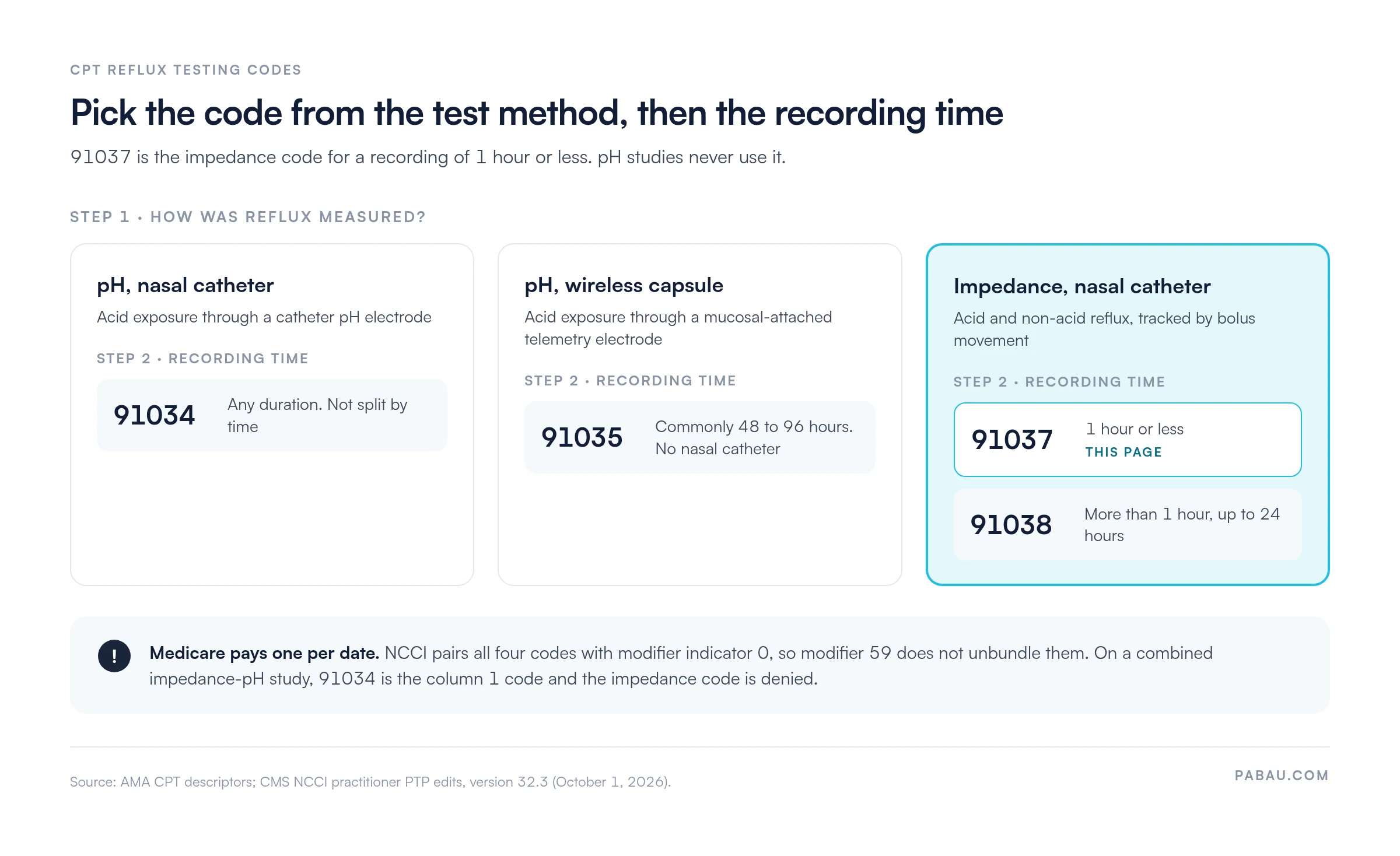
91037 is the CPT code for an esophageal function test that records gastroesophageal reflux through nasal catheter intraluminal impedance electrodes. It covers placement, recording, analysis and interpretation for a study of 1 hour or less.
Impedance tracks liquid and gas moving through the esophagus, so it detects reflux whether or not it is acidic. A recording longer than 1 hour, up to 24 hours, is reported with 91038 instead. Catheter pH monitoring is 91034, and the wireless capsule is 91035.
Let Pabau's smart automation suggest the right codes, reduce claim denials, and keep your practice compliant—effortlessly.
Automate repetitive tasks and focus on what matters most—your patients.
Reduce coding errors and ensure compliance with the latest regulations.
Clean claims, fewer denials, and faster reimbursements.
Powerful insights and reporting to help your practice thrive.
HIPAA compliant SOC 2 certified GDPR-compliant Trusted by 4,000+ clinics worldwide

CPT code 91037 reports a gastroesophageal reflux test with nasal catheter intraluminal impedance electrodes, for a recording of 1 hour or less.
A prolonged impedance study, longer than 1 hour and up to 24 hours, is 91038. Report one impedance code per session, never both.
Catheter pH monitoring is 91034 and the wireless telemetry capsule is 91035. Medicare NCCI edits pair all four codes with modifier indicator 0.
K21.00, K21.01, and K21.9 are the core ICD-10 codes for reflux testing, though payer LCDs vary and some require additional diagnoses.
Missing prior authorization, a recording time that does not match the code, and NCCI pair denials are the 91037 rejections to prevent first.
Pabau, a practice management platform, sends 91037 claims through the Claim.MD clearinghouse, which checks them for errors before they reach the payer.
CPT code 91037 describes an esophageal function test: a gastroesophageal reflux test with nasal catheter intraluminal impedance electrode(s) placement, recording, analysis and interpretation. Confirm the current descriptor in the American Medical Association (AMA) CPT codebook.
The code reports a recording of 1 hour or less. Prolonged companion 91038 covers a recording greater than 1 hour and up to 24 hours. Report one or the other, based on the documented recording time.
The clinician passes a thin catheter through the nose into the esophagus. Rings of impedance electrodes along the catheter measure changes in electrical resistance as liquid, gas, or mixed contents move past. That pattern shows each reflux episode, how far it travels, and how quickly it clears.
The table below separates the four related codes before you select 91037.
No single CPT code describes a combined impedance-pH study, and unlisted code 91299 does not either. Report 91037 or 91038 plus 91034, subject to the NCCI edits below, and confirm payer preference.
Bill a Bravo capsule study with 91035 and a pH-only catheter study with 91034, never as 91037. Choose by method first, then recording time.
Medical necessity for CPT code 91037 rests on the diagnosis codes linked to the claim. Payers cross-reference ICD-10-CM codes against their Local Coverage Determinations (LCDs) or National Coverage Determinations (NCDs) before authorizing payment.
Codes such as K21.9 are commonly accepted, but no ICD-10 code guarantees coverage across all payers. Always verify the applicable LCD for the MAC jurisdiction serving your practice before submitting a claim. Payer policies are updated annually and sometimes mid-year.
Before billing CPT code 91037, run a diagnosis crosswalk against the payer’s current LCD. Many commercial payers and Medicare Administrative Contractors publish their covered ICD-10 lists for esophageal reflux testing online. Checking the diagnosis when the study is ordered prevents most medical necessity denials.
A clean claim for CPT 91037 depends on a complete medical record. Missing any of the elements below is enough for a payer to deny on documentation grounds, and appeals require assembling the same records anyway.
These are the components a clean claim submission for 91037 requires in the chart:
Gastroenterology practices billing in a hospital or ASC setting should confirm that the facility also retains copies of the technical documentation. A split-billing scenario, where the physician bills modifier 26 and the facility bills modifier TC, requires both parties to have complete records.
Prior authorization requirements for CPT 91037 vary by payer type, plan design, and region. No universal rule applies. Stating that a payer does or does not require authorization without checking its current policy is a common mistake that leads to unexpected denials.
A prior authorization request for 91037 should include the ordering physician’s notes on persistent reflux symptoms and the PPI trial and its outcome. Add the ICD-10 code(s) that support the indication and the CPT code with its descriptor. Some commercial payers also ask for the gastroenterologist’s credentials and facility details. Linking the authorization to the submitted claim is a standard medical billing compliance step to build into your pre-service workflow.
Medicare reimbursement for CPT code 91037 is set annually through the Medicare Physician Fee Schedule (MPFS). Rates change each January 1 with the final rule. Pull current values from the CMS Physician Fee Schedule lookup tool before making revenue projections.
Use the FastRVU lookup tool to retrieve current work, practice expense, and malpractice RVU values for 91037 by geographic adjustment factor. Facility rates are typically lower than non-facility rates because the facility bills separately for overhead. Practice managers projecting revenue for in-office reflux testing should use the non-facility rate.
Modifier selection for CPT 91037 follows the standard split-billing rules for GI function testing codes. A wrong modifier quickly produces a denial or an underpayment that is hard to recover.
Never bill 91037 globally when the study was performed in a hospital outpatient department. Billing global in a facility setting without modifier 26 is a common audit trigger and can result in overpayment recoupment.
Denials for CPT 91037 cluster around a predictable set of errors. Identifying which pattern applies to a practice’s denial history is the starting point for effective denial management workflows.
Run a quarterly denial report filtered by CPT 91037 and sort it by denial reason code. When one CARC code accounts for a large share, the cause sits in a template or workflow. Fix it there, because individual appeals leave the next claim open to the same denial.
The National Correct Coding Initiative (NCCI) publishes quarterly procedure-to-procedure (PTP) edits on the CMS NCCI edits page. Those edits govern which code pairs Medicare pays together. The pairs below come from the Medicare practitioner PTP file effective October 1, 2026 (version 32.3).
NCCI edits update quarterly, and the hospital outpatient file is separate from the practitioner file. Check the current quarter for your claim type.
Manual claim preparation for esophageal function codes like CPT 91037 invites errors. Each claim needs the right code for the test method and recording time, plus a modifier that matches the setting. It also needs a diagnosis that fits the LCD and an authorization on file before the study.
Pabau keeps those checkpoints on the patient record the claim is built from. Its claims management software connects to the Claim.MD clearinghouse for US practices. That covers eligibility checks, 837P electronic claim transmission, and ERA/835 remittance processing across thousands of US payers. The clearinghouse checks each claim before submission and flags a modifier mismatch or a missing diagnosis while it can still be corrected.
For gastroenterology practices running reflux testing alongside a broader GI service mix, the documentation load is heavy. Pabau supports structured procedure notes and revenue cycle management workflows that tie the clinical record to the claim. With billing in the same system, the interpretation report, recording times, and diagnosis codes sit in the record the claim is built from.

Pabau helps gastroenterology practices manage claims, documentation, and payer rules in one place. Each 91037 claim is built from the order, the interpretation, and the authorization already on file.

CPT code 91037 is an impedance code, and most errors on it start with treating it as a pH code. Match the code to the test method first, then to the recording time. A short impedance study is 91037, a prolonged one is 91038, and catheter or capsule pH monitoring has its own codes.
Medicare bundles all four reflux-testing codes against each other, so plan combined studies before the claim goes out, not after the denial. To see how Pabau keeps the order, the interpretation, and the claim in one record, book a demo.

Need a clearinghouse that handles GI claims electronically? Pabau’s Claim.MD clearinghouse guide explains how the integration handles 837P transmission and ERA processing for US practices.
Struggling with denial patterns across multiple procedure codes? Denial codes in medical billing breaks down CARC and RARC codes so your team can action remittances faster.
Want to understand how the 837 file works in a clearinghouse submission? The 837 electronic claim file explained covers transaction structure, payer routing, and common submission errors.
Billing a wireless capsule pH study instead? CPT code 91035 covers the Bravo-style telemetry capsule, its documentation, and how it bundles with impedance codes.
CPT code 91037 covers a gastroesophageal reflux test using nasal catheter intraluminal impedance electrodes. It includes catheter placement, the recording, and the physician’s analysis and interpretation, for a study of 1 hour or less. A prolonged study, longer than 1 hour and up to 24 hours, is reported with 91038 instead.
CPT 91035 reports pH monitoring with a mucosal-attached telemetry electrode, such as the Bravo capsule, which records acid exposure wirelessly. CPT 91037 reports impedance testing through a nasal catheter, which tracks reflux by bolus movement rather than acidity. Medicare NCCI edits pair the two with modifier indicator 0, so they are not paid together for the same patient and date.
Both codes describe the same nasal catheter impedance test. The difference is recording time: 91037 covers 1 hour or less, and 91038 covers a prolonged study greater than 1 hour, up to 24 hours. Report one per session. Medicare NCCI edits pair them with modifier indicator 0, so modifier 59 cannot override the edit.
The work RVU for CPT 91037 changes annually with the Medicare Physician Fee Schedule final rule. The CMS Physician Fee Schedule lookup tool and the FastRVU tool both return current work, practice expense, and malpractice RVUs. Check them for your payment locality. Hardcoded RVU figures in static references become outdated each January.




