

ICD-10 Code R63.4: Abnormal weight loss
ICD-10 code R63.4: Definition, billability, and code structure ICD-10 code R63.4...

Last Updated: Nov 13, 2026
Billable Code Specific Code
K21.9 is the billable ICD-10-CM code for gastro-esophageal reflux disease without esophagitis. It applies when a physician has diagnosed GERD and no endoscopy or biopsy shows esophageal mucosal injury.
The most common error is keeping K21.9 after a scope confirms esophagitis. Once mucosal injury is documented, the code moves to K21.00 or K21.01. Getting that call wrong is a common cause of denials, and it costs practices rework and delayed payment on otherwise clean claims.
Let Pabau's smart automation suggest the right codes, reduce claim denials, and keep your practice compliant—effortlessly.
Automate repetitive tasks and focus on what matters most—your patients.
Reduce coding errors and ensure compliance with the latest regulations.
Clean claims, fewer denials, and faster reimbursements.
Powerful insights and reporting to help your practice thrive.
HIPAA compliant SOC 2 certified GDPR-compliant Trusted by 4,000+ clinics worldwide

K21.9 covers diagnosed GERD with no endoscopic or histologic evidence of esophagitis, and it is a billable primary diagnosis code for FY2027.
When esophagitis is documented, the correct code is K21.00 (without bleeding) or K21.01 (with bleeding), not K21.9.
Do not report symptom code R12 (heartburn) alongside K21.9 once the clinical note establishes the GERD diagnosis.
Documentation must state the confirmed GERD diagnosis, the symptom pattern, and the treatment history, such as diet changes and a PPI trial.
Pabau’s claims management, part of the practice software we build, sends US claims through Claim.MD and tracks status, eligibility and remittances.
ICD-10 Code K21.9 is the billable ICD-10-CM diagnosis code for gastroesophageal reflux disease without esophagitis. The code is unchanged in CMS’s FY2027 ICD-10-CM files, which apply to encounters from October 1, 2026 through September 30, 2027. It sits in category K21 within Chapter 11, Diseases of the digestive system (K00-K95), and is valid for inpatient and outpatient claims.
The official descriptor turns on the qualifier “without esophagitis.” That phrase carries the whole coding decision. It means the record holds no endoscopic or histologic confirmation of esophageal mucosal damage. When in doubt, ask whether the physician’s note or scope report documents esophageal injury. If it does, K21.9 is the wrong code.
K21.9 applies when a physician has diagnosed GERD from the clinical presentation, symptom pattern, or response to empirical treatment. No endoscopic finding of esophageal mucosal damage is on file. The lower esophageal sphincter (LES) dysfunction behind reflux produces a wide range of symptoms that map correctly to this code.
Conditions and presentations that correctly use ICD-10 Code K21.9 include:
Mucosal integrity is the clinical threshold. A patient can have severe symptoms, such as frequent heartburn, nocturnal regurgitation and chest discomfort, and still code to K21.9. That holds while any available scope shows intact mucosa, or when no scope was done and the note does not mention esophagitis.
Category K21 carries one Excludes1 note, for newborn esophageal reflux (P78.83). The other rows below are code-selection boundaries rather than Excludes notes. Each one still decides whether K21.9 is the right code for the encounter.
The R12 boundary matters most in daily coding. Under ICD-10-CM guidelines, sign and symptom codes are not assigned once the definitive diagnosis is established. When the note documents GERD as the diagnosis, R12 is not coded alongside it.
Billing R12 in place of K21.9 when the note clearly states GERD invites denials. Payers expect the established diagnosis code rather than the symptom.
K21.9 is used when esophagitis is absent. When esophagitis is confirmed, the code moves to K21.00 or K21.01 under the non-billable parent K21.0. The decision turns on one finding. Does the clinical record contain endoscopic or histologic evidence of esophageal mucosal damage?
A frequent error is assigning K21.9 when the EGD report mentions “mild erythema” or “friable mucosa.” If the gastroenterologist reads those findings as esophagitis in the assessment, the code moves to K21.00. If the EGD impression says “normal mucosa” or “no esophagitis,” K21.9 is correct whatever symptom severity the patient described.
Key rule: Follow the physician’s documented diagnosis, not the symptom description. The coder translates the documented assessment and never infers a diagnosis from symptom lists. The decision path below runs the same checks in order, from diagnosis to bleeding.
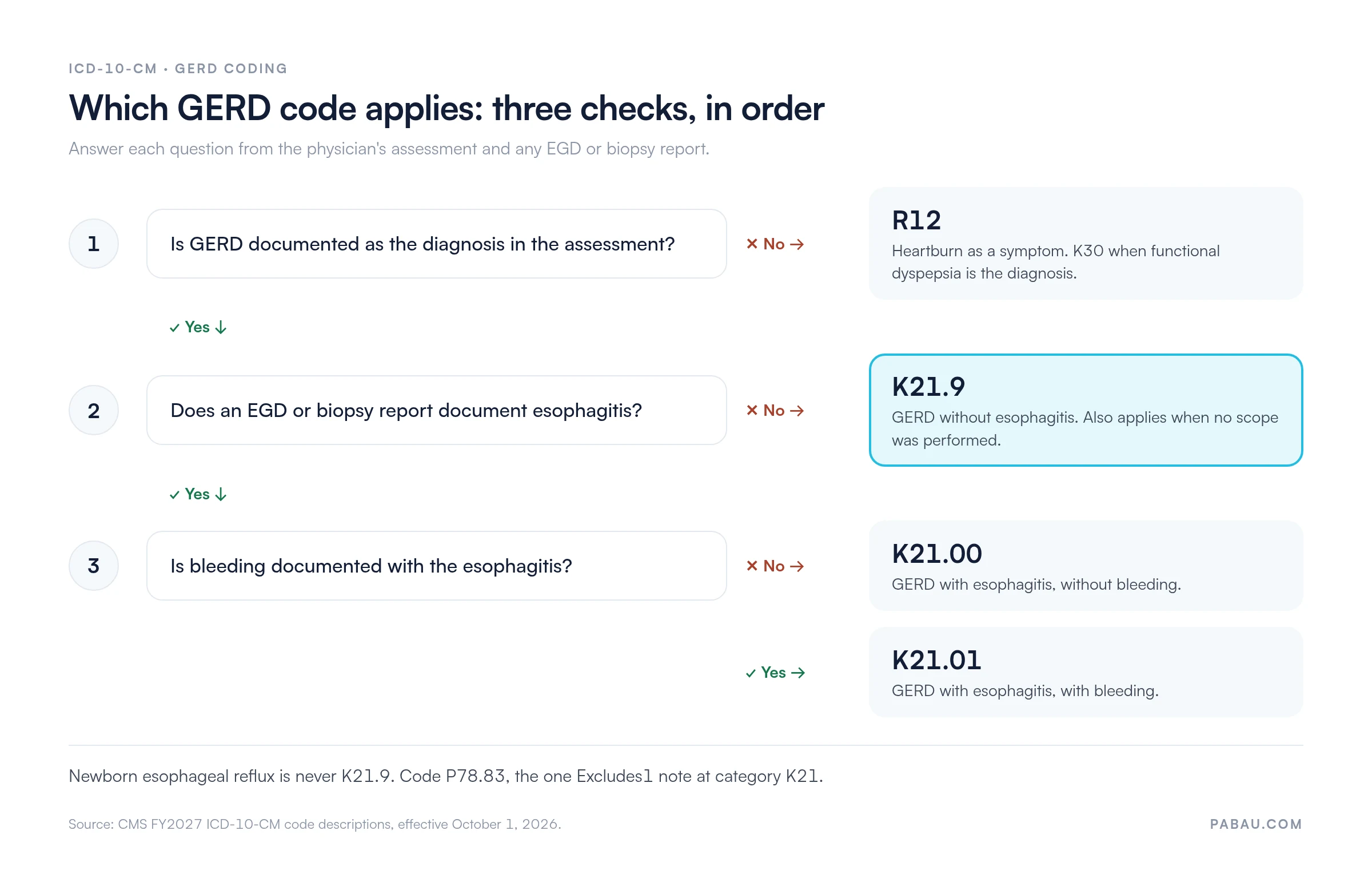
When a scope is ordered during the encounter and results are pending, hold coding until the EGD report is available. Assigning K21.9 before the scope result is returned creates rework if the report documents esophagitis and the code should be K21.00.
Several codes appear alongside or instead of K21.9, depending on what the clinical record documents. This reference prevents the two common mismatches: R12 when GERD is established, and K21.9 when esophagitis is confirmed.
A K21.9 claim stands on the physician’s clinical note. For clean claim submission, the note must demonstrate that GERD was an established diagnosis driving the encounter, not an incidental mention. CMS Local Coverage Determinations for anti-reflux procedures often include documentation checklists, and commercial payers typically require similar elements for medical necessity review.
The physician’s note must contain at minimum:
Coders reviewing notes for medical billing compliance should flag encounters where the note documents “acid reflux” in the HPI but the assessment only says “dyspepsia.” A mismatch between the history and the assessment is a common pre-authorization denial hook and an audit red flag.
The table below lists the CPT codes most often paired with K21.9 in GI and primary care practice. Each pairing holds only when the note supports both the service and the GERD diagnosis.
Pairing 43239 with K21.9 when the EGD report documents esophagitis is a mismatch auditors look for. The diagnosis code must reflect the final post-procedure impression, not the pre-procedure working diagnosis.
K21.9 rejections fall into five categories, and each one surfaces as standard medical billing denial codes on the remittance. Each has a specific root cause and a fix that prevents a repeat.
Good denial management workflows catch most of these before submission. A pre-claim step that checks the EGD report against the diagnosis code removes the wrong-esophagitis-code category almost entirely.
ICD-10 Code K21.9 as a standalone diagnosis code does not typically trigger prior authorization with Medicare, Medicaid, or most commercial payers. Prior authorization requirements in GERD billing attach to the procedure CPT codes, not to the diagnosis.
Procedures that commonly require prior authorization when billed alongside K21.9 include:
Medicare fee-for-service does not require prior authorization for most diagnostic procedures paired with K21.9, such as 43239 or 91035. Medicare Advantage plans run on individual plan rules, so verify each one separately.
Payer policies for GERD-related surgery change every year. Build a payer-specific prior auth matrix into the scheduling workflow rather than relying on last year’s experience.
Run insurance eligibility verification at the scheduling step, not on the day of service. For surgical anti-reflux procedures linked to K21.9, confirm prior auth status and coverage limits four to six weeks before the procedure date. That timing prevents day-of-service cancellations and claim holds. Pabau runs eligibility checks through Claim.MD, so the coverage response sits on the patient record before the procedure.
Accurate GERD coding depends on a consistent workflow that ties the physician’s documentation to the submitted diagnosis before the claim leaves the practice. A clinical record that captures the assessment separately from the HPI reduces coder interpretation errors and leaves a clear audit trail.
Follow these steps for each GERD encounter:
Many K21.9 errors begin when the EGD report, the physician’s assessment and the claim live in separate systems. The coder then reconciles them by hand before every submission.
Pabau keeps the clinical note, an uploaded scope report and the invoice on the same patient record. Its claims management software sends US claims through Claim.MD as CMS-1500/837P submissions. It also tracks claim status, eligibility checks and electronic remittances.
The coder still chooses between K21.9 and K21.00, with the evidence for that choice on the same record. When a remittance comes back denied, the team sees the reason code against that patient and corrects the claim from there.

Pabau keeps the clinical note and scope report on one patient record, sends US claims through Claim.MD, and tracks status, eligibility and remittances. Your team can follow each K21.9 claim from note to payment.

GERD coding turns on one documented finding: whether the record shows esophagitis. Make the EGD impression the last check before K21.9 goes on a claim, and the most common correction becomes rare.
The trade-off is timing. Holding a claim for a pending scope report delays submission by days, but it saves a full rework cycle when the report shows esophagitis.
Book a demo to see how Pabau keeps the note, the scope report and the claim on one record for GI billing teams.

Need to understand how clearinghouse submission works for GI claims? Medical claims clearinghouse guide explains how EDI claims flow from the practice to payers. It also covers what happens when the clearinghouse rejects a claim.
Trying to reduce your overall denial rate across all diagnosis codes? Revenue cycle management guide covers the end-to-end billing workflow from eligibility check through final payment posting.
Looking for a reference on electronic remittance advice and 835 files? Electronic remittance advice explains how ERA files carry denial reason codes and how to action them in your billing workflow.
ICD-10 Code K21.9 codes gastroesophageal reflux disease without esophagitis. It applies when a physician has diagnosed GERD and the record holds no endoscopic or histologic evidence of mucosal damage. It is a billable primary diagnosis code for FY2027 outpatient and inpatient encounters. Primary care and gastroenterology use it most for routine GERD management visits.
K21.9 applies when GERD is confirmed but esophagitis is absent. K21.0 is the non-billable parent for GERD with esophagitis documented by endoscopy or biopsy. Its subcodes are K21.00 when there is no bleeding and K21.01 when bleeding is documented. The deciding factor is whether the record shows esophageal mucosal damage.
No. Under ICD-10-CM coding guidelines, symptom codes like R12 (heartburn) are not assigned once the definitive diagnosis is established. When the physician’s note documents GERD as the confirmed diagnosis, R12 is not used. R12 is correct only when heartburn is the presenting complaint and GERD has not yet been diagnosed.
Common pairings are 99213-99215 for GERD management visits and 43239 for EGD with biopsy when the scope shows no esophagitis. 91035 is the wireless capsule pH study, and 91037 is the impedance reflux test with a nasal catheter. 43280, laparoscopic Nissen fundoplication, applies when surgery is indicated and esophagitis is not the confirmed diagnosis.
The most common reason is submitting K21.9 when the EGD report documents esophagitis, which calls for K21.00 or K21.01. Other causes are thin medical necessity documentation and R12 billed when GERD is established. A missing prior authorization for a surgical procedure paired with the diagnosis also triggers denials. Each has a fix at the documentation or workflow level.



