

CCSD code G5100: Bypass of duodenum billing guide
CCSD code G5100 bills a bypass that leaves the duodenum in place CCSD code G5100...

Last Updated: Oct 16, 2026
91035 is the CPT code for a gastroesophageal reflux test using a mucosal attached telemetry pH electrode. The capsule is placed endoscopically on the esophageal wall. It then transmits pH readings to a recorder the patient wears for 48 to 96 hours. The code covers placement, recording, analysis and interpretation.
Most denials on this code come down to documentation. The procedure note has to carry every LCD-required element, and the diagnosis code has to appear on the payer's covered list.
Let Pabau's smart automation suggest the right codes, reduce claim denials, and keep your practice compliant—effortlessly.
Automate repetitive tasks and focus on what matters most—your patients.
Reduce coding errors and ensure compliance with the latest regulations.
Clean claims, fewer denials, and faster reimbursements.
Powerful insights and reporting to help your practice thrive.
HIPAA compliant SOC 2 certified GDPR-compliant Trusted by 4,000+ clinics worldwide

CPT code 91035 reports wireless capsule pH monitoring, while catheter-based studies belong to 91034.
Pair the claim with K21.0 or K21.9 and document the failed PPI trial, or expect a medical necessity denial.
Modifier -26 applies when the physician interprets without owning the equipment, and -TC covers the facility’s technical component.
Medicare skips prior authorization, but most commercial plans want it before the capsule goes in.
Practice management software like Pabau submits the claim electronically and reports denial rates by CPT code.
CPT code 91035 is the AMA-maintained procedure code for a gastroesophageal reflux test using a mucosal attached telemetry pH electrode.
The Medtronic Bravo capsule is the device billed under it in almost every case. A gastroenterologist clips the capsule to the esophageal mucosa during an endoscopy. It then transmits pH readings to a recorder the patient carries for 48 to 96 hours, before detaching on its own.
The code carries a 0-day global period, so pre- and post-procedure evaluation and management services stay separately billable. Place of service moves the payment a long way, which the settings section below covers.
91034 covers a catheter-based study, run through the nose and usually recorded over 24 hours. 91035 covers the wireless capsule, placed endoscopically and recorded over 48 to 96 hours.
Mixing the two is the second most common source of denials on esophageal pH claims, behind medical necessity.
Billing 91034 and 91035 on the same date of service for one patient triggers an NCCI edit denial. Check the current CMS NCCI edit pairs before you submit if both studies were ordered.
Medical necessity is the single biggest denial driver on this code. The claim has to pair the procedure with an ICD-10 code that your MAC’s Local Coverage Determination (LCD) accepts.
The diagnoses below are the ones that usually clear, although the covered list differs by contractor.
LCD policies for esophageal pH monitoring vary by MAC jurisdiction, and Novitas, CGS and WPS each publish their own criteria. Confirm the diagnosis sits on your contractor’s covered list before the claim goes out, not after the remittance arrives.
Run a coverage check against your MAC’s LCD for esophageal pH monitoring before every 91035 submission. Novitas, CGS, and WPS each maintain separate covered-diagnosis lists. A K21.9 code that sails through with one MAC may require additional specificity documentation with another.
Modifier choice on 91035 turns on two questions. Who owns the recording equipment, and where did the service happen? Apply the wrong modifier, or leave it off when split billing applies, and the payment comes back short.
A physician employed by a hospital-based GI practice normally needs -26, because the facility owns the Bravo system. Private-practice gastroenterologists who own their equipment bill the global code in an office setting, with no modifier at all. Verify the split billing rules with your MAC before assuming global billing applies.
Medicare reimbursement for 91035 comes from the CMS Physician Fee Schedule. Facility and non-facility rates differ, because the non-facility rate carries a higher practice expense component.
The physician absorbs the equipment and supply costs in that setting. Geographic Practice Cost Index (GPCI) adjustments then pay an identical claim differently in Manhattan and rural Mississippi.
For current RVU-based calculations, the FastRVU 2026 RVU lookup returns Work, Practice Expense and Malpractice RVU values for 91035 with your locality applied. Rates change every year, so confirm against the current MPFS before you quote a patient or set an internal benchmark.
Commercial coverage varies more than Medicare’s does. Aetna’s Clinical Policy Bulletin and the BCBS medical policy pages both set out criteria for esophageal pH monitoring. Three themes repeat across the major plans.
Medicare does not require prior authorization for 91035. Most commercial payers do, and the requirement can change mid-year without notice. Policies also differ inside the same payer network, sometimes down to the employer group.
Verify benefits before you schedule the procedure, then confirm the prior authorization rule for 91035 specifically at each visit. Payers usually ask for some combination of the following.
Submit the request with the complete clinical note, the PPI trial documentation, and the EGD report attached. An incomplete submission is the fastest route to a retrospective denial, arriving after the capsule has already been placed.
The procedure note and the interpretation report each have to stand on their own. An auditor reads them separately, so a detail recorded only in the other document does not count in your favor.
The procedure note must contain:
The interpretation report must contain:
A structured note that auto-populates from the chart saves the coder from re-keying procedure details out of a PDF. That re-keying step is where most transcription errors start.
Five patterns cover the large majority of 91035 rejections across Medicare and commercial plans. Working them at the code level beats appealing claim by claim, because one root cause keeps producing the same denial.
The CARC codes on the 835 remittance tell you which category you are in. Reading them against the standard denial codes points you at the right appeal route. Review remittances in batches rather than one claim at a time, and the pattern shows up much faster.
The place of service (POS) code decides which fee schedule rate applies and which parts of the service you can bill separately. It changes what the practice collects for identical clinical work.
Facility and non-facility reimbursement for 91035 sit a long way apart. A private GI practice that owns its Bravo system collects the full non-facility rate.
A hospital-employed gastroenterologist collects the lower facility-rate professional fee, and the hospital bills the technical component separately under the APC system. Multi-setting GI groups need both figures in their fee schedule.
Gastroenterology coders have to keep 91035 apart from the neighboring 910xx codes, because several of them trigger NCCI edits on a shared claim. The endoscopy code 43235 comes up most often, since it is how the capsule gets placed in the first place.
The AAPC Codify CPT lookup is a useful commercial reference for the 910xx family. Check descriptors and edit relationships there before a complex GI claim goes out.
When billing 91035 alongside an EGD on the same date, the EGD was performed specifically to place the Bravo capsule. Document the dual clinical purpose clearly in the procedure note: the EGD is not incidental to the pH study. Missing this narrative is the reason modifier -59 or XU edits fail at appeal.
A 91035 claim passes six checkpoints between the order and the payment. Each one has a single item that has to be on record, and each one produces a predictable denial when that item is missing.
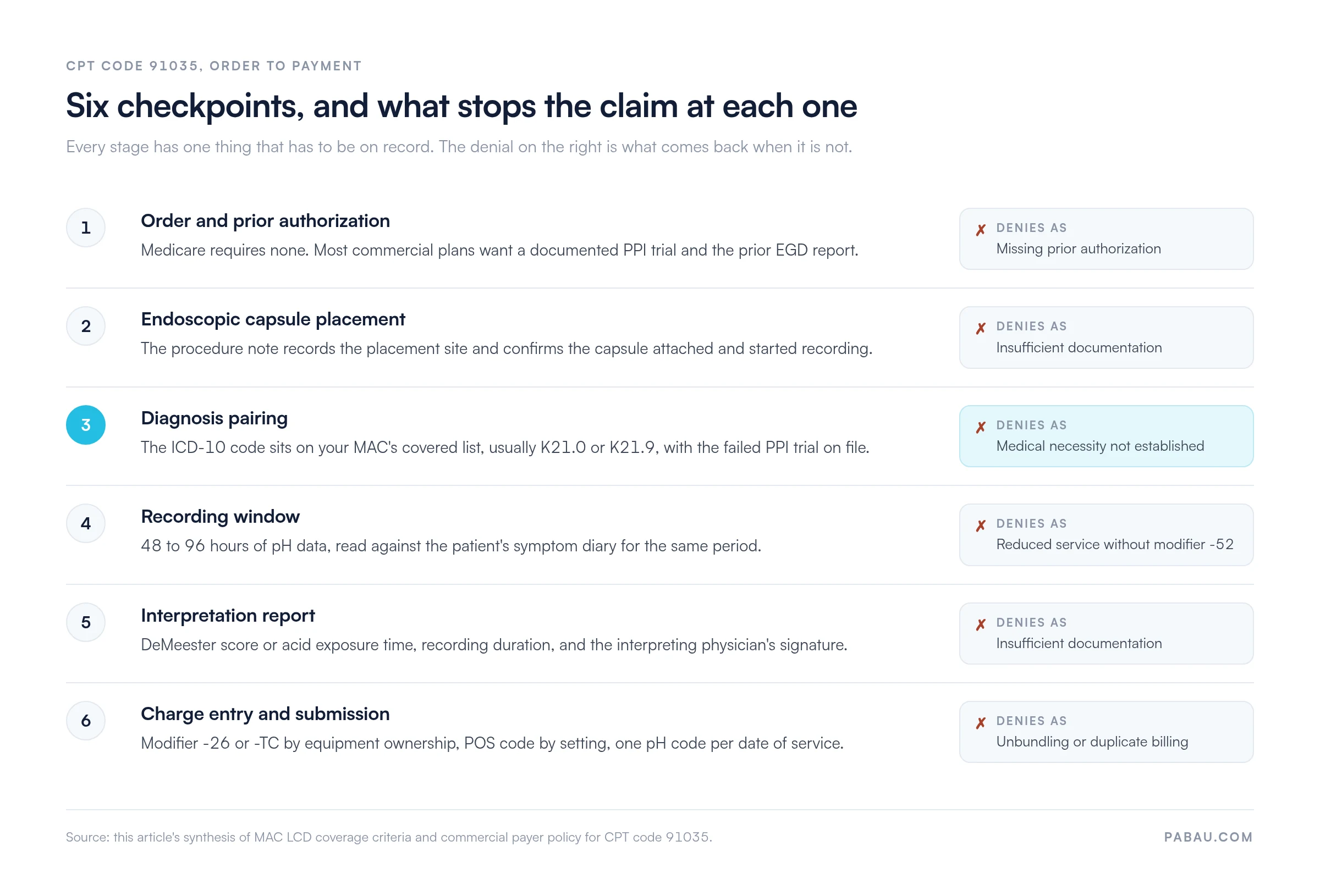
Work the list below in that order, and most of the five denial patterns never reach the payer.
Most GI practices run this workflow across three systems. The endoscopy note lives in the EHR, the prior authorization sits in a spreadsheet, and the claim leaves from a separate billing tool. Details get re-keyed at every handover, and that is where the transcription errors begin.
Pabau is practice management software that keeps the record and the claim together. The Bravo procedure note, the interpretation report and the patient’s uploaded documents all attach to the record the charge is raised from.
Our claims management software then submits that charge electronically through Claim.MD, our US clearinghouse partner, which reaches thousands of payers.
Reporting closes the loop. Denial rates break down by CPT code, by payer and by rendering provider. You can see at a glance whether 91035 rejections cluster around one contractor or one clinician. That turns a recurring denial into a single fix rather than a queue of appeals.
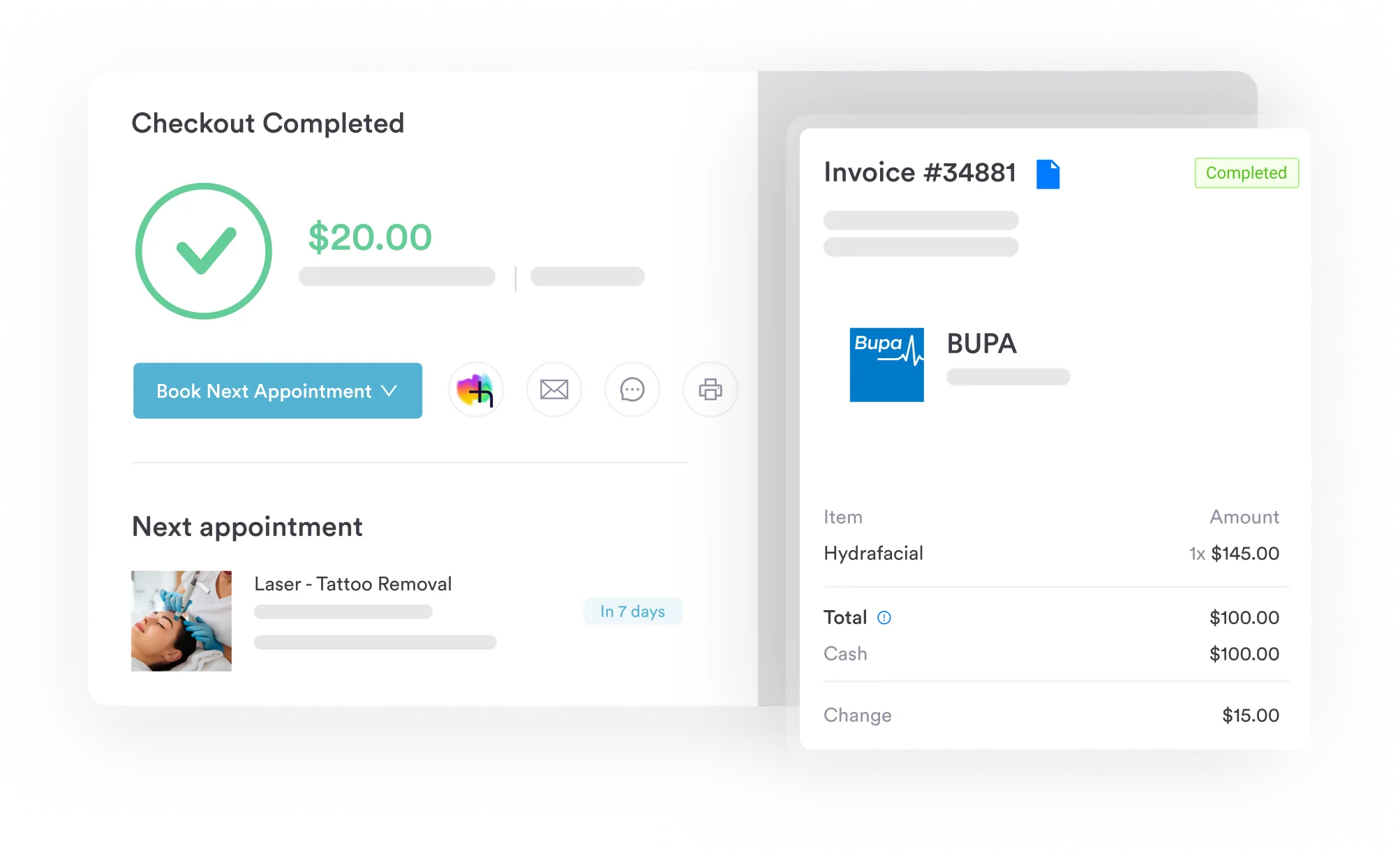

Pabau’s claims management tools attach the 91035 procedure note to the charge and report denial rates by CPT code. Clean claims go out through Claim.MD, which reaches thousands of payers. See how it works for your practice.

91035 rewards preparation far more than it rewards appeal writing. The prerequisites all sit upstream of the claim. They are the diagnosis you chose, the PPI trial you documented, and the authorization you secured before the capsule went in. Get those right and the denial queue shrinks on its own.
Pick one denial reason from the table above and audit last quarter’s 91035 claims against it. A single pass like that usually explains more rejections than a month of individual appeals. Then build the answer into your procedure note template, so the next claim carries it by default.
Practices that keep the note, the charge and the remittance in one system spend much less time reconstructing what happened six weeks ago. Book a demo to see how Pabau handles a GI claim from the endoscopy note through to the 835.

Need guidance on how clearinghouse claims submission works? Pabau’s Claim.MD clearinghouse guide explains how electronic claims reach payers and how ERA responses map to denial codes.
Billing the motility study alongside the pH test? CPT code 91010 covers the esophageal motility study that often precedes a wireless pH capsule referral.
Taking a biopsy at the same endoscopy? CPT code 43239 sets out the documentation an EGD with biopsy needs when it shares a date of service.
Troubleshooting a denied GI claim? Credentialing with insurance companies covers the provider enrollment steps that prevent claim-level rejections before they start.
Once per study. The code covers the whole recording period, whether that runs 48 hours or 96 hours. Billing a second unit for the extra days comes back as a duplicate.
No. There is no separate code for the capsule itself. In an office setting its cost sits inside the practice expense component of 91035. In a hospital outpatient department it sits inside the facility’s APC payment.
Payers rarely publish a fixed frequency limit. A repeat study needs a new clinical reason on the note, such as a change in therapy or new symptoms. Repeating it for the same indication inside a year usually triggers a medical necessity review.
Yes. Issue an ABN before the procedure whenever the diagnosis falls outside your MAC’s covered list, then append modifier GA to the claim. Without that signed form you cannot bill the patient after Medicare denies the charge.
Medicare allows 120 days from the remittance date to request a redetermination. Commercial deadlines are usually shorter, often 90 days or less, so check the plan’s provider manual before you build the appeal packet.



