

CPT Code 98981: RTM Treatment Management Billing Guide
CPT code 98981: Definition and official descriptor CPT code 98981 is an add-on c...

Last Updated: Nov 9, 2026
88189 is the CPT code for interpreting a flow cytometry panel of 16 or more markers. It pays for the physician's professional work, which is reviewing the gated data and writing a signed narrative report.
The instrument run is billed separately, with 88184 for the first marker and 88185 for each additional marker. Smaller panels use 88187 for 2 to 8 markers or 88188 for 9 to 15, and Medicare coverage follows the MAC's flow cytometry LCD.
Let Pabau's smart automation suggest the right codes, reduce claim denials, and keep your practice compliant—effortlessly.
Automate repetitive tasks and focus on what matters most—your patients.
Reduce coding errors and ensure compliance with the latest regulations.
Clean claims, fewer denials, and faster reimbursements.
Powerful insights and reporting to help your practice thrive.
HIPAA compliant SOC 2 certified GDPR-compliant Trusted by 4,000+ clinics worldwide

CPT Code 88189 pays for the physician’s interpretation of a flow cytometry panel with 16 or more markers, not for running the instrument.
The instrument run is billed separately, with 88184 for the first marker and 88185 for each additional marker.
Medicare coverage follows the MAC’s flow cytometry LCD, so each claim needs a qualifying diagnosis and a signed narrative interpretation.
Pabau, practice software with built-in insurance billing, sends CMS-1500/837P claims through Claim.MD and receives ERA remittances.
CPT Code 88189 is the pathology and laboratory code for interpreting a flow cytometry panel of 16 or more markers.
Its official AMA CPT descriptor reads “Flow cytometry, interpretation; 16 or more markers.” The code sits in the Pathology and Laboratory section (codes 80047-89398) and covers the professional component only. A qualified physician reviews the multi-marker data and writes a narrative report.
The 16-marker threshold is a billing requirement. If the documented panel covers fewer than 16 markers, report a lower-tier interpretation code instead. That is 88187 for 2-8 markers or 88188 for 9-15 markers. Submitting 88189 when the report lists 14 markers is a documentation mismatch that triggers denial and, in an audit, possible recoupment.
In medical billing terms, the interpretation code and the technical run code are separate services, billed separately. That split drives the structure of the whole 88184-88189 code family.
CPT Code 88189 covers the physician’s work of interpreting a flow cytometric panel that characterizes 16 or more cell-surface or intracellular antigen markers. The clinical application is almost always hematologic. Typical uses are immunophenotyping for chronic lymphocytic leukemia (CLL), acute lymphoblastic leukemia (ALL) and acute myeloid leukemia (AML). It also covers non-Hodgkin lymphoma (NHL), multiple myeloma, and myelodysplastic syndrome (MDS).
The code reimburses the pathologist’s time spent reviewing scatter plots and gating data, correlating marker expression with the clinical picture, and writing an interpretive report. That report must state conclusions rather than print data values, covering these points:
Three categories of work fall outside 88189’s scope. Misidentifying them causes either underpayment or audit exposure.
Instrument operation (technical component): Running the flow cytometer and acquiring data is billed with 88184 for the first marker and 88185 for each additional marker. A reference laboratory running the instrument bills 88184/88185. The pathologist reading the results bills 88189 with modifier 26 when billing the professional component only.
Panels with fewer than 16 markers: CPT Code 88189 does not apply when fewer than 16 markers were actually analyzed and documented. Coders must verify the pathology report marker count before assigning this code.
Non-covered indications: Each Medicare Administrative Contractor’s flow cytometry LCD lists the covered diagnoses. Panels ordered outside those indications, such as routine monitoring of a stable patient with no clinical change, are not covered. Without an advance beneficiary notice (ABN) on file, the practice cannot bill the patient for them.
The flow cytometry code family spans two service types. Technical codes pay for running the instrument and acquiring data, and interpretation codes pay for the physician’s report. Knowing where each code lands prevents the most common coding errors.
A complete 20-marker immunophenotyping panel bills 88184 once, 88185 19 times, and 88189 once, as the chart below lays out.
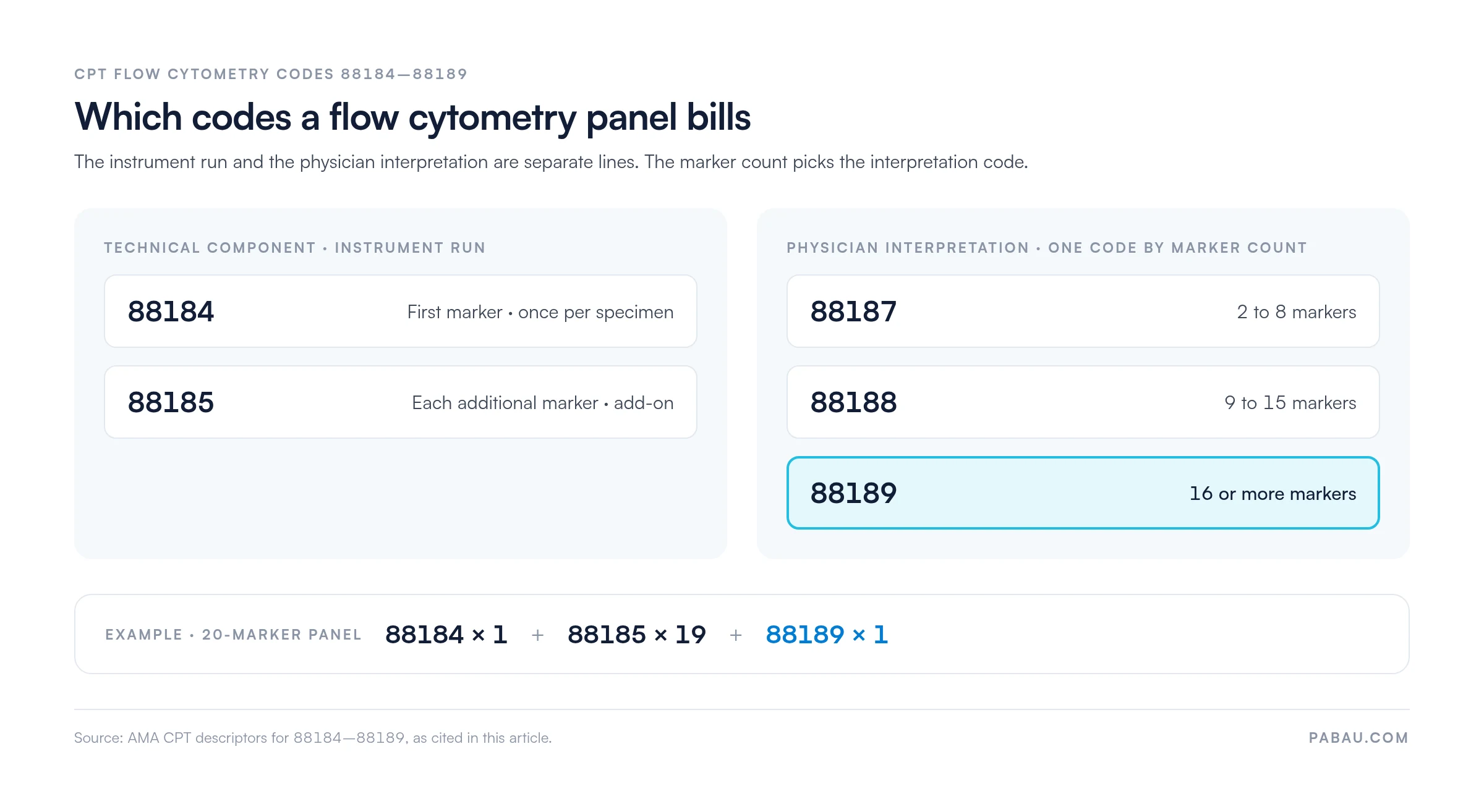
Each line pays for a different part of the work. The technical lines cover the instrument run, and the interpretation line covers the physician’s report.
Verify marker count directly in the pathology report before assigning 88189. Count the markers listed in the instrument output section, not those listed in the test order. Discrepancies between ordered and analyzed markers are a frequent audit finding.
Medicare coverage for CPT Code 88189 follows the flow cytometry LCD of the Medicare Administrative Contractor (MAC) for your region, such as Noridian’s L34215. Coverage requires a qualifying diagnosis that makes a 16-or-more-marker panel medically necessary.
Flow cytometry LCDs typically exclude monitoring of stable hematologic disease without documented clinical change. They also exclude repeat testing at a short interval with no new indication, and panels for diagnoses outside the covered list. When coverage is uncertain, issue an ABN before the service.
The pathology report is the claim’s evidentiary foundation. A data printout without a physician narrative does not meet LCD documentation standards and will not survive a post-payment audit.
Every report supporting a CPT Code 88189 claim must contain all of the following:
Missing any one of these elements is enough for a payer to deny or recoup the claim. A denial management workflow starts with the report itself. Build a documentation checklist into the pathology report template, so deficiencies are caught before the claim is generated.
Medicare covers CPT Code 88189 when a qualifying diagnosis meets the MAC’s flow cytometry LCD. Coverage rules differ by MAC region, so check the LCD in effect for your jurisdiction. Noridian covers Jurisdictions E and F, and NGS covers Jurisdictions 6 and K.
Commercial payers write their own flow cytometry policies, and some apply tighter frequency limits than Medicare. Those policies change independently of CMS, so confirm the current one before submitting large-panel claims. Practices that send claims through the Claim.MD clearinghouse can check eligibility before submission instead of finding problems at remittance.
The physician interpretation billed with CPT Code 88189 is paid under the Medicare Physician Fee Schedule. The technical codes 88184 and 88185 follow their own payment schedule, and rates are updated each calendar year. When different entities perform the technical and professional work, the payment splits into separate billable components.
For current-year Medicare allowable amounts, use the FastRVU lookup tool or the CMS Physician Fee Schedule search. Rates differ by geography (adjusted by the geographic practice cost index) and are updated each January 1. Never hardcode a reimbursement figure into billing workflows. Retrieve it from the current fee schedule at the time of the claim.
Most 88189 denials trace to a small set of repeating errors. Knowing the specific denial codes that map to each error makes prevention systematic rather than reactive.
A complete billing submission for a 20-marker immunophenotyping panel involves several codes and two distinct service lines. Checking the marker count against the interpretation code before the claim goes out catches mismatches that manual review misses. Claims management software keeps the codes, modifiers and diagnosis pointers together on one claim for that check.
Run the 88184/88185/88189 combination through your clearinghouse’s claim-edit engine before submission. Payers apply National Correct Coding Initiative (NCCI) edits to flow cytometry claims. Catching a modifier or bundling error at claim entry costs far less than a denial, appeal, and resubmission cycle.
CPT 88182 is not a member of the 88187-88189 interpretation family. It describes flow cytometry cell cycle or DNA analysis, such as DNA ploidy, rather than immunophenotyping by marker count.
The two codes measure different things, so the pathology report decides which one applies. A panel that characterizes antigen markers is coded in the 88187-88189 family, and DNA content analysis is coded 88182. The AAPC Codify CPT lookup carries the full guideline notes for both codes. After payment, read the electronic remittance advice adjustment reason codes to see why any line was reduced or denied.
Many practices that bill flow cytometry still assemble the claim by hand. A coder reads the pathology report, counts the markers, and keys the 88184, 88185 and interpretation lines. Eligibility gets checked on a separate payer portal, and remittances arrive somewhere else again.
Pabau, the practice management platform we build, supports US insurance billing through Claim.MD. The practice sends CMS-1500/837P claims, runs eligibility checks, receives ERA remittances and files secondary claims from one system. Prior authorization codes, dates and sessions are tracked on the patient’s case, with a warning when one is missing.
The outcome is fewer portal logins and one place to see why a flow cytometry line was paid, reduced or denied. Your coders spend their time on the marker count and the narrative, where most 88189 denials start.

Pabau supports US insurance billing through Claim.MD, with CMS-1500/837P claims, eligibility checks and ERA remittances. See how practices that bill flow cytometry keep claims, payments and denials in one place.

CPT Code 88189 rewards precision at every step. The report needs the right marker count, the claim needs the right interpretation code, and the ICD-10 code has to match the LCD. Most denials start in the documentation, long before the claim is built.
So the fix belongs upstream. Make marker identity, the signed narrative and the ordering physician required fields in the report template, and every claim built from it starts clean. Book a demo to see how Pabau’s Claim.MD billing handles eligibility, claims and remittances for practices that bill flow cytometry.

Need a clearinghouse for US claims? Claim.MD clearinghouse guide explains how electronic claims, eligibility checks and remittances move between a practice and its payers.
Want to understand how the claims lifecycle works end to end? Revenue cycle management explained covers each stage from coding through ERA posting and denial follow-up.
Building a denial prevention process for your practice? Superbill best practices shows how structured encounter documentation reduces downstream code errors before claims are generated.
CPT Code 88189 is the physician interpretation code for flow cytometry panels that analyze 16 or more cell-surface or intracellular antigen markers. It covers the professional component only: the pathologist’s review, analysis, and narrative report. The technical instrument-run component is billed separately using CPT 88184 and CPT 88185.
At least 16 markers must be analyzed and individually documented in the pathology report. If 15 or fewer markers were performed, CPT 88188 (9-15 markers) or CPT 88187 (2-8 markers) applies instead. The marker count in the documentation controls the code selection, not the number of markers ordered.
Yes, Medicare covers CPT Code 88189 when medical necessity is established under the MAC’s flow cytometry LCD. Coverage requires a qualifying hematologic malignancy diagnosis such as CLL, NHL, AML, or ALL. Claims for stable disease monitoring without a documented clinical change, or for diagnoses outside the LCD’s covered list, will be denied.
Yes, when both tests were actually performed and documented, because the codes describe different services. CPT 88182 covers cell cycle or DNA analysis, such as DNA ploidy, while 88189 covers interpreting a panel of 16 or more antigen markers. Check the current NCCI edits for the date of service before submitting both.
The most frequent denial cause is a missing or inadequate narrative interpretation in the pathology report. A data table or scatter-plot printout without a physician’s written diagnostic conclusions does not meet LCD documentation requirements. The second most common reason is a marker count below 16 documented in the report while 88189 is billed on the claim.
CPT 88184 is the base technical code for running the flow cytometer on the first marker. CPT 88185 is an add-on technical code billed once for each additional marker. CPT 88189 is the separate interpretation code for a panel with 16 or more markers in total. All three may appear on the same claim for a large immunophenotyping panel billed globally by one entity.




