CCSD code A7310: Biopsy of peripheral nerve
CCSD code A7310: definition and procedure scope CCSD code A7310 is the South Afr...

Last Updated: Oct 7, 2026
88185 is the CPT code for flow cytometry, cell surface, cytoplasmic, or nuclear marker, technical component only. Its official descriptor continues: each additional marker (List separately in addition to code for first marker).
It is an add-on code, billed once for every marker after the first and always with 88184 on the same claim. A 10-marker panel bills 88184 x1 and 88185 x9. The pathologist's interpretation is billed separately, on 88187, 88188 or 88189.
Let Pabau's smart automation suggest the right codes, reduce claim denials, and keep your practice compliant—effortlessly.
Automate repetitive tasks and focus on what matters most—your patients.
Reduce coding errors and ensure compliance with the latest regulations.
Clean claims, fewer denials, and faster reimbursements.
Powerful insights and reporting to help your practice thrive.
HIPAA compliant SOC 2 certified GDPR-compliant Trusted by 4,000+ clinics worldwide

CPT code 88185 is a technical-only add-on code for each flow cytometry marker after the first, and it never bills without 88184.
Bill one unit per additional marker, so a 10-marker panel goes out as 88184 x1 plus 88185 x9.
Medicare coverage is set by each MAC, for example CGS Billing and Coding article A56464, which accompanies LCD L34037 in Kentucky and Ohio.
The pathologist’s read bills separately on 88187, 88188 or 88189, tiered by how many markers were interpreted.
Pabau, the practice management platform we build, submits US claims electronically through Claim.MD, with eligibility checks before the visit.
CPT code 88185 is the add-on code for the technical component of flow cytometry, billed once for each marker analyzed after the first. The first marker goes on 88184, and 88185 can’t appear on a claim without it. A 12-marker leukemia panel, for example, bills 88184 x1 and 88185 x11.
Use the reference table below to confirm the basics before you code.
CPT 88184 covers the first cell-surface, cytoplasmic or nuclear marker in a flow cytometry panel. CPT code 88185 covers each marker analyzed after that one. The two codes work as a pair, so 88185 never appears on a claim without 88184.
A common billing error is submitting 88185 x1 for a multi-marker panel because the billing system defaults to one unit. Set the unit count to the number of additional markers in the lab report before the claim goes out.
Flow cytometry spans five codes in the AMA CPT code set. Two cover the lab’s technical work and three cover the pathologist’s interpretation. Knowing that split keeps coders from mixing the two sets up.
The interpretation codes (88187-88189) are physician services, billed separately from the technical codes (88184 and 88185). Both sets can appear on the same claim when the lab and the pathologist both did their part. Report one interpretation code per specimen, chosen by the number of markers interpreted.
CPT code 88185 applies when the lab analyzes cell-surface, cytoplasmic or nuclear markers on a clinical specimen by flow cytometry. Each marker billed under it must come after the first one reported on 88184.
Covered specimen types:
Common clinical indications:
The indication must call for multi-marker immunophenotyping. A routine blood count interpretation doesn’t qualify, and neither does a stand-alone CD4 count.
Units for CPT code 88185 equal the total number of markers analyzed, minus one. That subtraction accounts for the first marker billed under 88184. The lab report must list each antibody or reagent used, so the unit count can be audited.
Worked example: A standard leukemia immunophenotyping panel
Submitting 88185 x1 for this panel underbills by 10 units. Leaving the individual antibodies out of the report exposes the claim in an audit. A documentation check before submission prevents both errors.
Before you submit an 88185 claim, pull the lab report and count the antibodies listed. That count minus one is your 88185 unit total. If the report names only the panel, ask the lab for the antibody list before billing.
Solid documentation protects the 88185 claim with every payer. The lab report has to support both the units billed and the medical necessity of the panel.
Include these elements in the pathology or laboratory report:
Post-payment auditors look for the individual antibody list first. A report that says only “leukemia panel” doesn’t support the units billed, and it can lead to recoupment of the whole claim.
Medicare has no single national flow cytometry policy. Each Medicare Administrative Contractor (MAC) publishes its own. In Kentucky and Ohio, CGS covers 88185 under CGS Billing and Coding article A56464, which accompanies LCD L34037.
Other MACs publish their own flow cytometry LCDs and covered-diagnosis lists, so check the policy for your jurisdiction. Under every policy, the claim needs a diagnosis that supports medical necessity, documented in the ordering physician’s record.
CGS expects the most specific code available in the ICD-10-CM code set. It removed unspecified codes such as D84.9 and C83.30 from the list after they were added in error.
The codes below are examples of covered codes in the CGS article. Its full Group 1 list runs to 1,361 codes, so check it for codes not shown here.
A diagnosis that isn’t on the covered list is a leading cause of flow cytometry denials. Check the documented diagnosis against your MAC’s list before the claim goes out.
Medicare pays CPT code 88185 through the Medicare Physician Fee Schedule (MPFS). CMS adjusts rates by locality and updates them every year. The national amounts below come from the CMS 2025 relative value file, at a conversion factor of $32.3465. Check your own locality in the CMS Physician Fee Schedule lookup tool.
Panel size drives the claim total, as the chart below shows for four common panel sizes.
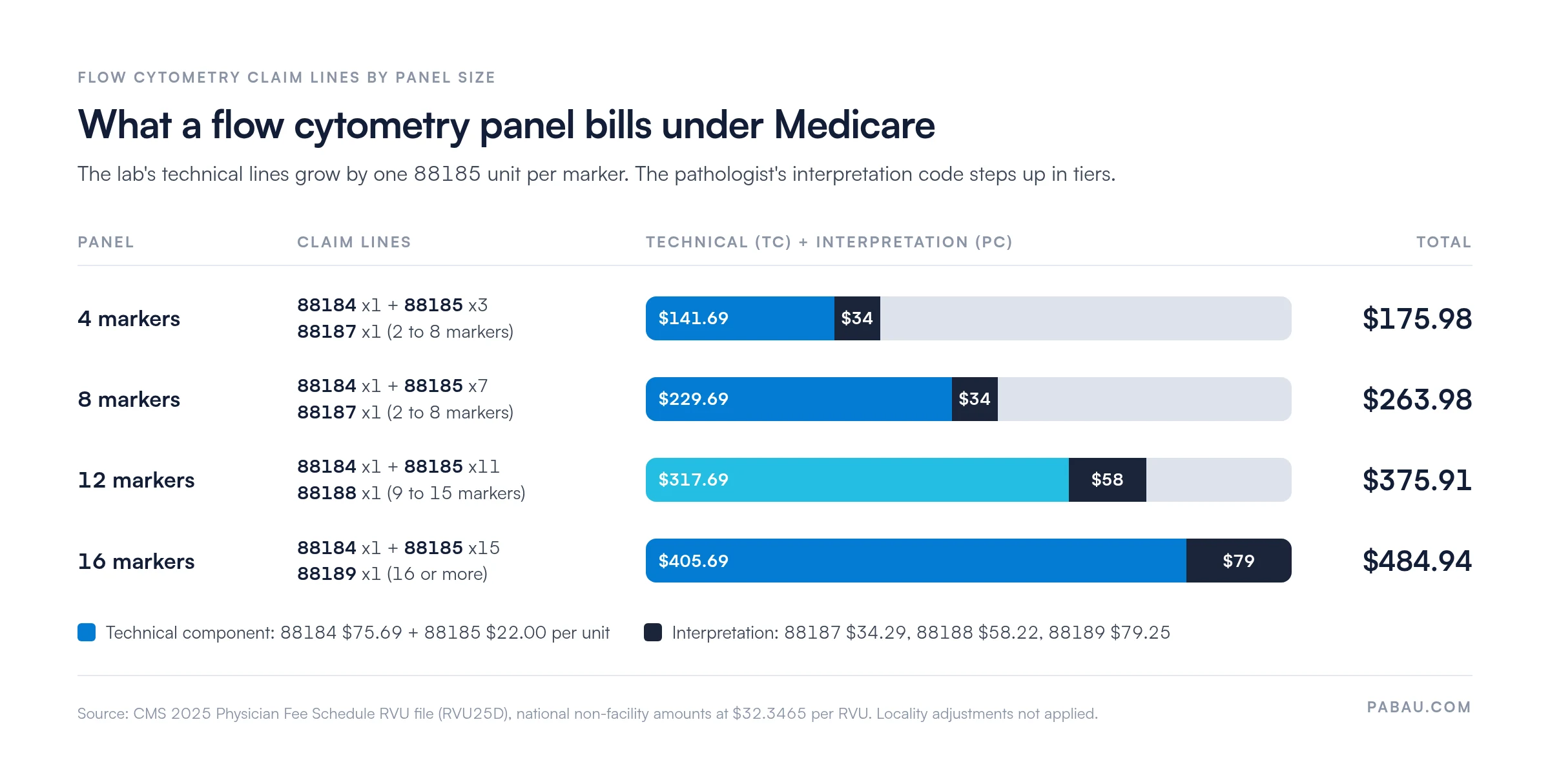
A 10-marker panel billed as 88184 x1 and 88185 x9 comes to about $274 for the technical component. If the pathologist interprets all 10 markers, 88188 adds $58.22.
CMS also sets a Medically Unlikely Edit (MUE) limit on 88185 units per date of service. Check the current MUE table before billing an unusually large panel.
Prior authorization (PA) for flow cytometry varies by payer and plan year. Traditional Medicare generally doesn’t require PA for 88185, but Medicare Advantage plans can. Medicaid rules are state-specific, and some programs require PA for multi-marker panels.
For a commercial PA request, include the documented clinical indication, the expected marker count and the ICD-10 code. If the plan has no flow cytometry guideline of its own, attach your MAC’s policy as supporting evidence. For CGS, that means article A56464 and LCD L34037.
Every flow cytometry claim follows the same path, and each step has its own failure point.
Most rejections surface at step four. A medical claims clearinghouse checks the claim against payer rules and returns errors before the payer sees them. Running insurance eligibility verification at step one catches coverage problems before the specimen is processed.
Before you submit, check that:
Flow cytometry claims need a correctly linked primary code and an auditable unit count. Those two requirements sit behind most of the denial patterns below.
If the same reason code keeps returning, fix the cause upstream. Tracking CARC codes on 88185 remittances shows whether denials cluster around units, diagnoses or missing authorizations. A structured denial management process then fixes the root cause instead of appealing claims one by one.
Several nearby pathology codes get confused with 88185. Billing two codes together when payer rules prohibit it is a frequent audit trigger in the 88000 series.
Immunohistochemistry on 88342 gets confused with 88185 because both detect antigens with antibodies. The difference is technique. 88185 uses flow cytometry on a single-cell suspension, while 88342 stains fixed tissue sections. Both can be billed on the same case when both were performed, subject to current National Correct Coding Initiative (NCCI) edits.
Surgical pathology on 88305 is a separate service too, since it covers gross and microscopic examination of the tissue itself.
Check the CMS NCCI edit table each quarter before billing 88185 alongside 88342 or other pathology codes. NCCI edits change four times a year, so a pair that was billable in Q1 may be bundled by Q3.
Lab billing teams often key flow cytometry claims by hand from the pathology report. That retyping is where unit counts slip and diagnosis codes get mistyped.
Pabau’s claims management software builds the claim from the patient record instead. CPT codes attached to the service land on the charge lines, and ICD-10 slots fill from the recorded problem list. The claim can’t be sent until required fields, such as membership numbers and authorization codes, are complete.
For US payers, claims go out electronically through Claim.MD. The same connection checks eligibility before the visit and tracks claim status after submission. Your team still owns the unit count, but it no longer rebuilds each claim by hand.

Pabau pre-fills claims from the patient record and submits US claims electronically through Claim.MD, with eligibility checks before the visit. Your billing team spends less time retyping lab claims.

Most 88185 problems start before the claim is built. The claim goes through when the report lists every antibody and the diagnosis is on your MAC’s covered list. After that, units are simply markers minus one.
So spend your review time on the panel report, not the claim form. When the report is complete, the coding follows from it. Book a demo to see how Pabau sends lab claims to payers straight from the patient record.

Need to understand how clean claims reduce lab denials? Clean claim best practices covers the components payers check before paying laboratory and pathology codes.
Submitting 837P electronic claims for the first time? 837 file format guide explains the EDI transaction structure used for CMS-1500 lab submissions.
Dealing with remittance adjustment codes after 88185 denials? Denial codes in medical billing maps common CARC codes to corrective actions for lab claim appeals.
Billing an antibody stain on tissue instead? CPT code 88341 covers the add-on for each additional immunohistochemistry antibody.
Coding the cytology side of the same workup? CPT code 88112 explains selective cellular enhancement in cytopathology.
No. The CGS article bills quantitative flow cytometry cell counts, such as CD4 counts, under 86355-86367. Don’t report 88184 or 88185 with those codes for the same laboratory analysis.
No. CMS lists 88185 with PC/TC indicator 3, which marks a technical-component-only code. The pathologist’s professional read goes on 88187, 88188 or 88189 instead.
No. The CGS article states that no CPT code exists for interpreting one marker, and another code shouldn’t be used in its place. Interpretation starts at 88187, which covers 2 to 8 markers.
No. DNA ploidy and S-phase analysis of a tumor by flow cytometry bills under 88182. Codes 88184 and 88185 cover immunophenotyping markers.
Only with a clinical reason. Medicare doesn’t pay for duplicate testing, so CGS allows it only when morphology or other factors suggest the specimens differ. Record that reason in the report.