

CPT Code 30801: Superficial turbinate ablation billing guide
CPT Code 30801: Official descriptor and procedure overview The American Medical ...

Last Updated: Nov 27, 2026
87660 is the CPT code for infectious agent detection by nucleic acid (DNA or RNA), Trichomonas vaginalis, direct probe technique. It covers a non-amplified DNA or RNA probe test for T. vaginalis. Labs usually run it on a vaginal swab, often within a combined assay such as BD Affirm VPIII.
An amplified test (NAAT) for the same organism bills as 87661, a wet mount as 87210 and a rapid antigen test as 87808. The method on the lab report decides the code.
Let Pabau's smart automation suggest the right codes, reduce claim denials, and keep your practice compliant—effortlessly.
Automate repetitive tasks and focus on what matters most—your patients.
Reduce coding errors and ensure compliance with the latest regulations.
Clean claims, fewer denials, and faster reimbursements.
Powerful insights and reporting to help your practice thrive.
HIPAA compliant SOC 2 certified GDPR-compliant Trusted by 4,000+ clinics worldwide

CPT code 87660 reports a direct (non-amplified) DNA or RNA probe test for Trichomonas vaginalis, such as the Trichomonas target on BD Affirm VPIII.
An amplified test (NAAT) for the same organism bills as 87661, so the method on the lab report decides between the two codes.
A Trichomonas wet mount is billed as 87210 and a rapid antigen test as 87808, never as 87660.
A59.01 or A59.00 supports a confirmed or suspected infection, N76.0 supports a vaginitis workup, and Z11.3 covers screening where the payer accepts it.
Pabau’s claims management software builds the claim from the visit record, so the code and the diagnosis reach the payer together.
CPT code 87660 is the code for infectious agent detection by nucleic acid (DNA or RNA), Trichomonas vaginalis, direct probe technique. AAPC’s code summary for CPT 87660 describes it as a lab test for T. vaginalis that uses a direct nucleic acid probe. The probe binds to the organism’s DNA or RNA in the specimen without an amplification step first.
The AMA maintains the descriptor as part of the CPT code set. Three elements define what the code covers:
The words that matter in the descriptor are “nucleic acid” and “direct probe.” Together they rule out microscopy, antigen tests and amplified assays. A practice that reads its own saline wet prep is not performing 87660, even though the organism is the same.
87660 covers one result: Whether a non-amplified probe detected T. vaginalis nucleic acid in the specimen. Other organisms, other test methods and the visit itself are reported on separate lines.
One run of the assay is one unit of 87660. A combined vaginitis assay that also reports Gardnerella and Candida adds a line for each of those organisms, as the panel section below shows.
Use 87660 when the lab detected T. vaginalis with a direct, non-amplified probe, and 87661 when it amplified the target first. Both codes report a nucleic acid test for the same organism, so the method alone separates them.
The CDC’s trichomoniasis treatment guidelines describe NAATs as highly sensitive, detecting more T. vaginalis infections in women than wet-mount microscopy. That clinical preference is why many labs now default to amplified testing. Before you bill 87660 through a new reference lab, ask which platform it runs.
Billing 87660 and 87661 for the same specimen on the same date needs care. Both report the same organism by nucleic acid, so a payer will expect a documented reason for running two methods. Check the current NCCI edits and the payer’s policy before you submit both lines.
Four different tests can detect T. vaginalis, and each one has its own code. The test name on the order is not enough. Two questions about the method on the lab report settle the code, as the decision path below shows.
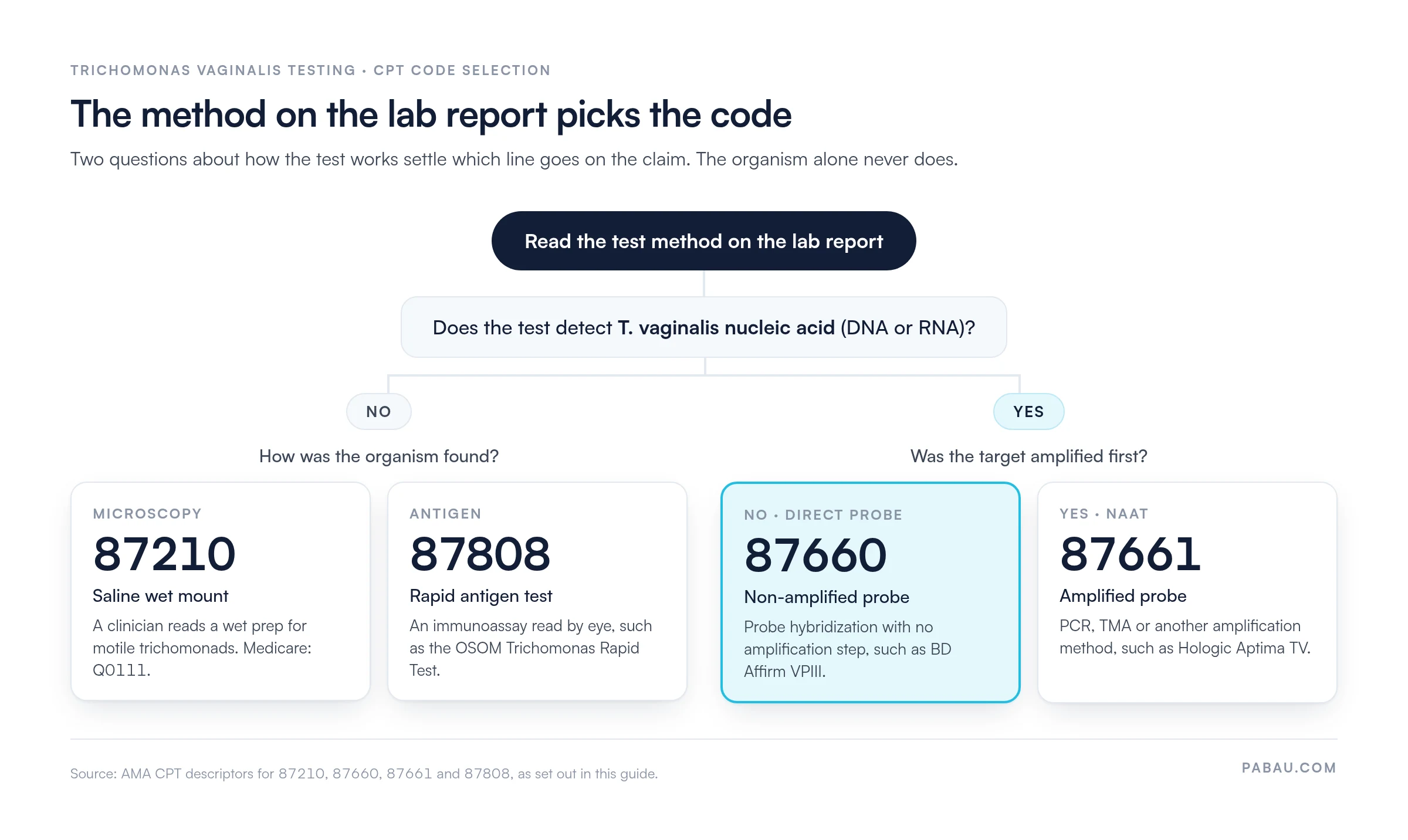
The table below adds what the lab or practice does for each method.
A wet mount billed as 87660 is the error to check for first. Some billing references describe 87660 as a microscopy code. If your charge master lists 87660 beside “wet prep,” correct the description before the next claim run.
The wet mount belongs on 87210 instead, or on Q0111 for Medicare under a provider-performed microscopy certificate. Q0111 is a HCPCS Level II code, so check it in a HCPCS code reference rather than the CPT manual.
87660 most often appears on a claim beside two other direct-probe codes, 87510 and 87480. Assays such as BD Affirm VPIII test one vaginal swab for Gardnerella, Trichomonas and Candida. A Blue Cross and Blue Shield of Illinois reimbursement policy names Affirm VPIII as a direct-probe DNA test. It may be reimbursable for patients with vaginitis symptoms.
Each organism the assay reports is a separate line with one unit. Code to the method behind each result, not to the brand name on the panel. A molecular vaginitis panel that amplifies its targets, such as BD MAX Vaginal Panel, bills under amplified or panel-specific codes, never 87660.
Before the first claim run with a new reference lab, ask for its test directory entry for each vaginitis assay. The entry names the platform and the CPT codes the lab assigns. Match your charge master to it, so a direct-probe Trichomonas result goes out as 87660 and an amplified one as 87661.
Every 87660 claim needs an ICD-10-CM code that shows why the test was ordered. For a patient with vaginal discharge or other vaginitis symptoms, N76.0 is the usual starting point until the result confirms the cause.
Screening claims carry the most coverage risk. Blue Cross and Blue Shield of Illinois, for example, does not reimburse trichomoniasis screening for asymptomatic patients. Confirm each code in the CDC/NCHS ICD-10-CM browser tool and against your payer’s policy before you submit.
Medicare pays CPT code 87660 under the Clinical Laboratory Fee Schedule (CLFS), not the Physician Fee Schedule. CLFS rates are national amounts set under the Protecting Access to Medicare Act (PAMA), with no geographic RVU adjustment. CMS updates them each year, so take the current rate from the CMS Clinical Laboratory Fee Schedule files rather than a third-party guide.
Pabau, a practice management platform with built-in US insurance billing, submits 87660 claims electronically through Claim.MD, its clearinghouse partner. The integration handles 837P claim files, eligibility checks before the visit and 835 electronic remittance advice. Your team sees what each payer paid and why, without reconciling paper EOBs.
Prior authorization is not usually required for 87660, but coverage rules still apply. Payer lab policies decide which patients and which diagnoses qualify, and they change more often than CPT descriptors do.
Run an eligibility check before each vaginitis visit. It confirms active coverage and shows whether the plan has lab management rules that limit direct-probe testing. Knowing the restriction before the swab goes to the lab avoids the denial.
Pabau runs insurance eligibility verification through Claim.MD before the encounter. The billing team then sees active coverage before the lab order goes out.
87660 denials follow predictable patterns, and most trace back to the method on the lab report or the diagnosis on the claim.
Claim.MD returns each payer’s 835 remittance to Pabau, so the denial reason sits next to the claim it belongs to. Across a month of remittances, repeated method-mismatch denials usually trace back to one line in the charge master.
Each element below should be in the record for the date of service before the claim goes out.
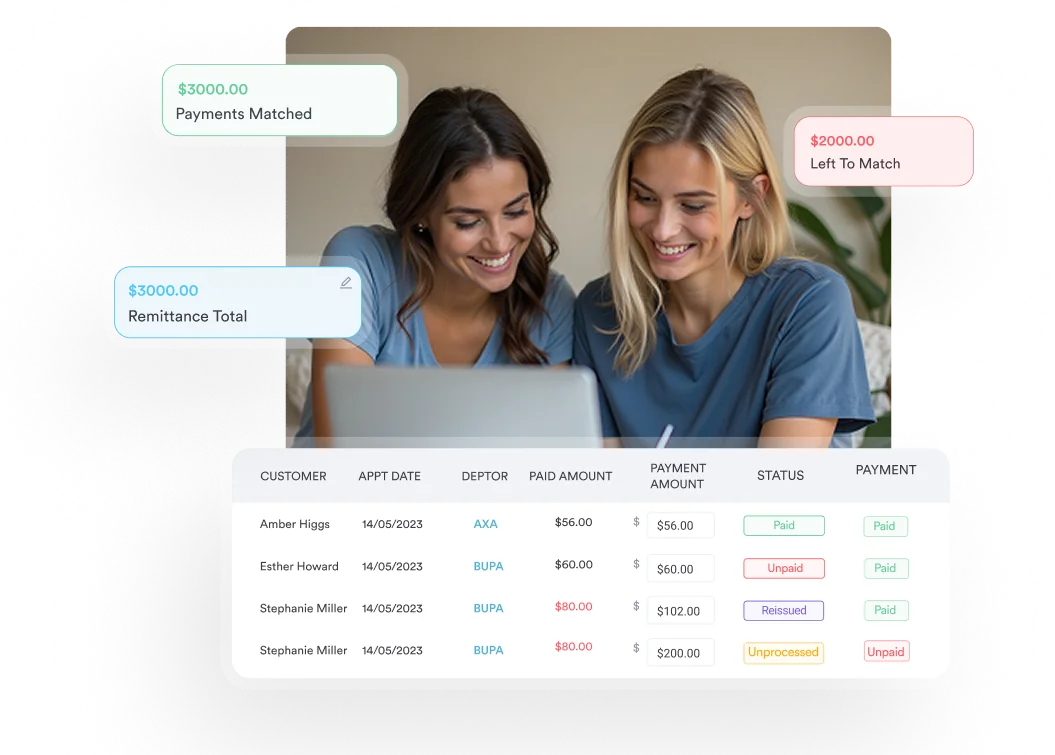
In many practices, the lab result arrives as a PDF and someone at the billing desk keys the code by hand. That step is where a direct-probe result becomes the wrong line, or where the diagnosis in the note never reaches the claim.
Pabau keeps the visit note, the diagnosis and the claim in one record. With claims management built in, the coder assigns 87660 against the documented indication. The claim then goes to the payer through Claim.MD with the diagnosis already linked.
When a payer rejects the line, the reason comes back on the 835 remittance into the same workflow. Your team sees why, corrects the claim and resubmits it from the record it started in.

Pabau keeps the visit note, the diagnosis and the claim in one record, so 87660 and 87661 lines go out with the indication payers check. See how it works for women’s health and sexual health practices.

Treat 87660 as a method code. It belongs on the claim only when the lab report shows a direct, non-amplified probe for T. vaginalis. A wet mount, a rapid antigen test and a NAAT each have their own code, so the organism alone never settles the choice.
Start with the charge master. If 87660 sits beside “wet prep” or a NAAT platform, fix that line first, because every later claim inherits it. Then make sure the note records the symptom that justified the test, since screening claims are where coverage fails most often.
To see how Pabau keeps lab codes, diagnoses and claims in step for women’s health practices, book a demo.

Need to understand how clearinghouse submission works for lab codes? Our Claim.MD clearinghouse guide explains how 837P claims move from practice to payer and back as 835 remittances.
Seeing recurring STI-related denials across your panel? Denial management in healthcare covers how to build a systematic denial tracking and appeals workflow.
Want the full picture on clean claim standards? What makes a clean claim walks through every field-level requirement that affects whether a claim pays on first submission.
CPT code 87660 is the code for infectious agent detection by nucleic acid (DNA or RNA), Trichomonas vaginalis, direct probe technique. It reports a non-amplified DNA or RNA probe test for T. vaginalis, usually on a vaginal swab. The Trichomonas target on BD Affirm VPIII is a common example.
87660 reports a direct, non-amplified probe for Trichomonas vaginalis, and 87661 reports an amplified probe (NAAT) for the same organism. The method on the lab report decides the code. The CDC describes NAATs as highly sensitive, and many labs now run them by default.
No. A wet mount read under the microscope is billed with 87210, and Medicare uses Q0111 under a provider-performed microscopy certificate. 87660 is a nucleic acid probe code. A rapid antigen test such as OSOM bills as 87808.
Only with a documented reason. Both codes report a nucleic acid test for the same organism, so payers expect one method per specimen. Check the current NCCI edits and the payer’s policy, and record why both tests were needed, before you submit both lines.
A59.01 (Trichomonal vulvovaginitis) and A59.00 (Urogenital trichomoniasis, unspecified) support a confirmed or suspected infection. N76.0 (Acute vaginitis) fits a symptomatic workup before the cause is known. Z11.3 covers screening, but some payers do not reimburse asymptomatic screening with this test.
Yes, when a combined assay such as BD Affirm VPIII reports each organism. Bill 87510 for Gardnerella, 87660 for Trichomonas and 87480 for Candida, one unit each. Check whether the payer prefers 87800, the multiple-organism direct-probe code, before you submit.
Yes. Medicare pays 87660 under the Clinical Laboratory Fee Schedule when medical necessity is documented. Your MAC’s coverage policy decides which diagnoses qualify. For asymptomatic screening, check coverage first and use an ABN when it is uncertain.




