



CCSD code G5100: Bypass of duodenum billing guide
CCSD code G5100 bills a bypass that leaves the duodenum in place CCSD code G5100...

Last Updated: Oct 16, 2026

CPT Code 87661 covers nucleic acid amplification testing (NAAT) for Trichomonas vaginalis, the most common curable STI in the United States.
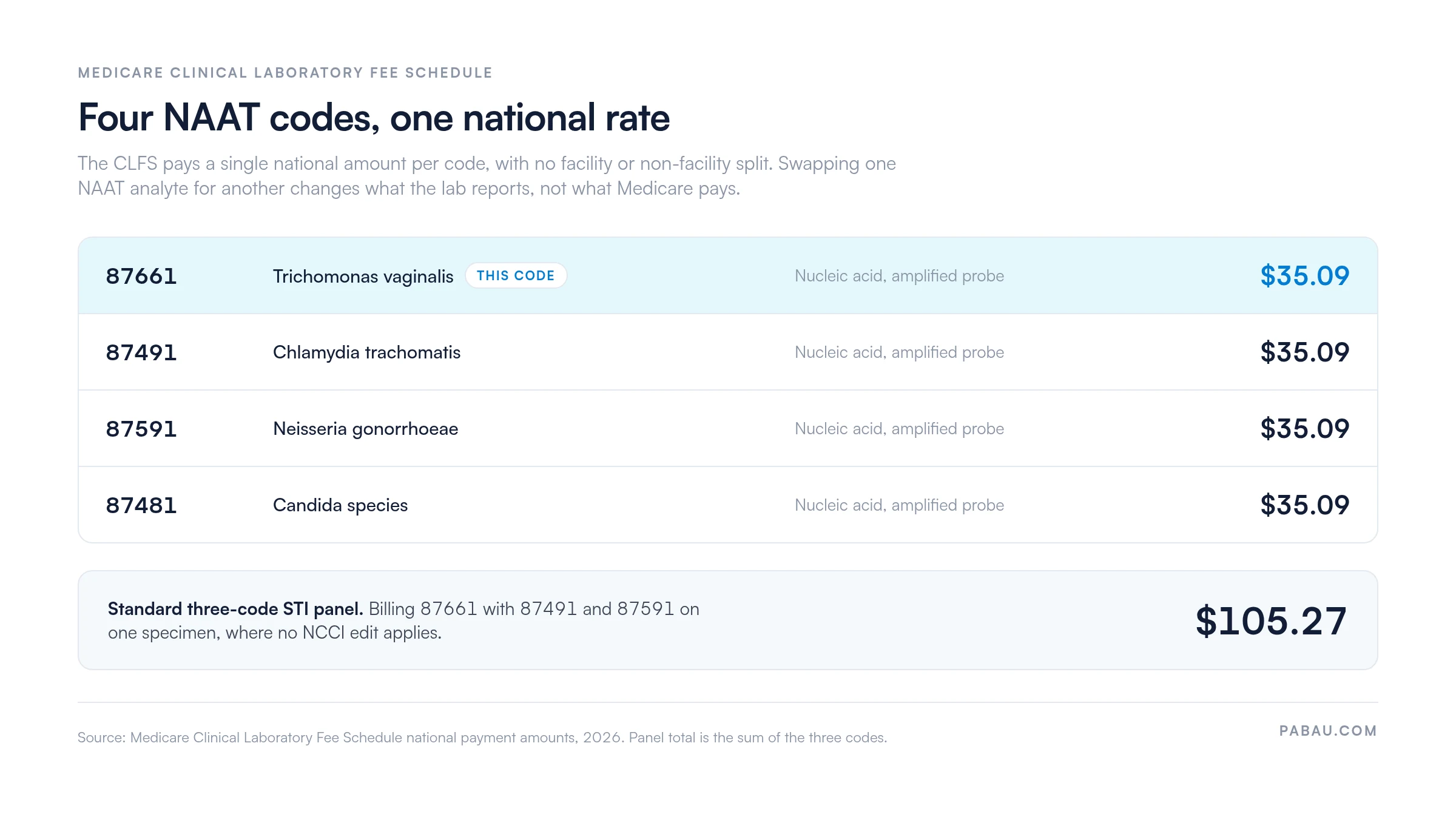
Medicare pays $35.09 for 87661 under the Clinical Laboratory Fee Schedule, the same national rate as 87481, 87491 and 87591.
Pair 87661 with ICD-10 code A59.01, A59.09, or Z11.3 to establish medical necessity, then check your MAC’s LCD.
The CPT descriptor carries no gender restriction, so a female-only edit still live in your billing system is a local configuration problem.
Pabau connects to Claim.MD for real-time eligibility checks, 837P claim submission, and ERA/835 remittance reconciliation.
CPT Code 87661 is the billable code for infectious agent detection by nucleic acid (DNA or RNA); Trichomonas vaginalis, amplified probe technique. It covers NAAT testing for trichomoniasis on a vaginal swab, a cervical swab, or urine. Medicare prices it under the Clinical Laboratory Fee Schedule, not the Physician Fee Schedule.
Trichomoniasis is the most prevalent curable sexually transmitted infection in the United States. The CDC estimates approximately 2.6 million infections each year. NAAT has replaced wet prep and culture as the diagnostic standard, because it finds infections the older methods miss.
Three failure points account for most denials on this code, and each one is fixable before the claim goes out:
CPT Code 87661 sits in the Infectious Agent Detection by Nucleic Acid (DNA or RNA) section of the CPT codebook. The American Medical Association maintains that code set. The full official descriptor reads: Infectious agent detection by nucleic acid (DNA or RNA); Trichomonas vaginalis, amplified probe technique.
The amplified probe technique language is the operative part of that descriptor. It separates 87661 from non-amplified probe detection, and it confirms that NAAT methodology is required to bill the code. A lab running a rapid antigen test or a wet prep cannot report 87661.
Trichomonas vaginalis is a protozoan parasite responsible for trichomoniasis. Up to 70% of infections are asymptomatic, so clinical presentation alone is an unreliable screen. Wet preparation microscopy, the older standard, has sensitivity of only 51-65% according to CDC STI treatment guidelines. NAAT reaches 95-100% sensitivity on the same specimen types.
The clinical case follows from that difference. Missed diagnoses perpetuate transmission and raise the risk of HIV acquisition. In pregnant patients, untreated infection is associated with preterm delivery. Aetna and Anthem both cover 87661 for symptomatic patients and defined screening populations, because the sensitivity gain justifies the higher cost.
CPT Code 87661 is reimbursed under the Medicare Clinical Laboratory Fee Schedule (CLFS), not the Physician Fee Schedule. Laboratory codes carry a single national rate, with no facility or non-facility split. CMS updates the schedule annually, effective each January 1.
Blood products follow a separate route. Medicare pays HCPCS code P9070 and other plasma units under the hospital outpatient system, not the CLFS.
The national CLFS rate for CPT Code 87661 is $35.09, and that figure has held since 2021. Confirm it against the current CMS clinical laboratory fee schedule files before you bill. Commercial rates vary widely from that benchmark.
The rate is also identical across the NAAT analytes a lab typically runs together, which changes how you should think about panel design.
The claim itself should carry the ordering provider’s NPI, the specimen type collected, and the applicable ICD-10 diagnosis code. Once the payer processes it, you receive an electronic remittance advice (ERA/835) with the payment or denial reason codes. Track those codes for NAAT-specific patterns rather than reading them claim by claim.
Commercial rates for CPT Code 87661 vary by payer and contract. The table below reflects the published position of each payer, and individual contract terms override it.
Selecting the right ICD-10 diagnosis code is the single most effective way to prevent automatic denials on CPT Code 87661. The payer uses that code to judge medical necessity, and the covered list varies by payer and by local coverage determination (LCD). Full descriptors and coding notes for the diagnoses below sit in our ICD-10-CM codes reference.
Use the most specific code the documentation supports. A59.01 is preferred over A59.9 when the patient is symptomatic and the anatomical site is recorded. The CrossCoder CPT-to-ICD-10 crosswalk helps confirm which diagnosis codes your MAC’s LCD lists as covered for 87661. Check that the list is current, since LCDs are revised periodically and no single covered list applies across every Medicare Administrative Contractor.
Clean claims for CPT Code 87661 share a consistent set of documentation elements. Miss one and you are into denial management in healthcare, which typically adds three to four weeks before the money arrives.
Submitting through a clearinghouse that validates the claim against payer edits before transmission catches errors while they are still cheap to fix. Practice management software like Pabau connects to Claim.MD, a US clearinghouse, for real-time eligibility checks and 837P claim submission. A claim that goes out correct on the first attempt avoids the rework cycle entirely.
CPT Code 87661 carries no gender restriction in its descriptor. Any female-only edit that rejects a male patient is a billing-system rule, not a CPT rule. It survives from the code’s historical association with vaginal specimens. T. vaginalis infects male patients too, and urine NAAT from a male patient is an FDA-cleared specimen type.
The MDIN update cited in some coding write-ups is not a national Medicare policy. It traces to a 2014 Indiana Health Coverage Programs bulletin. The state Medicaid billing system had applied a gender edit to this code in error, and the bulletin corrected it. Treat that as a state-level fix, not a CMS instruction.
The practical action is to audit your practice management or lab information system and confirm no gender edit is active on 87661. A claim for a male patient will fail a front-end edit and never reach the payer. If male-patient claims still reject on gender, check your own configuration first, then your MAC’s front-end edits.
CPT Code 87661 is frequently ordered alongside 87491 for Chlamydia trachomatis and 87591 for Neisseria gonorrhoeae as a standard STI panel. Each is separately reportable with its own National Correct Coding Initiative (NCCI) edit status. As a general rule the three may be billed together on the same specimen from the same encounter, because they detect distinct pathogens.
NCCI bundling edits can change quarterly, so verify the current tables before adding a new analyte to a panel. Key bundling considerations for CPT Code 87661:
Verify NCCI edit tables quarterly. CMS updates them four times per year, and a bundling rule that did not exist last quarter can appear mid-year. Run your standard NAAT panel through the current NCCI edit checker before your next submission cycle.
Knowing the wider family of NAAT STI codes helps with panel design and with avoiding unintentional bundling errors. The table below covers the codes most often billed alongside or instead of CPT Code 87661.
The AAPC Codify CPT lookup carries the full descriptions and current crosswalk data for each of these NAAT codes. When you bill a panel drawn from this family, check each pair against the current NCCI edit tables first.
Coverage for CPT Code 87661 is not automatic. Each major payer sets its own medical necessity criteria, and the claim documentation has to support them. Aetna, Anthem and Medicare broadly agree on symptomatic patients, then diverge sharply on asymptomatic screening.
Asymptomatic screening is the most variable area. Some Medicare MACs cover T. vaginalis NAAT screening for pregnant patients and HIV-positive individuals under specific LCDs. Commercial plans differ widely. When you order 87661 for asymptomatic screening, document the specific risk factor or guideline behind the test, rather than leaning on Z11.3 alone.
Denials on this code start upstream of the claim. The wrong gender flag, a missing diagnosis code, or a specimen type nobody recorded all originate in the clinical record. They then travel into billing untouched, and the biller finds out three weeks later.
Pabau keeps the order, the specimen detail, the diagnosis code and the claim in one patient record. A biller working an 87661 rejection reads the requisition and the note in the same place. Nobody reconciles a lab system against a separate billing platform. For a service running STI panels at volume, that removes the handoff where supporting detail usually goes missing.
Claims leave through Claim.MD, the US clearinghouse Pabau integrates with. That covers real-time eligibility verification before the specimen is collected, 837P claim submission, and ERA/835 remittance reconciliation once the payer responds. Our claims management software keeps that loop inside the system that already holds the patient record.

Pabau connects to Claim.MD for real-time eligibility checks, 837P claim submission, and ERA/835 remittance reconciliation. See how the billing loop runs from specimen collection through payment posting.

CPT Code 87661 rewards configuration more than effort. The rate is fixed at $35.09, the covered diagnosis list is short, and the bundling logic rarely shifts mid-year. What varies is whether your system is set up to send a claim that matches all three.
Audit the gender edit once and the male-patient rejections stop for good. Keep the ICD-10 pairing specific and the LCD check current, and most medical necessity denials go with them. The residual risk sits in panel bundling, which is why the quarterly NCCI check is worth putting in the calendar.
Book a demo to see how Pabau runs STI panel billing, from the eligibility check through to remittance posting.

Need to understand the full STI billing workflow? What is medical billing walks through the revenue cycle from order entry to payment posting.
Submitting claims electronically and want fewer rejections? Claim.MD clearinghouse guide covers how the clearinghouse validation layer catches errors before they reach the payer.
Getting denial codes back on NAAT claims? Denial codes in medical billing explains the most common CARC reason codes and how to work them.
CPT Code 87661 describes infectious agent detection by nucleic acid (DNA or RNA) for Trichomonas vaginalis using an amplified probe technique. It is the billing code for NAAT-based T. vaginalis testing, the reference standard for diagnosing trichomoniasis, with 95-100% sensitivity.
The national Medicare Clinical Laboratory Fee Schedule rate for CPT 87661 is $35.09, and it has been stable since 2021. Verify it against the current CMS CLFS file before billing, since CMS updates the schedule each January.
Yes. The CPT descriptor for 87661 carries no gender restriction, and urine NAAT from a male patient is an FDA-cleared specimen type. A female-only edit still active in your billing system is a local configuration issue, and it rejects the claim before the payer sees it.
The codes used most often with CPT Code 87661 are A59.01 (trichomonal vulvovaginitis) and A59.09 (other urogenital trichomoniasis). A59.9 (trichomoniasis, unspecified) and Z11.3 (encounter for STI screening) also apply. Select the most specific code the documentation supports, then verify coverage against your MAC’s LCD.
Generally yes, because each code describes detection of a distinct pathogen: T. vaginalis, Chlamydia trachomatis, and N. gonorrhoeae. Check NCCI bundling edits against the current quarterly CMS tables before billing any combination, since those edits can change.
Prior authorization requirements vary by payer and plan. Medicare does not usually require prior auth for laboratory codes. Anthem and some commercial plans require it for defined patient populations or indications. Verify the requirement with the patient’s plan before ordering the test.



