CPT Code 96573: Photodynamic therapy billing guide
CPT Code 96573: Definition and official descriptor CPT Code 96573 is a medicine/...

Last Updated: Nov 13, 2026
87210 is the CPT code for smear, primary source with interpretation; wet mount for infectious agents (e.g., saline, India ink, KOH preps). It covers the saline or KOH wet prep a clinician reads under the microscope during the visit, most often to work up vaginitis.
Medicare reports the same in-office wet mount and KOH prep as HCPCS Q0111 and Q0112 under a provider-performed microscopy certificate. For commercial payers, 87210 is the code to bill.
Let Pabau's smart automation suggest the right codes, reduce claim denials, and keep your practice compliant—effortlessly.
Automate repetitive tasks and focus on what matters most—your patients.
Reduce coding errors and ensure compliance with the latest regulations.
Clean claims, fewer denials, and faster reimbursements.
Powerful insights and reporting to help your practice thrive.
HIPAA compliant SOC 2 certified GDPR-compliant Trusted by 4,000+ clinics worldwide

CPT code 87210 covers wet mount smear examinations of primary-source specimens, such as vaginal, urethral and wound samples, read in-office or in a lab.
Billing 87210 takes a CLIA certificate that covers the test. Medicare reports PPM wet mounts and KOH preps as Q0111 and Q0112 instead.
Common denial triggers are the wrong code or modifier for the payer, an unsupported ICD-10 code, and NCCI conflicts with a same-day 87205.
Pabau’s claims management software sends US claims through Claim.MD with eligibility checks and ERA remittances, which helps cut avoidable 87210 rework.
CPT code 87210 reports a “smear, primary source with interpretation; wet mount for infectious agents (e.g., saline, India ink, KOH preps).”
That wording comes from the American Medical Association, which maintains the CPT code set. The code sits in the microbiology subsection (87003-87999) and covers direct microscopic examination of a primary-source specimen. The sample goes straight onto a slide and is read immediately, with no culture or processing step.
The key phrase is “primary source.” The specimen must come directly from the patient, typically vaginal secretions, urethral discharge, or wound exudate. Skin KOH is 87220 (Medicare Q0112). A processed or cultured specimen billed under 87210 is a coding error and an audit risk.
CPT code 87210 covers microscopic examination of a wet-mounted smear from a primary source specimen, intended to identify infectious agents through direct visualization. Normal saline shows motile trichomonads and clue cells.
Potassium hydroxide (KOH) dissolves epithelial cells to reveal fungal hyphae consistent with Candida. India ink preparations, also included in the descriptor, are used for other infectious agents such as Cryptococcus in specialized settings.
The organisms and findings that drive 87210 orders in ob-gyn and primary care practice include:
The descriptor requires “interpretation,” meaning the performing clinician or laboratory professional must review and document findings, not simply prepare the slide. A result of “no organisms seen” is a valid finding and must still be documented in the patient record.
Documentation is where most 87210 claims either survive or fail on audit. The medical record must establish that the physician or qualified laboratory personnel performed the microscopic examination, not simply that a specimen was collected.
The procedure follows these steps, each of which corresponds to a documentation requirement:
In an ob-gyn practice, the clinical note template should capture all five elements above as structured fields rather than one free-text comment. Structured notes make chart abstraction during a payer audit faster and easier to defend.
CLIA requirements are the most misunderstood compliance layer for CPT code 87210, and getting them wrong means the claim either denies or creates regulatory exposure. The Clinical Laboratory Improvement Amendments (CLIA), administered by CMS under 42 CFR Part 493, govern every setting that performs laboratory testing on human specimens.
Modifier QW and the Medicare Q codes: QW marks a CLIA-waived test on a claim. Verify 87210 against the current CMS waived list and each payer’s policy before you append it. For Medicare, the Illinois Department of Public Health PPM list reports wet mounts as Q0111 and KOH preparations as Q0112. Commercial payers generally take 87210 for the same work.
No modifier 26 split: Medicare pays 87210 under the Clinical Laboratory Fee Schedule, and lab test codes there carry no professional/technical split. A practice that prepares and reads the smear bills the code once, under its own CLIA certificate.
Checking coverage before the encounter, through insurance eligibility verification, shows whether the payer expects 87210 or a Q code. It also shows whether that payer requires QW. That settles the code before the claim is built.
Run a CLIA certificate audit once a year. Confirm your certificate type and expiration date, and check that every test you bill matches your certificate category. If a certificate lapsed six months ago, every 87210 claim filed since then is a compliance liability.
The three most commonly confused codes in this cluster each cover a distinct examination method. Using the wrong one is an upcoding or downcoding error, depending on direction. NCCI edits govern whether two of them can be billed on the same date.
87210 vs 87220: The distinction is specimen source and clinical purpose. CPT code 87210 covers a vaginal, urethral, or wound wet mount. CPT 87220 is “tissue examination by KOH slide of samples from skin, hair, or nails for fungi or ectoparasite ova or mites (eg, scabies).” A vaginal KOH prep for Candida belongs under 87210, so billing it as 87220 is a coding error.
87210 and 87205 on the same date: These two codes are not automatically bundled under NCCI edits. A saline wet mount and a Gram stain done on separate specimens, or for distinct clinical reasons, may both be billed for the same encounter.
The record must show that each examination was performed separately, by whom, and what it found. A note reading “wet prep and Gram stain performed” with no findings for each does not support dual billing. NCCI edits change quarterly, so check the current table before you bill both.
Once the preparation, specimen and payer are known, the right code follows. The chart below matches each in-office smear to its code, Medicare’s Q codes included.
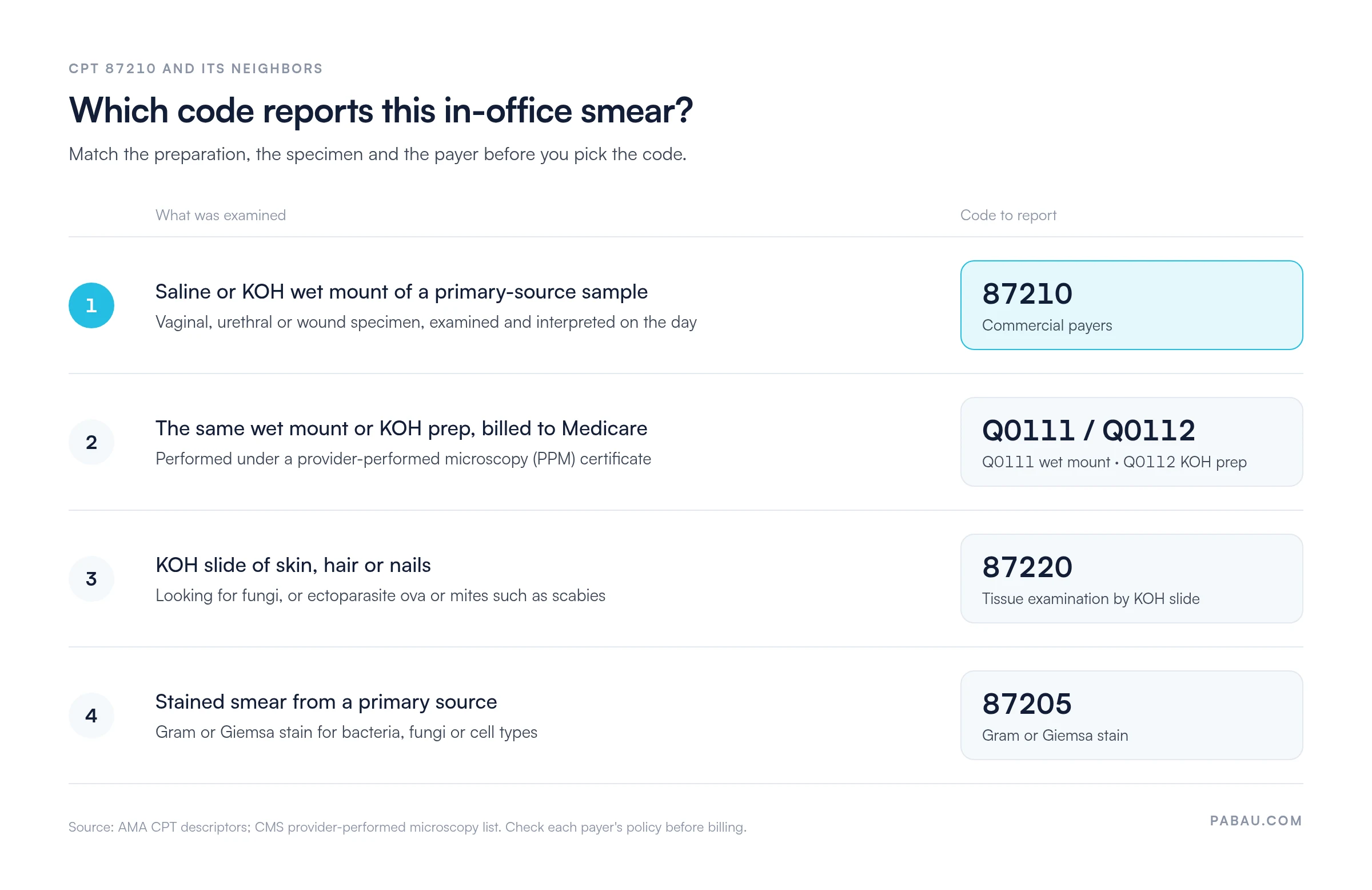
Payers validate medical necessity by checking the ICD-10-CM diagnosis code against an internal crosswalk for CPT code 87210. The wrong diagnosis code is one of the fastest paths to a CO-11 denial. The table below covers the most commonly accepted pairings and their clinical context.
For symptomatic vaginitis, N76.0 is the usual first pairing. When the smear comes back non-specific, N89.8 describes the encounter more accurately. Pre-loading these pairings into the lab order template cuts the chance of a coder picking an unlinked code. A claim whose diagnosis is missing from the payer’s crosswalk for 87210 is denied before a human reviewer sees it.
Medicare pays CPT code 87210 under the Clinical Laboratory Fee Schedule (CLFS), not the Physician Fee Schedule. CMS sets most CLFS rates from the weighted median of private payer rates. Check the current CMS CLFS file for this year’s 87210 rate before quoting a patient’s cost share. Under a PPM certificate, Medicare expects Q0111 or Q0112 in place of 87210.
Payer policy variation: Commercial payer policies on CPT code 87210 vary more than Medicare’s. Several large payers have medical policies that limit wet mount coverage in favor of nucleic acid amplification testing (NAAT) for trichomonas and bacterial vaginosis.
When a wet mount is done in place of NAAT, the record must show why the in-office prep suited this patient at this visit. Without that note, the claim can be denied as not medically necessary even when the ICD-10 code is accepted.
CPT code 87210 denials cluster around five root causes. Each shows up on the remittance as one of the standard denial codes, and each has a corrective action that stops it recurring.
The molecular testing denial (the final row) reflects a growing trend. Several payers now have policies that require NAAT testing for trichomonas rather than wet mount, citing sensitivity data. The wet mount for Trichomonas vaginalis has a reported sensitivity of roughly 44-68%, while NAAT tests reach 95-100%. When a practice chooses wet mount over NAAT, the medical record must state the clinical rationale. Without it, an appeal on this denial is unlikely to succeed.
A structured denial management workflow tracks 87210 denials by reason code. It shows whether the problem is systemic (the wrong code on every Medicare claim) or case-by-case (thin notes on single charts). Systemic fixes happen at the billing template level; case-by-case fixes require chart review and education for the ordering clinician. The clean claim standard for 87210 means the claim is complete, accurate, and contains no edits that require payer intervention before adjudication.
Before submitting an 87210 appeal on medical necessity grounds, pull the payer’s current LCD or medical policy for vaginal wet mount. Many LCDs specify exactly which diagnoses require NAAT over wet prep. If your diagnosis is on the list, an appeal without NAAT documentation will not succeed. Build the payer’s LCD language into your internal coding reference so the team knows which orders need a NAAT before an 87210 is billed.
Without a set workflow, each 87210 claim depends on the coder recalling one payer’s rules. Does this payer want 87210 or Q0111? Does the diagnosis pair pass, and is the CLIA number on file current?
Pabau, the practice management platform we build, links the wet mount note to the invoice and the claim. Its claims management software sends US claims through Claim.MD, with eligibility checks before the visit and ERA remittances after it.
The eligibility check shows the payer before the patient is seen, so the team knows whether the claim needs 87210 or a Q code. ERA remittances then post each denial reason against its claim, which makes a repeat CO-11 easy to spot. On a low-dollar code, one avoided resubmission can be worth more than the test pays.

Pabau links your clinical notes to billing, so 87210 claims go out with the right code, an accepted diagnosis, and eligibility checked through Claim.MD.

CPT code 87210 pays little per claim, so the margin sits in getting it right the first time. Before the next wet mount, confirm three things: your CLIA certificate type, the code each payer expects, and the diagnosis pairs it accepts.
Settle those once, in the billing setup, and the chart only has to carry clear microscopy findings. Leave them to memory and each denial costs more staff time than the test is worth.
To see that setup run against your own payer mix, book a demo and we’ll walk through in-office lab billing with your team.

Running a Gram stain alongside the wet mount? CPT code 87205 covers stained primary-source smears and when they can be billed with 87210.
Looking for the 837 file format guide for electronic lab claim submission? 837 electronic claim file explains the transaction set structure that carries your 87210 claims to Medicare and commercial payers.
Want to understand how remittance data reveals denial patterns? Electronic remittance advice (ERA) covers how to read 835 files to track CO-4, CO-50, and CO-97 denial reason codes systematically.
CPT code 87210 covers a smear from a primary source with interpretation, using a wet mount to identify infectious agents. Saline, India ink, and potassium hydroxide (KOH) preparations all qualify. It applies to vaginal, urethral, or wound specimens examined directly under the microscope during or immediately after collection, without culture or processing.
CPT 87210 covers wet mount examination of a primary-source specimen, typically vaginal, urethral, or wound, for organisms such as Trichomonas, Candida, and clue cells. CPT 87220 is tissue examination by KOH slide of samples from skin, hair, or nails for fungi or ectoparasite ova or mites (eg, scabies). A vaginal KOH prep belongs under 87210, not 87220.
No. Billing CPT 87210 without a valid CLIA certificate is a CMS compliance violation. A physician office needs a certificate that covers the test, most often a provider-performed microscopy (PPM) certificate. Medicare reports PPM wet mounts and KOH preps as Q0111 and Q0112. Under a certificate of waiver, verify the test against the current CMS waived list and each payer’s policy.
The most commonly accepted pairings are N76.0 (acute vaginitis), A59.01 (trichomonal vulvovaginitis), and N89.8 (other specified vaginal disorders). For confirmed yeast, use B37.31 or B37.32 (acute or chronic vulvovaginal candidiasis). Payers match the ICD-10 code against an internal crosswalk for 87210. A code missing from that crosswalk triggers a CO-11 or CO-50 denial automatically.
Yes, when a wet mount (87210) and a Gram stain (87205) were performed separately on the same date. The medical record must document each examination individually, with its own findings. Check the current NCCI edit table before billing both on the same claim, as edit indicators and modifier allowances change quarterly.
The most common trigger is the wrong code or modifier for the payer, such as 87210 sent to Medicare in place of Q0111. Next come an ICD-10 code that payer doesn’t accept for 87210, a CLIA number mismatch, and a payer policy requiring NAAT for trichomonas or BV. Each needs a different corrective action.