CPT Code 99465: Newborn resuscitation in the delivery room
CPT Code 99465: Definition and clinical description CPT Code 99465 is the AMA pr...

Last Updated: Nov 2, 2026
87480 is the CPT code for infectious agent detection by nucleic acid (DNA or RNA); Candida species, direct probe technique.
The test uses a non-amplified probe to find Candida DNA or RNA in a specimen, most often a vaginal swab. Amplified (PCR) Candida testing is reported with 87481, and quantification with 87482. Medicare pays 87480 on the Clinical Laboratory Fee Schedule.
Let Pabau's smart automation suggest the right codes, reduce claim denials, and keep your practice compliant—effortlessly.
Automate repetitive tasks and focus on what matters most—your patients.
Reduce coding errors and ensure compliance with the latest regulations.
Clean claims, fewer denials, and faster reimbursements.
Powerful insights and reporting to help your practice thrive.
HIPAA compliant SOC 2 certified GDPR-compliant Trusted by 4,000+ clinics worldwide

CPT code 87480 covers Candida species detection by direct (non-amplified) probe technique. Amplified NAAT or PCR testing is reported with 87481 instead.
Pair 87480 with ICD-10 B37.31 (acute candidiasis of vulva and vagina) or B37.32 (chronic) for recurrent cases. B37.3 is a non-billable header and won’t support the claim.
87480 can be co-billed with 87491 and 87591 as separately identifiable analytes. Modifier 59 or XU may be required, depending on the NCCI column indicator.
Pabau, the practice management platform we build, routes US claims through the Claim.MD clearinghouse, so each 87480 claim can be followed from submission to payment.
The American Medical Association (AMA) defines CPT code 87480 as “Infectious agent detection by nucleic acid (DNA or RNA); Candida species, direct probe technique.” Specifically, the code reports one analyte, Candida species, detected with a non-amplified hybridization probe. Amplified testing (NAAT or PCR) is reported with 87481 instead, and culture and antigen tests have their own codes.
Clinically, 87480 supports the workup of vulvovaginal candidiasis (VVC), recurrent VVC, or vaginal discharge of unclear cause. Direct probe vaginitis assays often test one swab for Candida, Gardnerella vaginalis and Trichomonas vaginalis. As a result, each organism carries its own direct probe code: 87480, 87510 and 87660.
The three Candida codes differ by laboratory method: direct probe, amplified probe, or quantification. Therefore, code the method the performing lab used, as shown on the lab report or in its test directory. In fact, payers check the reported code against that documentation, so a method mismatch is a routine cause of denials.
Reporting 87480 and 87481 together: Each code describes a different method, so report the code that matches the assay the lab ran. Indeed, reporting both for one specimen tells the payer that two separate tests were performed. However, bill both only when the lab ran both methods and documented each result, and check the current NCCI procedure-to-procedure table for the pair first.
Payers and MAC Local Coverage Determinations (LCDs) tie coverage of CPT code 87480 to specific, documented specimen sources. In fact, a specimen type that is neither listed on the requisition nor consistent with the supporting ICD-10 code is a predictable denial trigger.
Place of service (POS) records where the test was performed. CPT code 87480 is most commonly billed by independent reference laboratories (POS 81), hospital outpatient laboratories (POS 22), or physician office laboratories (POS 11). Medicare pays 87480 on the Clinical Laboratory Fee Schedule (CLFS) in each of these settings. However, it is not priced on the Physician Fee Schedule.
An unlinked or mismatched diagnosis is the leading denial trigger for CPT code 87480. Every claim must carry an ICD-10-CM code that establishes the clinical reason for ordering the Candida probe test. Therefore, choosing the ICD-10 code when the test is ordered, rather than at billing, prevents the most common linkage errors.
When the cause isn’t confirmed yet, N76.0 supports the order until the result comes back. Additionally, check every code against the ICD-10-CM set in force on the date of service, because CMS updates it each October 1. For example, B37.3 is now a header, so claims need B37.31 or B37.32.
Medicare reimburses CPT code 87480 under the Clinical Laboratory Fee Schedule (CLFS) in every setting, including independent, physician office and hospital outpatient labs. In fact, the test is excluded from the Physician Fee Schedule, so there is no facility or non-facility rate to look up. CMS publishes one national limitation amount per code in the CMS Clinical Laboratory Fee Schedule files. Therefore, check the current quarter’s file before quoting a rate.
Commercial payer coverage varies. Some payers restrict 87480 to symptomatic patients, and others require prior authorization for standalone vaginal pathogen panels. Indeed, payers that require prior auth don’t always grant it retroactively, so verify before ordering when the patient’s plan is unfamiliar. In addition, MAC Local Coverage Determinations (LCDs) govern Medicare coverage by jurisdiction, so a Novitas policy may not apply under CGS or WPS.
Check the patient’s plan rules before collecting the specimen, not before submitting the claim. If the plan limits 87480 to symptomatic patients, finding out after the lab runs the sample leaves no route to retroactive authorization.
CPT code 87480 is often ordered on a direct probe vaginitis panel alongside Gardnerella and Trichomonas probes. Specifically, each is a separately identifiable analyte and can generally be reported on its own. Nevertheless, bundling edits can still apply, so check the current quarter’s NCCI table before you submit.
Modifier 59 vs X-modifiers: When a bundling edit fires, modifier 59 (distinct procedural service) may allow separate payment. In addition, the more specific X-modifiers (XE, XS, XP, XU) do the same job. Specifically, modifier 59 or XU is only valid when the NCCI column indicator is “1” (modifier allowed). Otherwise, if the indicator is “0,” the codes are never payable separately. As a result, appending one anyway creates false claim exposure.
Overall, each element missing from the claim record maps to a specific claim adjustment reason code (CARC). A clean claim for 87480 needs these five components in place before submission.
Overall, most 87480 denials are preventable and fall into five patterns. An effective denial management workflow maps each pattern to a specific fix before the appeal deadline runs.
For Medicare denials, reference the AAPC Codify CPT lookup to confirm code status and any attached LCD policy notes before filing. Additionally, share the CARC denial codes reference with billing staff. Specifically, it shows how to route each denial type to the correct work queue.
CPT code 87480 covers the direct probe approach to Candida detection. In contrast, amplified testing and culture use different CPT codes and have distinct billing and clinical trade-offs. Coders sometimes see chart orders for Candida testing that don’t name a method, and that leads to miscoding. The diagram below maps each lab method to its code.
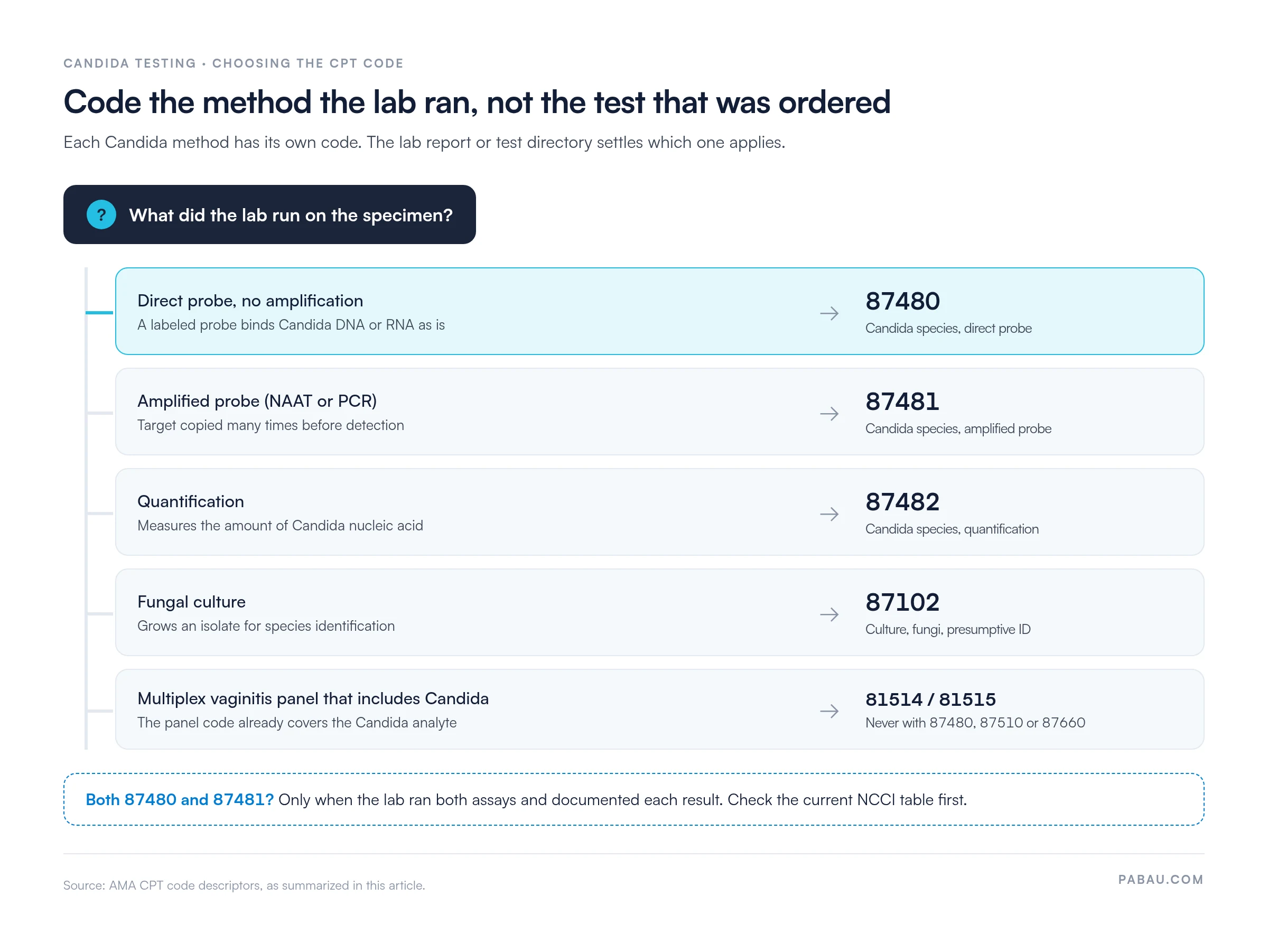
The choice between probe testing and culture affects the CPT code billed and, therefore, the documentation required. When a chart notes “Candida culture ordered” but the lab runs a probe assay, a claim for 87480 or 87481 won’t match the order. That creates a medical necessity mismatch. Therefore, ensure the order, the lab requisition, and the billed code all reflect the same method.
When a provider orders a ‘vaginal pathogen panel’ without naming a method, pull the lab’s test directory before coding. Many reference labs run amplified assays for every analyte in a panel, so Candida is reported with 87481, not 87480. Coding from the chart order alone without checking the lab report method is the root cause of most method-mismatch denials.
Candida probe claims usually stall on small mismatches: a header ICD-10 code, a vague specimen source, or an NCCI pair billed without the right modifier. Finding them often means logging in to one payer portal after another.
Pabau sends US claims through the Claim.MD clearinghouse for electronic submission and status tracking. With claims management built in, details already on the patient record flow into the claim, so your team doesn’t re-key them.
Your billing team then sees which 87480 claims were accepted, paid or denied in one place. That view feeds your wider revenue cycle management, so a denial gets corrected and resubmitted instead of sitting unnoticed.
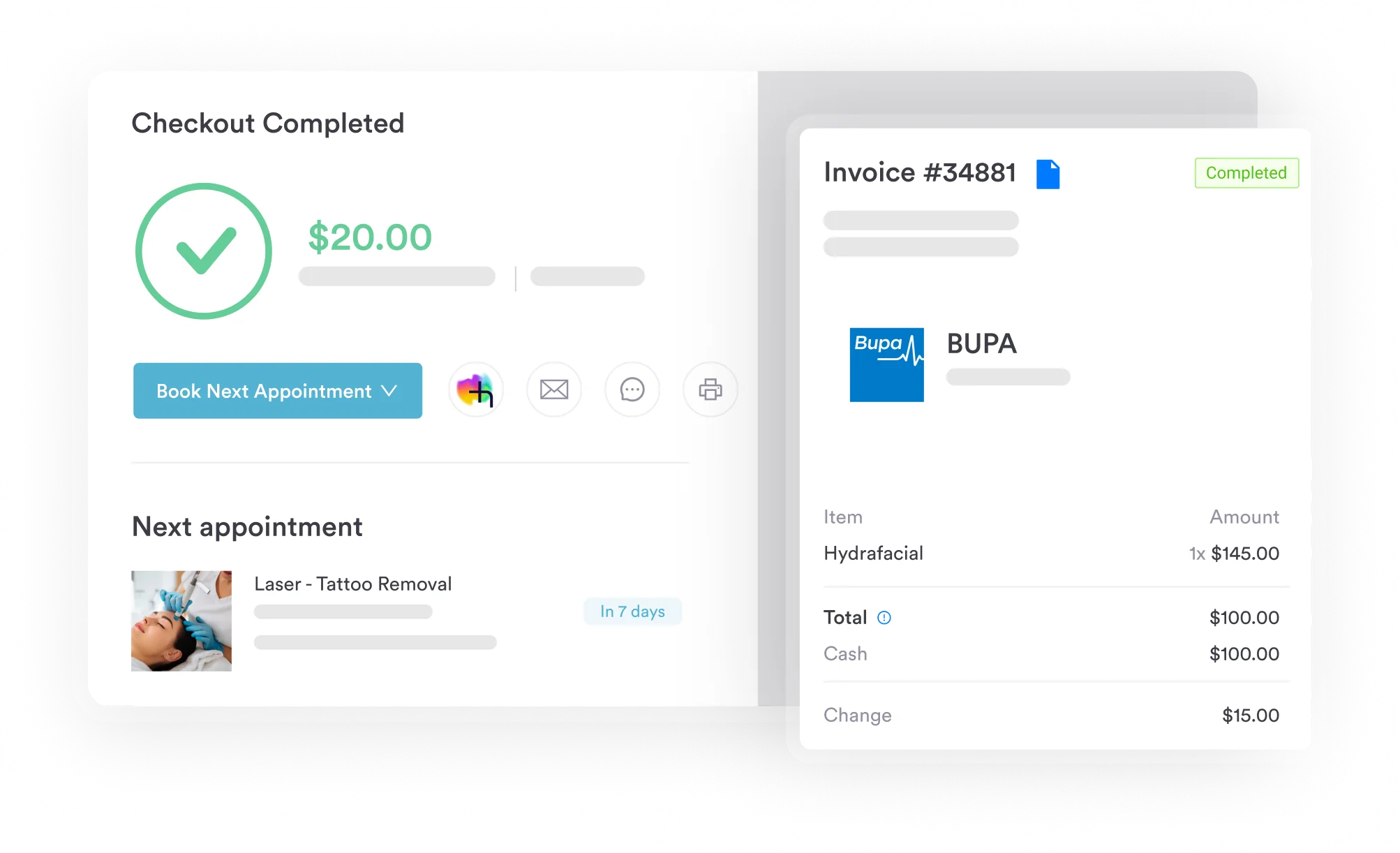

Pabau sends US claims through the Claim.MD clearinghouse and tracks each one, so your team can follow every lab claim from submission to payment.

CPT code 87480 is the direct probe code for Candida, and the costliest error is treating it as the PCR code. Therefore, check the lab’s method before you choose between 87480 and 87481.
Then link B37.31 or B37.32 rather than the B37.3 header, and name the specimen source on the requisition. In addition, add a modifier only when the NCCI column indicator allows it. In short, each of those checks closes off one of the denial patterns above before the claim goes out.
If your team spends hours chasing denied lab claims, book a demo to see how Pabau tracks each one to payment.

Managing electronic claim submission for lab codes? How 837 files work in medical billing covers EDI transaction formats and how clearinghouses route claims to payers.
Getting denials with no clear CARC code? Reading electronic remittance advice (ERA) explains how to extract denial reason codes from 835 transactions for faster resolution.
Billing a full vaginal pathogen panel? Building an accurate superbill walks through how to structure multi-code lab claims so bundling edits are caught before submission.
CPT code 87480 covers infectious agent detection by nucleic acid (DNA or RNA) for Candida species using a direct, non-amplified probe technique. Labs report it when a direct probe assay tests a specimen, usually a vaginal swab, for Candida. Amplified (PCR) Candida testing is reported with 87481 instead.
CPT 87480 and 87481 both detect Candida species but differ by method. CPT 87480 uses a direct probe that binds the organism’s DNA or RNA without amplification. CPT 87481 uses an amplified probe technique, such as PCR, which copies the target before detection. Report the code that matches the assay the lab ran.
The two most common denial reasons are a diagnosis that fails medical necessity (CARC 50) and an NCCI edit without a modifier (CARC 97). The other three are an exceeded frequency limit (CARC 119), missing prior authorization (CARC 15) and an uncovered or undocumented specimen type (CARC 252). Each has its own fix, listed in the denial table above.
Yes, CPT 87480 is subject to NCCI procedure-to-procedure edits, which CMS updates quarterly. Codes for other organisms, such as 87510, 87660, 87491 and 87591, are generally separately reportable as distinct analytes. A modifier may be required depending on the current NCCI column indicator. Before reporting 87480 with 87481, confirm the lab ran both methods and check the current edit table.