CCSD Code D1010: Radical mastoidectomy including meatoplasty
CCSD Code D1010: Definition and clinical scope CCSD Code D1010 is the UK private...

Last Updated: Nov 25, 2026
87510 is the CPT code for infectious agent detection by nucleic acid (DNA or RNA); Gardnerella vaginalis, direct probe technique. It covers a non-amplified probe test for the main organism behind bacterial vaginosis.
OB-GYN and women's health practices use it when a symptomatic patient's vaginal swab runs on a direct-probe assay. An amplified test bills as 87511 and a quantified result as 87512, so the method on the lab report decides the code.
Let Pabau's smart automation suggest the right codes, reduce claim denials, and keep your practice compliant—effortlessly.
Automate repetitive tasks and focus on what matters most—your patients.
Reduce coding errors and ensure compliance with the latest regulations.
Clean claims, fewer denials, and faster reimbursements.
Powerful insights and reporting to help your practice thrive.
HIPAA compliant SOC 2 certified GDPR-compliant Trusted by 4,000+ clinics worldwide

CPT 87510 covers direct, non-amplified nucleic acid probe detection of Gardnerella vaginalis and no other method.
The lab’s method decides the code: 87511 is the amplified probe technique, and 87512 is quantification of the same organism.
N76.0 (Acute vaginitis) is the usual ICD-10-CM pairing, but accepted codes vary by MAC jurisdiction and LCD.
A missing or unsupported ICD-10-CM link is the leading denial trigger for 87510 claims across commercial and Medicare payers.
CPT code 87510 is the code for Infectious agent detection by nucleic acid (DNA or RNA); Gardnerella vaginalis, direct probe technique. That descriptor belongs to the AMA’s CPT code set, which the AMA’s CPT Editorial Panel maintains. Three elements define the code’s scope:
Gardnerella vaginalis is the primary bacterial driver of bacterial vaginosis (BV). BV affects roughly one-third of reproductive-age women and is characterized by a shift in vaginal flora away from Lactobacillus dominance. Probe-based detection of Gardnerella vaginalis confirms the pathogen, supporting both the diagnosis and the medical necessity record that payers require. Use AAPC Codify to verify the descriptor wording for the current code year before submitting claims.
The code covers the detection step only. Specimen collection, office visits, and any additional organism-specific probes billed on the same date are separate line items. So is a gynecologic procedure at the same visit, such as an endocervical curettage reported with 57505.
Antigen-based assays and wet-mount microscopy are also excluded. Those tests use a different detection mechanism and fall under separate code families.
The lab report determines the correct code. Ask the performing laboratory which detection method it used before you choose among the three sibling codes.
Most current molecular platforms run amplified detection. For a new lab partner, 87511 is therefore the more likely code, while 87510 belongs to direct-probe methods. The diagram below maps each method on the report to its code.
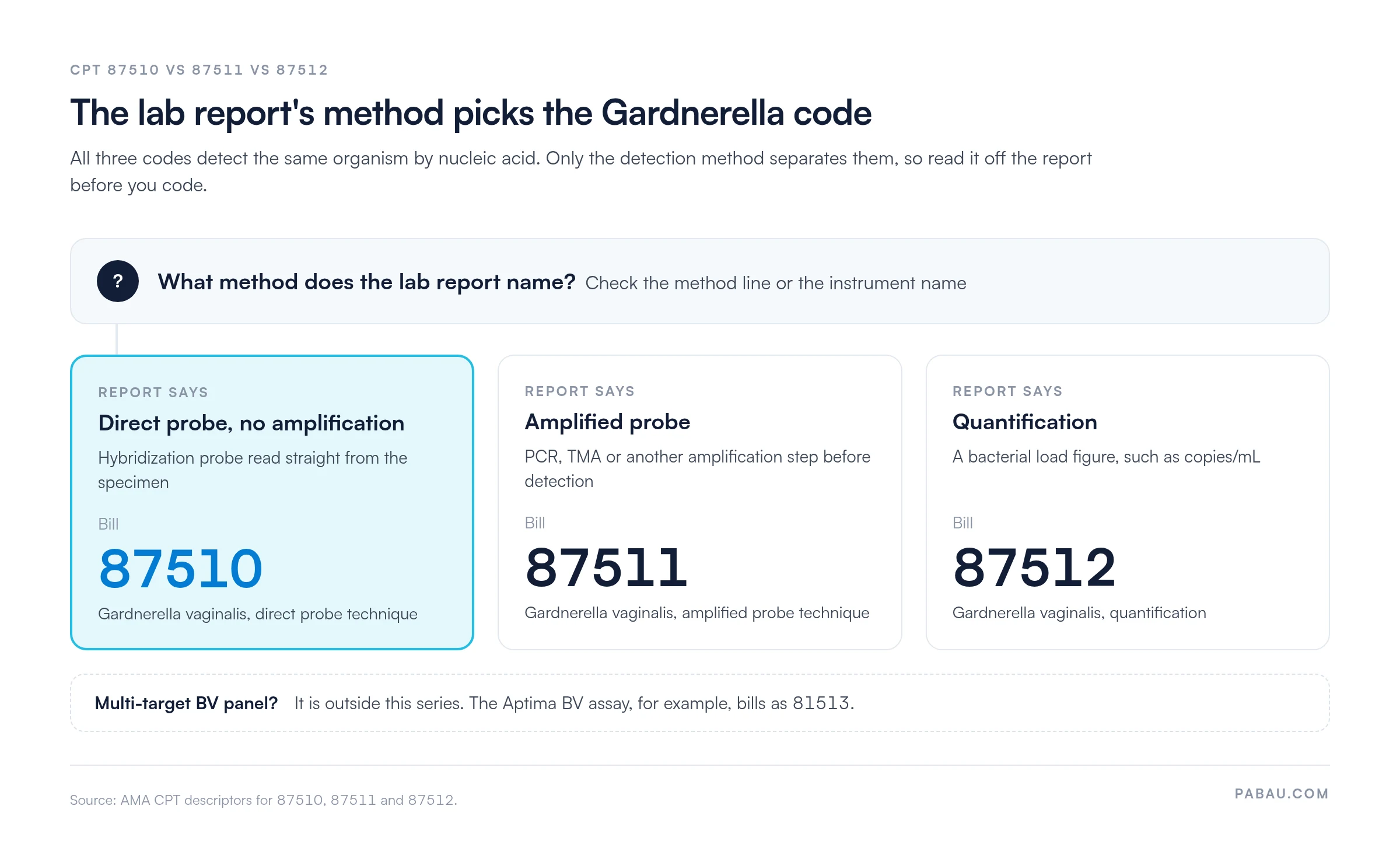
Direct-probe testing usually comes as a combined vaginitis assay. A Blue Cross Blue Shield of Illinois policy names BD Affirm VPIII as a direct-probe test for Gardnerella, Trichomonas and Candida. Each organism on that assay carries its own direct-probe code, listed in the next section.
Before choosing among 87510, 87511 and 87512, request the lab’s method documentation or check the instrument name on the report. Filing 87510 for an amplified test leads to a methodology denial that no modifier can fix. A multi-target BV panel such as Aptima BV sits outside this series and bills as 81513.
Clinicians rarely test for Gardnerella vaginalis in isolation. Standard vaginitis workups screen for bacterial vaginosis, Trichomonas vaginalis and Candida species at the same visit. Each organism has its own code family, and several codes can appear on one date of service when the clinical picture supports multi-organism testing. Our guide to medical billing fundamentals covers the full claim lifecycle behind these lines.
NCCI (National Correct Coding Initiative) edits govern same-day bundling across this code family. Edits change quarterly, so check the current table before each claim cycle. The most common pairing is with 87661, the amplified Trichomonas test, which is generally billable on the same date. Use CrossCoder for procedure-to-diagnosis crosswalks and bundling policy lookups.
Every CPT 87510 claim needs a linked ICD-10-CM diagnosis code that documents medical necessity. Accepted codes vary by payer and by the Local Coverage Determination (LCD) your Medicare Administrative Contractor (MAC) issues. An unsupported ICD-10-CM code is the single most common reason 87510 claims are denied. For symptomatic bacterial vaginosis, N76.0 is the usual starting point.
Confirm accepted diagnosis codes against the active LCD from your MAC before submitting. Use the CDC/NCHS ICD-10-CM web tool to look up current code descriptions and hierarchical context.
Medicare pays for CPT code 87510 under the Clinical Laboratory Fee Schedule (CLFS), which CMS administers under the Protecting Access to Medicare Act (PAMA). PAMA-based rates are set through private-payer market surveys and updated annually. The CMS Clinical Laboratory Fee Schedule files are the authoritative source for the current-year rate. Never cite a prior-year figure without confirming it still applies.
87510 claim denials follow predictable patterns. Most rejected claims trace back to one of five root causes, each with a clear fix. Strong denial management workflows catch most of these before submission.
Complete documentation is the foundation for a clean 87510 submission. Use this checklist before releasing any batch of lab claims. Submitting a clean claim the first time reduces processing delays and avoids the rework cost of denial appeals.
Capture the lab order and its ICD-10-CM pairing inside the clinical workflow. That step alone stops most of the documentation errors that drive 87510 denials in OB-GYN and sexual health practices.
Run a monthly audit of your 87510 remittance codes. CO-50 (not medically necessary) and CO-4 (procedure code inconsistent with the modifier) are the two adjustment codes to watch most closely. Tracking them by remark code each month shows whether denials come from documentation, method mismatches, or LCD coverage limits.
A Gardnerella lab order often passes through three hands. The clinician orders it, the lab reports it, and a biller rekeys the code and diagnosis into a separate claims tool. Each handoff is a chance for the wrong method code or an unsupported ICD-10-CM link to slip through.
Pabau, a practice management platform with streamlined claims management, keeps the order, the result and the claim in one patient record. US practices order Quest tests from the record, and Quest and Labcorp results sync back automatically. The method on the report then sits in front of the biller.
Claims go out through Claim.MD as CMS-1500 or 837P submissions, with eligibility checks before the visit and ERA remittances matched afterward. The result is fewer 87510 claims sent with a method or diagnosis mismatch, and less time spent on appeals.

Pabau connects scheduling, clinical notes and claims management, so lab orders like CPT 87510 flow from the encounter to the clearinghouse without manual re-entry.

Code 87510 only when the lab report names a direct, non-amplified probe. If the method line says PCR, TMA or another amplification step, bill 87511, and bill 87512 for a quantified result.
Settle the method and the ICD-10-CM pairing when the test is ordered, not after a denial. The trade-off is a short check on every lab claim, which costs far less than reworking a methodology denial or an LCD mismatch.
Book a demo to see how Pabau links lab orders, results and claims, so your 87510 claims go out right the first time.

Need to track denial patterns across your lab claims? Denial management in healthcare covers root-cause analysis frameworks and appeal workflows for common lab code rejections.
Submitting claims through a clearinghouse for the first time? How the Claim.MD clearinghouse works explains payer connectivity, real-time eligibility checks, and 835 ERA handling.
Want to understand the full revenue cycle behind lab billing? What is revenue cycle management walks through each stage from order to payment posting.
Running a direct-probe Candida test on the same swab? CPT code 87480 covers Candida species detection by direct probe technique, the sibling of 87510 on combined vaginitis assays.
Coding bacterial vaginosis without inflammatory signs? ICD-10 code N89.8 explains when other specified noninflammatory disorders of vagina is the right diagnosis.
CPT code 87510 covers infectious agent detection by nucleic acid (DNA or RNA) using a direct, non-amplified probe technique for Gardnerella vaginalis. It does not cover amplified probe detection of the same organism (87511), quantification (87512), culture-based detection, or testing for any other vaginal pathogen.
Medicare pays for 87510 under the Clinical Laboratory Fee Schedule (CLFS), with rates updated annually under PAMA. The current-year payment amount is published on CMS.gov in the CLFS files. Confirm the figure for the billing year before submitting, because rates change each January.
Commonly accepted ICD-10-CM codes include N76.0 (Acute vaginitis), N76.1 (Subacute and chronic vaginitis), N89.8 and N89.9. Some MACs may accept screening code Z11.3 for high-risk asymptomatic patients. Accepted codes are defined in the MAC LCD for your jurisdiction, so verify against your local LCD before submitting.
All three codes detect Gardnerella vaginalis by nucleic acid, but each covers a different method. 87510 is the direct (non-amplified) probe, 87511 is the amplified probe (NAAT/PCR), and 87512 is quantification, which reports a bacterial load figure. The method named on the lab report decides which code applies.
Yes, in most cases, because 87661 (Trichomonas vaginalis, amplified probe) tests a different organism. However, NCCI edits change quarterly, so verify the current edit table before submitting a claim that includes both codes. When both tests are medically indicated on the same date, the clinical documentation should show a separate indication for each.
Prior authorization requirements vary by payer and plan. Medicare does not typically require prior authorization for 87510 when documentation and an LCD-covered ICD-10 code support medical necessity. Commercial and Medicaid plans may require it in certain circumstances, so confirm with each payer before ordering the test.