CCSD code J1900: Gallbladder anastomosis billing guide
CCSD code J1900 joins the gallbladder to another organ CCSD code J1900 is the UK...

Last Updated: Oct 22, 2026
CPT code 87636 reports one molecular test that detects SARS-CoV-2, influenza A and influenza B from a single specimen. The lab amplifies nucleic acid for all three viruses in the same multiplex run.
The code turns on two facts. The test must be a nucleic acid amplification test (NAAT), and it must report exactly those three targets. Add RSV and the claim belongs under 87637. Get that choice right, pair it with a diagnosis that proves medical necessity, and the claim pays. The sections below cover the code choice, ICD-10 pairings, CLFS payment, modifiers and documentation.
Let Pabau's smart automation suggest the right codes, reduce claim denials, and keep your practice compliant—effortlessly.
Automate repetitive tasks and focus on what matters most—your patients.
Reduce coding errors and ensure compliance with the latest regulations.
Clean claims, fewer denials, and faster reimbursements.
Powerful insights and reporting to help your practice thrive.
HIPAA compliant SOC 2 certified GDPR-compliant Trusted by 4,000+ clinics worldwide

CPT code 87636 reports one multiplex NAAT that detects SARS-CoV-2, influenza A and influenza B from a single specimen.
Use 87637 when the panel also reports RSV, and 87635 when the NAAT targets SARS-CoV-2 alone.
Medicare pays 87636 under the Clinical Laboratory Fee Schedule (CLFS), not the Physician Fee Schedule. Rates normalized after the PHE ended on May 11, 2023.
Most 87636 denials come from four errors: an antigen test billed as a NAAT, the wrong sibling code, no QW modifier or no CLIA number.
Pabau’s claims management software pre-fills claims from the patient record, checks required fields and submits them through Claim.MD, with eligibility checks and remittance posting.
CPT code 87636 reports a single multiplex molecular test that detects SARS-CoV-2, influenza A and influenza B from one specimen. The lab amplifies nucleic acid for all three viruses in the same run, so one code covers the whole panel.
The AMA CPT Editorial Panel places 87636 under the parent heading Infectious agent detection by nucleic acid (DNA or RNA). Its own descriptor reads: severe acute respiratory syndrome coronavirus 2 (SARS-CoV-2) (Coronavirus disease [COVID-19]) and influenza virus types A and B, multiplex amplified probe technique.
That puts it in the 87471-87801 infectious agent detection by nucleic acid (DNA or RNA) range, within Microbiology (87001-87999).
The AMA created the code during the COVID-19 public health emergency (PHE) for panels that test for SARS-CoV-2 and seasonal flu together. It stayed active and billable after the PHE ended on May 11, 2023.
Four conditions have to hold before 87636 fits. The first is the method. The instrument must use an amplified probe technique, such as PCR, and antigen platforms don’t qualify however fast they are.
Each sibling code maps to a set of targets and a detection method. Choosing by assay brand rather than by the analytes detected is a coding error that payers deny. The tree below shows the two questions that settle the choice.
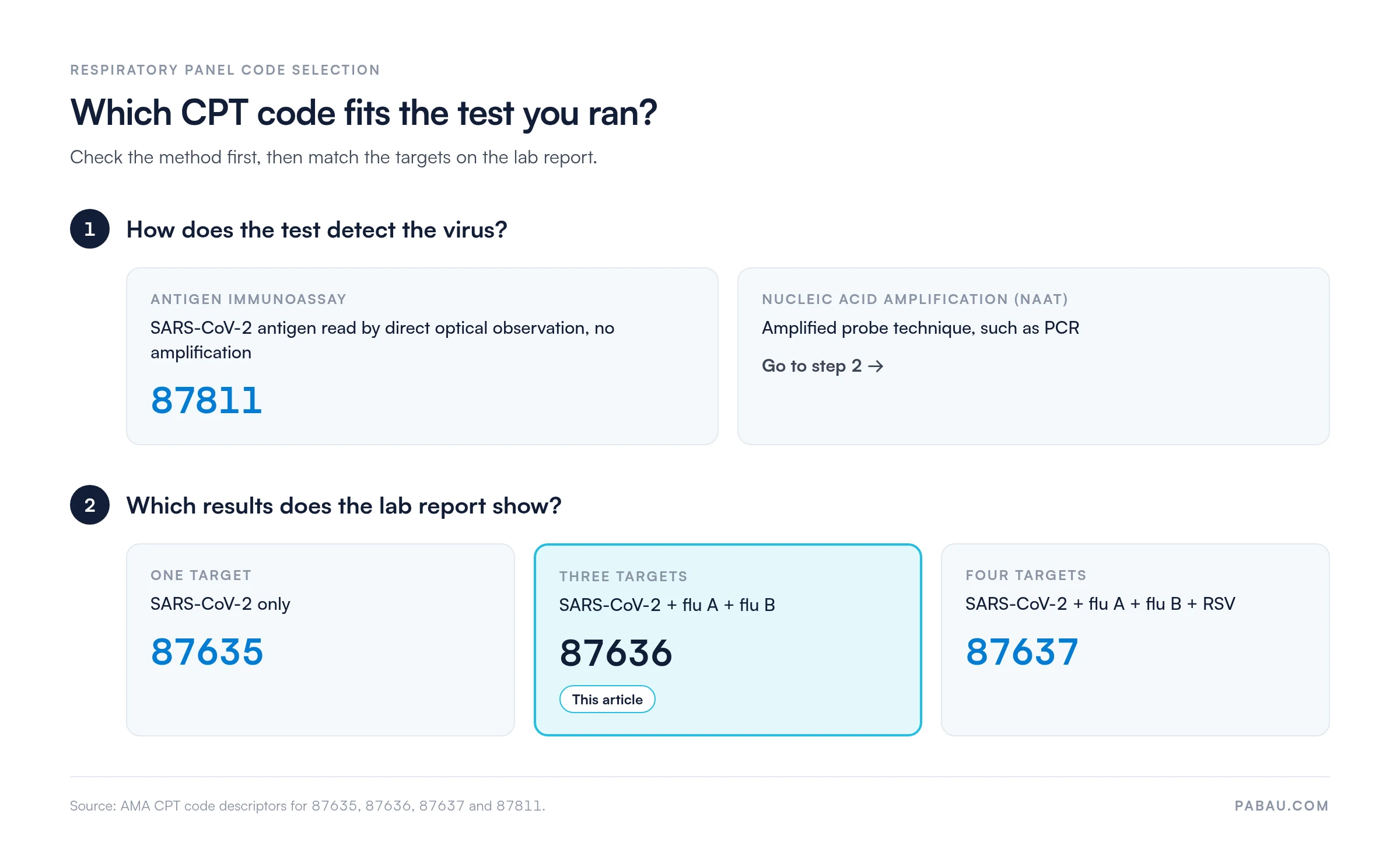
87636 vs. 87811: These codes describe different technologies. 87636 requires molecular amplification, while 87811 detects SARS-CoV-2 antigen protein directly. Billing 87636 for a rapid antigen reader is a method mismatch that audits catch easily, because the device’s CLIA listing shows its method. The AAPC CPT code lookup has the full descriptors side by side.
87636 vs. 87637: If the panel also detects RSV and the lab reports an RSV result, bill 87637 instead. Billing 87636 for a four-target report undercodes the service. Billing 87637 when RSV wasn’t a reported target is upcoding.
87636 vs. 87635: When the NAAT detects SARS-CoV-2 alone and the report shows no flu targets, bill 87635 instead. Billing 87636 for a single-analyte COVID test is upcoding.
Payers judge 87636 largely on the diagnosis code sent with it, and a missing or unsupported diagnosis is a common denial trigger. Each payer’s Local Coverage Determination (LCD) may limit which ICD-10-CM codes it accepts. Check the payer’s published policy before you rely on a pairing.
When all three targets come back negative, code the reason for testing instead of a confirmed disease. That might be a symptom such as R05.9, an exposure code or a screening code. Some Medicare Administrative Contractors (MACs) deny U07.1 on a negative result, because the lab report doesn’t support it.
Medicare pays 87636 under the CMS Clinical Laboratory Fee Schedule (CLFS), not the Physician Fee Schedule. CLFS codes are paid at the lesser of the billed charge or the national limitation amount. Most carry no geographic adjustment.
During the PHE, CMS paid emergency-era rates for multiplex COVID tests that ran well above standard CLFS pricing. Those rates expired when the PHE ended on May 11, 2023, and 87636 moved to standard CLFS pricing. Practices still budgeting at emergency rates saw revenue per claim drop.
CMS updates the CLFS every year, and new rates take effect on January 1. To check the current rate, download the CLFS data file from the CMS Clinical Laboratory Fee Schedule page. Find 87636, note the national limitation amount for the calendar year, and confirm any local instructions with your MAC.
Commercial rates may sit at, above or below the CLFS, so don’t assume they mirror Medicare. Ask your payer’s provider relations contact for its current lab fee schedule.
Check the CLFS every January, when the new fee schedule takes effect. Download the updated CMS CLFS file and compare the 87636 rate with last year’s. Then update the expected reimbursement in your billing system. If the loaded rate doesn’t match the published CLFS, the fee schedule import failed or the payer contract needs a second look.
Modifier choice for 87636 depends on where the test ran and which other lab codes share the claim. A wrong or missing modifier is a common denial trigger, so confirm the combination with your clearinghouse before you submit.
The facility’s CLIA certificate sets both where the test can run and which modifier applies. A Certificate of Waiver permits waived tests only. A Certificate of Compliance or Accreditation permits moderate- and high-complexity testing.
Run 87636 on a waived instrument at a waiver-certified site, and QW is mandatory on the Medicare claim. Run the same assay in a full-service lab under a Certificate of Compliance, and QW doesn’t apply.
Post-PHE audits of COVID testing codes have increased. Records that went unchallenged during the emergency are now grounds for denial and recoupment. Complete documentation is what turns an 87636 test into a clean claim.
Electronic claims carry that number inside the 837 file your clearinghouse sends. A blank field in the record becomes a blank segment on the claim.
Following one claim from start to finish shows where problems creep in. Here’s the usual path for a patient with symptoms who is tested in-house.
Here’s the coding step in practice. A patient arrives with fever and cough, and the panel returns flu A positive, with SARS-CoV-2 and flu B negative. The claim carries 87636 with J10.1, because the panel identified a seasonal flu virus.
Each line below maps to a denial reason in the next section. Tick all six and the claim is ready to go.
Most 87636 denials follow a handful of repeatable patterns. Sorting rejections by root cause before you resubmit is the core of denial management.
The National Correct Coding Initiative (NCCI) sets bundling edits that stop component codes being billed when a comprehensive code covers the service. For 87636, the principle is simple. You can’t unbundle a multiplex panel and bill each target separately. Claims management software that validates required claim fields before submission helps clean claims get through.
Modifier 59 can legitimately apply when a patient gets an 87636 panel and a separate test on the same day. The second test needs a different specimen or a different clinical purpose. The record must show both the separate indication and the separate collection.
Most of the fixes above are manual checks: the right code, the matching diagnosis, the CLIA number and the QW modifier. In a busy practice, those checks often happen at the end of the day, from memory, across several screens.
Pabau, the practice management and billing platform we build, moves that work into the patient record. The claim form pre-fills from the visit, so the CPT code and diagnoses already recorded land on the claim. Built-in CPT and ICD-10 lookup libraries help staff find codes quickly. The claim can’t be sent until its required fields are complete.
In the US, claims go out electronically through the Claim.MD clearinghouse, which also handles eligibility checks and remittance posting. Fewer claims bounce back for missing data, so your team spends less time chasing them.
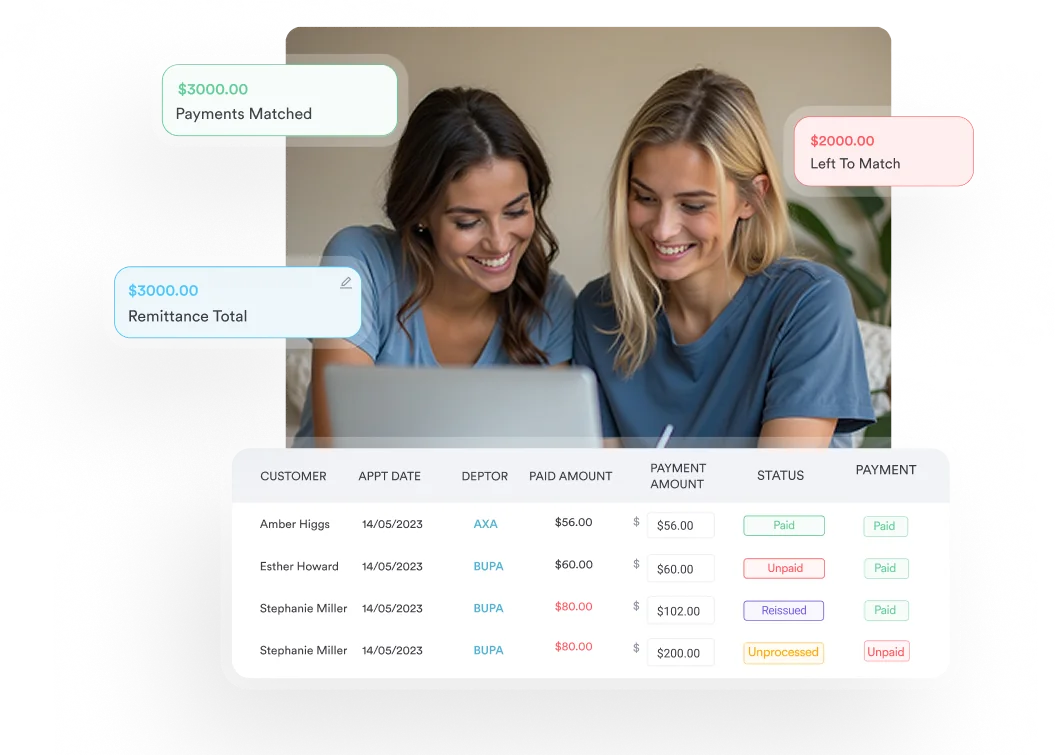

Pabau pre-fills claims from the patient record, validates required fields, and submits them through Claim.MD with eligibility checks and remittance posting. Your CPT 87636 claims reach payers complete.

CPT 87636 is a narrow code, and that works in your favor. Once the method and the three targets are confirmed, the code choice is settled. The denials that remain are predictable, and each one has a fix you can build into the workflow.
Start with the two checks that cost the most when missed: the method on the instrument and the CLIA number on the claim. Then pull the new CLFS file each January, so your expected payment matches what Medicare pays.
Pabau handles the claim side of that routine. It pre-fills claims from the record, checks required fields and submits them through Claim.MD. Book a demo to see how your 87636 claims can go out complete the first time.

Testing patients with no symptoms? ICD-10 code Z11.59 explains when the viral screening code supports a test like 87636.
Running a rapid flu antigen test instead? CPT code 87804 covers billing and reimbursement for antigen-based influenza testing.
Want to understand how denial patterns are tracked across codes? Denial codes in medical billing covers CARC and RARC code interpretation to speed up appeals.
Preparing for post-PHE audits? Medical billing compliance walks through the laws and violations behind lab claim recoupments.
Looking for the full billing picture? What is revenue cycle management explains the end-to-end process from lab order through payment posting.
Yes, when it’s a molecular test. A combo NAAT that reports SARS-CoV-2, flu A and flu B bills as 87636. A rapid antigen combo test doesn’t qualify, and a combo panel that adds RSV bills as 87637.
No. A home test isn’t a lab service performed under the practice’s CLIA certificate. The practice can bill a visit to review the patient’s symptoms, but not the home test.
One unit per panel. That single unit covers all three targets, so reporting three units, one per virus, overstates the service.
Yes. Payment depends on medical necessity, not on the result. Code the reason for testing, such as symptoms or an exposure, and keep the order on file.
Some 87636 assays are waived and others aren’t. The FDA’s CLIA test database lists each assay’s complexity. A waived assay run under a Certificate of Waiver needs modifier QW on Medicare claims.
Common pairings include U07.1 (confirmed COVID-19), Z20.828 (exposure to viral communicable disease) and Z11.59 (screening encounter). Flu results pair with J10.1 (identified seasonal influenza, A or B) and J11.1 (influenza, virus unidentified). The right code depends on the indication, the result and the payer’s LCD.