CCSD code G5100: Bypass of duodenum billing guide
CCSD code G5100 bills a bypass that leaves the duodenum in place CCSD code G5100...

Last Updated: Oct 16, 2026

CPT Code 87804 covers a rapid influenza test where a staff member reads the result by eye, not an instrument.
The code may be billed twice when the panel reports Influenza A and Influenza B separately, with both results charted.
The QW modifier is required when the test runs under a CLIA Certificate of Waiver. Omitting it is a leading denial trigger.
A molecular influenza test is not 87804. Nucleic acid testing bills under CPT 87502 and 87503 instead.
Practice management software like Pabau validates the code, modifier, and diagnosis before the claim leaves your practice.
CPT Code 87804 is the billing code for a rapid influenza diagnostic test read by direct optical observation. Its full descriptor is infectious agent antigen detection by immunoassay with direct optical observation; influenza.
Practices bill it at the point of care throughout flu season.
This reference is written for medical billers, coders, and practice managers in primary care, urgent care, and family medicine across the United States. It covers the code description, billing rules, 2026 Medicare figures, ICD-10 pairings, documentation, and the denial patterns that cost the most.
In plain terms, 87804 is the code for a rapid influenza diagnostic test (RIDT) performed at the point of care. The kit uses a lateral flow or similar immunoassay format, and a person reads the result visually rather than an analyzer reporting it.
The code falls within the 87800-87899 infectious agent antigen detection range of the AMA’s CPT code set. That range covers antigen detection methods, not nucleic acid ones.
The test itself does not require a laboratory analyzer. Most RIDT kits approved under a CLIA Certificate of Waiver can be run at the bedside by clinical staff. That makes CPT 87804 one of the most accessible in-office diagnostic codes to bill.
According to the AAPC’s CPT code reference, CPT 87804 applies only when the influenza test uses an immunoassay with direct optical observation. If your practice runs a molecular or PCR-based rapid test instead, a different code applies. Confirming the kit’s methodology before billing is the most effective way to avoid a mismatch denial.
The code, the modifier, and the diagnosis all have to line up before submission. That is what submitting a clean claim looks like for a point-of-care flu test.
CPT 87804 may be reported twice on the same date of service in one situation. The panel must distinguish Influenza A from Influenza B and chart a separate result for each strain. This is not automatic, and payer policies vary.
The QW modifier is governed by the Clinical Laboratory Improvement Amendments (CLIA) program. Billing without it from a waived facility claims a higher complexity level than your lab is authorized for. That triggers an automatic denial. QW itself comes from the HCPCS Level II modifier set, the same code system used for orthotics such as HCPCS code L2136.
Four separate checks decide what the 87804 line looks like, and they sit in different sections of this reference. The diagram below runs them in submission order.
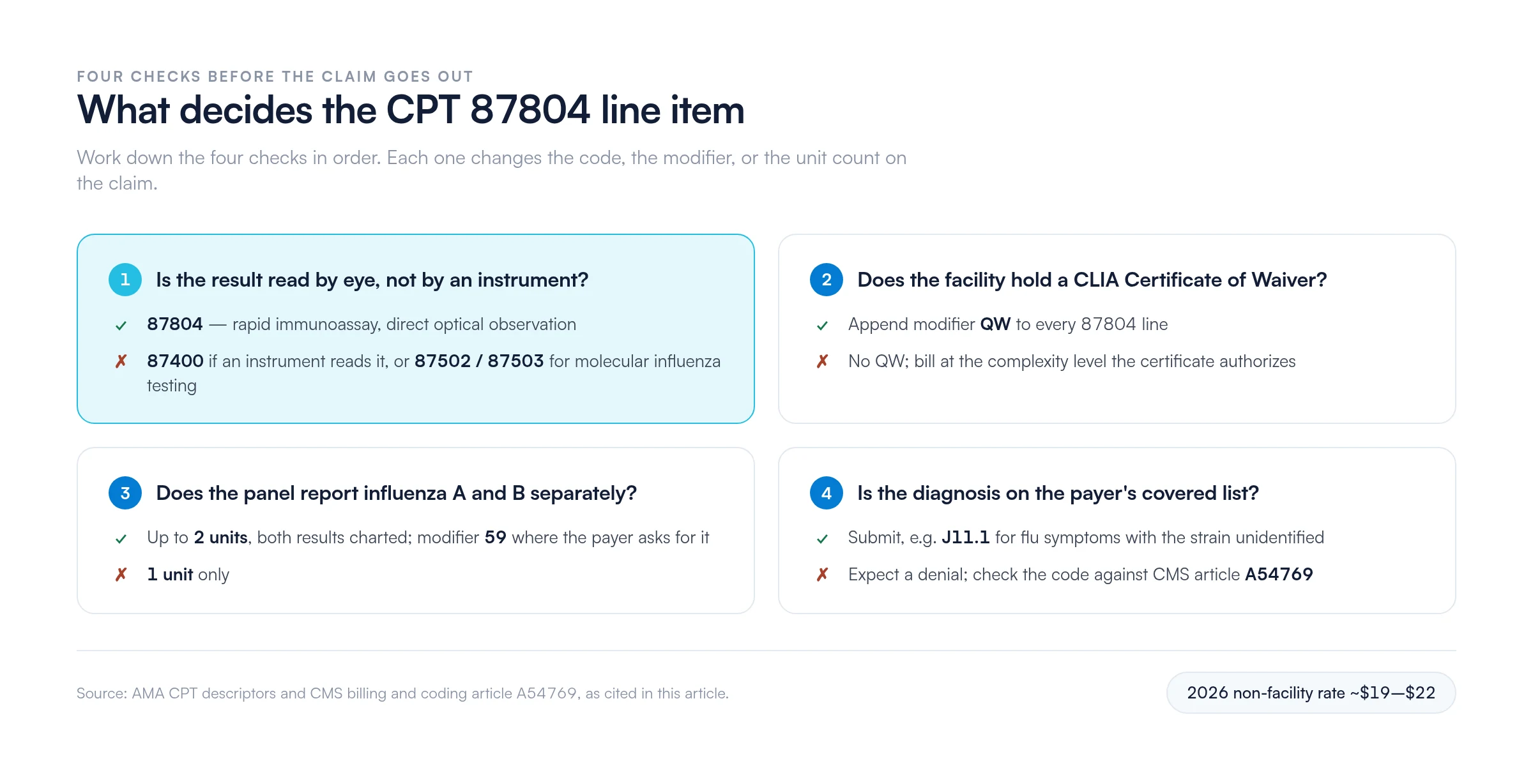
The diagnosis code paired with CPT 87804 must reflect the clinical reason for ordering the test. CMS billing and coding article A54769 lists the covered diagnoses for influenza diagnostic testing. The table below shows the ICD-10-CM codes most frequently paired with this code.
Verify specific covered diagnoses against the current CMS LCD A54769 and your MAC’s local policies. ICD-10-CM codes for influenza are updated annually, and a retired code from a prior fiscal year is a guaranteed denial.
Medicare reimbursement for CPT 87804 is set annually through the CMS Physician Fee Schedule. Rates vary by geographic region and MAC jurisdiction.
Based on available 2026 fee schedule data, the approximate non-facility rate is $19-$22, and the facility rate is lower. Always confirm the exact rate for your locality before using figures for billing projections.
You can look up your practice’s rate by entering 87804 in the CMS Physician Fee Schedule search. Select your MAC jurisdiction and locality code to get the local figure.
The FastRVU 2026 RVU lookup shows the Work, Practice Expense, and Malpractice RVU components behind that payment rate. Comparing remittance amounts against your expected rate is the fastest way to catch underpayments on this code.
Commercial payer rates are typically negotiated separately and may exceed Medicare rates. Private payers are not obligated to follow the CMS fee schedule.
CPT 87804 sits among several other influenza and respiratory test codes. Picking the wrong one is a common and preventable error, particularly when a combo test covers both influenza and COVID-19.
When your practice uses a combo flu/COVID rapid test kit, bill CPT 87804 for the influenza component. Bill CPT 87811 for the COVID-19 component on the same claim. Both require the QW modifier if performed under a CLIA Certificate of Waiver. Confirm with your payer that both codes are reimbursable together before ordering the kit in bulk.
Those two codes both cover antigen detection. A combo panel that amplifies nucleic acid bills differently. One multiplex run covering SARS-CoV-2, influenza A and influenza B bills as a single unit of CPT 87636. Where only the COVID-19 target is amplified, CPT 87635 applies instead of 87811.
A panel that reaches past flu and COVID-19 into other respiratory viruses changes the code again. Three to five viral targets on one multiplex run bill as CPT 87631, not the influenza-only molecular codes.
Medicare’s billing and coding article A54769 specifies that documentation must support medical necessity for every influenza diagnostic test claim. Keep that documentation in the patient record before the claim is submitted, not after a denial triggers an audit request.
Test results and physician orders stay in the patient record for a minimum of six years at the federal level. Some states require longer retention periods, so check your state’s rule before setting a purge schedule.
CPT 87804 denials follow predictable patterns. Knowing the top triggers, and the correction each one needs, is the most direct route to a better first-pass claim rate.
Tracking denial reason codes on 835 remittance files makes patterns visible at scale. Reading your electronic remittance advice (ERA) data against the list of common denial codes surfaces systemic coding errors. Catching them early stops the same mistake repeating across a whole flu season.
Flu season creates volume spikes that strain manual billing workflows. A practice running dozens of rapid flu tests a day repeats the same three checks on every claim. Those are the modifier, the ICD-10 pairing, and the unit count. A single template error compounds fast.
Practice management software like Pabau has claims management built in, so code and modifier combinations get validated before the claim leaves the practice. QW omissions and unsupported diagnosis codes get caught at the point of entry, not three weeks later on a remittance file.
Pabau’s electronic claims integration with Claim.MD connects your billing workflow to a clearinghouse that reaches thousands of US payers. Claims are validated against payer edits before submission, for CPT 87804 alongside every other code your practice bills.
The integration handles CMS-1500 and 837P claim formats and returns ERAs, so your billing team can reconcile charges against payments. For practices submitting claims in bulk through flu season, that validation step catches most of the modifier and diagnosis errors behind 87804 denials.
Integrated billing also creates an audit trail for CLIA documentation, tying the test result recorded at the point of care to the claim it supports. That is what an auditor looks for during a medical necessity review.

Pabau brings scheduling, documentation, and claims submission together, so your billing team spends less time chasing denials and more time getting paid. Built-in code validation catches the errors before the claim goes out.

CPT Code 87804 is not a difficult code, but it is an unforgiving one. Confirm the methodology, add QW where the facility is waived, and pair the claim with a supported diagnosis. Chart the result while the patient is still in the room.
The dual-unit scenario is the one place where no general rule holds. Influenza A and B on separate lines is a payer-by-payer question. Verify it at the MAC or payer level before flu season starts, not during it.
Practices with recurring denials on this code almost always trace them to one of the five patterns above. A pre-submission check catches all five. Book a demo to see how Pabau builds that check into in-office diagnostic billing.

Want to understand how clearinghouse validation works? Medical claims clearinghouse guide explains how claims are scrubbed and routed before reaching payers.
Want to stop denials before the claim exists? Insurance eligibility verification covers the pre-visit checks that prevent the most common denials.
Reconciling payments against your expected rates? Electronic remittance advice shows how to read an 835 file and spot underpayments on diagnostic codes.
Submitting claims in bulk through flu season? 837 electronic claim files breaks down the format clearinghouses expect and where submissions fail.
Exploring billing software options for your practice? Best medical billing software for US practices compares the leading platforms by feature set and clearinghouse integration.
CPT Code 87804 is the billing code for infectious agent antigen detection by immunoassay with direct optical observation for influenza. It covers rapid influenza diagnostic tests (RIDTs) whose result is read by eye, without an instrument, at the point of care.
CPT 87804 can be billed twice when the panel differentiates Influenza A from Influenza B and documents a separate result for each strain. Payer policies vary. Some require modifier 59 on the second unit, and others do not accept two units at all. Verify with the payer before billing dual units.
The approximate 2026 Medicare non-facility rate for CPT 87804 is $19-$22, depending on geographic locality. Rates are adjusted annually by CMS through the Physician Fee Schedule. Use the CMS fee schedule search with your MAC jurisdiction and locality code to confirm the exact rate.
No. CPT 87804 is an antigen test read by direct optical observation, so a molecular influenza test bills elsewhere. CPT 87502 covers nucleic acid detection of the first two influenza types or subtypes. Code 87503 is the add-on for each additional type or subtype.
CPT 87804 covers rapid influenza antigen detection by immunoassay with direct optical observation. CPT 87811 covers the same kind of test for SARS-CoV-2. When a combo flu and COVID test kit is used, both codes are reported on the same claim, one for each analyte.
The QW modifier is required when CPT 87804 is billed from a facility operating under a CLIA Certificate of Waiver. Modifier 59 may be required by certain payers when billing a second unit for a separate Influenza B result. Modifier 91 applies if the same test is repeated on the same day for documented medical reasons.
Most denials come from four errors. The QW modifier is missing on a CLIA-waived test. The ICD-10 code sits outside the payer’s covered list. Two units are billed without modifier 59 where the payer requires it. Medical necessity is not documented. A pre-submission code and modifier check prevents most of them.