



CCSD code G5100: Bypass of duodenum billing guide
CCSD code G5100 bills a bypass that leaves the duodenum in place CCSD code G5100...

Last Updated: Oct 16, 2026
CPT code 87637 bills a single multiplex amplified probe test that detects SARS-CoV-2, influenza A, influenza B, and RSV from one respiratory specimen. All four targets have to sit on the assay. If the platform skips RSV, 87636 is the correct code, and billing 87637 anyway reads as upcoding.
That one analyte decides whether the claim pays or comes back denied. What follows covers the official scope, the 87636 comparison, and what Medicare pays under the lab fee schedule. Documentation, modifiers, and the errors that trigger denials come after that.

CPT code 87637 covers one multiplex amplified probe test that detects SARS-CoV-2, influenza A, influenza B, and RSV together.
All four targets must appear on the assay, so a panel without RSV is billed as 87636 instead.
The code sits in the nucleic acid detection family, which rules out antigen tests and lateral-flow rapid tests.
Medicare pays 87637 from the Clinical Laboratory Fee Schedule, so the rate is a flat national figure with no RVU components.
Most denials trace back to code choice, thin medical necessity notes, or a missing CLIA number on the claim.
CPT code 87637 is a nucleic acid detection code. It describes one multiplex amplified probe test that finds SARS-CoV-2, influenza A, influenza B, and RSV in the same respiratory specimen.
The code sits in the 87xxx infectious agent range and pays from the CMS Clinical Laboratory Fee Schedule (CLFS), not the Medicare Physician Fee Schedule. Annual CLFS updates set the rate, so no RVU calculation comes into it.
All four analytes have to be targeted for 87637 to apply. When the lab platform leaves RSV out, billers use 87636 instead. Claiming 87637 for a three-analyte panel is upcoding, and it can trigger a payer audit.
RSV is the only difference. CPT 87637 carries it as a fourth target, while 87636 covers SARS-CoV-2 and influenza types A and B only. Both codes need a multiplex amplified probe method and a respiratory specimen.
That narrow split causes a large share of respiratory panel coding errors. A practice may run a four-target instrument, then bill the three-target code out of habit.
Here is how the mix-up usually happens. A patient arrives in December with fever and a cough, and the front desk orders the practice’s standard respiratory panel.
The instrument reports four results, RSV included. The charge template still carries 87636 from last season, nobody edits it, and the claim underpays by a full analyte.
So before you choose between the two codes, confirm that the report or the instrument specification names RSV as a target. That record is what supports your code choice if a payer asks later.
Four codes cover most respiratory panel billing, and the method separates them first. The decision runs in two steps: check the technique, then read the target list off the report.
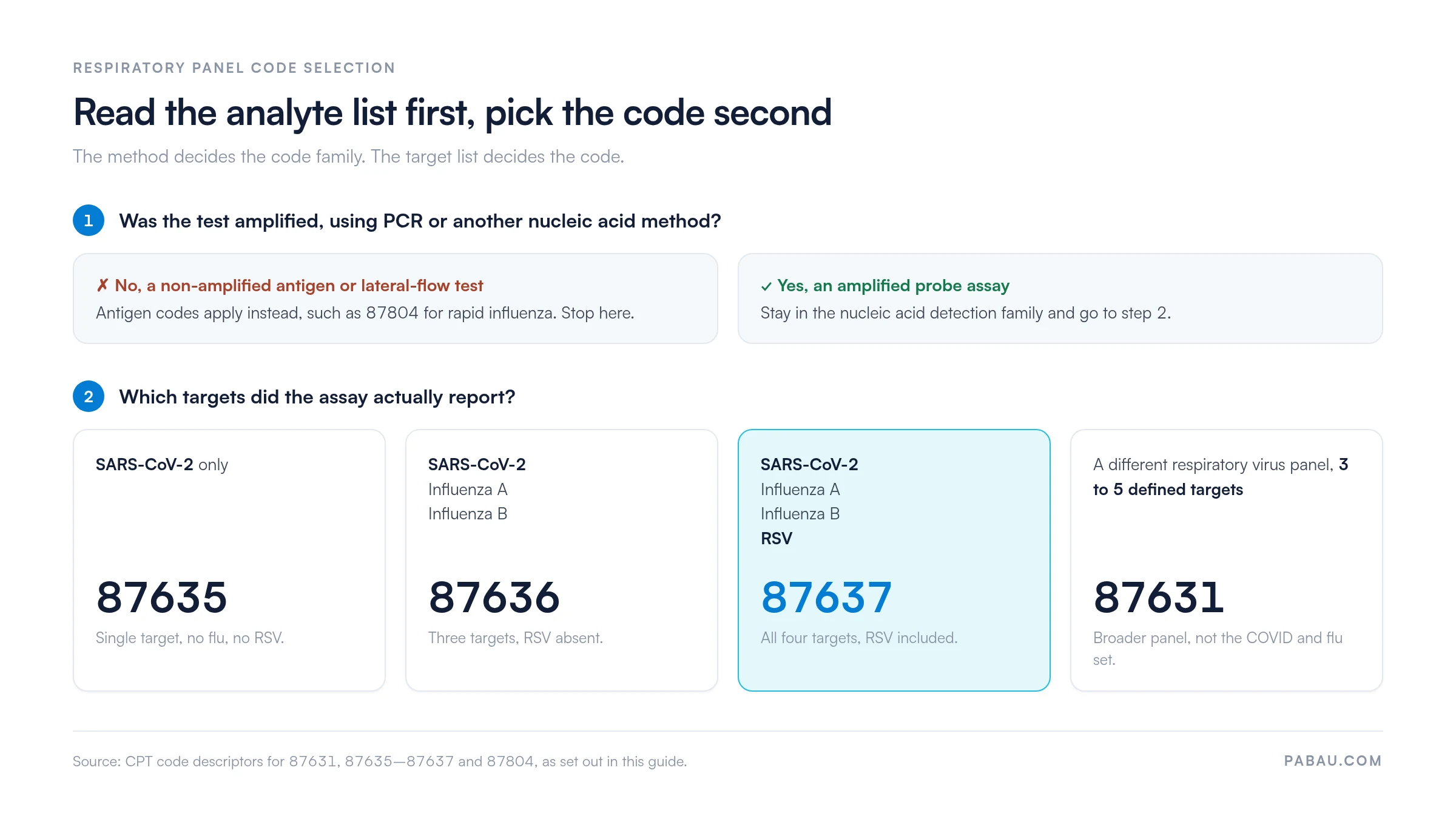
When the order is COVID-19 testing alone, with no flu or RSV targets, the right code is 87635 rather than 87637.
A multiplex panel of three to five respiratory targets that does not match the fixed 87637 assay bills under 87631 instead.
Point-of-care testing lands somewhere else entirely. Because 87637 requires amplification, only PCR and similar platforms qualify, and a lateral-flow test never does, however many viruses its packaging names.
Medicare pays 87637 from the Clinical Laboratory Fee Schedule. CMS sets those rates nationally and updates them every year. Since the figure moves annually, take it from the CMS Clinical Laboratory Fee Schedule rather than a third-party aggregator.
Four points shape what 87637 pays:
Pull the CMS CLFS annual update file from cms.gov each October, before the new rates take effect. Aggregator sites often publish estimated rates ahead of the final CLFS release. Those estimates can differ from the confirmed figures your payers work from.
A clean 87637 claim has to prove two things. The first is the technique the lab used, and the second is the clinical reason a four-target panel was ordered.
Medicare Administrative Contractors, known as MACs, publish Local Coverage Determinations that define acceptable indications. Requirements differ by jurisdiction, so read your own MAC’s LCD before you submit.
Run this list against the encounter record rather than against memory.
Knowing the path helps you put the check at the right step.
Steps three and four cause most of the damage, and both are checkable before the batch leaves the building. The wider clean claim requirements apply to lab lines exactly as they do to office visits.
None of the three is automatic with 87637. Each answers a specific question about the encounter, and the answer has to be in the record.
Check each modifier against your MAC’s LCD or the payer’s own policy before appending it. Adding 59 by reflex is a common audit finding, and QW belongs only on a platform that carries a waiver.
Medicare coverage for 87637 runs on CMS guidance plus MAC-issued LCDs. CMS widened multiplex respiratory coverage during the COVID-19 Public Health Emergency. That period has ended, so confirm the current position with your MAC before billing in 2026.
Coverage also splits by payer type:
Most 87637 denials come from five preventable errors. Each one is catchable before the claim batch goes out.
When one does slip through, the remittance advice names the reason. Reading the matching denial codes tells you whether to correct and resubmit or to appeal.
Run a weekly audit that compares the analytes on each lab report against the CPT code billed. A spreadsheet check before claim batching is enough to catch 87636 and 87637 mismatches. Catching one there costs a minute, while catching it after a denial costs an appeal.
In most practices this check happens in someone’s head. A biller reads the analyte list, keys the charge, and the claim joins the next batch. Missing CLIA numbers and lapsed policies travel out with it.
Practice management software like Pabau moves those checks earlier. The claim is built from the charge already sitting in the patient record. The ordering provider, the NPI, and the diagnosis link all travel with it. Required fields get validated before the file is created.
In the US, Pabau connects to the Claim.MD clearinghouse for 837P submission, eligibility checks, and ERA remittance posting. Eligibility can run before the specimen is collected, so a lapsed policy surfaces while the patient is still in the building.
Remittances then post back against the original charge, which keeps the follow-up list short. All of it sits inside Pabau’s claims software for practices, next to the record the charge came from.

Pabau builds claims from the charge on the patient record, submits them electronically through Claim.MD, and posts remittances back automatically. See how it handles lab lines like 87637.

The four-analyte rule is the whole code. Read the target list on the report, match it to 87637 or 87636, and most of what goes wrong with these claims never starts.
Put that check in the batching routine rather than the appeals queue. Comparing report to code before submission costs a minute. The same catch after a denial costs a rework, a resubmission, and weeks of waiting for payment.
If lab charges, eligibility checks, and remittances currently live in three separate systems, book a demo and see how one patient record handles all three.

Need to work out why a lab claim came back unpaid? Denial codes in medical billing explains the most common CARC reason codes and how to respond to each.
Want to understand the 837P format used for lab submissions? 837 file billing guide covers the EDI transaction structure payers expect for electronic claims.
Checking coverage before the specimen is collected? Insurance eligibility verification walks through the checks that stop non-covered service denials at the front desk.
Mapping how money reaches the practice? Revenue cycle management sets out each stage from registration to posted payment, including where lab lines differ.
Comparing systems to handle lab billing? Best medical billing software for US practices reviews platforms that support CLFS code submission, eligibility checks, and ERA workflows.
Yes, 87637 remains a current CPT code and appears in the 2026 fee schedule material. Codes in this family have been revised since the pandemic, so check the current CPT code set and your MAC’s policy each year before billing.
One unit covers all four targets from a single specimen on one date of service. Billing a second unit, or adding individual analyte codes such as 87635 on top, reads as unbundling and usually triggers a rejection.
Use the diagnosis that records why the test was ordered, which is usually the respiratory signs, symptoms, or a documented exposure. A confirmed infection code added after results arrive does not replace the ordering indication, so keep both in the note.
Yes, provided the lab holds a CLIA certificate covering the complexity of that assay. Multiplex amplified probe tests are moderate or high complexity unless the specific platform carries a CLIA waiver, in which case modifier QW applies.



