HCPCS Code E0272: Foam rubber mattress billing guide
HCPCS Code E0272: official descriptor and code overview HCPCS Code E0272 is the ...

Last Updated: Nov 6, 2026
79005 is the CPT code for radiopharmaceutical therapy, by oral administration. It covers any therapeutic radiopharmaceutical a patient swallows, which in practice almost always means I-131 for hyperthyroidism or thyroid cancer. The route decides the code, so there is no dose tier, and a repeat dose is billed as 79005 again.
The code pays for giving the dose, while the I-131 goes on its own HCPCS line, billed per millicurie. A units mismatch on that line holds up the whole claim. Below are the lines that travel with 79005, the paperwork payers check, and the denials worth heading off.
Let Pabau's smart automation suggest the right codes, reduce claim denials, and keep your practice compliant—effortlessly.
Automate repetitive tasks and focus on what matters most—your patients.
Reduce coding errors and ensure compliance with the latest regulations.
Clean claims, fewer denials, and faster reimbursements.
Powerful insights and reporting to help your practice thrive.
HIPAA compliant SOC 2 certified GDPR-compliant Trusted by 4,000+ clinics worldwide

CPT code 79005 reports radiopharmaceutical therapy by oral administration, and the route decides the code, not the dose.
Report 79005 once for each oral therapeutic dose, because no separate code exists for a repeat treatment.
Dose calculation and the risk and benefit discussion are included, while a documented E/M service is reported separately.
The radiopharmaceutical goes on its own HCPCS Level II line, such as A9517 for I-131 capsules, billed per millicurie.
Codes 79000 and 79001 were deleted on January 1, 2005, so a claim that still carries them is rejected as invalid.
CPT code 79005 is the Category I code for radiopharmaceutical therapy, by oral administration. The American Medical Association places it in the Radiopharmaceutical Therapy subsection (79005-79999) of Nuclear Medicine, within the Radiology chapter. The code is route-based, so it applies to any therapeutic radiopharmaceutical the patient takes by mouth.
There is no dose tier and no millicurie threshold. Most 79005 claims involve sodium iodide I-131, given as a capsule or an oral solution for hyperthyroidism or thyroid cancer.
What is included: The code covers the oral administration of the therapeutic dose and the dose calculation. It also covers the risk and benefit discussion with the patient.
What is reported separately: Any separately documented E/M service, plus the radiopharmaceutical supply on its own HCPCS line. Diagnostic thyroid uptake or imaging studies, such as 78014, also go on their own lines.
Because the code follows the route, the indication never changes the CPT code. It does change the ICD-10 code and the paperwork the payer wants.
The indication also shapes prior authorization. Cancer cases usually need pathology and operative reports. Hyperthyroidism cases usually need thyroid function tests and, where one was done, an uptake study.
Since January 1, 2005, radiopharmaceutical therapy codes have been organized by route of administration. Pick the code that matches how the agent entered the body, then report it once per administration. An intravenous dose, for example, is billed as 79101, never as 79005.
No dedicated code exists for a repeat or subsequent oral treatment. When a patient returns for a second I-131 dose, 79005 is reported again for that administration. A lower hyperthyroid dose and a higher cancer dose also report the same way.
Dose still matters on the claim, just in a different place. The administered activity in millicuries sets the units on the HCPCS supply line, covered next.
Search your charge master and claim templates for 79000, 79001 and 79030. Any surviving reference to these deleted codes produces an invalid-code rejection, so replace it with 79005 before the next claim goes out.
CPT 79005 pays for giving the dose. The radiopharmaceutical itself goes on its own HCPCS Level II line, and the therapeutic I-131 codes are billed per millicurie.
Units equal the administered activity, so a 100 mCi capsule dose is billed as A9517 with 100 units. Check the units against the administration record before submission, not against the order alone.
Payers check medical necessity by matching the ICD-10 code on the claim to the procedure. For 79005, the diagnosis must reflect a condition treated with oral radiopharmaceutical therapy.
ICD-10-CM guidelines reserve Z85 history codes for cancers that were excised with no further treatment directed at the site. Radioiodine given to ablate remnant tissue or treat residual disease is treatment, so C73 stays primary. Reporting Z85.850 in its place invites a medical-necessity denial.
Modifier choice depends on who bills which part of the service, and on whether another code billed that day triggers an edit.
Confirm the professional and technical split for 79005 in the current fee schedule file before you set up -26 and -TC billing. A global claim sent after the facility has billed -TC triggers a duplicate claim edit. Never add -59 by default, because without an edit to bypass it only adds audit risk.
Medicare pays 79005 under different systems depending on where the service happens. The rates sit in the Centers for Medicare and Medicaid Services Physician Fee Schedule tools.
Commercial rates are set by contract. Tracking allowed amounts by payer shows where 79005 is underpaid, which is the job of revenue cycle management.
Many commercial payers and Medicare Advantage plans require prior authorization for oral radiopharmaceutical therapy. Rules differ by plan, so check each policy before you schedule the treatment date.
Start the authorization package as soon as the order is signed. Most requests for 79005 draw on the following documents:
Radiology benefit managers such as eviCore review nuclear medicine requests for some plans. Check the payer’s provider portal to see who handles the review before you submit.
A clean 79005 claim is built in the same order as the treatment. Each step adds one piece the payer later checks against the others.
Put together, those steps produce a claim with three or four lines. Each line answers to a different part of the chart, as the diagram below shows.
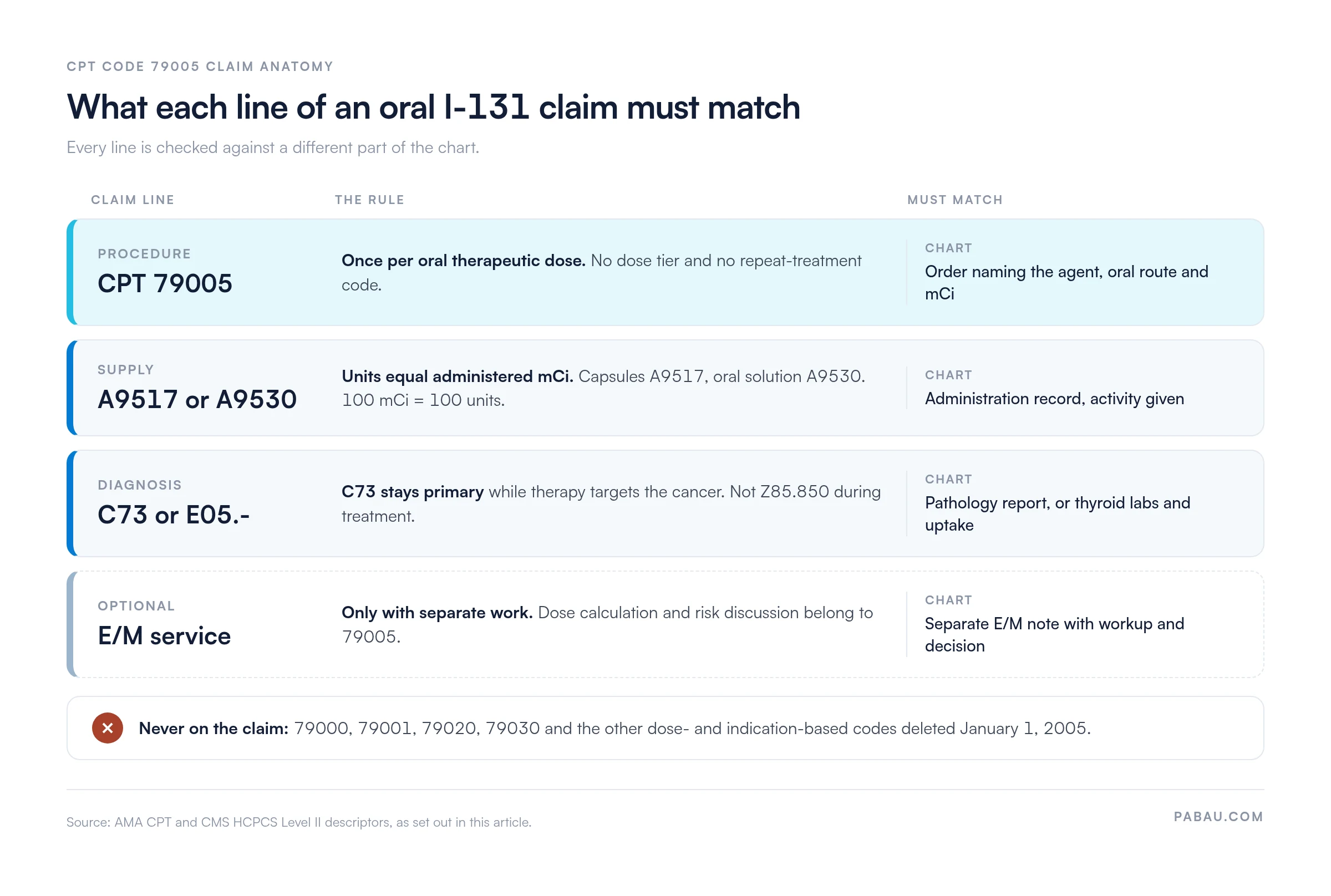
The medical record must support every line on the claim. Under medical billing compliance standards, a 79005 chart should show the following before submission.
Meeting clean claim requirements means the chart, the CPT line and the supply line agree before the claim goes out. The administered mCi in the record should match the units on the HCPCS line exactly.
Build a 79005 pre-billing check with four points. Confirm the oral route is documented and the supply units match the administered mCi. Then confirm any E/M note shows separate work and the primary ICD-10 code fits the indication.
A 79005 claim carries two paid lines, the procedure and the supply, so a mismatch on either one stalls payment. Each denial below can be caught with a check before submission.
Use our guide to denial codes in medical billing to trace each claim adjustment reason code on the remittance advice back to its billing error.
Many 79005 problems start when the order, the administration record and the claim live in separate systems. Billing staff then reconcile them by hand, often only after a denial arrives.
Pabau, the practice software we build, keeps patient records, appointments and billing in one place. Its claims tools for practices send US claims through Claim.MD, the clearinghouse Pabau integrates with.
Payer responses come back into the same system, so your team can follow each 79005 claim from submission to payment. Coding decisions such as the route code, supply units and modifiers stay with your coders.
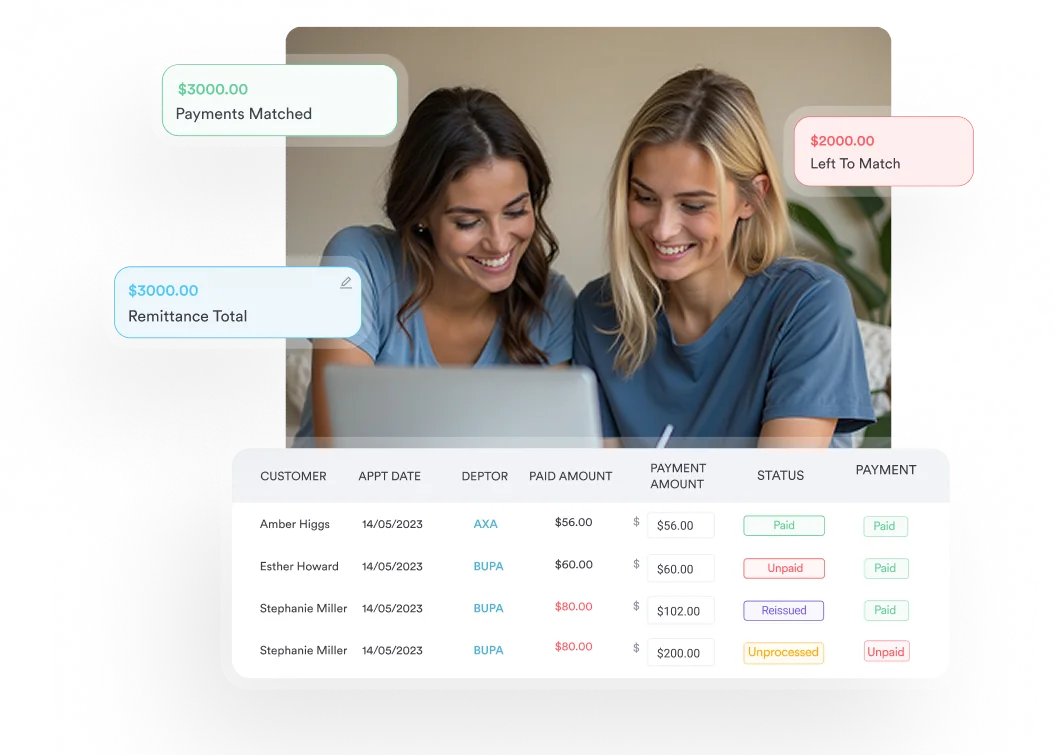

Pabau sends US claims through Claim.MD and brings payer responses back into one system. Your team sees where each nuclear medicine claim stands without switching tools.

CPT code 79005 is simpler than older references suggest. The route decides the code, so an oral therapeutic dose reports as 79005 whether it is the first treatment or the third.
The risk now sits in the lines around it. Match the supply units to the administered activity, keep C73 primary while therapy targets the cancer, and bill E/M only when the note supports it.
Clear the 2005 deletions out of your templates first, because that fix takes minutes and stops a whole run of rejections. Book a demo to see how Pabau follows each radioiodine claim from submission to payment.

Billing an IV radiopharmaceutical instead? CPT code 79101 covers intravenous radiopharmaceutical therapy and its HCPCS drug lines.
Billing the uptake scan before treatment? CPT code 78014 explains thyroid imaging with uptake and how it sits beside therapy claims.
Coding the thyroid cancer diagnosis? ICD-10 code C73 covers malignant neoplasm of the thyroid gland and when it stays primary.
Need to read denial reason codes on a remittance? Denial codes in medical billing maps CARC codes to their root causes and standard appeal responses.
Want a clearinghouse that supports 837P electronic claims? How Claim.MD clearinghouse works with Pabau explains the submission, eligibility and ERA workflow end to end.
When I-131 is swallowed as a capsule or solution, the procedure code is CPT 79005. The isotope is billed separately, as A9517 for capsules or A9530 for solution.
No. 79005 is for therapeutic doses only. A diagnostic uptake or scan is coded from the 78012-78018 range, with the diagnostic isotope on its own supply line.
The route. 79005 covers a radiopharmaceutical taken by mouth, while 79101 covers one given intravenously. Billing an oral I-131 dose as 79101 is a coding error.
One unit per millicurie administered. A 100 mCi capsule dose is billed as 100 units of A9517, matched to the administration record.
Yes, when the note shows separate work, such as the clinical workup and the decision to treat. Dose calculation and the risk discussion already belong to 79005.
CPT 79005 replaced them for oral therapy. Codes 79000, 79001, 79020, 79030 and 79035 were deleted on January 1, 2005, when therapy codes moved to a route-based structure.