CCSD code 20210: Pure tone audiogram billing guide
CCSD code 20210 is the UK private billing code for a pure tone audiogram by air ...

Last Updated: Nov 16, 2026
J3240 is the HCPCS Level II code for injection, thyrotropin alpha, 0.9 mg, provided in 1.1 mg vial. It covers Thyrogen, the recombinant TSH given before radioiodine ablation or follow-up testing in differentiated thyroid cancer, so patients can stay on thyroid hormone.
One unit equals one 0.9 mg injection, so the standard two-injection course is billed as 2 units. Medicare Part B pays the drug at ASP plus 6% in the physician office. Report the 11-digit National Drug Code where the payer requires it.
Let Pabau's smart automation suggest the right codes, reduce claim denials, and keep your practice compliant—effortlessly.
Automate repetitive tasks and focus on what matters most—your patients.
Reduce coding errors and ensure compliance with the latest regulations.
Clean claims, fewer denials, and faster reimbursements.
Powerful insights and reporting to help your practice thrive.
HIPAA compliant SOC 2 certified GDPR-compliant Trusted by 4,000+ clinics worldwide

J3240 reports Thyrogen (thyrotropin alfa) at one unit per 0.9 mg injection, not one unit per course.
The label regimen is two injections 24 hours apart, so a complete course is 2 units of J3240.
Medicare Part B pays J3240 at ASP plus 6% in the physician office, and CMS updates the rate every quarter.
Medicaid, many commercial payers, and Medicare Advantage plans require the 11-digit NDC with J3240, so check each payer’s policy.
In Pabau, the practice management platform we build, practices can record the drug administration and prepare the claim. US claims go out through Claim.MD.
HCPCS Code J3240 is the CMS Level II code for “Injection, thyrotropin alpha, 0.9 mg, provided in 1.1 mg vial,” the drug sold as Thyrogen.
CMS maintains Level II codes and lists J3240 with that descriptor in its quarterly HCPCS code files. Each unit equals one 0.9 mg injection. The code belongs to the J-code (drugs administered other than oral method) series.
Searches for “Thyrogen billing code” and “thyrotropin alfa injection billing” both lead to J3240. No other HCPCS code describes thyrotropin alfa. Reporting the unlisted codes J3490 or J3590 instead is incorrect and invites denials.
J3240 reports thyrotropin alfa given by intramuscular injection for its two FDA-approved uses in well-differentiated thyroid cancer. The first is TSH stimulation before radioiodine ablation of thyroid remnants after a near-total or total thyroidectomy. The second is TSH stimulation for follow-up serum thyroglobulin testing, with or without radioiodine imaging.
When an encounter falls outside a covered indication, payers return the claim with a medical necessity denial. Check your MAC’s policies and the plan’s drug policy before billing J3240 for any other use.
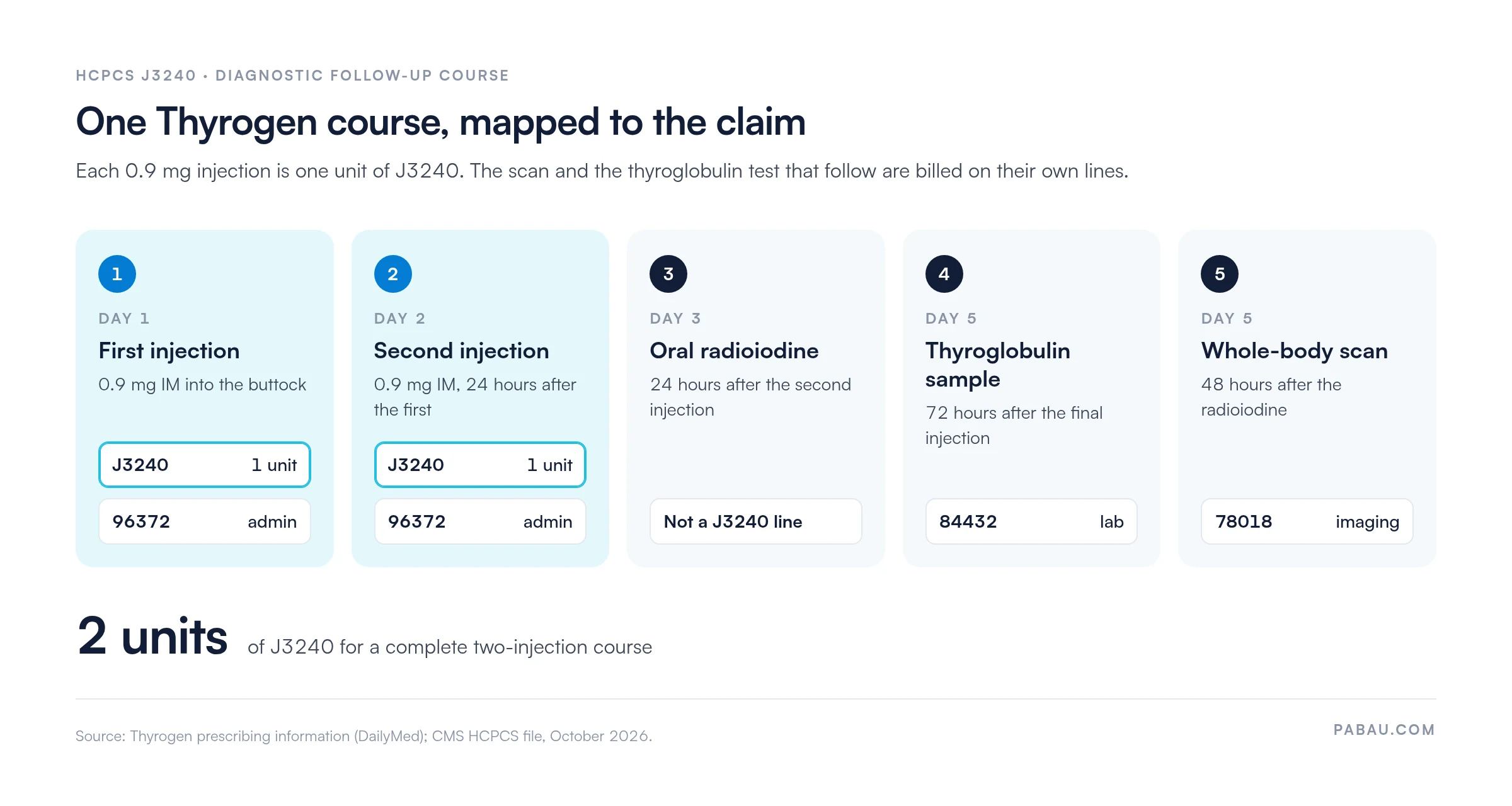
The FDA-approved Thyrogen prescribing information sets a two-injection regimen. The patient gets 0.9 mg IM into the buttock, then a second 0.9 mg IM injection 24 hours later. Because J3240 is defined per 0.9 mg, each injection is one unit, and a complete course is 2 units on the claim.
The label also fixes the follow-up timing. Oral radioiodine is given 24 hours after the second injection, and diagnostic scanning follows 48 hours after the radioiodine. For thyroglobulin testing, the serum sample is drawn 72 hours after the final injection.
Those later steps are billed on their own lines, so the timeline below is worth keeping next to the charge ticket. Each injection’s administration is reported with 96372. The whole-body scan for thyroid cancer metastases is reported with 78018, and the thyroglobulin test with the lab code 84432.
Under-reporting units leaves payment unclaimed. Over-reporting exposes the practice to overpayment recoupment. The administration record should support every unit billed.
Document these elements for each J3240 unit:
With Pabau’s claims software for practices, the team can record the drug administration and prepare the claim in the same system. US claims go out through Claim.MD.
Every J3240 claim needs a linked ICD-10-CM diagnosis code that establishes medical necessity. Check your MAC’s policies and the plan’s drug policy for the codes each one accepts. An unsupported diagnosis is a frequent cause of medical necessity denials.
Use C73 while the cancer is still being treated, which includes radioiodine ablation after surgery. Switch to Z85.850 once treatment is complete and there is no evidence of disease, which covers most follow-up testing. Never use a thyroid code that does not match the documented clinical picture.
Medicare Part B covers J3240 under the benefit for drugs given incident to a physician’s service or in a facility. Payment depends on where the drug is given, and CMS publishes the quarterly payment limits in its ASP pricing files.
ASP-based rates change each quarter. Update internal fee schedules against the current CMS quarterly ASP file, because this quarter’s J3240 rate may differ from last quarter’s.
Commercial payers and Medicare Advantage plans set their own fee schedules and coverage criteria. Some pay a percentage of the Medicare allowable, and others use a contracted rate. Verify coverage and the contracted rate with the plan before giving Thyrogen when reimbursement certainty matters.
Traditional Medicare fee-for-service (FFS) generally does not require prior authorization for J3240, but many Medicare Advantage and commercial plans do. Assuming an MA patient follows FFS rules is a common and costly mistake.
When prior authorization is required, the request usually includes:
Some MA plans also ask for documentation that thyroid hormone withdrawal is not appropriate for the patient.
Before scheduling the first Thyrogen injection, run a benefits and eligibility check specifically for the J-code drug benefit, not just the physician office visit benefit. Many MA plans route drug prior-auth requests to a separate pharmacy benefit manager (PBM). Confirm the correct PA submission pathway before the administration date to avoid retro-authorization headaches.
Several codes get confused with J3240 in billing system code lists. The table below sets out the differences.
Check the drug name against the J-code descriptor before every submission. The AAPC HCPCS code lookup works as a second check, and the PGM Billing free HCPCS lookup cross-references drug names against descriptors.
J3240 claims deny for a predictable set of reasons, and denial management workflows should catch each one at claim preparation. The table uses CARC and RARC codes, which our guide to common denial codes explains in full.
Medicaid, many commercial payers, and Medicare Advantage plans require the 11-digit National Drug Code (NDC) with J3240, so check each payer’s policy. A missing NDC is a common denial trigger with payers that require it.
The Thyrogen carton prints the package NDC as 58468-0030-2. On the claim, pad it to the 11-digit 5-4-2 format, 58468-0030-02, sent electronically as 58468003002. Check the NDC on the carton you gave the dose from before you bill.
Place of service (POS) must reflect where the drug was given, not where it was ordered. A Thyrogen injection given in the physician office (POS 11) but billed under a hospital provider number creates a POS mismatch. Payment rules and patient cost-sharing differ between the office and the hospital outpatient department, so the POS entry changes the payment. Checking the claim against clean claim standards before transmission catches NDC and POS errors before the payer does.
When a new Thyrogen shipment arrives, check the carton’s NDC against your billing system’s drug master before the first injection. A quick check at intake prevents a CO-16 denial weeks later.
A Thyrogen claim often draws on three places: the nursing note, the stock log, and the billing system. Each copy step is a chance to enter one unit instead of two, or to drop the lot number.
In Pabau, the practice records each injection against the patient and the appointment, with the vial’s lot and expiry. Prior authorization codes, dates, and sessions sit on the patient’s case, and Pabau warns when one is missing.
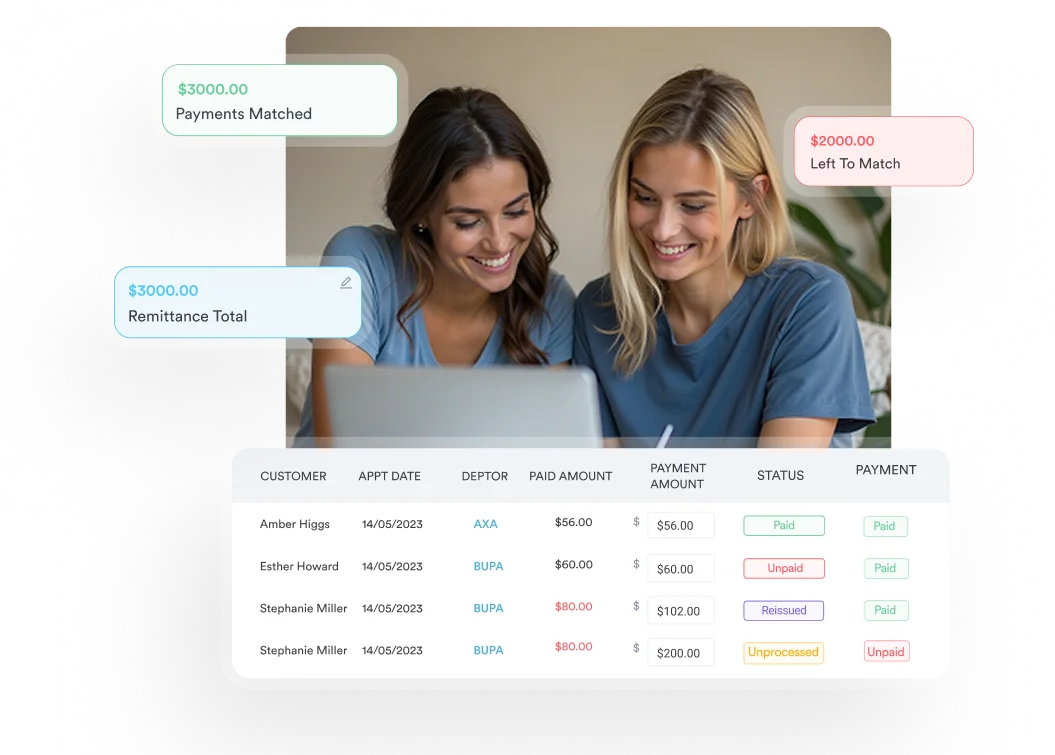
US claims go out as CMS-1500/837P claims through Claim.MD, with eligibility checks before the visit and ERA remittances posted back. Your billing team sees a short-paid Thyrogen line before it becomes an aged balance.

Record the Thyrogen lot against the patient and appointment, track the prior authorization on the case, and send J3240 claims through Claim.MD.

The code choice for Thyrogen is simple, since no other HCPCS code describes the drug. J3240 claims go wrong on the details: units, the NDC, and prior authorization.
Build those checks into the charge before it reaches the payer. Tie units to the injections in the administration record, and keep the current NDC in your drug master. Confirm the plan’s authorization rules before Day 1, and a superbill with these fields makes the check routine.
Book a demo to see how Pabau records Thyrogen administration and sends J3240 claims through Claim.MD.

Need a full J-code drug billing framework? Medical billing fundamentals covers how injectable drug claims move from charge capture to payment posting.
Seeing recurring denials on injectable drug claims? Denial codes in medical billing maps common CARC and remark codes to corrective actions across drug J-codes.
Want to benchmark your claims submission process? Medical billing compliance guidance outlines documentation standards that support clean J-code claim submission.
HCPCS Code J3240 is the Level II code for “Injection, thyrotropin alpha, 0.9 mg, provided in 1.1 mg vial.” It reports Thyrogen, the recombinant human TSH used before radioiodine ablation or follow-up testing in differentiated thyroid cancer.
Two units. The label regimen is 0.9 mg IM, then a second 0.9 mg IM injection 24 hours later. J3240 is defined per 0.9 mg, so each injection is one unit and the full course is 2 units on the claim.
Yes, Medicare Part B covers J3240 for its FDA-approved thyroid cancer uses. In the physician office, payment is ASP plus 6%, and in a hospital outpatient department the drug is paid under OPPS. Rates update quarterly, so check the current CMS ASP file.
Use C73 (malignant neoplasm of thyroid gland) while the cancer is still being treated, including radioiodine ablation. Use Z85.850 (personal history of malignant neoplasm of thyroid) for follow-up after treatment ends. Check the payer’s policy for the codes it accepts.
Traditional Medicare FFS generally does not require prior authorization for J3240, but many Medicare Advantage and commercial plans do. Verify the plan’s rules before giving Thyrogen. Assuming FFS rules apply to MA patients is a quick route to a CO-197 denial.
Medicare pays J3240 at the Average Sales Price plus 6% in the physician office. CMS updates the dollar amount every quarter in its ASP pricing files, so use the current quarter’s file rather than a fixed figure.
The usual causes are units that don’t match the injections given, and a missing or invalid NDC for payers that require one. Missing prior authorization, the wrong place of service, and an unsupported diagnosis also cause denials.