

HCPCS code E0198: Water pressure pad billing guide
HCPCS code E0198 is a water pad for a standard mattress HCPCS code E0198 is the ...

Last Updated: Oct 13, 2026
79101 is the CPT code for radiopharmaceutical therapy, by intravenous administration. It covers a physician-supervised IV infusion of a therapeutic agent such as radium-223 (Xofigo) or lutetium Lu 177 vipivotide tetraxetan (Pluvicto). The drug itself is billed on a separate HCPCS Level II line.
Common denial triggers include selecting the wrong route-of-administration code, omitting the companion HCPCS drug code, and missing prior authorization before the infusion date.
Let Pabau's smart automation suggest the right codes, reduce claim denials, and keep your practice compliant—effortlessly.
Automate repetitive tasks and focus on what matters most—your patients.
Reduce coding errors and ensure compliance with the latest regulations.
Clean claims, fewer denials, and faster reimbursements.
Powerful insights and reporting to help your practice thrive.
HIPAA compliant SOC 2 certified GDPR-compliant Trusted by 4,000+ clinics worldwide

CPT Code 79101 covers intravenous radiopharmaceutical therapy only. Oral, intracavitary, intra-arterial and intra-articular routes each have their own codes.
The radiopharmaceutical drug is never bundled into 79101, so the matching HCPCS Level II drug code goes on its own claim line.
CIGNA (through Evicore), Anthem (through Carelon) and BCBS Texas commonly require prior authorization for 79101, so verify each payer’s current code list before the infusion.
Pabau’s claims management software submits 79101 claims through Claim.MD, runs eligibility checks and tracks ERA remittances.
CPT Code 79101 is the American Medical Association’s procedure code for radiopharmaceutical therapy by intravenous administration. Specifically, it sits in the Nuclear Medicine subsection (78000-79999) of the Radiology chapter, among the Radiopharmaceutical Therapy codes (79005-79999).
The code covers the administration itself: the supervising physician’s work preparing, monitoring and documenting the IV infusion of the therapeutic agent. However, it does not cover diagnostic imaging, radioactive waste handling or the cost of the radiopharmaceutical.
In fact, intravenous administration is the only route this code covers. The CPT code set assigns a separate code to each other route. As a result, picking the wrong one is a common technical denial in nuclear medicine billing.
The radiopharmaceutical’s cost is always excluded from CPT 79101 reimbursement. Therefore, bill the matching HCPCS Level II drug code on its own line of the same claim to recover the drug cost. Indeed, leaving that companion line off is another common denial trigger, alongside missing prior authorization.
Each therapeutic radiopharmaceutical has its own code in the HCPCS Level II codes set. In addition, that code and CPT Code 79101 go on the same claim, on separate lines. Specifically, the HCPCS line captures the drug cost, and the CPT line captures the administration service. The grid below pairs each agent with both lines, including the one agent whose administration code is not 79101.
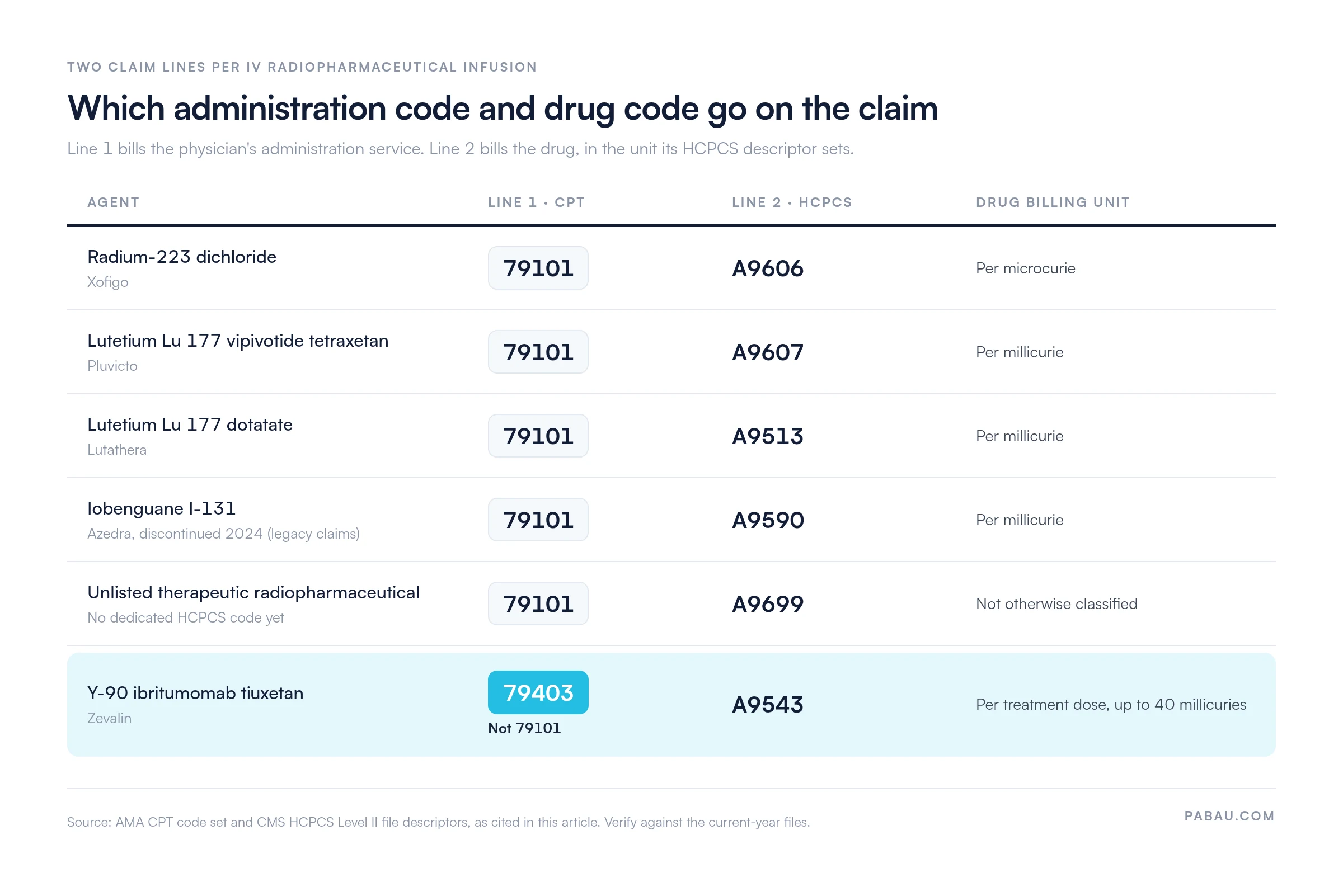
CMS updates radiopharmaceutical HCPCS codes every year, so check the current-year file before billing a newer FDA-approved agent. However, Zevalin is the exception to the pairing above. Specifically, its drug line is A9543, but its IV administration is billed with 79403 rather than 79101. The A9607 reference covers Pluvicto’s drug line in more detail.
Check HCPCS radiopharmaceutical codes against the current CMS HCPCS Level II file each January. A drug first billed under a provisional or not-otherwise-classified code, such as A9699, can move to a dedicated A-code once CMS assigns one. Billing a retired or superseded HCPCS code alongside CPT Code 79101 leads to a technical denial, and the resubmission can take weeks.
Documentation for CPT Code 79101 must establish three points clearly: the radiopharmaceutical administered, the IV route, and the supervising physician’s identity. Indeed, pre-payment reviewers check for each of them.
First, use this workflow for every CPT 79101 encounter, and confirm each payer’s clean claim submission requirements before the appointment date.
A missing element rarely triggers a denial at submission. Instead, it surfaces on audit or appeal, where a note written after the fact carries little weight.
Medicare pays CPT Code 79101 under the CMS Physician Fee Schedule (MPFS), with separate facility and non-facility rates. However, CMS pays for the radiopharmaceutical drug through a separate drug payment pathway, not through the 79101 rate itself.
Therefore, before submitting, confirm the place-of-service code matches where the infusion happened and that the HCPCS drug code sits on its own claim line. Indeed, the MPFS rate for 79101 changes every year, so check the current-year fee schedule rather than carrying last year’s figure forward.
In contrast, commercial payers pay negotiated rates, so check your payer-specific fee schedule or EOB history for the contracted amount. Then reconcile each electronic remittance against that rate. Otherwise, a short payment on a high-cost drug line can otherwise age into a write-off.
Major commercial payers and Medicare Advantage plans commonly require prior authorization for CPT Code 79101 before the infusion date. Therefore, verify each payer’s current code list as part of your prior authorization process. In fact, administering without an approved authorization leads to a denial, and appeals rarely succeed when none existed.
Payer PA policies change. For this reason, check the payer’s live policy document before each treatment cycle, not only at the initial authorization.
When submitting a PA request, most payers require:
For example, for Xofigo and Pluvicto, the primary diagnosis is prostate cancer, reported with C61, plus a secondary code for the metastatic site.
Overall, CPT Code 79101 claims attract scrutiny because they combine a high-cost drug, frequent prior authorization requirements, and documentation that spans clinical and billing teams.
Common denial triggers include the wrong route-of-administration code, a missing HCPCS drug line, and a missing or lapsed authorization. As a result, structured denial management workflows catch these patterns before they repeat. The table pairs each trigger with its fix.
Specifically, route errors do the most damage when the note correctly describes IV administration while the claim lists 79005 (oral). Pre-payment review flags that mismatch between record and code. Therefore, coding from the route documented in the note, rather than from a standing order template, prevents this error.
Build a CPT 79101 pre-submission checklist. Confirm the HCPCS drug code matches the administered agent and the authorization number is on the claim. Check the place-of-service code against the infusion location. Then confirm the ICD-10 diagnosis code meets the payer’s clinical criteria for that radiopharmaceutical. A two-minute review at submission prevents a three-week resubmission cycle.
The 79005-79999 family covers the full range of therapeutic radiopharmaceutical services. In most cases, route of administration separates these codes, rather than the agent. However, the exception is 79403, which covers IV infusion of a radiolabeled monoclonal antibody such as Zevalin. For this reason, check the AAPC CPT code lookup and AMA coding resources for current descriptor language before you select a code.
Nuclear medicine teams billing CPT Code 79101 handle high-value claims, where one denied treatment cycle can cost tens of thousands of dollars. Consequently, routing them through a medical claims clearinghouse catches formatting and payer-ID errors before the payer sees them.
Pabau’s claims management software submits claims through Claim.MD, its US clearinghouse partner, which connects to thousands of US payers. In addition, the integration covers CMS-1500 and 837P claim submission, real-time eligibility checks with supported payers, and ERA/835 remittance tracking.
For 79101, that means your team can check coverage before the infusion date and see each payment or denial as the remittance arrives. Meanwhile, your billers still own code selection and authorization, while submission and follow-up sit in the same system as the patient record.

Pabau’s claims management software submits CPT 79101 claims through Claim.MD, runs eligibility checks and tracks ERA remittances. Your team sees payment status without chasing payers.

CPT Code 79101 rewards preparation more than coding knowledge. Most billers know the code covers IV administration only. Instead, denials come from the handoffs. For example, an order never names the route, a drug line is left off the claim, or an authorization lapses between cycles.
Therefore, assign an owner to each of those three checks before the infusion is scheduled, and the claim leaves clean. Otherwise, a single treatment cycle can sit in appeal for weeks.
Book a demo to see how Pabau submits radiopharmaceutical claims and tracks each remittance through to payment.

Need to understand how clearinghouse claim edits work? Claim.MD clearinghouse overview explains how electronic claim validation catches errors before payer submission.
Tracking down the right denial codes on a 79101 rejection? Denial codes in medical billing maps CARC and RARC codes to corrective actions.
Want to understand how ERA remittance works after a 79101 claim pays? Electronic remittance advice (ERA) covers 835 transaction processing and payment reconciliation.
Preparing a prior authorization request for a radiopharmaceutical? Medical prior authorization form gives you a ready template for the clinical details payers ask for.
Billing Lutathera alongside 79101? HCPCS code A9513 covers the lutetium Lu 177 dotatate drug line and its per-millicurie units.
CPT Code 79101 is the procedure code for radiopharmaceutical therapy by intravenous administration. It applies when a physician supervises the IV delivery of a therapeutic agent such as radium-223 dichloride or lutetium-177 PSMA. The code covers the administration service only, and the drug is billed on a companion HCPCS Level II line.
Yes. Radium-223 dichloride (Xofigo) is given intravenously, so CPT Code 79101 is the correct administration code. The drug cost is billed separately with HCPCS code A9606, reported per microcurie. Confirm the code against the latest CMS HCPCS Level II file before billing.
The HCPCS code depends on the agent. Report A9606 for radium-223 dichloride (Xofigo), A9607 for lutetium Lu 177 vipivotide tetraxetan (Pluvicto) and A9513 for lutetium Lu 177 dotatate (Lutathera). Iobenguane I-131 uses A9590 on legacy claims, since Azedra was discontinued in 2024. Agents without a dedicated code use A9699. The HCPCS code always goes on its own claim line.
Yes. CPT Code 79101 can be billed with place-of-service code 11 (office) when the IV radiopharmaceutical therapy is given in the office. The non-facility MPFS rate applies, which is higher than the facility rate because it covers in-office practice expense. Confirm the office holds the radiation safety setup and NRC or Agreement State license the agent requires.



